
What is a good open rate for a newsletter?
Many engaged newsletters should aim for about 25% to 40%, but list source, category, age, cadence, and reader relationship can push that lower or higher. A practical benchmark is 20% to 28% for likely human opens, and 30% to 40% for reported platform opens that may include Apple Mail Privacy Protection inflation, based on ClickMinded’s interpretation of third-party benchmark data in our newsletter statistics and average newsletter open rate guides.
These are newsletter-specific working ranges, not ClickMinded-owned benchmark data. Campaign Monitor puts a good email open rate at 17% to 28%, depending on industry, while Klaviyo reports a 31% average campaign open rate across industries and 45.1% for the top 10% of performers. ClickMinded applies those campaign benchmarks carefully to newsletters.
| Newsletter type | Good reported open rate | Practical read |
|---|---|---|
| B2B newsletters | 25% to 40% | Strong when the list is opt-in, role-specific, and recently engaged. |
| Creator newsletters | 30% to 45%+ | Higher when readers subscribe to a person or narrow point of view. beehiiv reports top newsletter open rates around 38%, with top performers reaching 55%. |
| Ecommerce newsletters | 20% to 35% | Promo-heavy lists often sit lower than editorial or loyalty-focused sends. Klaviyo’s campaign average is 31% across industries, but sales blasts need their own read. |
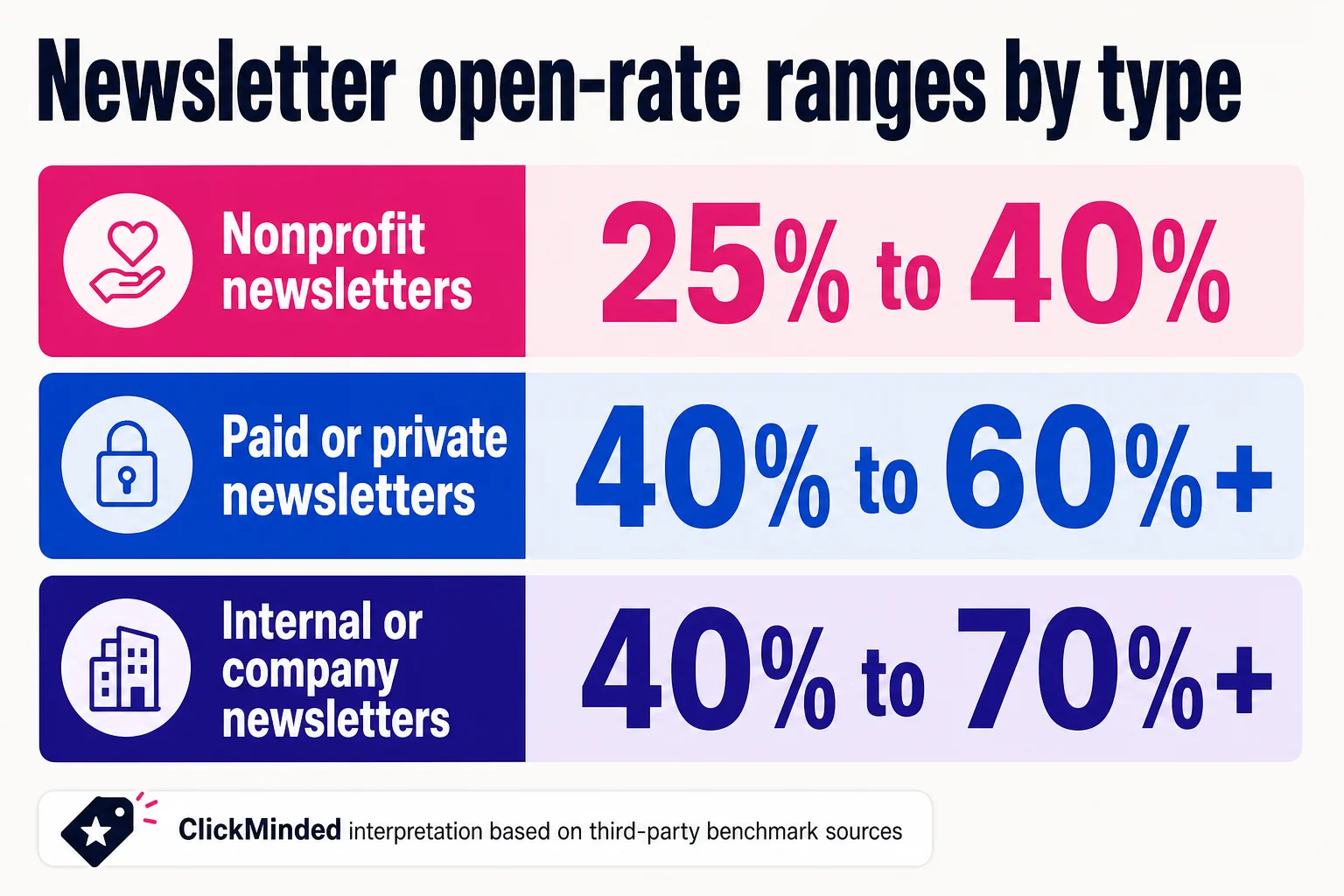
| Nonprofit newsletters | 25% to 40% | Mission affinity can lift opens when updates are real, not constant donation asks. |
| Paid or private newsletters | 40% to 60%+ | Paid access and tight curation can push rates above broad marketing lists. Treat very high rates as reported opens unless MPP adjustment is clear. |
| Internal or company newsletters | 40% to 70%+ | Employee audiences can run high because the sender relationship and work context are stronger. |
Start with list intent. A 28% open rate on a cold ecommerce list may be excellent. A 28% open rate on a paid analyst newsletter may be a warning sign. Treat 30% to 40%+ averages in 2025 and 2026 as privacy-inflated unless the source explains how Apple Mail Privacy Protection was handled.
A good newsletter open rate needs a better benchmark than “average”
An average newsletter open rate is a starting point, not a target. Broad benchmark pages often mix newsletters with promotions, automations, outreach, sale announcements, and one-off campaigns. Mailchimp’s 2026 benchmarks report an average open rate of 31.35% for Business and Finance and 35.63% for all users, but that does not mean every B2B newsletter below 35% is broken.
| Label | Reported open rate | Practical read |
|---|---|---|
| Average | 20% to 35% | Compare carefully. The dataset may include non-newsletter campaigns. |
| Good | 25% to 40% | Healthy for many opt-in newsletters, especially when clicks and replies hold up. |
| Strong | 35% to 50% | Usually means a clear promise, recent subscribers, or a tighter audience. |
| Investigate this | 50%+ | Great for paid, private, or tiny lists. Suspicious for broad lists unless Apple Mail Privacy Protection is accounted for. |
Use benchmarks as a sanity check, then diagnose the list. High-intent signup sources should raise your “good” bar. Old, broad lists or weak lead magnets may make a lower rate realistic. For wider comparison, see ClickMinded’s guides to average email open rate, good email open rate, and email marketing metrics.
Newsletter benchmarks depend on the job the email is doing
A newsletter is a recurring relationship product. A promotional campaign is usually trying to create a transaction, announce something, or move a segment toward an offer. Those jobs create different open-rate expectations, even when both emails come from the same brand.
| Email type | Audience intent | Cadence | Common KPI | Why open-rate expectations differ |
|---|---|---|---|---|
| Newsletter | Ongoing updates, ideas, curation, or community access | Weekly, biweekly, monthly, or seasonal | Opens, clicks, replies, return visits, subscriber retention | Subscribers learn the rhythm and decide whether to make time for it again. |
| Promotional campaign | A deal, launch, product update, or timely offer | Sales calendars, launches, holidays, or inventory | Revenue, conversion rate, clicks, attributed orders | Opens can spike around strong offers and drop when the list gets too many sales messages. |
| Automated or lifecycle email | Signup, browse, cart, trial, renewal, or inactivity | Triggered by behavior or lifecycle stage | Conversion, activation, recovery, retention | Opens reflect trigger quality as much as subject line quality. |
| Transactional email | Receipt, login code, shipping update, password reset, or account notice | Triggered by a required action | Delivery, completion, support deflection | Opens are often high because the recipient expects or needs the message. |
Ecommerce promotional benchmarks help when you are planning offers or comparing revenue campaigns. ClickMinded’s broader email marketing benchmarks and email marketing statistics pages fit that wider view.
For newsletter open rate benchmarks, keep ecommerce campaign data in its lane. A flash sale, abandoned cart flow, and weekly editorial newsletter may share the same ESP dashboard, but they measure different audience behavior.
Newsletter open rate benchmarks by type
Use these as working targets, then compare against your own segment history and the closest peer set. ClickMinded’s newsletter statistics page has the broader source list, and the average newsletter open rate guide is better for sanity-checking general averages.
| Newsletter type | Good range | Why it differs | Watch out for |
|---|---|---|---|
| B2B | 25% to 40% | Relevance by role, company size, buying stage, and signup source drives a lot. | Old webinar lists can quietly wreck the average. |
| Creator | 35% to 55% | Readers often subscribe to a person, which gives the send a warmer starting point. | Public examples skew toward creators with unusually loyal audiences. |
| Ecommerce | 20% to 35% | Product interest helps, but inbox fatigue hits fast when “newsletter” means “sale again.” | Compare editorial sends to editorial sends, not carts, coupons, or promos. |
| Nonprofit | 25% to 40% | Mission affinity helps when updates are specific and useful. | Donation-heavy cadence can suppress engagement. |
| Paid or private | 45% to 70% | Intent is higher, and subscribers often know exactly what they paid to receive. | Small lists swing wildly. Use cohorts, not one send. |
| Internal company | 45% to 75% | Employees may need the information for work. | Required reading can inflate opens without proving attention. |
Treat open rate as a directional metric
Open rate still belongs in the dashboard, but the plumbing is weird now. Apple Mail Privacy Protection can prefetch email images through Apple servers, making some opens look human even when the reader has not viewed the message (Campaign Monitor explains the reporting effect). Security scanners, image blocking, forwards, stale lists, and re-engagement sends add more noise.
| Caveat | How it can distort open rate |
|---|---|
| Apple Mail Privacy Protection | Can inflate opens through image preloading. |
| Image blocking | Can hide real opens. |
| Bot or security scanning | Can create machine opens. |
| Forwarded emails | Can blur who opened. |
| Inactive subscribers | Can drag averages down. |
Use open rate for trend direction, subject line testing, sender health, and list quality checks. Pair it with clicks, replies, conversions, unsubscribes, and broader email marketing metrics before making budget calls.
Improve the list before you rewrite the newsletter
Start with list quality. A smaller list of people who asked for the newsletter will usually beat a larger list built from old customers, scraped contacts, giveaway entrants, and “sure, add me” webinar leads. Segment by recent engagement, send your best version to the active group first, and treat the cold group as a recovery project.

| Current open rate | Check next |
|---|---|
| Under 15% | Source quality, deliverability, stale subscribers, unclear signup promise. |
| 15% to 25% | Cadence, subject line clarity, send time, segment mix. |
| 25% to 40% | Compare against the right peer set, then improve clicks and replies. |
| Above 40% | Protect the promise. Do not broaden the list just to grow faster. |
Make the newsletter promise clear, send on a cadence people can recognize, and test subject lines for specificity over cleverness. Clean inactive subscribers when they stop opening or clicking across a meaningful period.
For context, compare against what counts as a good email open rate and track opens alongside your other email marketing metrics.
Newsletter open rate FAQ for quick checks
What is a good open rate for a newsletter? For an engaged list, use 25% to 40% as a practical target, then compare by format in our newsletter statistics and average newsletter open rate guides.
Is 20% good? Yes for broad, older, or ecommerce-heavy lists. Weak for curated creator or paid lists.
Is 40% good? Yes. Protect that list quality.
What can inflate opens? Smaller, newer, paid, or highly opted-in lists often run higher. Apple Mail Privacy Protection can also inflate opens by preloading content, as Campaign Monitor explains.
B2B? Usually 25% to 40%. Ecommerce? Often lower, so use ecommerce-specific email marketing benchmarks. Paid newsletters? Often higher.
Track opens, clicks, replies, and conversions. Third-party benchmarks reflect their own platform or survey data; ClickMinded’s ranges are planning guidance.