
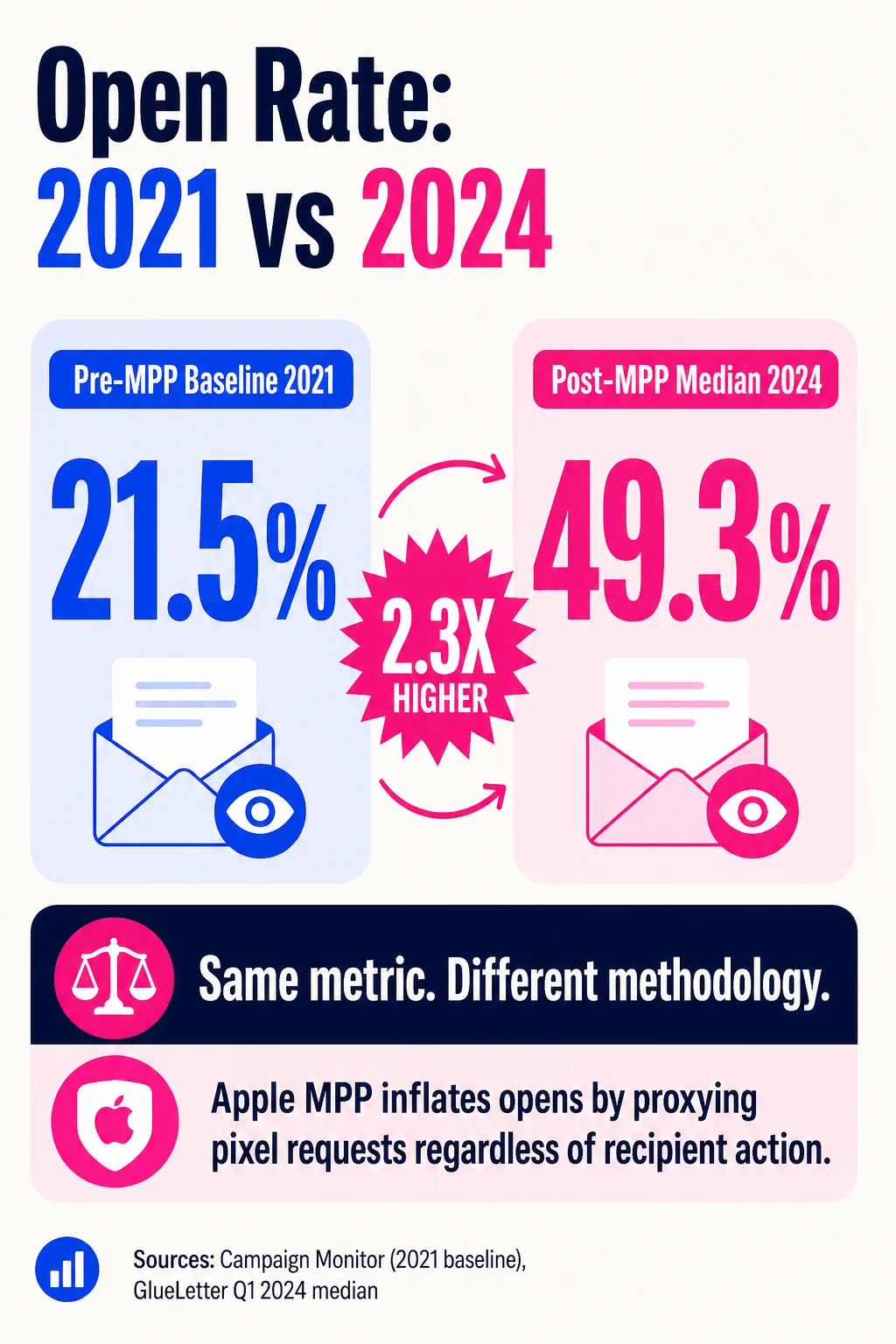
Depending on which report you read, the average newsletter open rate is either 21% or 49%. Both numbers are technically correct, and understanding why tells you almost everything about how to read newsletter benchmarks.
The short version: Apple’s Mail Privacy Protection, which launched with iOS 15 in September 2021, routes emails through Apple’s own proxy servers and pre-downloads message content, including the 1x1 tracking pixels that email platforms use to detect opens.
That pre-download registers as an open on the sender’s server whether or not the recipient ever looked at the email.
The result is that any list with a meaningful share of Apple Mail users will show inflated open rates that don’t reflect actual reading behavior.
Campaign Monitor’s 2022 benchmarks, which captured mostly pre-MPP data, showed an industry average of 21.5%. GlueLetter’s more recent data, which explicitly includes MPP and Google image-caching opens, puts the median at 49.3% for Q1 2024. Both figures are reported accurately. They’re measuring different things.
Most benchmark roundups bury this in a footnote, if they mention it at all. This post leads with it because every open rate number below needs to be read with that context in place.
Beyond the MPP problem, newsletter benchmark data is scattered across a dozen platforms that each report from their own user base, use different methodologies, and have obvious incentives to make their numbers look good. This reference pulls from more than twelve primary sources: Beehiiv, Mailchimp, Litmus, Campaign Monitor, MailerLite, HubSpot, Pew Research Center, Omeda, GlueLetter, the DMA, Google News Initiative, and Statista, among others. Where a number comes from a single self-reported dataset, that’s flagged.
The goal is one place to find the benchmarks that actually matter, with enough context to tell whether a given number applies to your situation or someone else’s entirely.
Use this page alongside the broader email marketing statistics guide when you need channel context, email marketing metrics when you need clean KPI definitions, and marketing benchmarks or email marketing benchmarks when you need comparison ranges. For newsletter-specific open rate answers, use good newsletter open rate and average newsletter open rate. For the full stats library, start with the marketing statistics hub.
If you are looking for what to send instead of what to measure, start with our email newsletter ideas guide, then use the benchmarks below to decide whether those ideas are working.
Email newsletters by the numbers: how big is this channel, actually?
Before getting into what constitutes a good open rate or click rate, it helps to know the scale of the thing you’re measuring.
Statista projects roughly 4.89 billion global email users by 2027, up from an estimated 4.37 billion in 2023. Daily email volume is on a similar trajectory, with projections exceeding 408 billion emails per day by 2027. These figures cover all email, not newsletters specifically, but they establish the infrastructure newsletters run on.
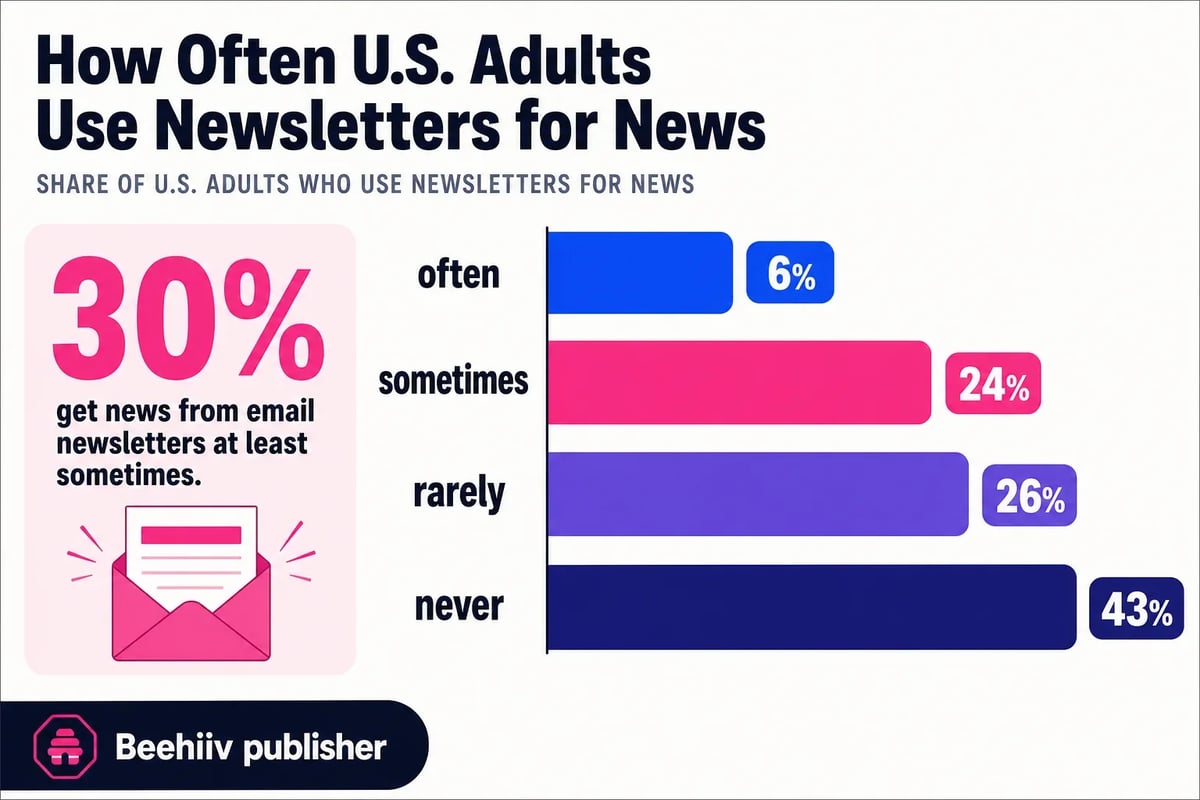
On the newsletter side, Pew Research Center’s February 2026 survey of 5,153 U.S. adults found that 30% get news from email newsletters at least sometimes. That’s a substantial share of the adult population, though notably, only 3% named newsletters as their preferred news platform. People read them, but typically alongside other sources.
Platform-level data adds more texture, with the caveat that it’s self-reported. Beehiiv’s State of Newsletters 2026 report covers activity across its 65,000+ newsletters and is not representative of the broader ecosystem. With that framing: Beehiiv publishers sent 28 billion emails in 2025, reaching 255 million unique readers. Open rates across the platform averaged above 41%. Paid subscription revenue across Beehiiv newsletters hit $19 million in 2025, up from $8 million in 2024. The median time from launching a newsletter to earning a first dollar was 66 days for newsletters that started in 2025.
On the marketer adoption side, HubSpot’s 2026 marketing data puts email among the most used channels, with 40% of marketers actively using it, tied with organic social. Three in four say they plan to maintain or increase their email investment in 2026.
The channel is large, measurably active, and generating real revenue for a subset of operators. Whether it’s the right channel for a given use case is a separate question, and the benchmarks below are where that answer starts to take shape.
Open rates: what the numbers say, and what they’re hiding
The MPP problem isn’t a footnote. It’s the frame. When Apple launched Mail Privacy Protection in September 2021, it began pre-fetching email content on its servers before users opened messages, which triggers open-tracking pixels regardless of whether anyone actually read anything. Early measurement showed MPP accounting for roughly 5% of tracked opens in its first week, with a corresponding ~6.5% jump in reported unique opens. By 2025, the effect compounds depending on how many of your subscribers use Apple Mail. If your list skews toward iPhone users, a large share of your “opens” may be server pings, not eyeballs.
This is why Campaign Monitor’s 2022 benchmark showed a cross-industry average around 21.5%, while GlueLetter’s Q1 2025 data, which explicitly includes MPP and Google image-caching opens, puts the median at 49.3%. Neither figure is wrong. They’re measuring different things.
With that caveat in place, here are Mailchimp’s 2025 industry-level benchmarks. These are self-reported ESP data, covering sends through Mailchimp’s platform only, and they reflect post-MPP conditions.
| Industry | Average open rate |
|---|---|
| Nonprofits | 40.04% |
| Education & Training | 35.64% |
| Business & Finance | 31.35% |
| Ecommerce | 29.81% |
| Cross-industry average | 35.63% |
The nonprofit-to-ecommerce gap is real and consistent across sources. The likely explanation is audience intent: nonprofit subscribers opted in with higher motivation, while ecommerce lists often include people who gave an email address to get a discount and never expected a relationship.
One figure that shows up frequently but deserves its own context: welcome emails. Mailmend reports average welcome email open rates around 68.6%, with immediate automated welcome messages reaching up to 80%. These numbers are real, but they describe a specific moment: the window right after someone subscribes, when curiosity is highest and inbox placement is fresh. Treating welcome email open rates as a baseline for ongoing performance will skew your expectations badly.
What open rate can tell you, post-MPP, is relative performance over time within your own list. Trend direction still matters. Cross-list comparison, or benchmarking against industry averages from a different ESP, is much less reliable than it used to be. Click-based metrics have become the more trustworthy signal, which the next section covers in detail.
CTR, CTOR, and the bot problem hiding inside your click data
CTR and CTOR measure related but different things, and conflating them leads to bad benchmarking. CTR (click-through rate) divides total clicks by total emails sent. CTOR (click-to-open rate) divides clicks only by opens. The second metric tells you how compelling your content was to people who actually opened the email. In theory, CTOR should filter out the unengaged portion of your list, making it a cleaner performance signal.
In the post-MPP era, “should” does a lot of work in that sentence. Because MPP inflates the opens denominator, CTOR calculations now divide clicks by an artificially large number, which pushes CTOR downward even when content quality holds steady. Neither metric is clean anymore, which is worth keeping in mind when you see CTOR targets cited as a fixed benchmark. The Campaign Monitor guidance puts a healthy CTOR in the 10-15% range, and that’s a reasonable directional target. Treat it as a relative indicator within your own list rather than a universal standard.
Then there’s the bot problem, which is more severe than most ESP reports acknowledge.
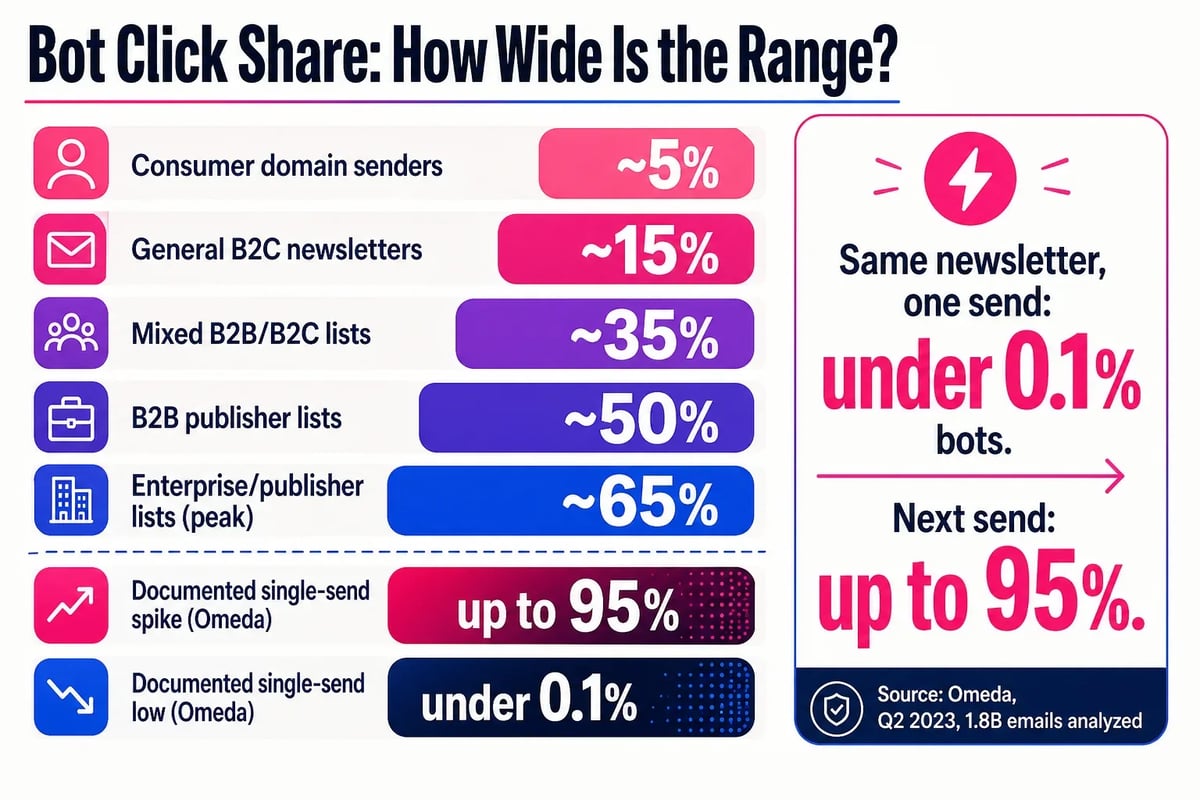
Omeda’s analysis of 1.8 billion emails sent in Q2 2023 found that roughly 63-65% of email clicks were generated by bots. Most of these aren’t malicious. Security products like Proofpoint pre-scan every link in an incoming email to check for threats, registering a click in your ESP’s tracking before a human ever sees the message. Inbox Collective notes that bot share varies significantly by ESP and audience, with some consumer-domain lists as low as 5%. The variance is real, and the unpredictability is worse: Omeda has documented cases of the same newsletter showing under 0.1% bot clicks on one send and spikes near 95% on another.
Mitigation tactics exist. Placing hidden “stealth” links in emails, comparing click timestamps to open timestamps, and excluding known data-center IP ranges can filter some bot activity. But none of these approaches are reliable enough to treat filtered CTR data as precise.
With that caveat in place, here are typical human-driven CTR ranges across audience types:
| Audience type | Typical CTR range |
|---|---|
| General consumer newsletters | 2-3% |
| Nonprofit / mission-driven | ~4% |
| B2B / SaaS | ~1.5-2% |
| Media / creator-led | 3-6%+ |
| Cross-industry average | ~2-5% |
Sources: Admailr, Beehiiv, HubSpot. These figures represent estimates of human-driven engagement and should be treated as directional, not definitive.
Link placement and CTA copy do affect CTR, but bot inflation complicates any A/B attribution you run at the click level. If you’re testing creative, validate results against downstream behavior in Google Analytics, not just what your ESP reports as clicks.
What a newsletter is actually worth (and what the numbers are measuring)
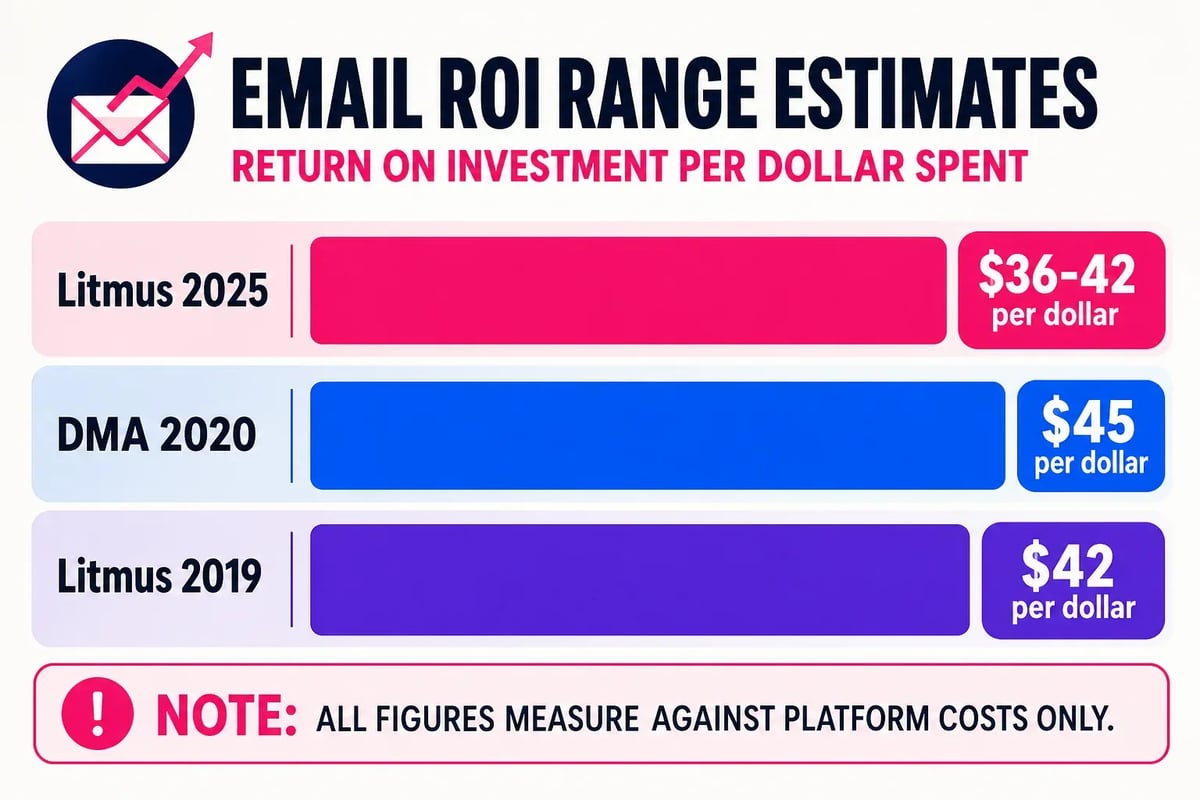
The ROI figures cited for email marketing are everywhere, and they don’t agree with each other. Litmus’s State of Email 2025 puts the return at $36-$42 per $1 spent. The UK’s Data & Marketing Association reported roughly £35.41 per £1 in 2020, which converts to around $45 at the time. An earlier Litmus report from 2019 cited 42:1. These figures are frequently quoted as if they’re measuring the same thing. They aren’t.
Most published ROI benchmarks measure returns against ESP platform costs only. They don’t account for the full cost of running a newsletter: writer time, design, subscriber acquisition, testing, and overhead. As Zembula has noted, the $36-$42 figure is a useful directional signal, not a precise net-return calculation. Treat it as evidence that email is a cost-efficient channel, not as a promise about your own economics.
Conversion rates tell a similar story. Email consistently outperforms social on conversion, with cross-industry email averages around 8% compared to roughly 3% for social, though both figures vary substantially by industry and list quality. Automated flows outperform broadcast sends by a significant margin: cart abandonment sequences convert at approximately 8%, welcome series at around 4%, while one-off blast emails average closer to 0.87%, according to Litmus’s ROI research. The gap between those numbers makes a strong argument for investing in triggered sequences before optimizing broadcast frequency.
On the paid newsletter side, the numbers are real but modest. Pew Research’s February 2026 survey of 5,153 U.S. adults found that 7% had paid or donated to a news-focused newsletter in the past year. That’s a meaningful slice of audience, but it’s not a mass-market behavior yet. Beehiiv’s platform data offers some supporting context: paid subscription revenue across its network reached $19M in 2025, up from $8M in 2024, a 138% increase. The paid model is growing, but the median creator on Beehiiv still took 66 days from launch to their first dollar of revenue. There’s no shortcut through the list-building phase.
The honest summary is that newsletter economics vary enormously based on monetization model, list quality, and what costs you include in the denominator. ROI benchmarks are useful for making a business case, not for forecasting your specific returns.
Ready to put these benchmarks to work? The Newsletter Generator helps you build and send newsletters that are actually worth opening.
List size is the wrong thing to optimize for
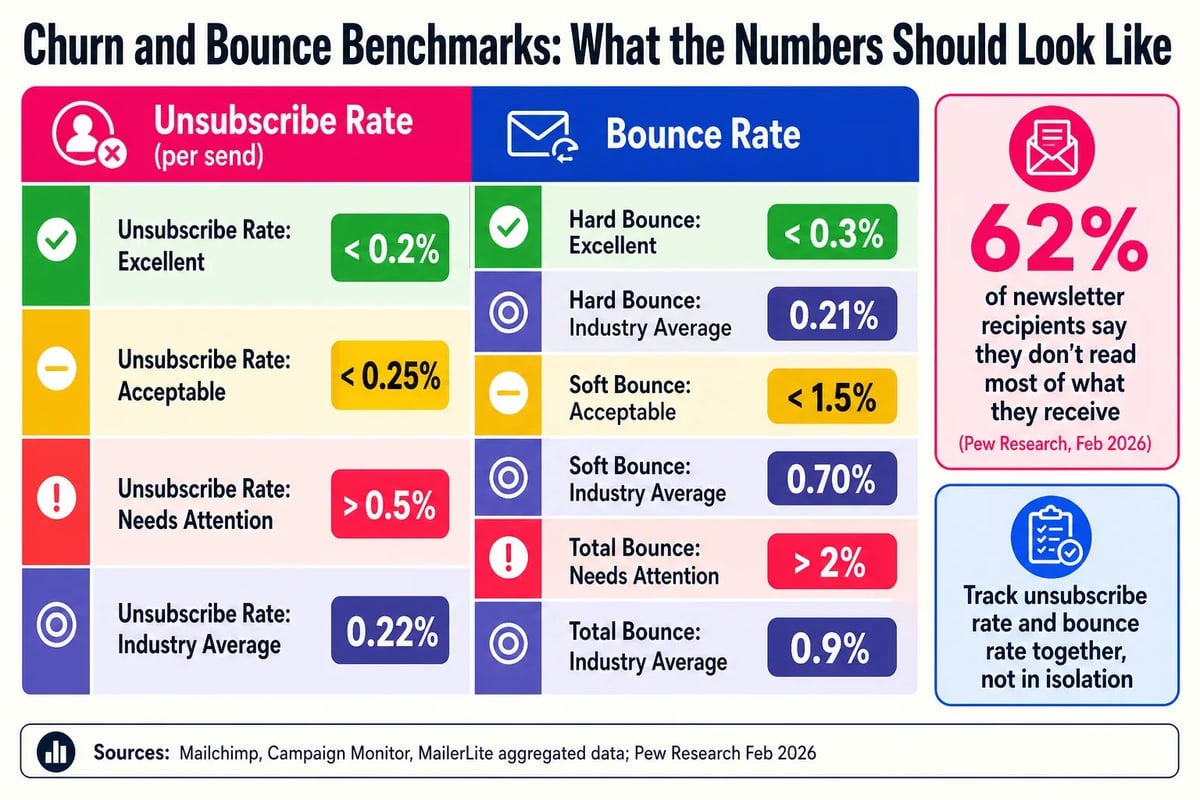
A newsletter with 100,000 subscribers sounds more impressive than one with 8,000. It isn’t necessarily. Pew Research’s February 2026 survey found that 62% of newsletter recipients say they don’t end up reading most of what they receive. That means a large portion of any list is essentially dead weight on delivery costs, and a drag on every engagement metric you’re tracking. Raw subscriber count measures reach potential, not actual audience.
The benchmarks that matter more are unsubscribe rate and bounce rate, and they should be tracked together, not in isolation.
Unsubscribe rate benchmarks (per send)
Across Mailchimp, Campaign Monitor, and MailerLite data, the cross-industry average per-send unsubscribe rate sits around 0.22%. Under 0.2% is considered excellent; under 0.25% is a reasonable target for most newsletters. Rates above 0.5% consistently signal a content-audience mismatch, a list that was built too aggressively, or both.
Bounce rate benchmarks (permission-based lists)
For opt-in lists, total bounce rate should stay below 2%, with hard bounces ideally under 0.3-0.5% and soft bounces under 1-1.5%. Mailchimp’s aggregated data puts average hard bounces at approximately 0.21% and soft bounces at 0.70%, for a combined total around 0.9%. Cold outreach lists run roughly 7-8%, which is why cold prospecting data shouldn’t be used as a benchmark for newsletter health.
One structural reason bounce rates climb is natural list decay. Email addresses go stale at roughly 2-3% per month without active maintenance, meaning a list that isn’t regularly cleaned loses meaningful deliverability ground over a year regardless of how good the content is.
On list growth rates, sourced benchmarks are thin. A commonly cited practitioner heuristic is 1-5% net monthly growth for an active newsletter, but that figure isn’t tied to a primary research study. Treat it as directional rather than authoritative.
What is clear from the Pew data is that subscriber count without engagement context is close to meaningless. A list where 62% of subscribers aren’t reading most issues isn’t a 100,000-person audience. It’s closer to 38,000 people who actually showed up, and a lot of overhead on the other 62%.
Unsubscribe rate and list growth rate read differently depending on what’s underneath them. Growing at 3% per month while losing 0.5% per send on a disengaged list is a different story than the same numbers on a list that consistently opens and clicks.
How often you send matters more than when you send it
Most newsletters send weekly. According to Seventh Seed survey data cited by Beehiiv, roughly 45% of newsletters send once a week, and about 33% send multiple times per week. Daily and monthly cadences each represent a smaller slice of the distribution.
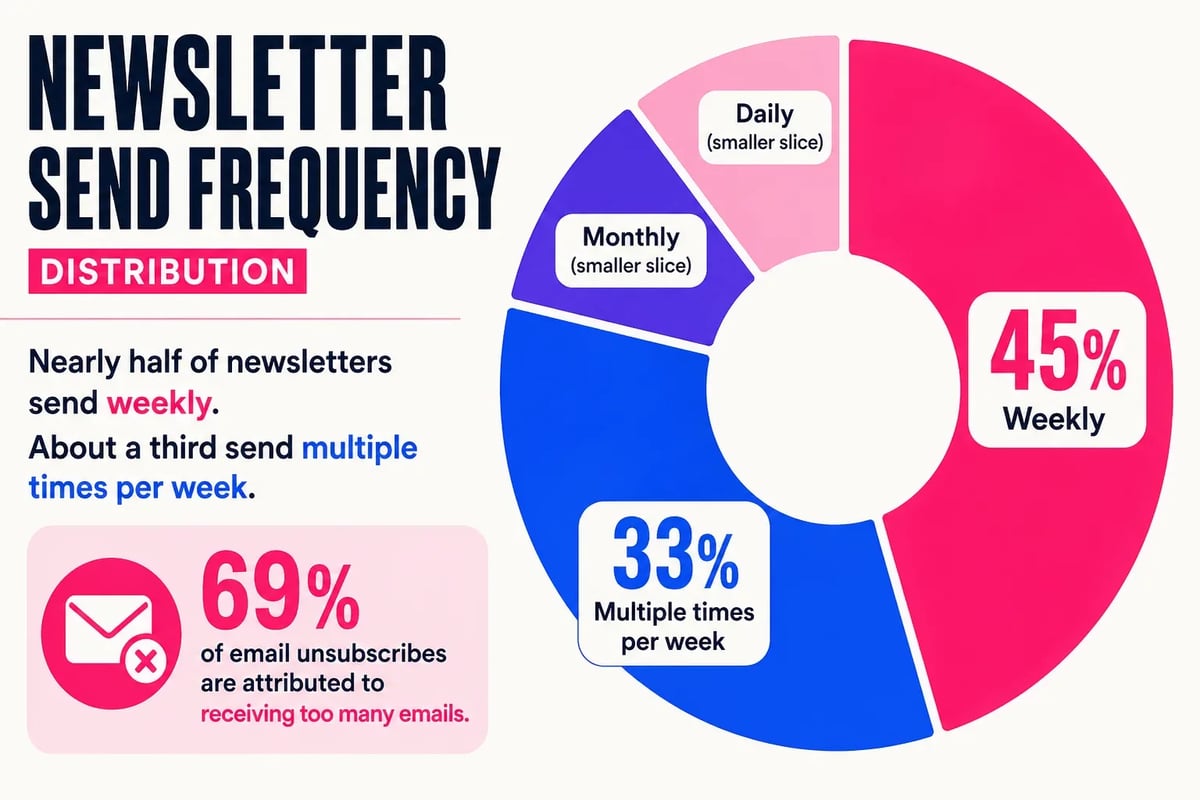
Frequency matters because it’s one of the most direct levers on unsubscribe rate. Around 69% of email unsubscribes are attributed to receiving too many emails, a figure that surfaces across multiple ESP analyses, though the underlying HubSpot source is cited through intermediaries rather than a direct report. What’s consistent across Campaign Monitor and SMTP.com data is the pattern: unsubscribe spikes tend to follow send-volume increases, and rates above 0.5% per send are a reliable early signal that cadence has outrun audience tolerance.
MailerLite’s cadence guidance, drawn from roughly 1.4 million campaigns, recommends a range of monthly to twice-weekly as the zone where opens and clicks hold up without driving abnormal churn. Sending less than once a month tends to lift individual open rates while suppressing overall engagement over time, because infrequent sends don’t build reading habits.
On send timing, MailerLite’s larger dataset of approximately 2.1 million campaigns identifies Friday as the top-performing day, with a 49.72% open rate and 8.09% click rate. Friday 6pm local time is flagged as the single window where high opens and high clicks coincide, which the report describes as the only day where that overlap occurs. Friday mornings between 8 and 11am also show elevated opens. These numbers come from MailerLite’s own user base and shouldn’t be treated as universal law. Audience type, industry, and list geography all shift optimal timing enough that your own send-time testing is more reliable than any aggregated benchmark.
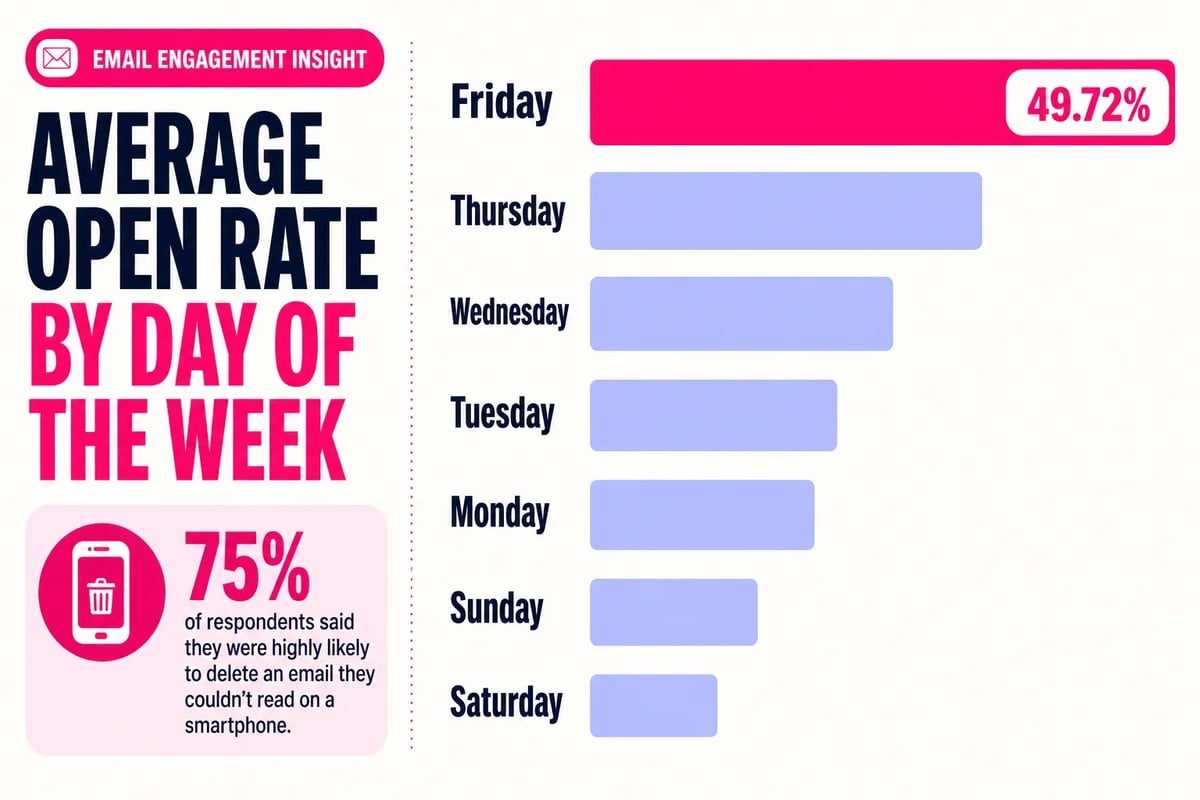
A callout worth preserving from a 2013 Constant Contact study, reported by Adotat: 75% of respondents said they were highly likely to delete an email they couldn’t read on a smartphone. The study is over a decade old, and mobile email behavior has only become more dominant since then. Format for mobile or accept that a significant share of your audience won’t read past the preview text.
What the numbers actually tell you (and what to do about them)
The most useful single fact in this entire post may be the one from Pew’s February 2026 survey: 62% of newsletter subscribers say they don’t read most of what they receive. That’s not a failure of email as a channel. That’s a description of how people treat their inboxes. Your subscribers are not waiting for your next issue. Most of them are skimming subject lines and deleting. The benchmark that matters, then, is whether your content is consistently worth the interruption.
That reframe changes how you read the other numbers. Open rate tells you almost nothing post-MPP. CTOR, calculated as unique clicks divided by unique opens, is the better signal because it measures what happened among people who actually engaged with the message. MailerLite’s dataset of 3.6 million campaigns puts the median CTOR at 6.81%. If yours is consistently below that, the content isn’t earning the click. If your open base is very low to begin with, fix subject lines first, because CTOR needs a sufficient open pool to mean anything.
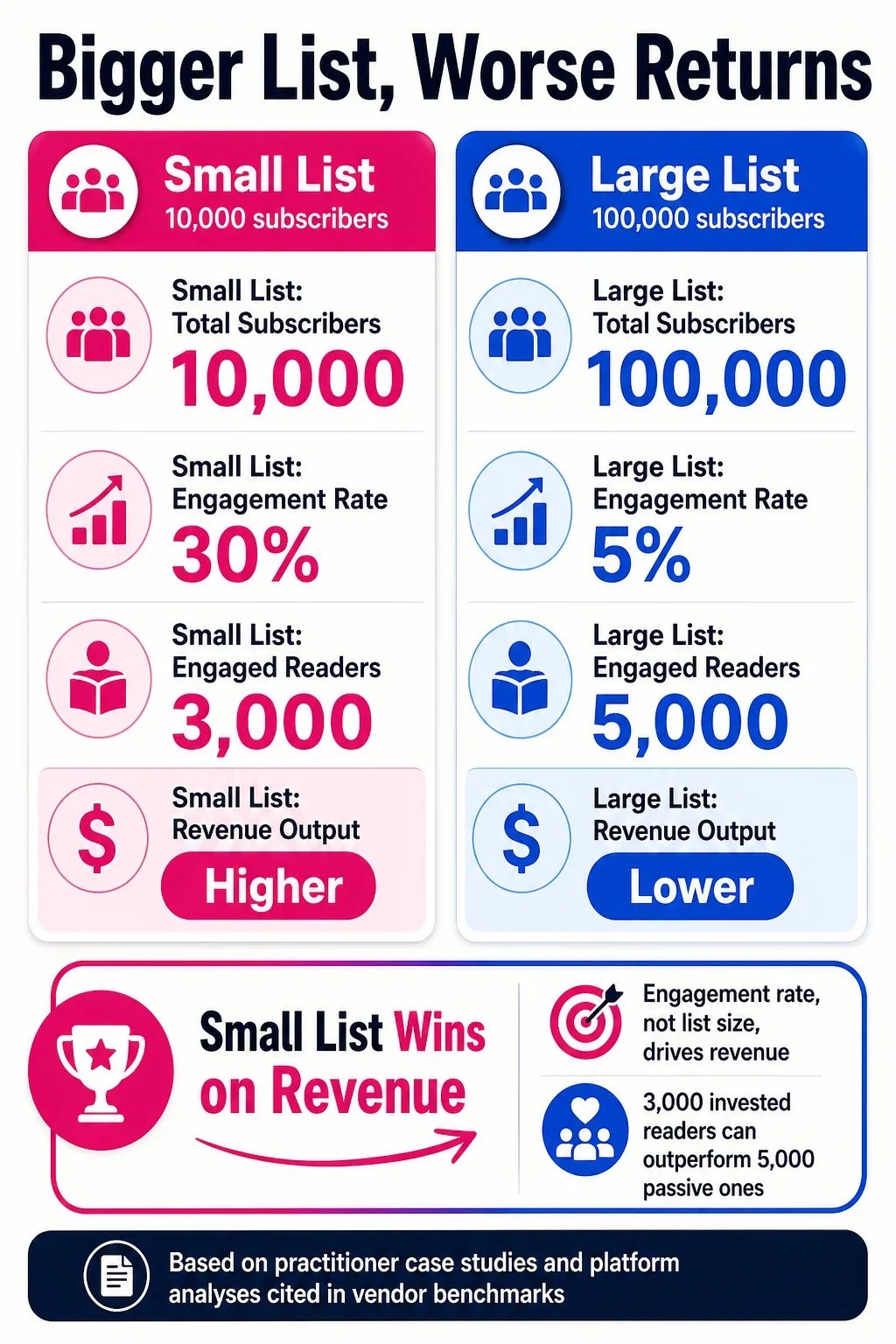
On list size: a 20,000-subscriber list with 30% engagement outperforms a 100,000-subscriber list at 5% engagement by a significant margin in revenue terms. Growth metrics look good in a deck. Engagement metrics predict whether the list actually works.
ROI figures between $36 and $45 per dollar spent are real, but they assume competent execution: a clean list, consistent sends, and content subscribers actually want. The channel doesn’t produce those returns by default.
Send weekly if you can maintain quality. Format for mobile. Track CTOR, not opens. And accept that most of your list won’t read most of your issues, which means the ones who do are the audience worth optimizing for.
Ready to put these benchmarks to work? Generate your first newsletter issue and start building the list worth measuring.
Questions people actually ask about newsletter benchmarks
What is a good open rate for a newsletter in 2026?
Reported open rates of 30-40% are considered solid, but those figures include Apple MPP inflation. Adjusted for real human opens, 20-28% is a more honest target.
What is a good click-through rate for a newsletter?
A click rate of 2-3% against total sends is typical cross-industry. CTOR, which measures clicks among openers, is the more useful signal; aim for 10-15%.
What is the ROI of email marketing?
Estimates range from $36 to $45 per dollar spent depending on the source, methodology, and which costs are included. Those figures usually do not account for full production costs.
How often should a newsletter be sent?
Weekly is the most common frequency. Sending more than once per week can work, but it tends to correlate with higher unsubscribe rates unless the content justifies the cadence.
How many Americans pay for newsletters?
Pew Research Center's February 2026 survey found that 7% of U.S. adults paid or donated to a news newsletter in the past year.
What is a good unsubscribe rate?
Under 0.25% per send is the standard benchmark. Anything above 0.5% consistently suggests a list quality or frequency problem.
How do I get started with weekly newsletters? Use the Newsletter Generator to create your first newsletter in minutes.