
What is a good open rate for email marketing?
A good open rate for email marketing is usually around 20% to 30% for many engaged lists, but that range is a practical rule of thumb, not a universal benchmark. Some broad ESP benchmarks sit near the low 20s, while current ecommerce and platform-specific benchmarks can run into the low 30s or higher. Privacy changes can also inflate opens, so use open rate as a directional metric, then compare it with clicks, conversions, unsubscribes, and revenue. For a wider view, see our guides to email marketing benchmarks and email marketing statistics.
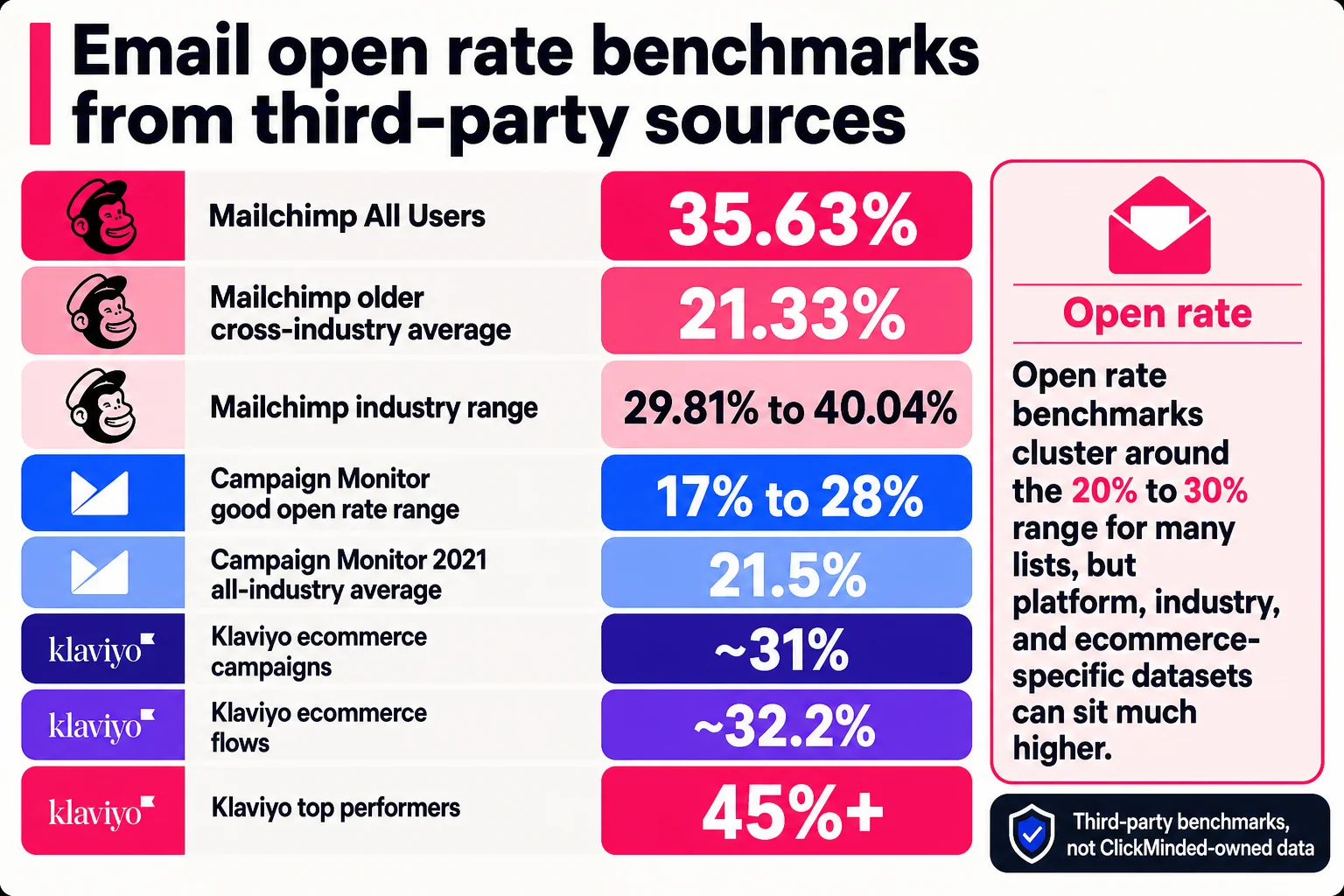
These are third-party benchmarks from ESPs and industry reports. ClickMinded does not own these datasets.

| Source | Context | Reported open rate or range | Best use of this benchmark | Caveat |
|---|---|---|---|---|
| Mailchimp | Current platform benchmark across Mailchimp users | 35.63% average open rate for “All Users” | Compare against a large ESP dataset with industry breakouts | Mailchimp also has older content citing 21.33% across all industries, so check which Mailchimp page and dataset you are using |
| Mailchimp | Industry-specific benchmark table | 29.81% for Ecommerce to 40.04% for Non-Profits | Sense-check performance by industry | Platform mix, sender quality, and tracking rules affect the averages |
| Campaign Monitor | General guidance across industries | 17% to 28% is generally a good open rate | Useful baseline for “are we in the normal zone?” conversations | The same guidance cites a 21.5% all-industry average from 2021 data, so it is older than some current ESP datasets |
| Klaviyo | 2026 ecommerce benchmarks | 31% for campaigns and 32.2% for flows | Stronger fit for ecommerce brands than broad all-industry averages | Ecommerce, automated flows, and Klaviyo’s customer base can push results higher than general benchmarks |
| Klaviyo | 2026 top ecommerce performers | 45.1% for campaigns and 45.8% for flows | Shows what excellent ecommerce performance can look like | Top-performer numbers are aspirational, not the bar every list should be judged against |
What counts as a good open rate for email marketing?
Use this as a diagnostic, then compare it with your own average email open rate trend and the downstream email marketing metrics that prove people acted.
| Performance label | Rough range | What it usually means | What to check next |
|---|---|---|---|
| Below average | Under 20% | You may have a targeting, deliverability, list fatigue, or sender-trust issue. This sits below many broad “good” ranges, including monday.com’s 15% to 25% typical good range. | Check inbox placement, inactive subscribers, send frequency, sender name, and weak segments. |
| Average | 20% to 30% | Normal for many broad, engaged lists. If revenue and clicks look healthy, do not panic because a competitor posted a shinier screenshot. | Compare by segment, send type, and trendline. One campaign is not a diagnosis. |
| Good | 30% to 40% | Strong for many teams, especially when the audience expects the message. Omnisend puts a strong 2026 ecommerce open rate around 28% to 35%. | Check whether opens match clicks, replies, conversions, or revenue. |
| Excellent | Above 40% | Strong in many contexts, and common for lifecycle emails, ecommerce flows, or highly engaged lists. Klaviyo’s top ecommerce performers report open rates above 45% for campaigns and flows in its 2026 benchmarks. | Verify send type, audience size, and privacy-inflated opens before declaring victory. |
Why benchmark sources disagree
Email open rate benchmarks differ because each source is measuring a different slice of email: sender types, industries, list sizes, campaign formats, automation flows, and tracking rules.
A Klaviyo benchmark is most useful for ecommerce campaigns and flows. Mailchimp or Campaign Monitor works better as a broad cross-industry gut check. HubSpot community threads and Reddit discussions can show what operators are seeing day to day, but the methodology is usually messy. Treat those as context, not a scoreboard.
| Source | Best use | Watch out for |
|---|---|---|
| Mailchimp benchmarks | Broad email marketing comparison | Too general for deep ecommerce lifecycle analysis |
| Campaign Monitor guidance | Campaign-level expectations | Less useful for platform-specific flows |
| Klaviyo benchmarks | Ecommerce campaigns, flows, and retail email | Poor fit for B2B newsletters or SaaS onboarding |
| Mailjet advice | Deliverability and sender-practice checks | Not a precise industry benchmark |
| ActiveCampaign benchmarks | Automation and CRM context | Not a clean market-wide average |
| monday.com guidance | Simple marketer range-setting | Light on advanced segmentation |
| HubSpot community discussions | Operator sanity checks | Self-reported and inconsistent |
| Reddit discussions | Edge cases and tracking complaints | Dangerous as a benchmark source |
Newsletters, promotional blasts, onboarding sequences, nonprofit updates, and retail promos behave differently because subscribers expect different things from them. If you send a recurring editorial email, compare against newsletter-specific resources like our guides to newsletter open rate, average newsletter open rate, and newsletter statistics. If you run abandoned cart flows, use ecommerce lifecycle benchmarks instead.
Compare your open rate to the right email type
Your open rate only means something after you name the email. Industry matters, but send type and list quality usually explain more of the gap. A newsletter to opted-in readers, a B2B nurture email, and a promo blast to old leads should not share one generic benchmark.
| If your email is… | compare against… | avoid comparing against… |
|---|---|---|
| Newsletter to opted-in readers | Newsletter benchmarks, your own recent sends, and resources like newsletter open rate | Cold lead blasts or ecommerce promo averages |
| Promotional blast to old leads | Reactivation campaigns and older-list segments | Fresh subscriber benchmarks |
| Abandoned cart flow | Ecommerce lifecycle benchmarks, including Klaviyo’s ecommerce benchmarks | General cross-industry campaign averages |
| Product launch to customers | Past customer announcements and segmented launch sends | Broad B2B newsletter averages |
| Agency client report | Client comms, account updates, and relationship-based email | Retail promo benchmarks |
| B2B nurture sequence | CRM and automation benchmarks, such as ActiveCampaign’s benchmark context | Consumer newsletter averages |
Cadence and segmentation do a lot of work here. A weekly email to people who asked for weekly advice has a different ceiling than a monthly promo sent to every contact in the CRM since 2019. List source matters too. Customers, demo requesters, and newsletter subscribers are warmer than giveaway entrants or imported event lists.
For a broader read, use our email marketing benchmarks guide, then judge each segment against its own history.
Treat opens as a directional signal
Open rate still belongs in your reporting, but do not treat it like a clean headcount of human attention. Apple Mail Privacy Protection can preload tracking pixels, so an open may register before anyone reads the email. Privacy tools can also hide device and location detail. Image blocking does the reverse, because a real reader can open the message without loading the pixel. Security scanners can trigger activity before the email reaches a human inbox.

Platforms define and filter opens differently, too, so Mailchimp, Klaviyo, and your CRM may disagree. Track opens as a trend, then judge performance with the rest of your email marketing metrics: clicks, conversions, revenue per recipient, unsubscribes, spam complaints, and inbox placement. Opens are the smoke alarm. The fire, if there is one, shows up somewhere else.
Improve opens by improving the list
Use this checklist before rewriting every subject line in a panic.
-
Clean the denominator. Remove hard bounces, suppress long-term inactive contacts, and stop mailing people who never opted in.
-
Segment by intent. Separate buyers, leads, trial users, newsletter readers, and reactivation groups. Compare each group against the right baseline, using our email marketing statistics and email marketing benchmarks pages for context.
-
Fix sender trust. Use a recognizable from name, consistent domain, and reply-to address people trust.
-
Match the subject line to the email. Curiosity is fine. Bait trains people to ignore you.
-
Test cadence. Too many sends burn attention. Too few make you unfamiliar.
-
Protect deliverability. Authenticate your domain, monitor spam complaints, and avoid sudden volume spikes.
-
Compare like with like. Newsletter, promo, and lifecycle emails need separate baselines.
FAQ: What is a good open rate for email marketing?
What is a good open rate for email marketing in 2026? For engaged lists, 20% to 30% is a useful reference. Compare against your industry in our email marketing benchmarks.
Is 20% good? Often, yes, especially for broad promos. Check the average email open rate before panicking.
Is 30% good? Usually strong, unless privacy inflation is carrying the number.
Why is Klaviyo higher than Mailchimp? Klaviyo skews ecommerce and lifecycle-heavy. Mailchimp publishes broader industry benchmark reports.
What about newsletters? Use newsletter context: newsletter open rate, average newsletter open rate, and newsletter statistics.
Optimize for opens or clicks? Track both. Apple Mail Privacy Protection can inflate opens, so pair them with downstream email marketing metrics and email marketing statistics. Compare against the right peer set and watch trendlines.