
The review stats worth putting in your 2026 plan
Use the stats that change what you do next, not the ones that make a vendor deck look spicy.
| Statistic | Source | Use it for | Caveat |
|---|---|---|---|
| 97% read online reviews for local businesses before visiting | Capital One Shopping, 2026 | Local SEO | Secondary research |
| 49% trust reviews as much as personal recommendations | Capital One Shopping, 2026 | Trust reporting | Category risk matters |
| Consumers read 10 reviews on average before trusting a business | BrightLocal | Volume targets | Averages blur categories |
| 73% do not trust reviews older than a month | Capital One Shopping, 2026 | Review cadence | Freshness varies by category |
| 88% trust written reviews more than star ratings alone | Capital One Shopping, 2026 | Review display | Trust is not conversion proof |
| 76% trust mixed reviews more | Capital One Shopping, 2026 | Moderation | Perfect ratings can look fake |
| 89% expect businesses to respond | Capital One Shopping, 2026 | Response ops | Not ranking proof |
| 88% oppose AI-generated reviews | Capital One Shopping, 2026 | Fake review policy | Definitions vary |
Score the sources before you build the plan. A clean survey and a recycled blog stat do not deserve the same weight.
How we scored the sources
ClickMinded is compiling and interpreting third-party online review statistics here. We are not claiming proprietary review data, secret platform access, or a hidden platform dataset.
We gave the most weight to primary research, platform documentation, academic research, and government or regulatory sources, including BrightLocal survey research, Google Business Profile documentation, Northwestern Spiegel, and the FTC.
We treated well-sourced editorial or industry reports as useful when they explain where the numbers came from. Capital One Shopping’s 2026 page says its review data is compiled from publicly available sources, so it counts as secondary research, not first-party telemetry.
We used vendor listicles, reposted stats, unclear methodology, and giant macro estimates with caution. Claims like reviews influencing $3.8 trillion in revenue worldwide are better for framing than forecasting.
Every specific statistic gets a source link or is labeled as synthesis.
Reviews reduce buyer uncertainty when they look real
Online reviews statistics get sloppy when they turn trust into one giant number. A review for an emergency plumber, a $19 phone case, a hotel, and a B2B software vendor does not carry the same weight. The buyer’s risk is different, the platform is different, and the review content is different.
For marketers, the safer reading is this: reviews help buyers judge credibility when they reduce uncertainty. A detailed review with a real experience, recent context, and a believable mix of pros and cons usually does more trust work than a perfect five-star wall that looks like it was assembled in a basement by interns named “Customer A.”
Regulators are treating that distinction seriously. The FTC’s review rule, announced August 14, 2024 and effective October 21, 2024, targets “deceptive and unfair conduct involving consumer reviews and testimonials”. The Federal Register notice says the rule “prohibits selling or purchasing fake consumer reviews or testimonials, buying positive or negative consumer reviews”, and it also covers insider reviews, suppression, and fake social indicators.
Marketer takeaway: reviews reduce buyer uncertainty, but usefulness depends on category, platform, recency, review quality, and whether the review environment looks clean. Treat trust as a diagnostic signal, not a universal benchmark.
Set review benchmarks against the market you actually compete in
There is no honest universal answer to “how many reviews do we need?” A dentist in a dense suburb, a boutique hotel, and a niche ecommerce brand live in different review economies. Category, location density, purchase risk, and the visible competitor set all change the benchmark.
Use a practical review scorecard instead:
Compare your review volume with the top local competitors buyers see beside you. Track review velocity, meaning whether new reviews arrive steadily instead of in one suspicious burst. Watch recency, since stale reviews may describe an old staff, old menu, old shipping process, or old product version. Read the text, because a 4.6 rating with detailed praise for punctuality, cleanliness, and problem-solving can be more useful than a 4.9 with thin “great service” blurbs.
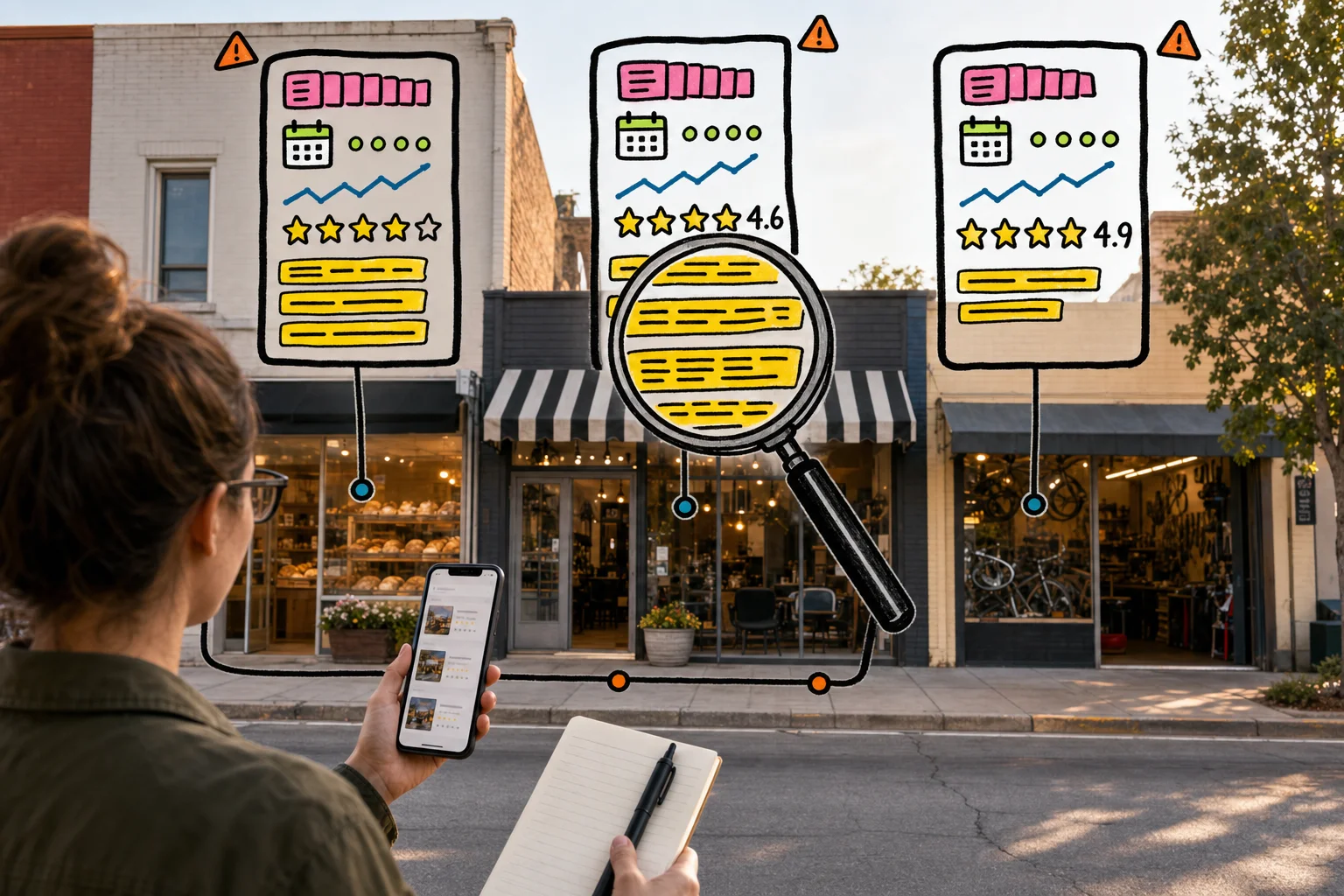
Google encourages businesses to keep profiles current and respond to reviews, while third-party local SEO research treats review recency, volume, ratings, and sustained growth as practical local visibility signals, not a published ranking formula from Google. Google also requires a verified Business Profile before owners can reply to reviews and says replies should be professional, concise, meaningful, and non-promotional. For marketers, the benchmark is comparative and operational: volume, freshness, velocity, negative patterns, and review substance.
Treat reviews as discovery assets, not a magic ranking button
Reviews help people choose you after they find you, and they can also shape what searchers notice in local results: star rating, review count, review snippets, photos, and recent customer language. That matters for local SEO, but keep the claim clean. Google says local results are based mainly on relevance, distance, and prominence, and its Business Profile guidance encourages businesses to manage and reply to customer reviews. That is not the same as saying every new review pushes you up one position.
For marketers, the useful move is to treat reviews as part of the search experience. Baymard found that 95% of users relied on reviews during product evaluation, and users wanted rating counts alongside averages because counts helped them judge credibility. Local buyers do the same mental math on map packs and business profiles. If you are reporting on local visibility, pair review metrics with rankings, clicks, calls, direction requests, and conversions. For broader context, see our SEO statistics guide.
Choose review platforms by how buyers actually shop
Google should usually be the first platform you clean up, especially for local search. After that, follow buyer behavior. BrightLocal’s Local Consumer Review Survey helps because it separates local reviews from ecommerce reviews, which many online reviews stats pages blur together.
| Business type | Platforms to watch |
|---|---|
| Local service | Google, Yelp, Facebook, BBB for trust-sensitive work |
| Restaurant | Google, Yelp, Tripadvisor, Facebook |
| Healthcare | Google, Healthgrades, insurance directories |
| Ecommerce | On-site reviews, Google, marketplace reviews, Trustpilot where relevant |
| SaaS or B2B | G2, Capterra, category sites, LinkedIn |
| Travel | Google, Tripadvisor, Booking or Expedia reviews |
Facebook still matters when community discovery matters, so connect this with your social media statistics work.
Use reviews to answer buyer objections on the page
For ecommerce CRO, treat reviews as decision support, not magic conversion dust. Ask where shoppers hesitate: sizing, durability, delivery, fit, setup, support, refund risk. Review content can answer those objections in a way brand copy usually cannot.
Northwestern’s Spiegel Research Center has published research on how star ratings and review content relate to purchase behavior, but those findings are study-specific. Do not paste a universal “reviews increase conversion by X%” slide into your next board deck unless the source matches your product, traffic, price point, and review display.
For reporting, separate review presence, review quality, and review UX. A product page with 4.8 stars and two vague reviews is weaker than one with useful text, photos, filters, and enough volume to reduce doubt. Add this to your conversion rate optimization statistics and lead generation statistics planning when reviews affect form fills, demos, or checkout confidence.
Treat review credibility as a compliance risk
Fake reviews are now a legal and platform risk, not just a reputation annoyance. The FTC’s 2024 rule bans practices such as fake consumer reviews, insider reviews without disclosure, buying positive or negative reviews, review suppression, and misleading review displays tied to company-controlled review sites or badges. Google’s contribution policy also prohibits fake engagement, impersonation, incentives, and content that does not reflect a real experience.
AI makes the review trust problem messier because generic, polished review text is easier to produce at scale. Do not claim a precise “AI review percentage” unless you have a credible source. For planning, audit the controllable stuff: solicitation language, incentives, moderation rules, syndication, review gating, and whether negative reviews are being hidden in ways that would fail a regulator’s sniff test.
Treat review replies as visible customer service
Review responses are useful because buyers can see how the business behaves when praise, confusion, or complaints show up in public. Google gives owners a normal workflow to read and reply to Business Profile reviews, which makes replies part of basic local operations.
The safe marketing advice is simple: respond to detailed positive reviews, answer serious complaints, and fix repeated issues instead of writing nicer apologies for the same broken process. Avoid copy-paste replies, legal threats, keyword-stuffed nonsense, and defensive essays written in the emotional register of a restaurant owner replying at 1:13 a.m. after three espressos.
Do not claim replies directly increase revenue or rankings unless the source actually measured that effect and explains the limits.
Turn review data into operating habits
Use online reviews statistics as planning inputs, not universal laws. BrightLocal is strongest for local behavior, Capital One Shopping is useful for broad online review statistics, and ecommerce research belongs closer to product-page and CRO decisions.
For 2026, put reviews into the same reporting rhythm as traffic, leads, and conversion work.
Action list:
- Build a steady review request process.
- Prioritize recent reviews.
- Respond to useful reviews and serious complaints.
- Diversify platforms based on buyer behavior.
- Watch for suspicious review patterns.
- Benchmark against real competitors buyers see in search results.
Related ClickMinded resources: marketing statistics, digital marketing statistics, SEO statistics, social media statistics, lead generation statistics, and conversion rate optimization statistics.