
SEO statistics to use carefully in 2026
SEO still works. The harder part in 2026 is proving where it works, because the same ranking can produce a click, an impression-only brand touch, an AI Overview citation, a local pack interaction, or nothing you can cleanly attribute in analytics.
Treat SEO statistics as planning evidence, not trivia. Roundups like Ahrefs 107 SEO Statistics for 2026, WordStream SEO statistics, SeoProfy SEO statistics, Intergrowth SEO stats, GoodFirms AI SEO stats, and Semrush AI SEO statistics collect plenty of useful numbers. The better move is sorting those numbers by the decision they help you make.
The audience for SEO statistics is usually building decks, forecasts, content plans, or client arguments. If that is you, pair this page with broader marketing statistics, reporting definitions in marketing metrics, and performance ranges in marketing benchmarks.
| Statistic or evidence type | Useful for | Caveat |
|---|---|---|
| Search still sends discovery demand when users have a specific need, product, place, or brand in mind | Defending SEO in annual planning | Do not use generic “search begins everything” claims without the original study date, market, and definition |
| Informational queries may trigger AI summaries more often than commercial or navigational queries in some datasets, including SeoProfy SEO statistics | Segmenting content by intent | Rates depend on dataset, country, device, and SERP type |
| AI Overviews and AI search features can reduce traditional clicks on some informational SERPs | Adjusting CTR forecasts and reporting expectations | Lower clicks do not automatically mean lower business value. Citations, branded searches, and assisted conversions may still matter |
| Zero-click searches are common enough that SEO reports need more than sessions | Explaining why impressions, rank visibility, local actions, and brand demand belong in SEO reporting | Estimates vary by clickstream panel, device mix, geography, and how Google-owned clicks are counted |
| Google remains the dominant search engine in most market share datasets | Sizing search opportunity and prioritizing Google technical SEO | Market share is behavior data. It does not predict your traffic |
| Many pages receive little or no Google traffic | Setting content quality, indexing, and pruning expectations | This is often misused to imply content is pointless. It usually says more about demand, links, intent fit, and indexation |
| Backlinks still correlate with ranking strength in many SEO datasets | Prioritizing digital PR, link earning, and authority building | Correlation is not a recipe. Link quality, topical fit, brand strength, and query type change the value |
| AI SEO statistics show marketers are adapting workflows, reporting, and SERP analysis, including GoodFirms AI SEO statistics and Semrush AI SEO statistics | Updating team processes, tooling, and executive education | Vendor and survey data can reflect respondent mix and product framing. Validate with your own analytics |
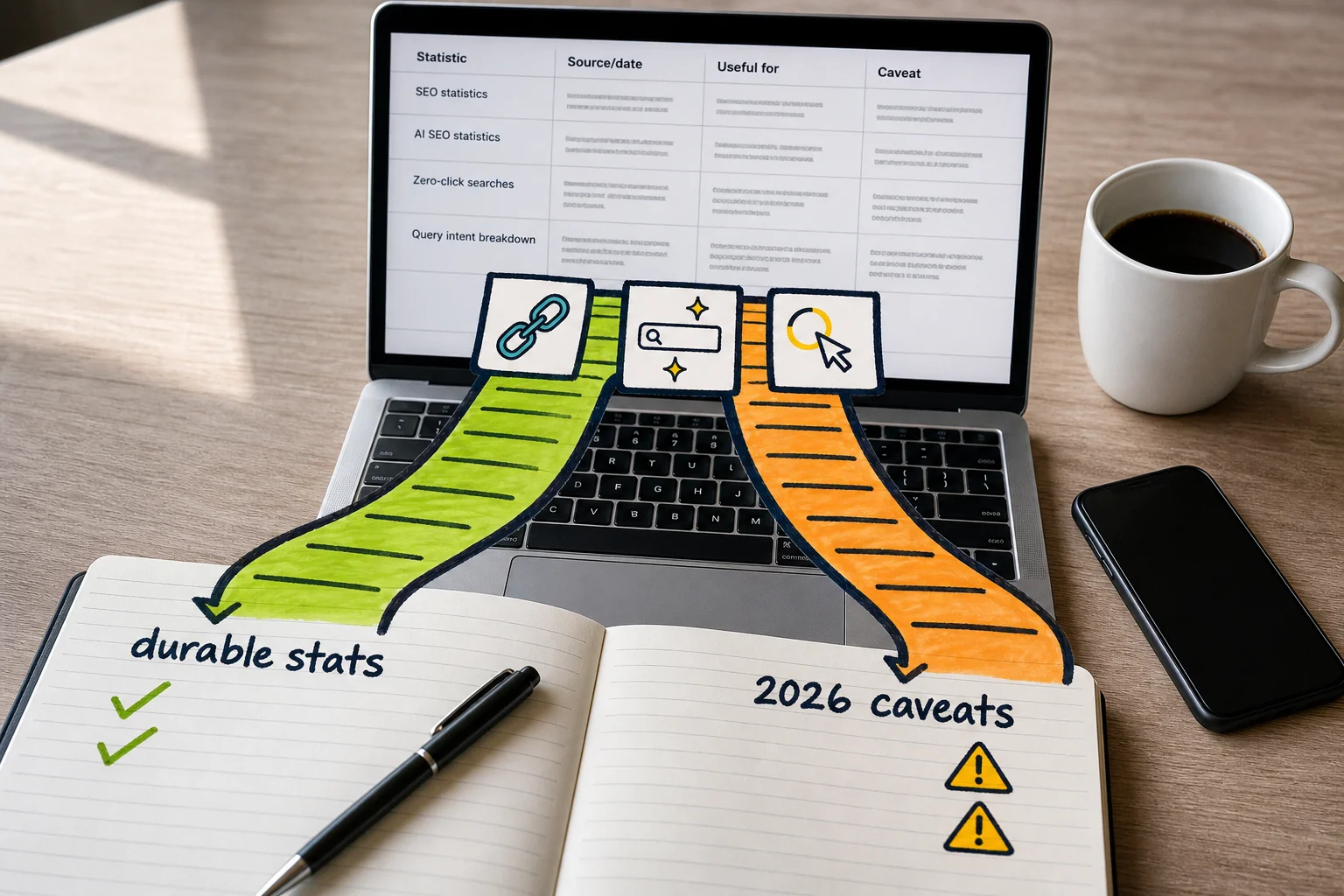
The split matters because durable SEO fundamentals and 2026-specific shifts answer different questions. A backlink correlation can explain why authority still matters. It cannot tell you whether an AI Overview will absorb clicks for a definition query. A zero-click study can warn you that sessions undercount visibility. It cannot tell you whether your product comparison page will convert.
Use durable stats for budget, staffing, and channel strategy. Use context-dependent stats for forecasting, reporting caveats, and SERP-specific decisions. Every number needs a source, a date where available, and a clear job.
A practical filter for SEO statistics
Every SEO statistic needs five labels before it goes into a deck: source, date, geography, sample or methodology, and intended use. If one is missing, the number may still help, but it should not carry the argument alone.
Start by separating search behavior data from SEO performance benchmarks. Behavior data tells you what users or SERPs appear to do, such as clickstream estimates for zero-click searches or market share reports. Performance benchmarks tell you what sites, pages, campaigns, or tool databases achieved. Mixing them is how a team turns a broad search estimate into a forecast for its own blog, product pages, or local landing pages.
| Source type | Good for | Watch-outs |
|---|---|---|
| Clickstream studies | Directional search behavior, click patterns, zero-click trends | Panels can have bias, device gaps, and opaque sources. Treat broad rates as estimates. |
| Market share data | Sizing search platforms by country, device, or time period | Market share does not predict your organic traffic, CTR, or conversions. |
| Platform and vendor benchmarks | Comparisons inside a toolset, such as visibility, CTR, backlinks, or SERP features | Tool databases have coverage limits and commercial incentives. Useful, but not neutral population samples. |
| Survey data | Marketer adoption, priorities, perceived impact, workflow changes | Surveys measure what respondents report, not actual searcher behavior or revenue. |
| Ranking-factor correlation studies | Finding patterns worth testing, such as links, content depth, or authority signals | Correlation does not prove cause. Query set, vertical, and SERP type can change the pattern. |
| Secondary roundups | Fast discovery of useful stats and sources | Roundups often compress caveats. Click through before citing. |
Clickstream work is a good example. It can help explain how users move, pause, and reconsider on Google, but the method often depends on instrumented panels and data partners, so panel bias and opaque sourcing are part of the tradeoff. SparkToro’s 2026 zero-click analysis is useful for directional planning, but its framing belongs with the number. The claim that less than one-third of Google searches send a click is a behavior estimate, not your site’s expected CTR.
Zero-click and AI Overview stats need tighter labeling because the same phrase can come from clickstream behavior, SERP tracking, or a marketer survey. Semrush’s intent-based approach is more useful for planning because informational and transactional searches behave differently.
Use roundups from GoodFirms, Ahrefs, WordStream, SeoProfy, Intergrowth, and Semrush to find leads, then verify the original context. A copied statistic without its date and method is just a number wearing a suit.
Search engine optimization statistics for search behavior and market share
Search behavior stats help you size the channel. They do not tell you what your CTR, conversion rate, lead quality, or revenue will be. Use them near the front of a planning deck, before the section where you model organic traffic or pipeline.
Google is still the center of search planning in 2026, even with AI search and social discovery taking more attention. Market share datasets vary by provider, device, and date, but they point in the same direction. One 2026 market share report put Google’s global all-device share at 89.3% in early 2026, with competitors collectively around 10.7%. Another roundup reports Google at 91.4% global search market share in 2026. Treat the difference as a reminder to cite the exact dataset, not as a reason to ignore the pattern.
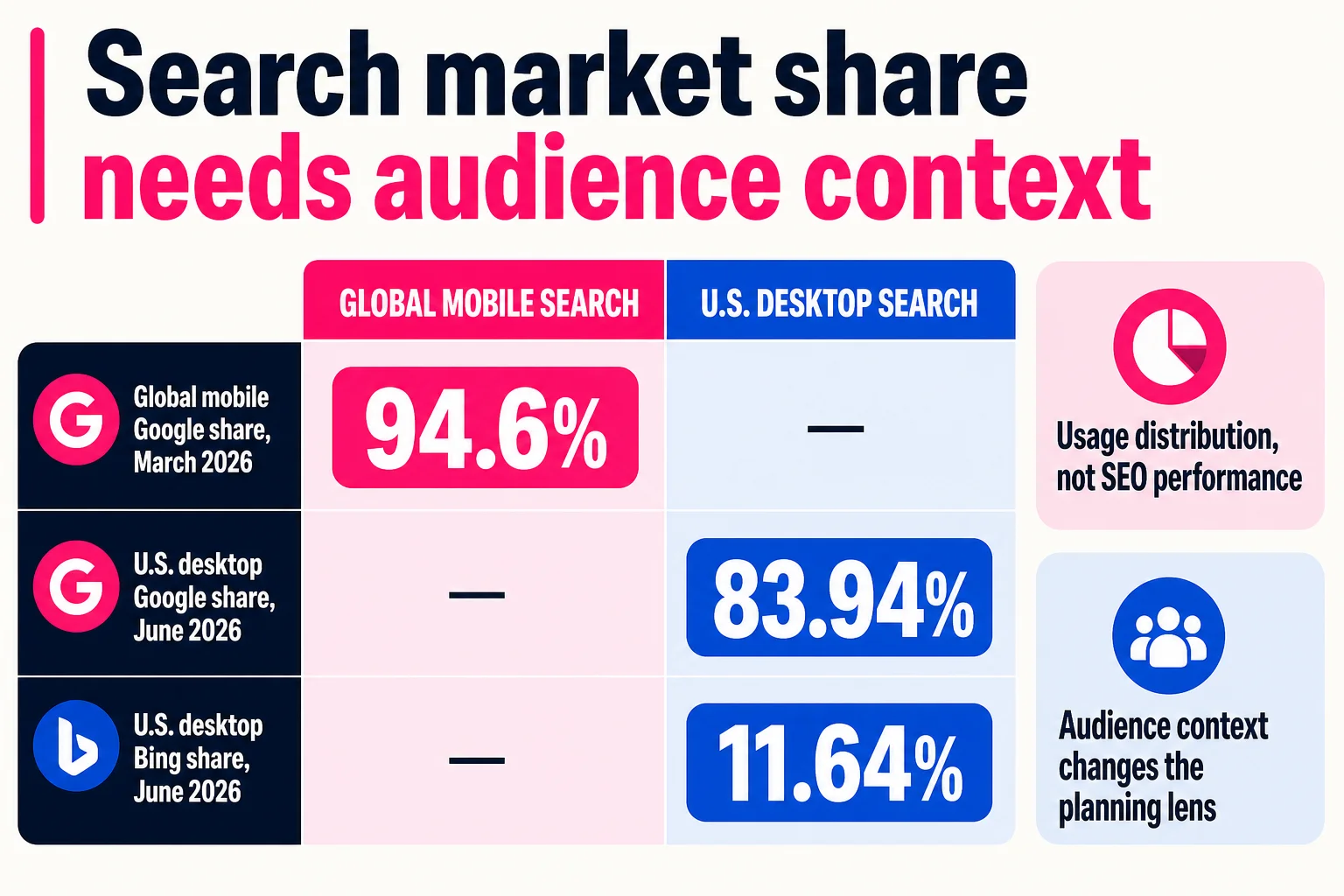
Device split matters. The same 2026 global report lists Google at 81.1% of global desktop search and 94.6% of global mobile search as of March 2026. For U.S. desktop search, StatCounter shows Google at 83.94% and Bing at 11.64% in June 2026. If your audience is B2B, regulated, enterprise, or older-skewing, desktop and Bing deserve a closer look than a global all-device average suggests.
Bing’s gains are real but easy to overstate. One 2026 analysis reports Bing’s global all-device share rising from 3.0% to 4.1% in the 24 months after the February 2023 Copilot launch. That matters for paid search, enterprise search behavior, and some desktop-heavy SEO plans. It does not mean Bing now carries the same organic opportunity as Google for most sites.
The old claim that “68% of online experiences begin with search” still appears in SEO statistics roundups, including familiar pages like Ahrefs’ SEO statistics lists, WordStream’s SEO statistics, SeoProfy, Intergrowth, and similar collections. Use it carefully. It is broad, older, and often repeated without enough method context. It can support the general idea that search remains a major discovery behavior. It should not appear in a 2026 forecast as if 68% of your future sessions, leads, or customers will begin with Google.
Search also no longer means one blue-link SERP on one engine. People search on Google, Bing, YouTube, TikTok, Reddit, Amazon, app stores, maps, AI assistants, and embedded search boxes inside marketplaces and SaaS tools. A founder may ask ChatGPT for a vendor shortlist, watch two YouTube reviews, search Google for pricing, and then click a Reddit thread before filling out a demo form. Your attribution report may give one channel the credit. The user did not behave that neatly.
Zero-click estimates belong in this behavior bucket too, not in your performance benchmark slide. Some 2026 roundups report that 58% to 62% of Google searches end without a click, while SparkToro’s clickstream-based analysis argues that less than one-third of Google searches send a click. Those numbers help explain why visibility, brand search, SERP ownership, and assisted demand matter more in reporting. They do not predict the click rate for your page on a specific query.
For planning, use market share to decide where search demand lives. Use behavior stats to explain how discovery is changing. Save CTR, traffic, and conversion claims for SEO performance benchmarks, where query type, ranking position, SERP features, brand demand, and page intent can be measured directly.
Organic search traffic and CTR stats need query-level context
Organic search still sends meaningful traffic, especially for sites with useful content libraries, product pages, comparison pages, local pages, and branded demand. The mistake is treating “organic traffic” as one bucket with one expected CTR. A branded navigational query, a “best software” query, and an informational query with an AI Overview behave very differently.
Ahrefs’ 2026 analysis argues that Google still sends far more referral traffic than AI search tools, with ChatGPT estimated at about 12% of Google’s search volume. That supports continued SEO investment, but the methodology matters. Ahrefs uses its own index and modeled clickstream estimates, not Google’s full internal data. Use the number directionally, not as a traffic forecast you paste into a board deck and hope nobody asks follow-up questions.
CTR is where expectations have changed most. Position 1 still matters, but a top ranking does not guarantee the same click share it did when SERPs were simpler. Featured snippets, local packs, shopping modules, video results, People Also Ask, forums, Reddit threads, and AI-generated answers can all grab attention before the first traditional organic result. Ahrefs’ AI Overview analysis found that AI Overviews reduce clicks, especially on informational queries where the SERP can answer the question directly.
| Stat | How people quote it | Better way to use it |
|---|---|---|
| Organic search remains a major source of web referral traffic | ”SEO is still one of the biggest traffic channels.” | Justify SEO as a channel, then model traffic by query type, ranking position, and SERP layout. |
| Less than one-third of Google searches may send a click, per SparkToro’s 2026 clickstream analysis | ”Most Google searches are zero-click.” | Explain why impressions and visibility can rise while clicks stay flat. |
| AI Overviews can reduce organic CTR | ”AI is killing SEO traffic.” | Plan for informational-query risk. Commercial, local, branded, and high-consideration queries can still send clicks. |
| Many pages receive no Google traffic | ”Most content fails, so SEO does not work.” | Check demand, intent, indexation, content depth, internal links, backlinks, and SERP fit before blaming the channel. |
The “pages get no Google traffic” stat is especially easy to abuse. Ahrefs’ search traffic studies show how uneven organic traffic distribution can be across pages, but they rely on Ahrefs’ index and estimated Google traffic. A page with no estimated visits may target a query with no demand, miss intent, sit outside the index, duplicate another page, lack internal links, have thin content, or compete in a SERP where stronger domains own the clicks. That says plenty about targeting and execution. It does not prove SEO fails.
Keep branded and non-branded reporting separate. Branded CTR is often high because the searcher already wants you. Non-branded CTR is more exposed to SERP features, comparison behavior, ads, and AI summaries. Blending both into one “organic CTR” average can make a weak non-branded program look healthy, or make a strong brand look like an SEO machine when the demand was created somewhere else.
If your organic program depends on publishing, compare these numbers with broader content marketing statistics so the SEO discussion includes production quality, refresh cycles, and distribution, not only rankings.
AI SEO statistics and zero-click search statistics need extra caveats in 2026
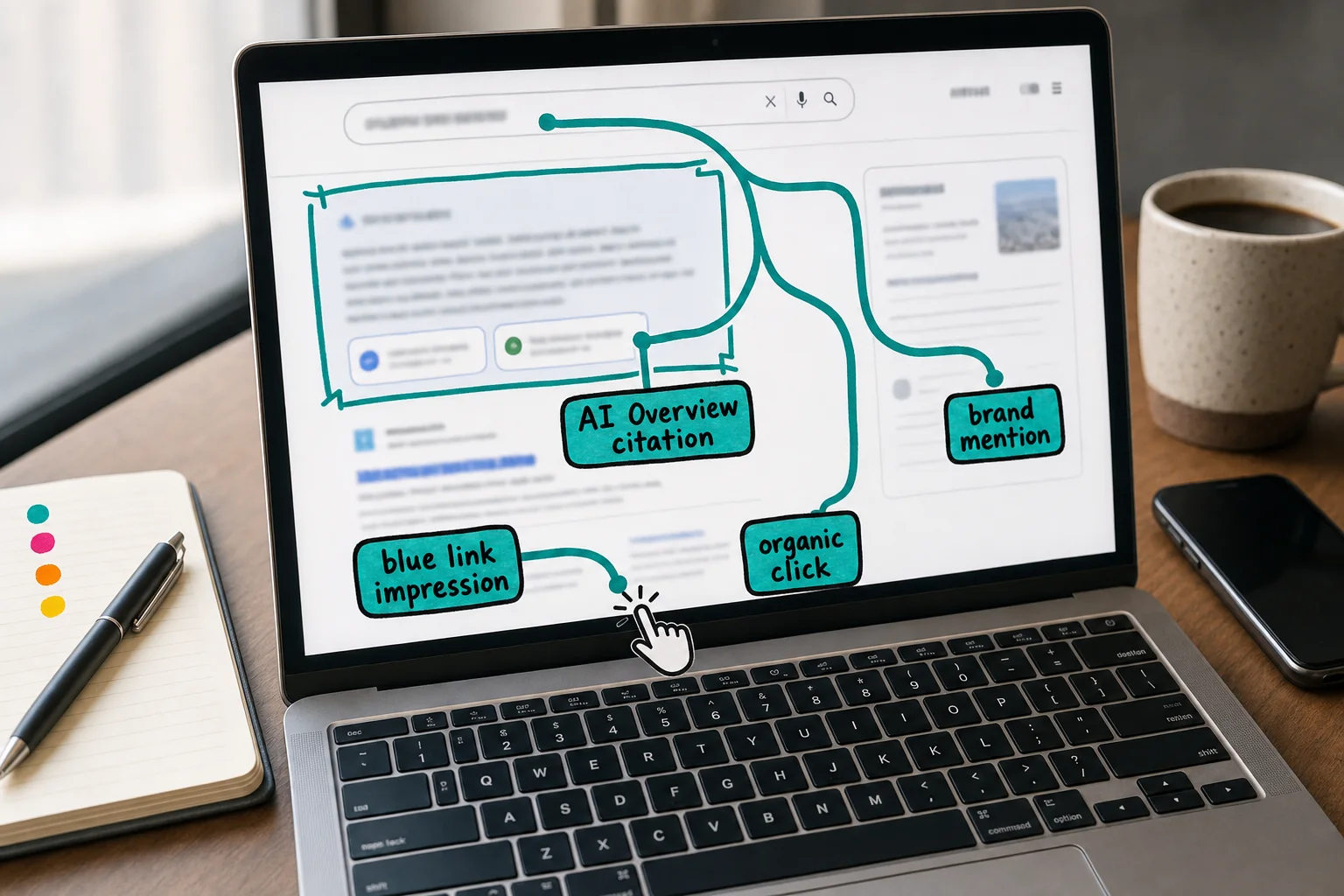
AI Overviews have made SEO reporting messier because a search impression can now mean several different things. A traditional blue-link impression, an AI Overview citation, a brand mention inside an answer, and a referral from an AI assistant do not behave the same way.
The strongest current AI SEO statistics point to material coverage, but not stable coverage. A Q1 2026 Conductor analysis summarized by QuickSEO looked at 21.9 million queries and found AI Overviews on 25.11% of searches. Semrush data cited in the same analysis showed AI Overview prevalence rising from 6.49% in January 2025 to about 25% in July 2025, then dropping to 15.69% in November 2025. Treat those as benchmarks for studied query sets, not a universal rule. Geography, device, language, vertical, query intent, and detection method can all change the number.
Google-reported reach numbers are large, but they also need source context. Industry summaries report that AI Overviews reach about 2 billion monthly users, are available in 200 plus countries and 40 plus languages, and drive roughly 10% higher search usage for query types where they appear. The useful planning point is that Google is putting AI answers into normal search behavior. The risky interpretation is assuming every market, SERP, and keyword set is affected equally.
Zero-click search statistics are even easier to misuse. Digital Applied reports that when AI Overviews are present, the zero-click rate is approximately 83%, and AI Mode queries reach about 93% zero-click. SeoProfy reports that about 26% of users end their search session immediately after seeing an AI Overview. Those figures are useful for scenario planning, especially for informational content. They should not be pasted into every SEO forecast as if a local service query, a branded login query, and a B2B comparison query all behave the same way.
GoodFirms’ AI SEO stats page and Semrush’s AI SEO statistics page are good examples of how ranking pages are adapting the category around AI search, zero-click behavior, and SERP visibility. Use them as starting points, then check the underlying date, sample, and definition. A survey stat like Semrush’s finding that nearly 70% of businesses report higher ROI from using AI in SEO says something about marketer adoption and workflow confidence. It does not prove that AI-generated content ranks, converts, or survives quality review in your category.
The practical reporting shift is to track more than organic clicks. Keep monitoring clicks and conversions, but add assisted conversions, branded search demand, share of SERP visibility, AI Overview citations where your tools can detect them, AI assistant referral traffic where analytics can separate it, and content performance on high-intent queries that still earn visits. Pair those with broader AI marketing statistics if you need to explain adoption trends outside SEO.
SEO statistics for content, indexing, backlinks, and ranking factors
Classic SEO inputs still matter, but they are easy to turn into fake certainty. Content volume, indexation, backlinks, and ranking-factor studies can help you prioritize work. They should not become recipes where 2,000 words plus 47 links equals position one. Google has never worked that cleanly, and AI-heavy SERPs make the shortcut even weaker.
Use content statistics to size effort, not copy a word count. If a roundup says longer posts rank better, check the date, sample, query type, and whether it measured ranking pages or pages that earned links and authority over time. Those are different things. A useful benchmark shows what serious competitors are investing in, how often they refresh key pages, and which formats earn visibility. For broader planning data, pair this with our content marketing statistics guide rather than treating SEO content as a separate spreadsheet kingdom.
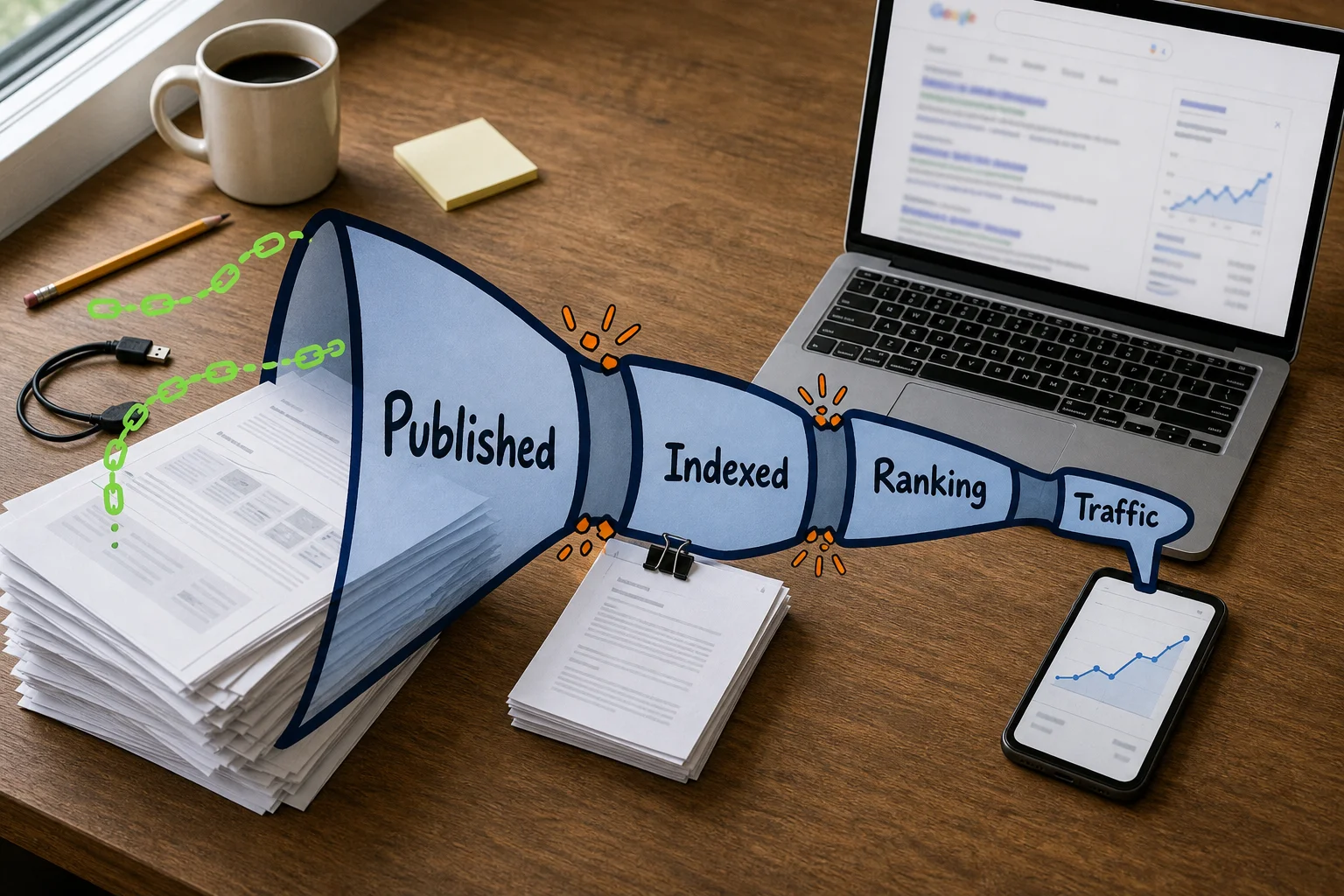
Publication does not equal indexing. Indexing does not equal ranking. Ranking does not equal traffic.
That sequence prevents bad reporting. A page can be published and never indexed. It can be indexed and rank nowhere useful. It can rank and still earn little traffic because demand is low, the SERP answers the question directly, ads or SERP features push results down, or the snippet does not attract clicks.
Backlinks can help with discovery because links give search engines more paths to find pages. Ahrefs’ backlink guide notes that backlinks can help search engines discover content faster, which may support indexing speed, though that does not prove a page will rank well. Internal links, sitemap hygiene, crawl depth, canonical tags, duplication, and content quality still matter.
Backlink statistics are useful, with caveats. Ahrefs says its backlink index includes more than 35 trillion historical external backlinks and is updated with fresh data every 15 to 30 minutes. A Fractl write-up says Ahrefs crawls more than 490 billion web pages and maintains an index of more than 35 trillion external backlinks. Those numbers explain why backlink tools help with competitive research, but no tool has perfect coverage. Community reports have raised accuracy and coverage caveats around backlink data, so treat link indexes as directional evidence.
The stronger backlink takeaway is referring domains, not raw link totals. Ahrefs reports a correlation between more referring domains and more organic search traffic, and its tools separate backlinks from unique referring domains at the site, directory, and page level. That matters because 500 links from one weak source rarely mean the same thing as 50 relevant links from 50 trusted sites.
Ranking-factor statistics need the biggest warning label. Correlation studies can show that high-ranking pages often have more links, stronger authority signals, or deeper content. They do not prove that copying those traits will cause the same ranking. Use these stats to decide where links, content refreshes, and technical fixes deserve attention.
Local, mobile, ROI, and reporting benchmarks that tie SEO to revenue
Business benchmarks belong in a different bucket than search behavior stats. A zero-click study tells you how SERPs behave. A local SEO report tells you whether people called, requested directions, booked, or visited. Keep those separate in your marketing metrics dashboard, or every reporting meeting turns into a fog machine.
For local SEO, Google Business Profile is often the cleanest measurement surface. SeoProfy cites that a verified Google Business Profile receives around 200 clicks or interactions per month, but treat that as a secondary-source benchmark unless the methodology is disclosed. The practical KPIs are still useful: calls, website clicks, direction requests, bookings, menu views, messages, and location-level conversion rate. Pair those with local landing pages, GBP updates, review velocity, mobile UX, call tracking, and online reviews statistics when you need trust and reputation context.
ROI statistics are the least portable SEO stats. Margins, sales cycle, attribution model, brand demand, and content maturity can swing results wildly. Lead-gen, home services, healthcare, legal, and multi-location brands can often tie local SEO to revenue through calls, bookings, directions, and store visits. Publishers and ecommerce brands with longer journeys need softer assisted metrics and cohort reporting. Use public marketing benchmarks as planning ranges, then build your own by location, query type, and conversion action.
FAQ about SEO statistics and AI search
What SEO statistics matter most for 2026? Separate search behavior, market share, organic CTR, AI visibility, zero-click behavior, and revenue. Start with current marketing statistics, then check the source date and method.
Is SEO still worth it with AI search? Yes. AI search changes where visibility happens, but it still needs crawlable pages, useful content, authority signals, and clear brand evidence. Related AI marketing statistics can help with adoption context.
What percentage of searches are zero-click? SparkToro and Similarweb reported that 68% of U.S. Google searches were zero-click in early 2026. Treat it as a clickstream estimate.
Do AI Overviews reduce organic traffic? They can. A July 2025 Pew study found users clicked organic results 8% of the time when an AI Overview appeared, versus 15% without one.
What is the best source for SEO statistics? Primary studies with dates, sample sizes, and methods beat roundup pages. Cite the original when possible.