
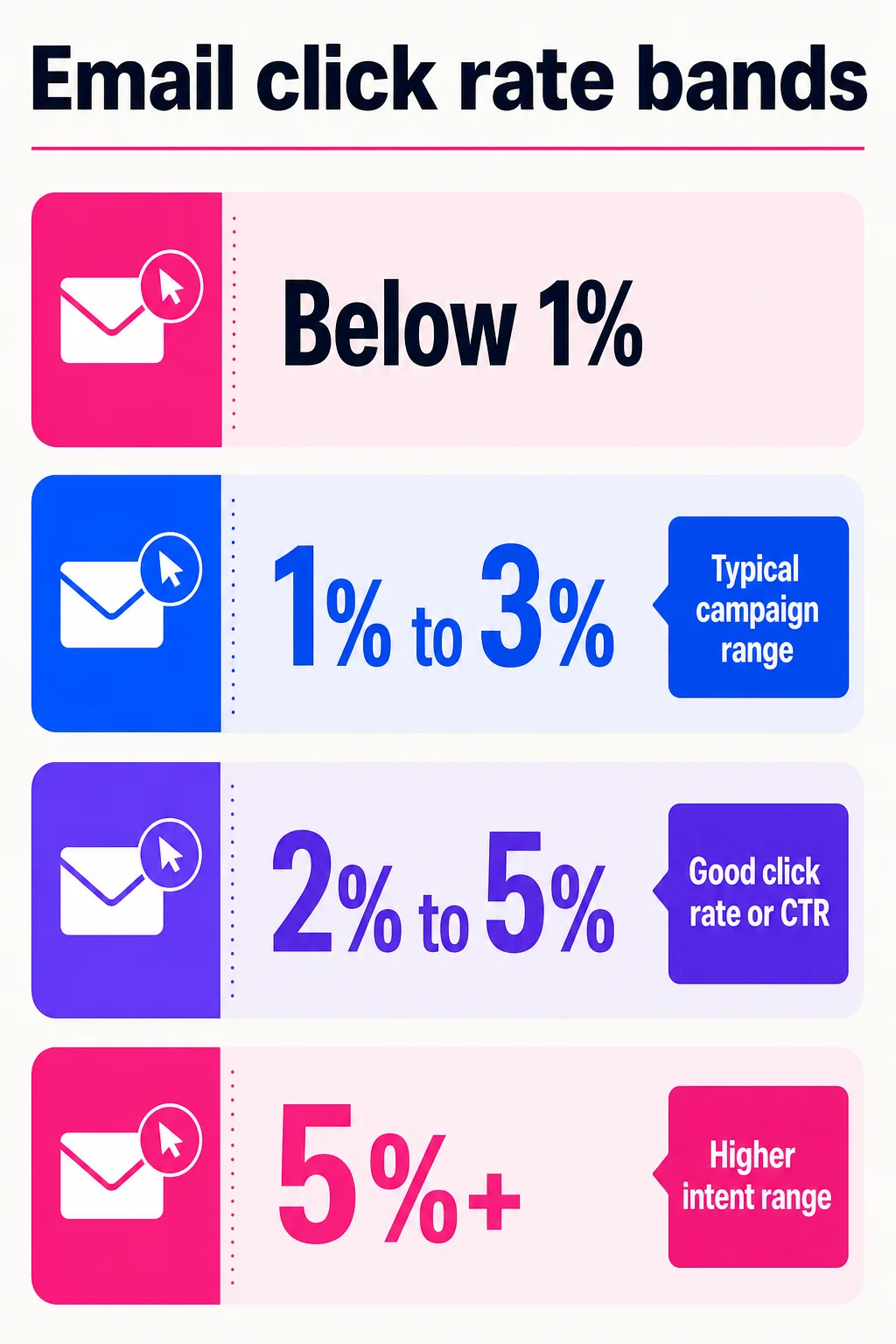
A good email click rate usually starts around 2%
For many email campaigns, a normal click rate lands around 1% to 3%. A 2% to 5% click rate is often strong, depending on your industry, list quality, send type, and whether your platform calculates clicks against sent emails, delivered emails, or another denominator.
Campaign Monitor puts a good email CTR at 2% to 5%. MailerLite’s 2025 benchmark report shows an average click rate of 2.09% across more than 3.6 million campaigns. Klaviyo’s 2026 benchmark data reports an average campaign click rate of 1.69%, while automated flows average 5.58%.
CTOR is a separate metric. Campaign Monitor frames a good click-to-open rate as 6% to 17%, so do not compare CTOR to click rate as if they measure the same thing. That is how teams end up celebrating the wrong number in a dashboard meeting, which is a very specific kind of spreadsheet sadness.
ClickMinded is interpreting third-party benchmark data here. We do not own those datasets, and the numbers vary because each platform has its own customer base, definitions, and reporting window. For more detail, see our guides to email marketing benchmarks and average email click rate.
| Metric | Rough “good” range | Use it for | Caveat |
|---|---|---|---|
| Click rate or CTR | 2% to 5% | Campaign engagement against sends or deliveries | Vendors define the denominator differently |
| Typical campaign range | 1% to 3% | Broad performance checks | Industry and list quality can swing the number |
| Automated flow click rate | Around 5% or higher | Triggered lifecycle emails | Flows usually have higher intent than newsletters |
| CTOR | 6% to 17% | Relevance among openers | It uses opens, so it is not comparable to CTR |
Know which click metric your platform is showing
Before you compare a report to a benchmark, check the label and the denominator. Email tools often use “click rate,” “CTR,” and “click-through rate” as synonyms, usually meaning unique clicks divided by delivered emails. Some use CTR for an opens-based number, which overlaps with CTOR and makes everything annoying fast. Campaign Monitor describes click-through rate, or email click rate, as clicks on a hyperlink, CTA, or image inside an email.
For a fuller glossary, see ClickMinded’s guide to email marketing metrics.
| Metric | Common formula | Use it for | Watch-out |
|---|---|---|---|
| Click rate | Unique clicks / delivered emails x 100 | Campaign engagement benchmarks | Usually delivered-based, but verify |
| CTR / click-through rate | Unique clicks / delivered emails x 100 | Comparing email engagement | Some tools use opens instead |
| Unique click rate | Unique clickers / delivered emails x 100 | Human-level engagement | Best benchmark-friendly version |
| Total click rate | Total clicks / delivered emails x 100 | Repeat clicks and link interest | One person can inflate it |
| Email CTOR | Unique clicks / unique opens x 100 | Relevance after the open | Twilio defines CTOR this way, so do not compare it to delivered-based CTR |
Use the formula before you judge the number
A good email CTR depends on the denominator sitting under it. Same campaign, same clicks, different denominator, very different story.
Formula callouts:
Unique click rate = unique clickers / delivered emails
Total click rate = total clicks / delivered emails
CTOR = unique clickers / unique opens
If 500 people click after 20,000 emails are delivered, the unique click rate is 2.5%. If those same clickers came from 5,000 unique opens, the CTOR is 10%. Both can be true. They answer different questions.
Some platforms use sent emails instead of delivered emails, which usually lowers the rate because bounces stay in the denominator. Check your ESP’s metric glossary before comparing your report to any email click rate benchmark.
Clicks are still cleaner than opens for diagnosing content and offers, especially after privacy changes made opens noisier. See ClickMinded’s guide to a good email open rate for that caveat. Also watch for bot clicks and security scanners. Automated link checking can inflate clicks, especially for B2B, enterprise, government, education, and security-conscious lists.
Email click rate benchmarks by source: how to compare without fooling yourself
An email click rate benchmark only helps if you know what sits underneath it: customer base, tracking rules, industry mix, and denominator. Treat ESP benchmarks as reference points, not market law. For a wider stats view, see ClickMinded’s email marketing statistics page.
| Source | Metric label | What it’s best for | Caveat |
|---|---|---|---|
| Mailchimp email marketing benchmarks | Click rate | Small business, newsletters, broad SMB lists | Uses Mailchimp customers and Mailchimp’s industry categories |
| Campaign Monitor good email metrics | Click-through rate and click-to-open rate | Marketers comparing CTR against CTOR | Defines CTR against delivered emails and CTOR against opens; treats a 2% to 5% click-through rate as a typical good range |
| Klaviyo email benchmarks | Click rate, placed order rate, revenue metrics | Ecommerce brands, especially Shopify-style lifecycle programs | Much less useful for B2B, media, SaaS, or nonprofit sends |
| Salesforce email benchmarks | Email benchmarks by industry | Larger brands and enterprise marketing teams | Audiences can skew more enterprise than SMB ESP datasets |
Match the source to your campaign before you judge the number. A founder sending a product update to 8,000 trial users should not grade it against an ecommerce flash-sale benchmark without adjusting for intent, audience, and denominator.
Why the same click rate can mean different things
A 2% click rate can be solid for a broad B2B newsletter, weak for a high-intent onboarding email, and weirdly high for a cold list getting poked by security tools. Ecommerce promos, nurture emails, nonprofit updates, onboarding, and transactional emails need different targets.
| Factor | How it changes your read |
|---|---|
| Industry | Buying cycles, urgency, and habits vary. |
| Audience relationship | Customers and active trials usually click more than old subscribers. |
| Send type | Transactional and onboarding emails carry stronger intent than newsletters. |
| Offer strength | A relevant offer can beat a prettier template. |
| List source | Opt-in lists give cleaner signals than rented or scraped lists. |
| Frequency | Over-sending can depress clicks before unsubscribes spike. |
| Bot/security filtering | Link scanners can inflate clicks, especially in B2B reports. |
Use benchmarks as a sanity check, then judge clicks against intent and downstream action. A smaller group of high-intent clickers can matter more when you connect clicks to email marketing conversion rate.
Diagnose the click problem before changing the button color
Start with the pattern, not the template. If opens are low too, your click rate problem probably starts before the email body: audience fit, sender name, subject line, list hygiene, or send timing. Opens are a shakier diagnostic than they used to be because privacy features can affect open tracking, which is one reason Mailchimp frames CTOR as a way to judge content engagement after the open event rather than relying on opens alone (Mailchimp).
If opens look healthy but clicks are weak, fix the offer-message fit. The body may be explaining one thing while the CTA asks for another. Tighten the promise, cut competing links, make the CTA specific, and segment by intent instead of blasting everyone with the same ask. Use your email marketing metrics view to compare this pattern across send types.
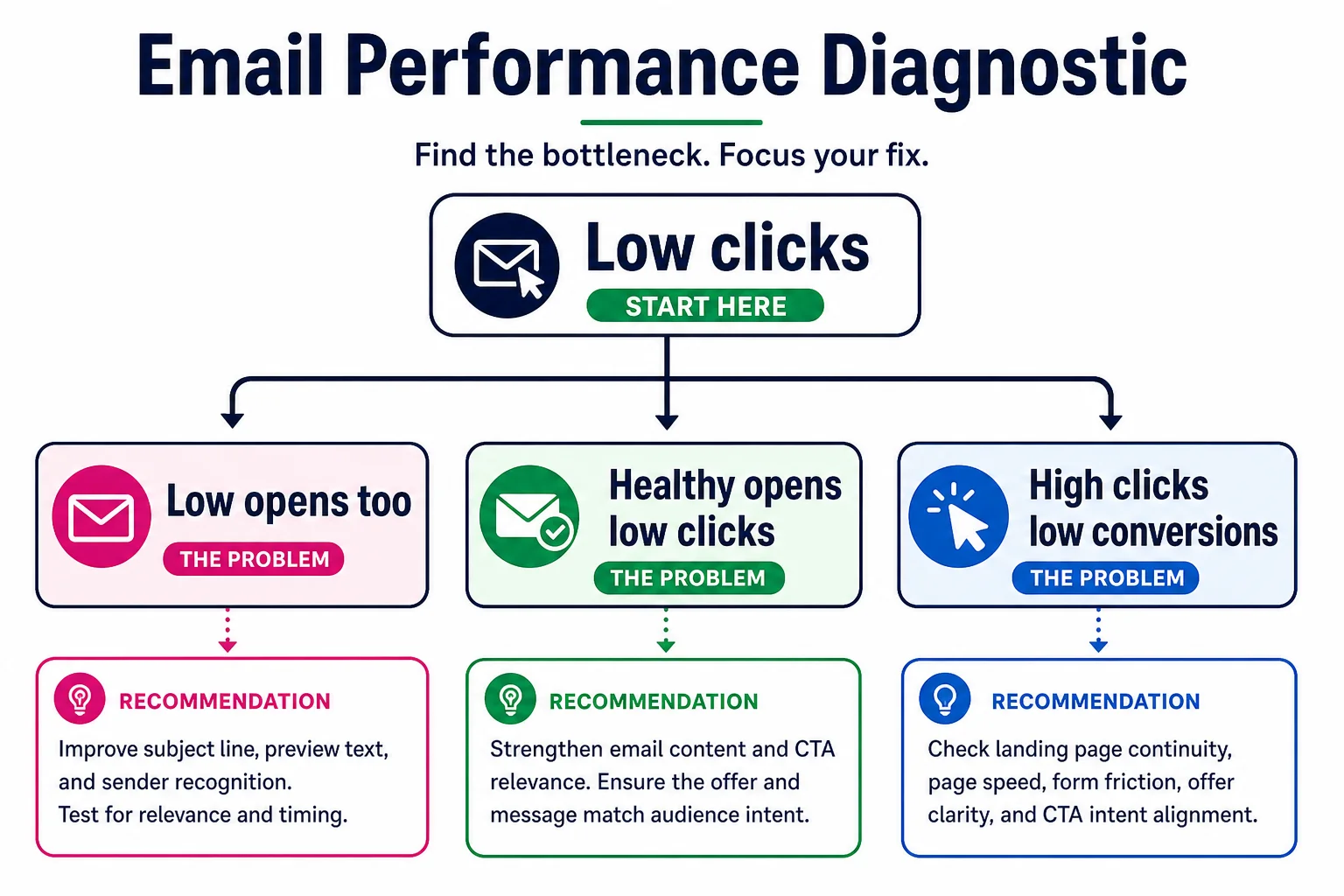
If clicks are high but conversions are low, stop celebrating the click spike. Check landing page continuity, page speed, form friction, offer clarity, and whether the CTA attracted curiosity instead of purchase intent. Tie the campaign back to email marketing conversion rate before calling the test a win.
Measure what happens after the click
Clicks beat opens for diagnosing intent, but raw click volume can still lie to your face. Bot clicks and security scanners can create sudden clicks immediately after send, clicks on every link in the email, or clicks from tools that never become real sessions. A common giveaway is an ESP showing a click spike while web analytics shows little matching traffic.

Use UTMs, web analytics, conversion tracking, CRM data, and post-click quality checks. Compare clicks against signups, purchases, pipeline, revenue, retention, and your email marketing conversion rate. A good average email click rate is useful. A click rate that produces qualified action is better.
FAQ on good email click rates
What is a good click rate for email marketing? Many campaigns land around 1% to 3%. A 2% to 5% range is often strong, depending on industry, list source, and denominator. Compare against current email marketing benchmarks and your own baseline.
Is 2% a good email click rate? Yes, if it is based on sent or delivered emails.
What is a good email CTR? Often 2% to 5%, but check how your ESP defines CTR.
What is email CTOR? CTOR is clicks divided by opens, so it measures the email after the open.
Why does my click rate differ from Google Analytics sessions? Bots, privacy tools, blockers, redirects, and UTM issues can all create gaps.
Should I optimize for clicks or conversions? Optimize for qualified clicks that lead to revenue, pipeline, retention, or another real business goal.