
Your “content strategy” is probably just a blog topic list
Most content strategies are not strategies. They are a list of blog topics someone put in a spreadsheet, maybe sorted by month, possibly color-coded. That is a content calendar. A calendar tells you when. A strategy tells you why, for whom, what, and where.
Those are four different questions, and most content programs never answer them. They just start writing.
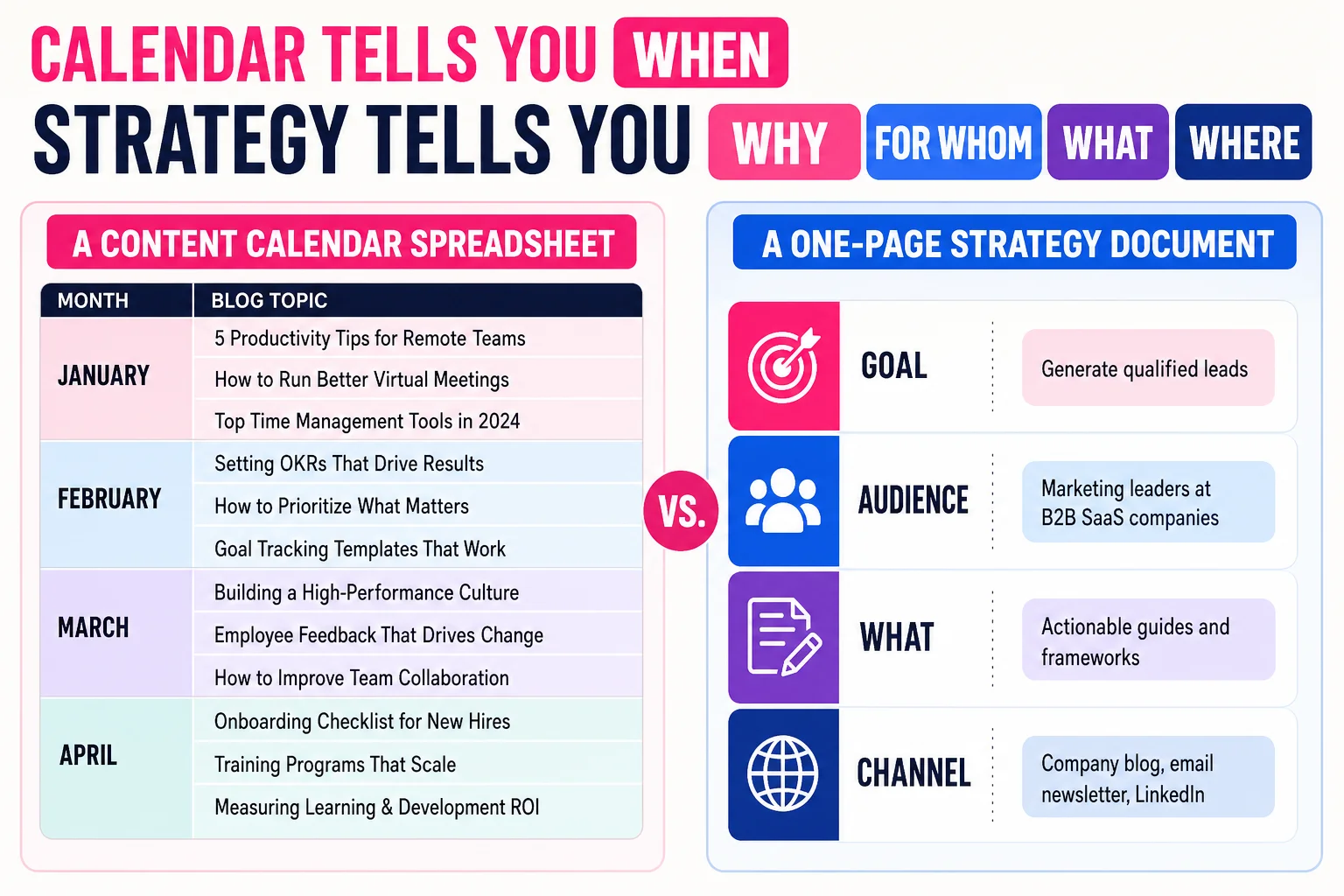
The distinction matters more than it sounds. A calendar without a strategy is a schedule for producing content that may or may not move any business metric. You can publish consistently for a year and end up with a tidy archive, a modest social following, and no revenue to show for it. CMI’s B2B research consistently finds that marketers with a documented strategy report stronger results than those without one, yet the majority of content programs still run on vibes and a Notion board.
This guide is not about vibes.
What follows is the exact 10-step content marketing strategy ClickMinded runs. Not a framework we invented to fill a blog post. The actual one, with actual numbers behind it.
Those numbers: over 260,000 organic visits per year. More than half a million total annual visits across all channels. An email list above 100,000 with a 40%+ open rate. Email alone drives 45% of revenue on a last-touch basis, and email readers spend 52% more time per session than organic search visitors. One person manages the content operation. We scaled from 2-5 posts per year to 5-10 posts per month after building a repeatable workflow that cut per-post production time from multiple days to under an hour.
Those results did not come from publishing more. Five pages out of nearly 6,000 indexed drive 93% of our organic traffic. The strategy is about concentration, not volume.
The 10 steps break into three phases. Steps 1-5 are everything you decide before writing a single word: goals, audience, formats, topics, and prioritization. Steps 6-8 are the operational core: editorial workflow, the AI production process, and distribution. Steps 9-10 are measurement and the update system that extracts maximum value from content you have already published.
Along the way, this guide consolidates four major content marketing frameworks that most other guides cover in isolation. You will see the 5 C’s, the 70-20-10 model, the Four Pillars, and the Big 5 in one place, with a plain verdict on when each one is actually worth using.
There is also a full AI workflow section. Not “use AI for ideation” but an actual step-by-step process from brief to published post, including where AI saves real time and where handing it the wheel produces content you will regret.
If you want the free strategy template referenced throughout, grab it above. If you want the full walkthrough, keep reading.
Strategy, plan, and calendar are not the same thing (and confusing them is expensive)
A content marketing strategy is a documented answer to four questions: who are you trying to reach, what problems are you solving for them, what content will you create, and how does that connect to a business goal. Everything else, including the blog post schedule, the keyword list, and the Notion board with color-coded status columns, is execution infrastructure. Useful, but downstream.
The hierarchy runs like this: strategy defines the why and the who. A content plan translates that into specific topics, formats, and channels. An editorial calendar assigns dates to the plan. Most teams build the calendar first, skip backward through the plan, and never write the strategy at all. Then they wonder why the content feels random six months in.

That gap has a measurable cost. CMI’s 2024 B2B research, which surveyed 1,186 global B2B marketers, found that 53% of top performers cited having a documented strategy as a key factor in their success. Not “we had a strategy in our heads.” Documented. Written down. Shared. The word matters because documentation forces specificity. You cannot write down “create good content that drives growth” and have it mean anything. The moment you try, you hit the questions: growth for whom, what kind of content, measured how?
There’s a fair counterpoint here: a documented strategy is not automatically a good one. CMI’s own statistics show that only about 29% of marketers with a documented strategy rate it extremely or very effective. So documentation alone does not save you. But it is the floor. A strategy that lives in someone’s head cannot be tested, updated, or handed to a contractor. It evaporates the moment that person leaves or gets busy.
The other honest caveat: survey data on “documented strategies” is unreliable across the industry. Depending on which study you read, somewhere between 40% and 66% of B2B marketers claim to have a documented strategy. The range is that wide because nobody agrees on what “documented” means. A slide deck from three years ago technically counts. This is not a problem you can solve with statistics. It is a problem you solve by actually writing yours.
For context on where content strategy fits inside a broader marketing framework, the digital marketing strategy guide covers the full picture. Content is one channel inside a larger system, and knowing that relationship helps you avoid the trap of treating content as the entire strategy rather than a part of it.
None of this is particularly complicated in theory. The reason most teams skip the strategy layer is not ignorance. It is friction. Writing a real strategy requires sitting with uncomfortable questions like “what is this content actually supposed to do for the business” before you have anything to publish. It feels slower than just starting. And in the short run, it is. A calendar gives you something to ship next week. A strategy takes a day or two to write and produces nothing immediately visible.
The failure, then, is structural. Teams optimize for the feeling of making progress (content going live, metrics ticking up) over the conditions that make progress sustainable. The next section covers the frameworks that actually help you build those conditions without turning strategy into a semester-long project.
Four frameworks walk into a SERP: here’s which one you actually need
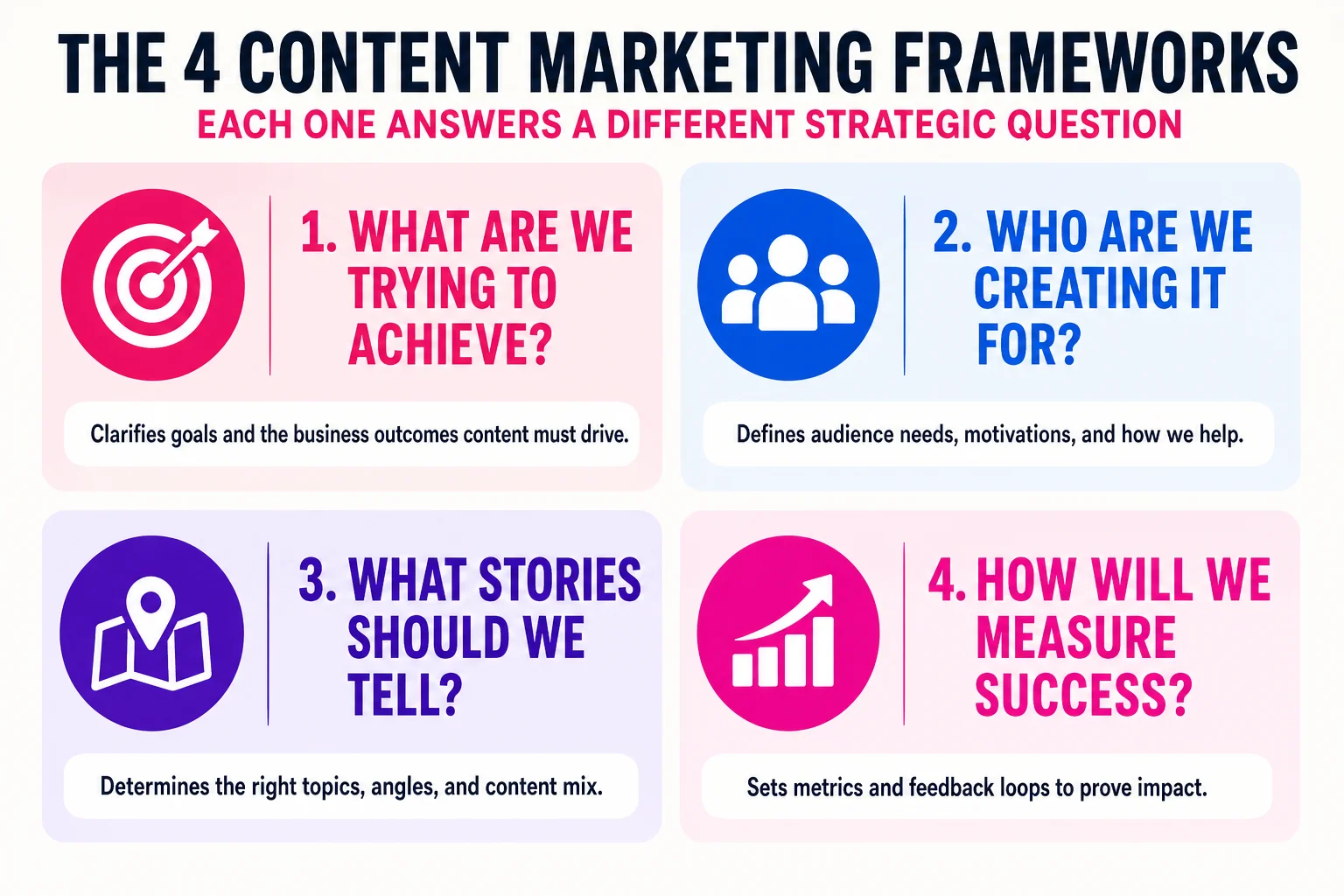
Most content marketing frameworks are not competing ideas. They answer different questions. The reason practitioners argue about which one is “best” is that they are usually solving for different problems and have never compared the four side by side. This section does that.
The 5 C’s: a setup checklist for new programs
The 5 C’s of content marketing covers five areas: Company Focus (what you stand for and what differentiates you), Customer Experience (who you’re targeting and what they need), Channel Promotion (where your content lives), Content Creation (what you’re actually making), and Check-Back Analysis (how you’ll know if it worked). You will also see agency variants — Convince & Convert uses Calibrate/Create/Curate/Circulate/Convert; Phable swaps in Clarity, Consistency, Creativity, Customer-Centricity, and Conversion. The letters change. The intent does not: run through the list before you publish anything and confirm you have an answer to each component.
The 5 C’s is a setup checklist. Use it when you are building a content program from scratch or inheriting one that feels scattered. If you can answer all five C’s coherently, you probably have the minimum viable strategy in place.
70-20-10: a budget allocation rule for teams with real output
Popularized by Coca-Cola’s Content 2020 initiative, 70-20-10 tells you how to spread your content investment: roughly 70% on proven formats you know work (long-form SEO posts, email newsletters), 20% on emerging bets (new formats, distribution experiments), and 10% on genuinely experimental plays where you expect to learn more than you convert.
The ratio forces a practical decision. If everything you publish is a core SEO article, your 10% experiment never gets resourced. If you chase every new platform equally, you burn the 70% that reliably drives traffic and revenue. It is a portfolio logic applied to content, and it is more useful once your program has enough volume to have a “proven” bucket worth protecting.
Use 70-20-10 when you have a running content program and need to make a budget case for doing something different without abandoning what works.
The four pillars: the diagnostic audit framework
The four pillars model breaks a content operation into Strategy (goals and positioning), Creation (editorial process and production), Distribution (how content reaches an audience), and Measurement (analytics and feedback loops). Unlike the 5 C’s, which runs horizontally across content types, the four pillars cut vertically through your operation. A broken Distribution pillar shows up even when Strategy and Creation are healthy. A weak Measurement pillar means you are making creation and distribution decisions based on guesses.
This is the framework to reach for when auditing an existing program. Run through each pillar and ask where the system breaks down. For most teams, it is either Distribution (“we publish and then wait”) or Measurement (“we track page views and call it done”). The steps in this guide map directly onto these four pillars, which is not an accident.
The Big 5: the topic-selection filter for audience trust
Marcus Sheridan’s Big 5, documented in They Ask, You Answer, identifies the content categories buyers actually search for before making a purchase decision: pricing and cost, problems and negatives, comparisons, best-of lists, and reviews. Most companies avoid these topics because the answers are complicated or mildly unflattering. That avoidance is the opportunity. When your competitors refuse to write an honest comparison article, the honest comparison article ranks.
The Big 5 is a topic-selection filter, not a full strategy. Use it to build out the bottom of your funnel, the content that converts readers who are already close to a decision, not readers who are just getting oriented.
The quality-over-volume point that runs through all four frameworks is not abstract. In one documented case study via Semrush, Diggity Marketing shifted from publishing as much as possible to publishing far less but with significantly deeper research and better targeting. The result was a 527% increase in organic traffic. That number is real and it is not typical, but the direction it points is consistent with how all four frameworks work: they are filters, not faucets. The job is to produce less random content and more content that maps to a clear strategic need.
Each framework earns its place. The 5 C’s gets you started. 70-20-10 keeps your budget honest. The four pillars tells you where your operation is broken. The Big 5 points you at the topics that actually close deals.
The five decisions that actually determine whether your content works
Everything in the previous section was diagnostic. This is where you make decisions. Five of them, in order, before you open a doc and type a single word.
Step 1: Set one goal your content has to serve
Content marketing can drive organic traffic, build an email list, generate leads, or reduce churn. It cannot do all of them equally well at once, especially not with a one-person operation.
Pick the primary goal. Not a list. One. Everything downstream flows from that answer: topic selection, content type, distribution channel, measurement.
Early-stage and need pipeline fast? Your goal is probably bottom-of-funnel conversion. Building long-term authority? Search visibility. Retention is the problem? Engagement among existing customers. Each goal points toward a different set of topics, formats, and metrics.
Do this now: Finish this sentence: “Our content exists to ________.” If you reach for “and,” you have two goals. Pick one.
Step 2: Define your SMVP, not your buyer persona spreadsheet
Most content teams build personas that look like HR profiles: age range, job title, income bracket, a stock photo, a name like “Marketing Mary.” These are mostly fiction, assumptions about a person that age badly.
A better starting point is the SMVP, the Smallest Minimum Viable Persona. Instead of a comprehensive persona document that takes weeks to produce and immediately goes stale, you build the leanest version that gives your content real direction: what this person is trying to accomplish, what they already know, what frustrates them, and what would make them trust you enough to keep reading.
You can build one in a two-to-three hour session with anyone who talks to customers: sales, support, a founder. Pull from actual conversations. If you have sales call recordings, run the transcripts through an LLM to surface recurring pain points and exact customer language. That raw material beats any persona template.
One constraint: pick ONE primary persona. Writing for “developers AND marketing managers AND C-suite executives” produces content that serves none of them well. The SMVP is a forcing function to stop writing for everyone and start writing for someone.
Do this now: Write your SMVP in five bullets: their primary goal, their current knowledge level, their biggest frustration, the question they are actually searching, and the one thing that would make them trust your content.
Step 3: Choose your content types before you choose your topics
Topics do not exist in a vacuum. A topic delivered in the wrong format reaches no one. Before you build a topic list, decide which content types your program will actually sustain.
Long-form SEO articles, newsletters, video explainers, podcast episodes, comparison pages, and case studies all have different production costs, different distribution paths, and different funnel positions. A two-person team cannot do all of them well. A one-person operation probably sustains two formats at most.
The Big 5 framework from the previous section is a useful constraint here: pricing pages, competitor comparisons, and review-style content are bottom-of-funnel formats that convert readers already close to a decision. Long-form educational content feeds the top. Most programs need both, but if you are starting from zero, BOFU assets tend to deliver measurable ROI faster because the intent is already there.
Do this now: List the two content types your team can realistically produce every month. Add a third only when the first two are on a consistent schedule.
Step 4: Find your topics where competitors aren’t looking
Keyword tools tell you what people search, not what they actually struggle with. The best topic sources are where your customers talk when they are not performing for an audience.
Pull your support ticket backlog. Read the questions that come in before and after a sale. If you have sales call recordings, transcribe them and run the output through an LLM with a prompt like “list the top ten objections and recurring questions from these calls.” The result will contain phrases your customers actually use — more valuable than any keyword volume estimate. Teams like Copy.ai use this workflow to convert transcript output directly into content briefs, catching emerging topics weeks before they appear in keyword tools.
Pair that with a keyword research tool for volume validation. The combination beats either source alone.
Do this now: Pull five support tickets or sales call notes. Find one question your website does not currently answer. That is your next content idea.
Step 5: Prioritize ruthlessly, because volume kills more programs than laziness does
The Diggity Marketing case from the previous section is worth repeating: shifting from high-volume, lower-quality publishing to fewer, more researched pieces produced a 527% increase in organic traffic. That pattern holds across programs of all sizes.
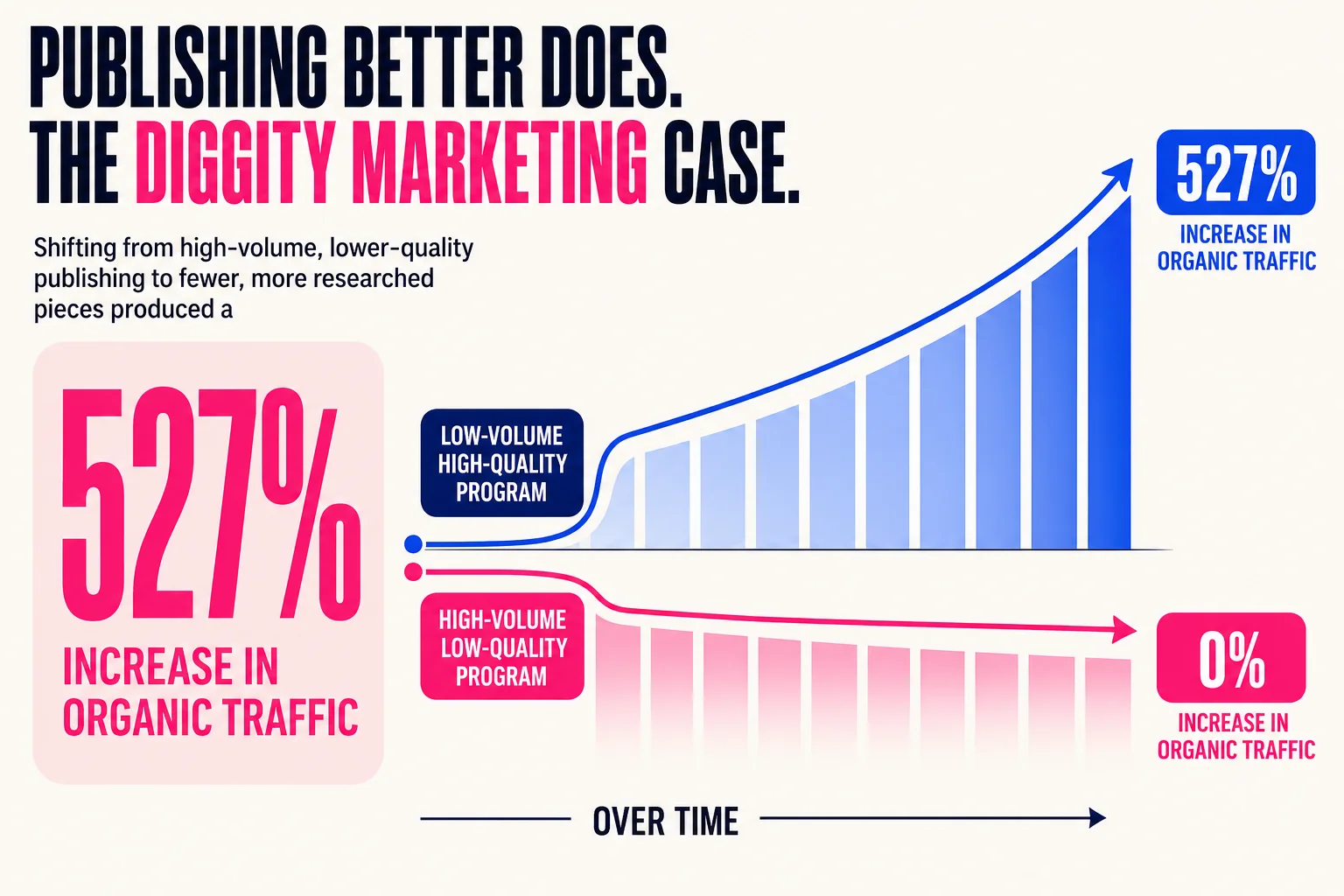
Publishing more does not compound. Publishing better does, because each piece earns links, ranks for multiple terms, and gets updated rather than abandoned. Before you add a topic to your calendar, ask whether you can make it the best available resource on that question. If the answer is no, wait until you can.
A useful filter from your content marketing strategy template: score each candidate topic on search demand, business relevance, and your realistic ability to produce something better than what ranks now. Only topics that clear all three make the list.
Do this now: Take your current topic list and cut it in half. Whatever survives gets the production time the cut topics would have consumed.
The part everyone skips: actually building, writing, and getting people to read it
You have a goal, a persona, a content type list, and a prioritized topic queue. Now comes the part most “content strategy” guides treat as obvious: the calendar, the production workflow, and distribution. These are not obvious, and the way most teams handle them is why so much content gets written and never read.
Step 6: Build an editorial calendar that reflects reality, not ambition
An editorial calendar is not a wish list. It is a production commitment. The gap between the two is where most content programs die.
Start with your actual capacity, not your ideal capacity. A one-person team producing two high-quality long-form posts per month is a real calendar. “One post per week plus a newsletter plus video” is a fantasy calendar that produces four mediocre pieces in January and a guilty silence in February.
The calendar should track four things per piece: the topic and target keyword, the content type and intended funnel stage, the owner and due date, and the distribution plan. That last column is the one nobody fills in, and it is the reason content gets published and immediately forgotten.
For new programs, a 60-day runway of planned content is enough to start. You can see what is coming, adjust before you are already late, and build the habit of publishing on a schedule instead of publishing when inspiration strikes.
Step 7: Use AI as a force multiplier, not a ghostwriter
Here is the actual ClickMinded AI workflow. Not “use AI for ideation,” but the real five-step sequence that cut per-post production time from two to five days down to under one hour.
Brief. Every piece starts with a structured brief: goal, target persona, search intent, target keyword, angle, competing posts to beat, and the specific experience or data point only we can include. The Marketing Strategy Generator handles the strategic framing; the Keyword Planner validates search demand. A brief without that last field — the thing only you can add — produces generic output no matter which model generates the draft.
Outline. Feed the brief to an LLM with a prompt that asks for a header structure matching the search intent, not a generic article shape. Review it yourself before writing a word. AI outlines default to comprehensiveness over argument; your job is to cut whatever does not serve the reader’s actual question.
Draft. The Blog Post Generator produces a working draft from the outline. This is where AI earns its time savings: the first draft that used to take eight hours now takes minutes. What it cannot produce is your genuine experience, your company’s real data, or the specific observation that makes a reader think “I haven’t seen this framed that way before.” Those go in during editing, not drafting.
Edit. This is the non-negotiable human stage. AI drafts are structurally competent and factually risky. Every claim that requires verification gets checked. Every passage that sounds like the banned-words list in this guide gets rewritten. The Brand Voice Generator helps teams enforce a consistent voice across multiple editors, but the judgment calls — what to cut, what to deepen, where the argument is thin — are not delegable.
Publish, distribute, measure, update. Scheduling and distribution get covered in Step 8. Measurement and updating are Steps 9 and 10.
The honest version of where AI helps versus hurts: it accelerates structure, first drafts, repurposing, and metadata. It kills strategy when teams let it replace the brief, skip the editing stage, or publish output that contains no original insight. The content that ranks and converts in 2025 has something in it that an AI could not have generated alone.

Step 8: The 1:3 rule: produce once, distribute three ways minimum
Publishing is not distribution. It is a precondition for distribution.
The 1:3 rule is simple: every piece of content you publish should be distributed through at least three channels before you consider it done. A long-form blog post becomes a Post Remixer output into a Twitter/X thread, an email newsletter section, and optionally a LinkedIn carousel or short video pull quote. The production cost of the original piece is already sunk; each additional format is almost entirely leverage.
The channel hierarchy matters. At ClickMinded, email drives 40,000+ sessions per year and is the third-largest traffic source, ahead of all paid and social channels combined by a factor of six. Email readers average 6 minutes 39 seconds on-site versus 4 minutes 22 seconds for organic visitors, and they view twice as many pages per session. The Newsletter Generator turns a blog post into a send-ready email in a fraction of the time manual drafting takes.
Social comes second, not because it converts better (it does not: email conversion rates run roughly 6-8% versus social’s 1-3%), but because it seeds the audience that eventually subscribes. Use Post Remixer to adapt content for each platform without rewriting from scratch.
The workflow: publish on Tuesday, send the email version Wednesday, schedule social posts for Thursday and Friday. One piece, three distribution events, one week. That is a content operation, not a content calendar.
If you can’t measure it, you’re just guessing
Step 9: Four tiers of measurement (and the AI Overviews caveat)
Most content teams track the wrong things. Page views feel like progress. Follower counts feel like momentum. Neither tells you whether content is doing anything for the business.
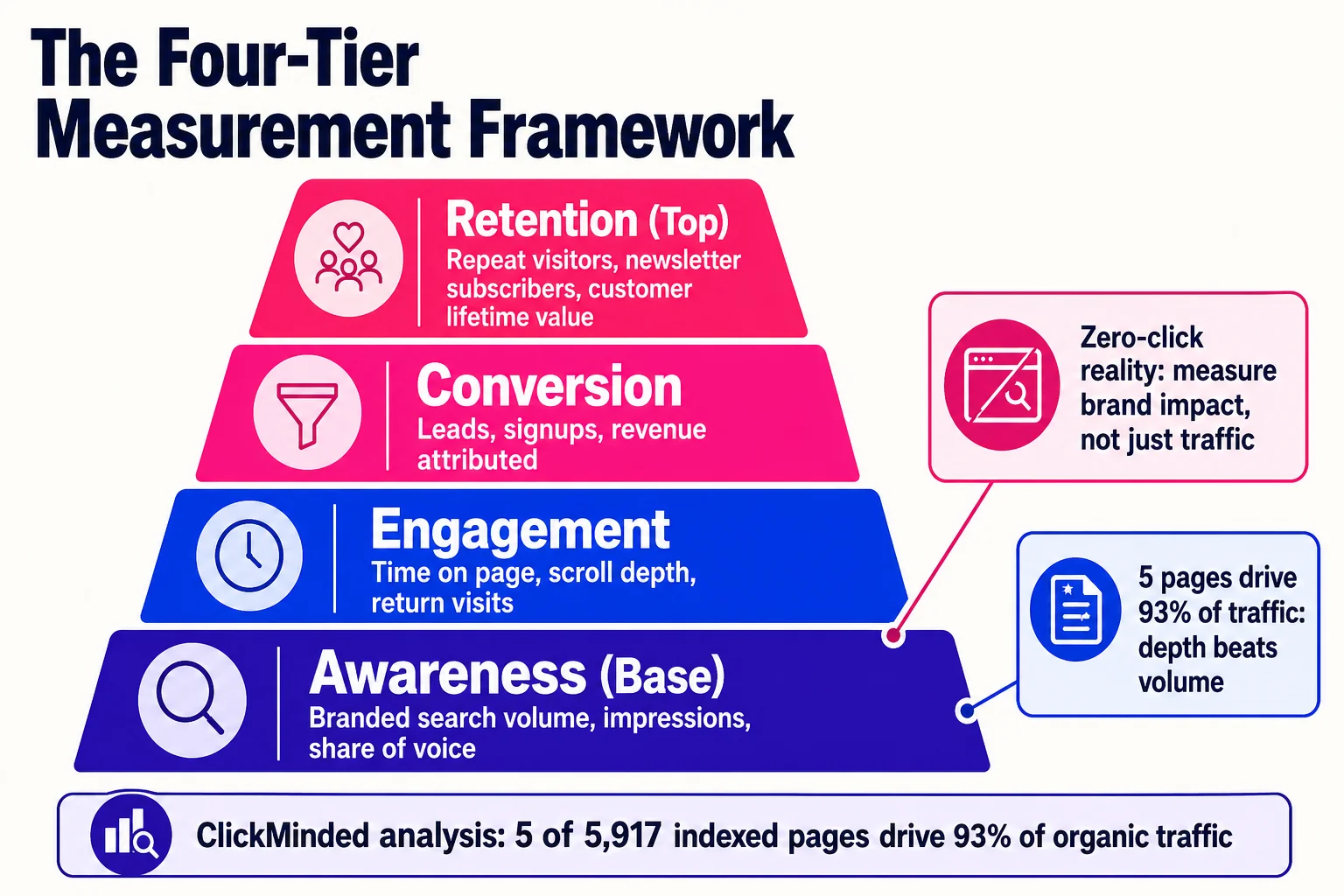
The CMI’s content measurement framework structures this across four tiers: Awareness, Engagement, Conversion, and Retention.
Awareness metrics tell you if people are finding you: organic impressions, branded search volume, share of voice. The useful signal is whether branded search grows over time, which means people are looking for you specifically, not just stumbling in from a generic query.
Engagement metrics tell you if people care once they arrive: time on page, pages per session, scroll depth, return visitor rate. An email reader averaging 6 minutes 39 seconds on-site and 3.54 pages per session is engaged. A social visitor bouncing in under 30 seconds is not. Watch the channel breakdown, not the aggregate.
Conversion metrics are where most teams should focus harder: email signups, demo requests, trial starts, revenue attributed to content. If a piece drives 4,000 organic visits and zero signups, it is a traffic asset, not a business asset.
Retention metrics close the loop: subscriber churn, repeat purchase rate, customer lifetime value by acquisition channel.
One caveat worth naming: BrightEdge research shows impressions for queries with AI Overviews grew roughly 49% year-over-year while CTRs dropped nearly 30% since May 2024. Google is showing your content to more people and sending fewer of them to your site. Organic clicks are a noisier signal than they used to be. The right response is to measure brand impact alongside traffic: is branded search growing? Are newsletter subscribers up? Those signals survive a zero-click environment.
The ClickMinded concentration story is useful here: five pages out of 5,917 indexed drive 93% of organic traffic. A handful of genuinely authoritative pieces outperform hundreds of thin ones. Measure depth of impact on the pieces that matter.
Step 10: The repurposing matrix
Publishing a piece once is the lowest-return use of the work that went into it.
Refreshing existing posts consistently outperforms publishing new ones: common outcomes include 20–50% traffic increases within roughly 60 days, at 30–50% less production time than a new piece. Posts ranking in positions 4–20 with noticeable traffic drops are the highest-value refresh targets.
For repurposing, the Post Remixer handles the mechanical conversion. The strategic logic:
| Source format | Repurposed formats | Primary channel |
|---|---|---|
| Long-form blog post | Email newsletter section | Email list |
| Long-form blog post | Twitter/X thread | Social |
| Long-form blog post | LinkedIn carousel | Social |
| Data-heavy post | Standalone stat graphic | Social / PR |
| Guide or tutorial | Short-form video script | YouTube / TikTok |
| Email newsletter | Blog post expansion | Organic search |
| Podcast or interview | Pull-quote post + summary | Social / Email |
The workflow: publish the original, send the email version within 48 hours, schedule social formats across the following week. One piece becomes seven distribution events with no new research required.
The posts driving 93% of our traffic did not get there by being published once. They got there because they were updated, repurposed, and redistributed whenever they had something new to say.
What actually works, and what quietly kills content programs
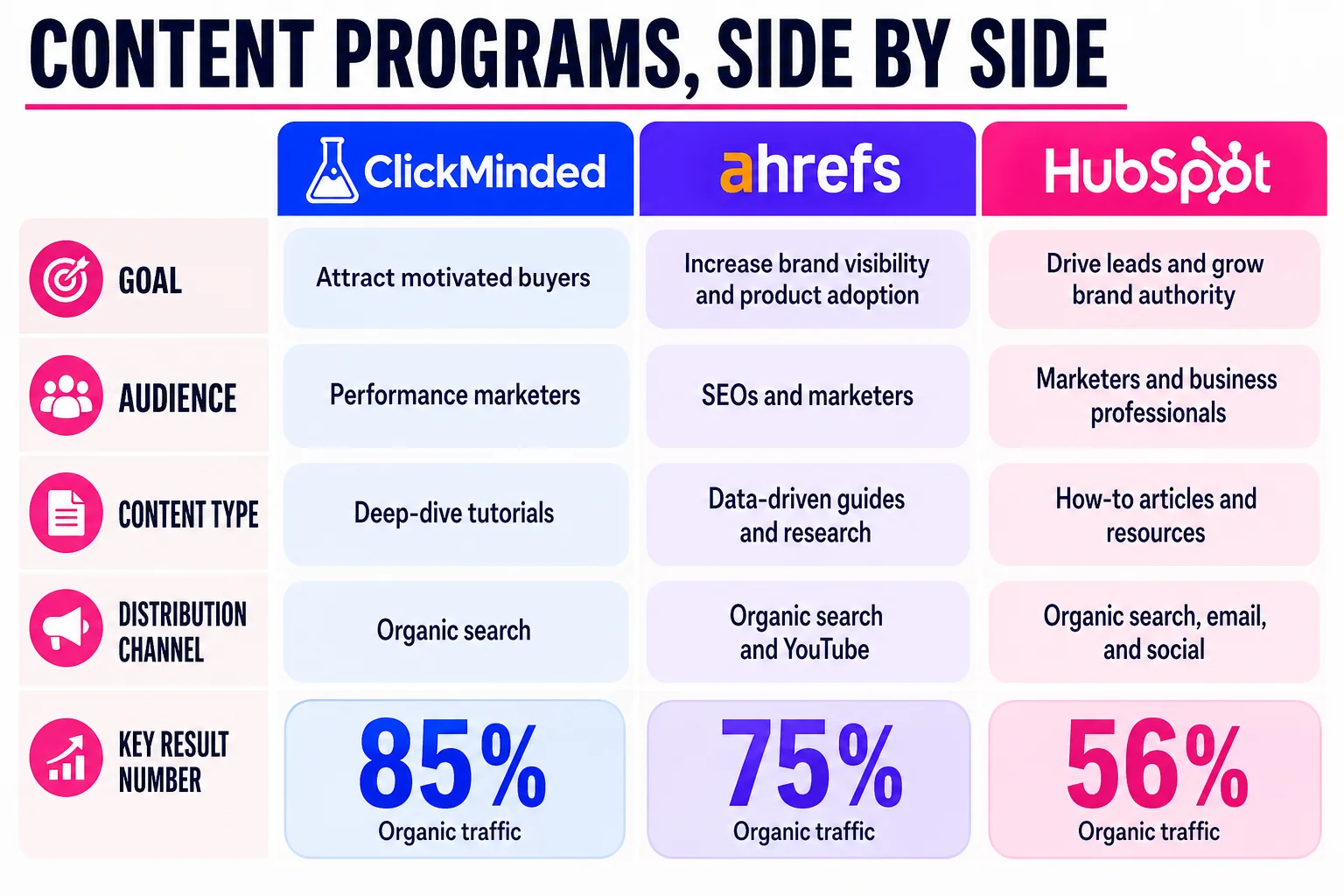
Three real programs. Different contexts, same underlying pattern.
ClickMinded
Goal: drive qualified leads for digital marketing courses without a paid acquisition budget.
Audience: marketers, founders, and freelancers searching for how-to content on SEO, email, and paid channels.
Content types: long-form guides targeting high-volume, high-intent keywords.
Distribution: organic search as the primary channel, email as the retention engine. Blog posts get repurposed into newsletter sections within 48 hours of publishing.
Results: 263,684 organic sessions per year from a site with 5,917 indexed pages, where five pages drive 93% of that traffic. The email list has 100,000+ subscribers at a 40%+ open rate, generates 40,475 sessions per year, and accounts for 45% of revenue on a last-touch basis. One person runs the entire operation. Per-post production time dropped from two to five days to under an hour after integrating an AI-assisted workflow.
The concentration is the point. A handful of genuinely useful pieces, consistently updated, outperform a high-volume publishing schedule by a wide margin.
Ahrefs
Goal: generate product signups without a traditional salesforce.
Audience: SEOs, content marketers, and agency practitioners searching for tactics and tools.
Content types: in-depth tutorials, original data studies, free tools that double as lead capture.
Results: roughly 695,000 monthly organic visitors, around 109,000 ranking keywords, Domain Rating 91, and growth past $50M ARR without external funding. The content and product function as the same thing: use the free tool, see what the paid product does, convert.
HubSpot
Goal: generate inbound leads at scale for CRM and marketing software.
Content types: blog posts, pillar pages, topic clusters segmented by buyer group.
Results: HubSpot’s blog peaked at around 4.22 million organic visits in January 2024 before dropping to roughly 2.56 million by December 2024. HubSpot attributes part of that to intentionally pruning more than 30,000 low-converting legacy pages. Whether that fully explains the decline is contested by outside analysts. Even programs with massive SEO equity aren’t immune to Google’s quality signals or AI Overview suppression of informational queries.
The six mistakes that kill content programs
Publishing without a defined goal is the most common. If no one agreed on what success looks like before the first post went up, the program will drift toward vanity metrics.
Writing for everyone is the second. “Our audience is marketers” is not an audience. An audience is a job title, a specific problem, and a point in a buying journey.
One-and-done publishing wastes most of the production budget. A post published once and never updated, repurposed, or redistributed delivers a fraction of its potential return.
Volume without quality is a documented trap. Semrush’s content pruning guide lays out how to identify low-performing content, then improve, consolidate, redirect, or remove it so the site becomes easier for users and search engines to understand.
Publishing AI drafts without human editing compounds the volume problem. Tests on fully AI-generated content show roughly 18% higher bounce rates and 31% lower time on page compared to human-edited equivalents. The performance advantage sits in the hybrid workflow: AI-assisted, human-edited.
Inconsistent publishing followed by promotional bursts is the last one. Audiences disengage fast when a newsletter goes quiet for six weeks and then returns with a product launch. Consistency compounds; inconsistency erodes trust faster than most teams expect.
Questions people actually ask before starting
What is a content marketing strategy? A content marketing strategy is a documented plan for how your business will use content to reach a defined audience, generate traffic or leads, and move people toward a business goal. It covers what you publish, for whom, on which channels, and how you measure whether it’s working. It sits above your editorial calendar (which is just scheduling) and your content plan (which is just topic selection).
What’s the difference between content strategy and content marketing strategy? Content strategy is an organization-wide discipline covering how all content is created, maintained, and governed across a business. Content marketing strategy is narrower: it’s the marketing-specific version focused on attracting and converting an audience. Build the marketing strategy first. The broader governance layer can come later, once you have a functioning program.
How long does content marketing take to work? Early signals like indexed pages, impressions, and initial backlinks can appear within 90 days. Meaningful organic traffic typically starts building between 6 and 12 months for well-executed programs. Consistent lead generation usually takes 8 to 18 months, depending on domain authority, content quality, publishing cadence, and how competitive your topics are. Paid promotion can accelerate early awareness but doesn’t replace the compounding effect of sustained organic content.
What is the 70-20-10 rule in content marketing? It’s a content mix guideline: roughly 70% of what you publish should educate your audience, 20% should engage or entertain, and 10% can be directly promotional. The ratio keeps you from turning your content channel into a product catalog while still giving you room to sell.
How do I measure content marketing ROI? Track it across four tiers: awareness (traffic, impressions, branded search growth), engagement (time on page, pages per session, email open rates), conversion (leads, trials, purchases attributed to content), and retention (repeat visits, subscriber growth, churn reduction). Last-touch attribution undercounts content’s role. First-touch or multi-touch models give a more honest picture of how organic and email content drive revenue over time.
If you made it this far, you have the strategy. What most people do next is nothing, because building this out from scratch feels like a lot. So here’s the shortcut: grab the free content marketing strategy template, run your goals and audience through the Marketing Strategy Generator, and set up your email engine with the Newsletter Generator.
For the production layer underneath this strategy, use the AI marketing guide to decide where automation belongs, ChatGPT for marketing for promptable workflows, and how to use AI for SEO when the content has to rank. The Blog Post Generator handles the brief-to-draft step, the Brand Voice Generator keeps editors aligned, and the Post Remixer turns pillar content into channel-specific distribution.
If email is one of your distribution channels, pair this guide with how to start a newsletter, how to write a newsletter, email newsletter ideas, and the newsletter benchmarks before you build the calendar.
The strategy is the hardest part. The template handles the rest. Start here.