
The nonprofit newsletter most donors quietly unsubscribe from
Most nonprofit newsletters fail the same way: they arrive as a list of events, a thermometer graphic at 62%, and a closing paragraph that starts with “Your support makes all the difference.” Donors read one or two, recognize the pattern, and stop opening them. Not with drama. They just stop.
The tension every nonprofit communicator faces is real: how do you stay present in a donor’s inbox between campaigns without every issue reading as a warmup to an ask? Nonprofit email open rates outperform most industries, which means the audience is genuinely reachable. The question is what you do with that attention once you have it.
This guide covers the practical mechanics: how to write for the three different readers on your list without segmenting your database, the 3:1 content ratio that keeps donors opening for reasons other than obligation, a full content idea bank, frequency guidance, subject line principles that actually earn the open, and a complete example issue you can use as a model. (For the broader email playbook this newsletter sits inside — automations, deliverability, segmentation — see our email marketing strategy guide.)
The three audiences inside your nonprofit newsletter list
Your email list looks like one thing. It’s actually three.
A donor who gave $150 to your food bank in November opens your newsletter to find out what that money did. Did it buy groceries? Feed a specific number of families? They’re looking for a receipt, emotionally speaking. A volunteer who sorted produce last Saturday opens the same email looking for the next shift date or a simple acknowledgment that they showed up. A general supporter who signed a petition two years ago and never did much else opens it because they still care about hunger, loosely, and something in the subject line caught them.
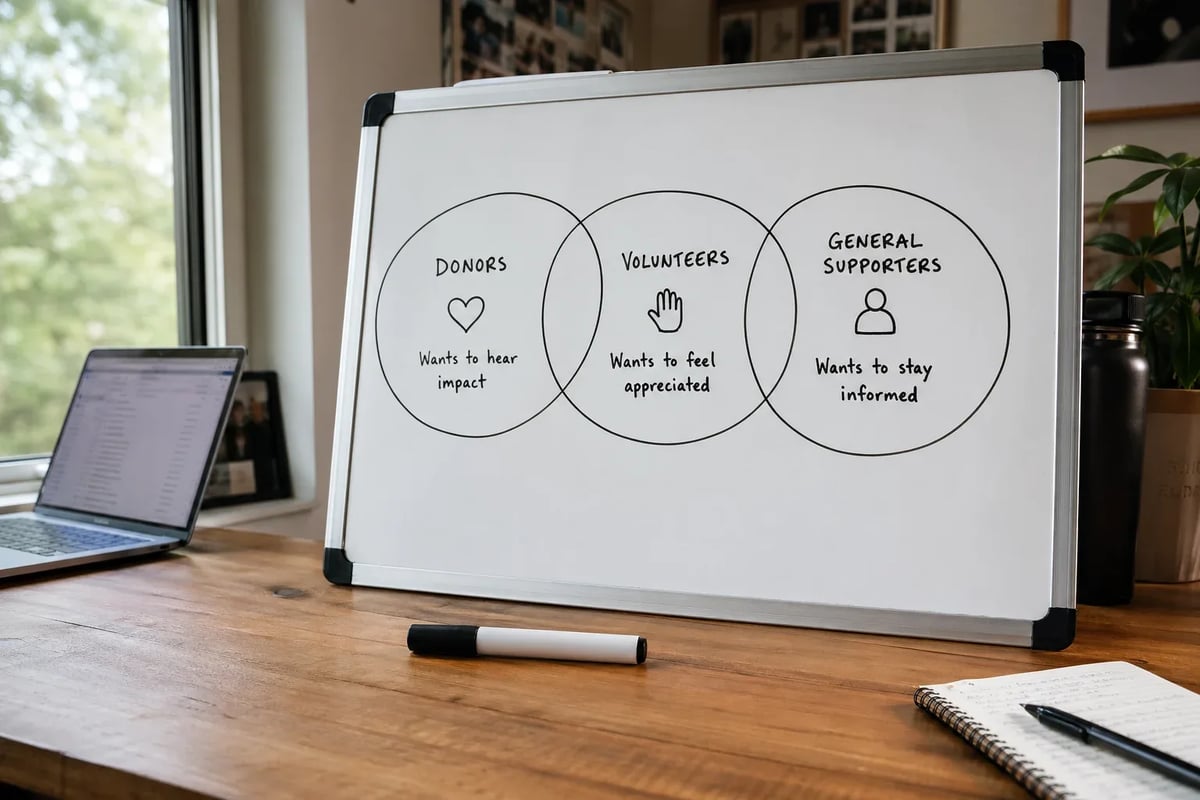
Same newsletter. Three completely different reasons to read it.
Most small-to-mid-size nonprofits aren’t running segmented lists, and that’s fine. The solution isn’t infrastructure, it’s content mix. One impact story with a named person and a specific outcome serves the donor. A short volunteer CTA with a date and a sign-up link serves the volunteer. A piece of educational content about local food insecurity serves the supporter who isn’t ready to do anything yet but might be eventually.
Each reader finds their thing. Nobody feels ignored, and nobody feels like they’re being asked for money every time you show up in their inbox.
Three emails before you ask for anything
The 3:1 rule is simple: for every fundraising ask you send, send three emails that have nothing to do with asking. Practitioners across development consulting and nonprofit marketing, including Kindsight, GARET, and Benevity, consistently point to this ratio as a baseline for keeping donor relationships functional between campaigns. No controlled study backs it. The evidence is observational: organizations that lead with value before asking tend to see better open rates and more responsive donors when the ask arrives.
So what counts as “value-first”? A story about a real person your program served. Content that teaches donors something about the issue they care about. A public volunteer shout-out, a program milestone with real numbers, a behind-the-scenes look at the work. What it does NOT mean: a board announcement, a vague “thank you for your support,” or an internal update nobody outside your staff cares about.
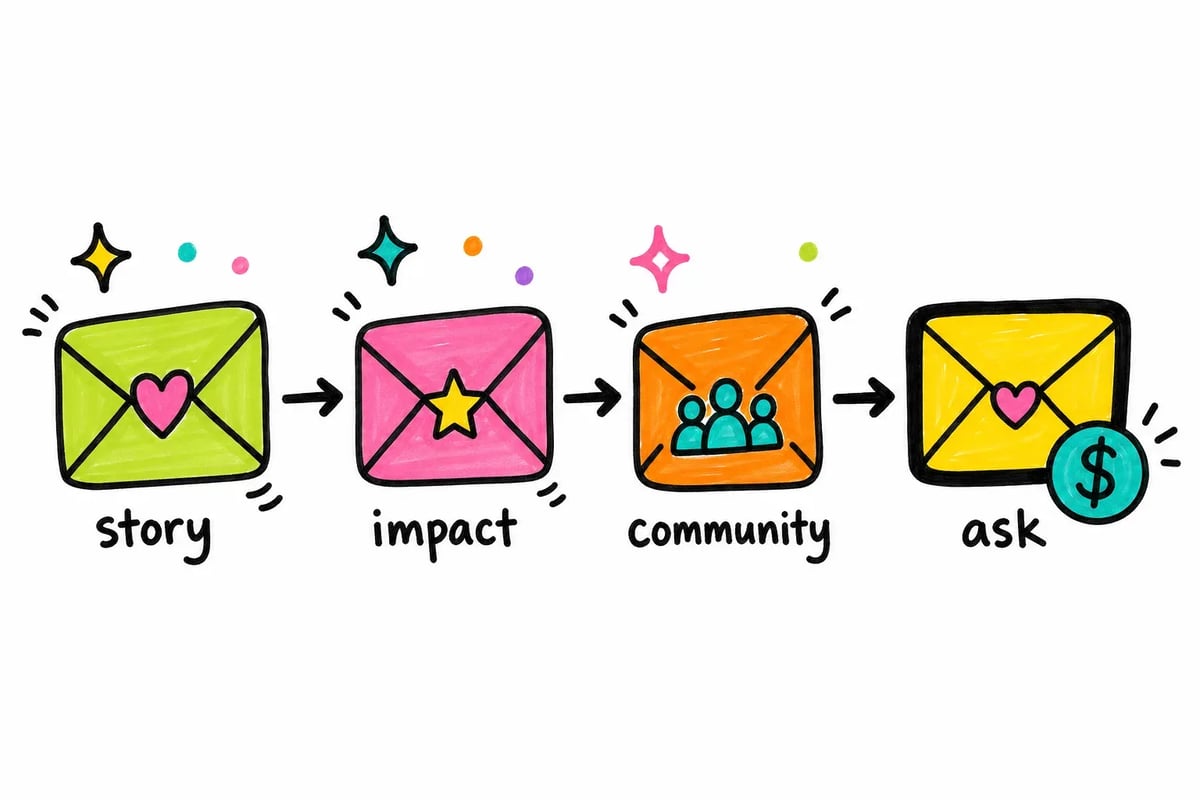
The ratio works because it trains your list. Readers start opening your emails expecting something worth reading instead of bracing for a donate button. By the time the ask arrives, it reaches people who already feel connected to the outcome. Donor engagement research consistently shows that list trust, built through non-ask content over time, separates organizations with strong email response rates from those that only hear back during year-end campaigns.
What to actually put in your nonprofit newsletter
Good nonprofit newsletter ideas sort into four buckets.
Impact and story
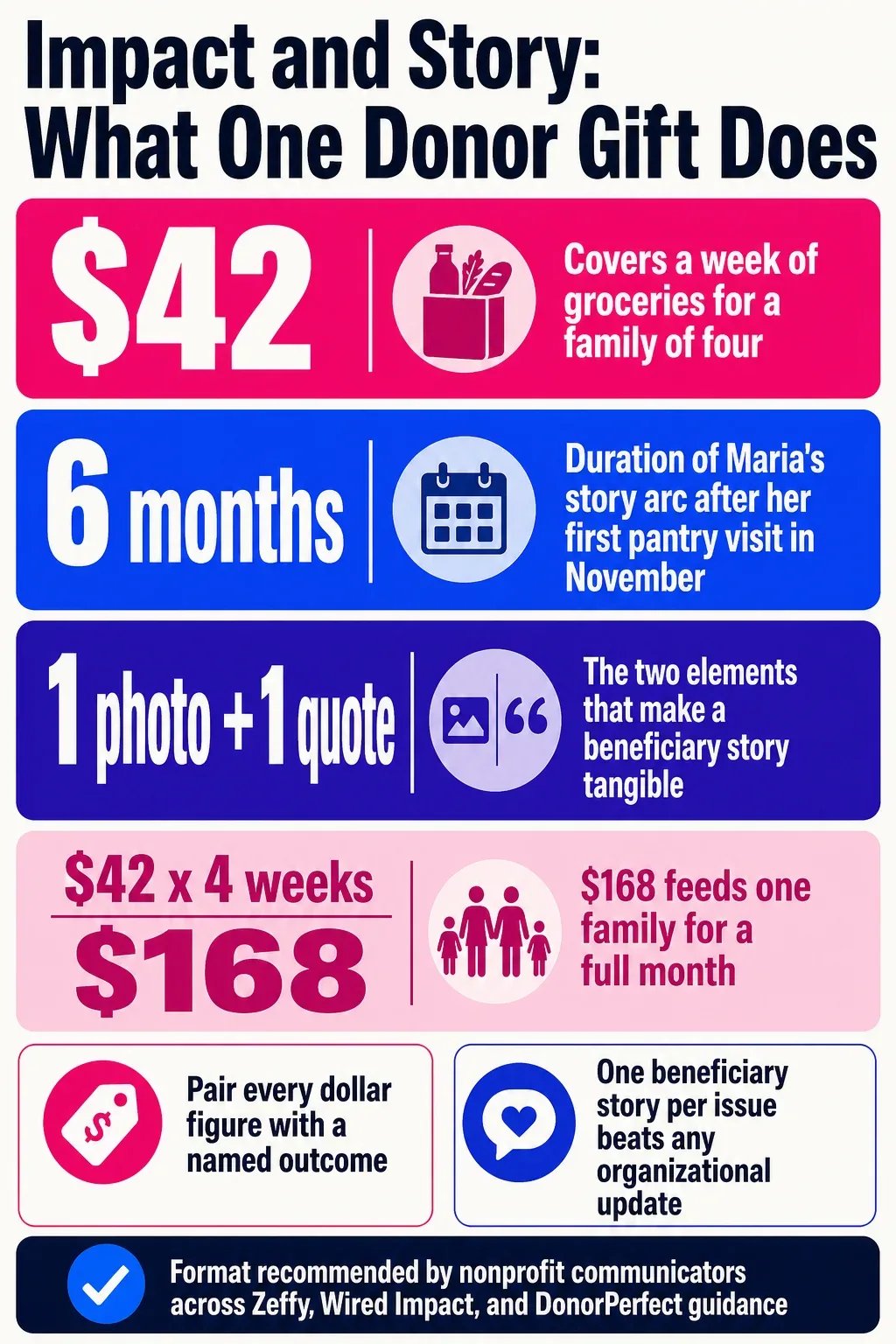
This is your heaviest lifter. A beneficiary-centered story with a before/after arc, a quote from the person served, and a direct line to donor action does more than any organizational update ever will.
Topics that work: “Maria came to our pantry for the first time in November. Here’s what happened in the six months after.” A “where are they now” follow-up on someone you featured a year ago. A dollar-to-outcome breakdown — “$42 covers a week of groceries for a family of four” — paired with a photo. Impact becomes tangible instead of theoretical.
Educational
Educational content treats readers as people who understand the issue, not just people who donated to it. A short explainer on why food insecurity spikes in summer when school lunch programs pause. A stat about the gap between SNAP benefits and actual grocery costs. A myth-busting item (“No, most people visiting food pantries are employed”). Wired Impact and Whole Whale both flag this category as consistently underused.
Community and belonging
Volunteer spotlights. A photo from last Saturday’s sort. A donor anniversary acknowledgment (“You’ve been with us for three years”). Behind-the-scenes content about what happens between the donation and the shelf. These items, as Inbox Collective notes, build the sense that readers are inside the organization rather than watching from outside.
Fundraising (the “1” in 3:1)
This slot runs once every four issues. When it appears, tie it directly to a story from an earlier section rather than dropping it cold. “Last month we told you about Marcus. Right now, we have 47 more families on our waitlist. A gift of $50 this week gets one of them started.” Specific, connected, no pressure spiral.
Sending frequency: the honest version
Monthly is the standard. Frequent enough to stay present, manageable enough to keep quality up. Quarterly is the floor — go longer than three months and list health slips, open rates drop, and warm subscribers go cold.
Bi-weekly works only if your programming actually generates enough material. Sending twice a month on a thin pipeline is how newsletters become obligation-reading.
Increase cadence around matching gift windows, major program launches, or active campaigns. Pull back right after a heavy ask — readers need a beat before the next one.
The real constraint isn’t strategy, it’s capacity. Most people running a nonprofit newsletter are also handling donor acknowledgments, grant reports, and whatever landed in their inbox that morning. Monthly is sustainable. Protect it.
Your subject line is the whole argument
“Newsletter — June” tells a reader exactly one thing: that you have a newsletter and it is June. Neither is a reason to open anything. The format trains your list to treat your email as administrative mail.
The fix is one principle: give the reader a reason specific enough to feel like it was written for them.
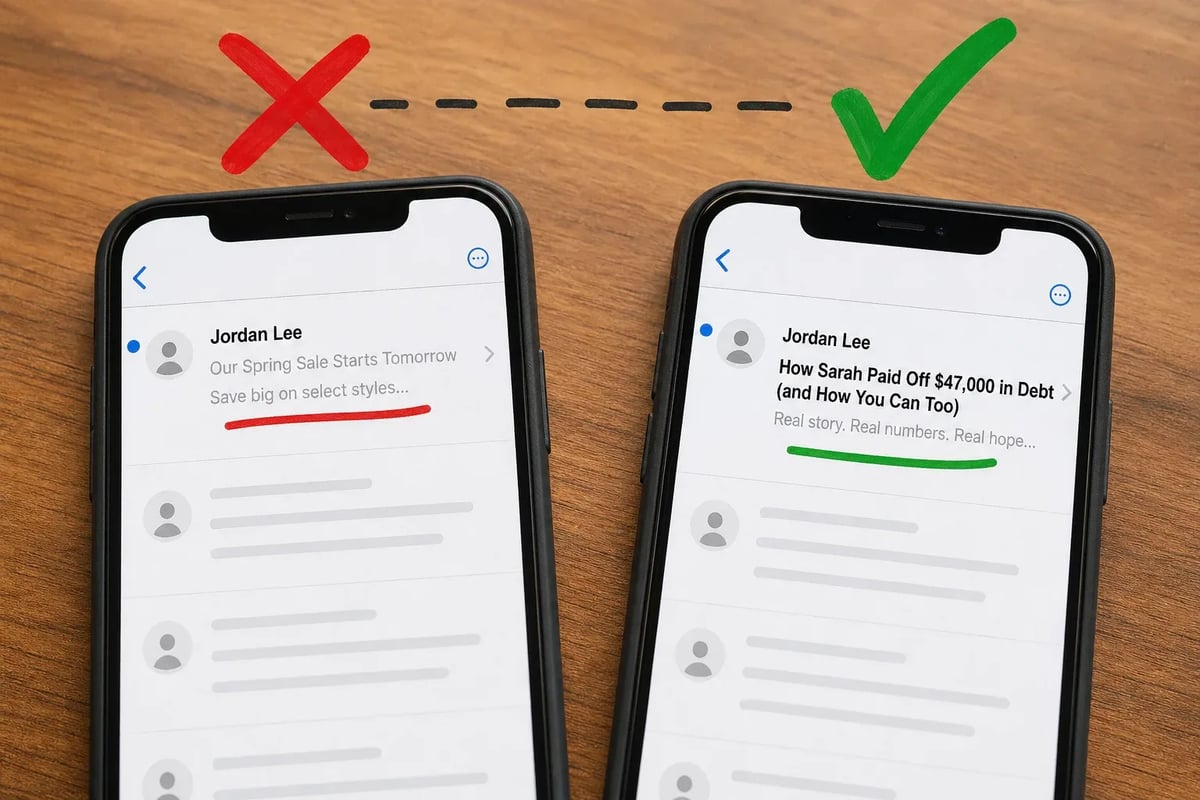
Six examples, with the mechanism behind each:
Story-driven: “She came in for groceries. She left with something bigger” opens a gap the reader needs to close. “The night Marcus almost gave up” names a person and a moment, making the email feel like a story.
Impact-driven: “What 847 meals look like in real life” pairs a number with a promised image. “Here’s what your gift did in April” speaks directly to a donor who wants the receipt.
Curiosity-driven: “We weren’t expecting this response” withholds the result just long enough to earn the click. “One question our volunteers keep asking” implies community and pulls in readers who already identify as part of it.
Specificity is respect for the reader’s time.
What a real nonprofit newsletter looks like in practice
Below is a complete issue for Riverside Community Food Bank, a fictional organization. Nothing is a placeholder.
Subject line: Rosa hadn’t eaten a hot meal in four days
Preview text: Here’s what happened when our mobile pantry pulled up to her street.
Impact Story
Rosa is 71 and lives alone in the Millbrook neighborhood. When our mobile pantry stopped on her block for the first time in March, she was third in line. She told our volunteer coordinator she hadn’t had a hot meal since the previous Thursday. She now picks up groceries every other week. Her daughter, two states away, called us to say thank you.
No dramatic arc. Just a woman who needed food and now has it.
Program Update
Our mobile pantry expanded to five new sites in Q1. Those sites now reach 570 households each month that weren’t in our network before. Our kitchen team preps 6,400 meals a day to keep pace. Three more sites are planned before September.
Get Involved
Saturday, June 14th, we’re packing 5,000 meal boxes at the warehouse. Shifts run 9 a.m. to noon. We need 80 volunteers and have 31 spots left. [Sign up here.] Bring closed-toe shoes.
A Note on Giving
$25 covers 75 meals. That’s the math. [Donate here.]
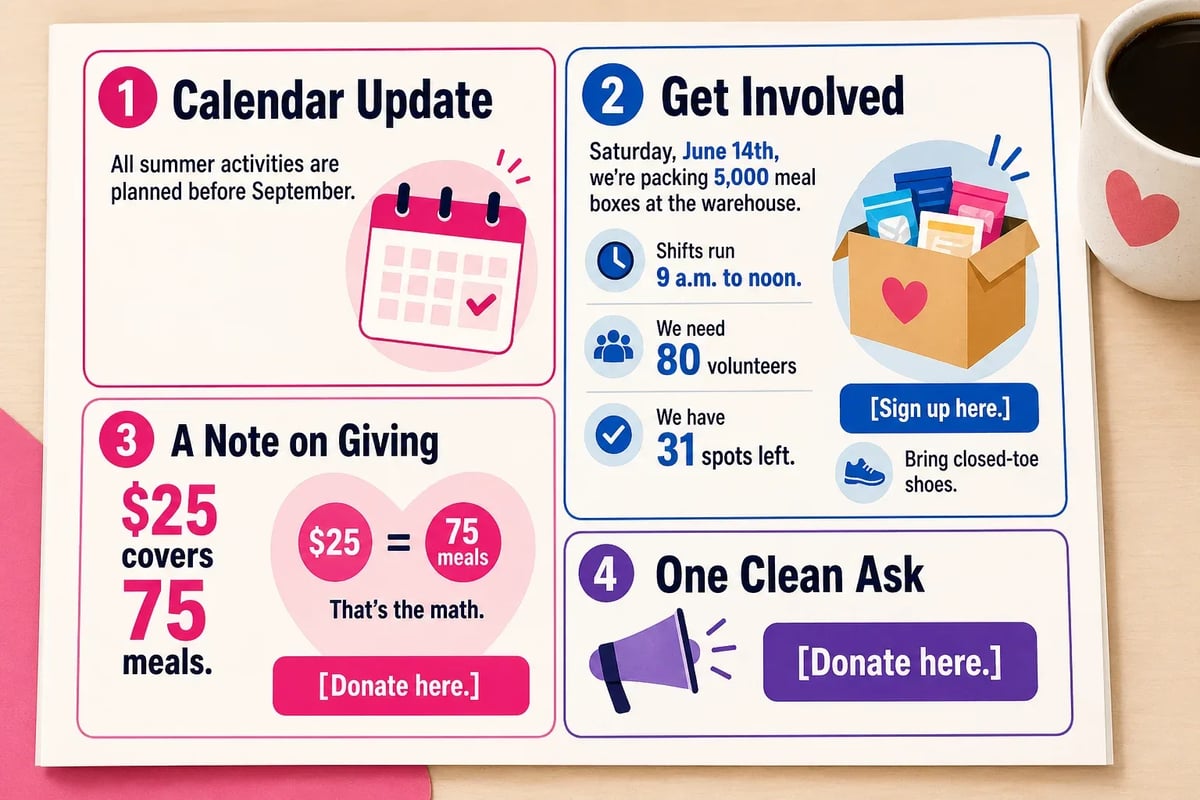
Three sections that give, one clean ask at the end. No apology for the donation mention, no guilt. Just a number, an outcome, and a link.
Frequently asked questions
What should a nonprofit newsletter include?
A nonprofit newsletter should include impact stories, educational context, volunteer or community updates, and occasional fundraising asks. The strongest issues give donors and supporters a reason to open even when they are not being asked to give.
How often should a nonprofit send a newsletter?
Monthly is the standard cadence for most nonprofits because it is frequent enough to stay present and manageable enough to keep quality high. Quarterly is the floor, while bi-weekly only works when the organization has enough real program activity to support it.
What is the 3:1 rule for nonprofit newsletters?
The 3:1 rule means sending three value-first emails for every direct fundraising ask. Those value-first emails can be impact stories, educational notes, volunteer spotlights, or behind-the-scenes updates.
Should every nonprofit newsletter ask for donations?
No. Asking in every issue trains readers to expect a donation pitch. A healthier pattern is to build trust with stories and useful updates, then make a specific ask when it connects naturally to the work you just showed.
A tool that does the first draft for you
If the structure above makes sense but the writing itself is where your Tuesday afternoons disappear, the ClickMinded Newsletter Generator is worth a look. You feed it the raw material you already have — a program update, an outcome number, a story like Rosa’s — and it produces a complete, on-brand draft you can review and send. The writing work shrinks from a three-hour block to about thirty minutes of editing. It won’t replace your judgment about what stories matter, but it removes the blank-page problem that causes good newsletters to just not get sent.