

The Short Verdict for Agencies
If you’re deciding whether to renew, switch or buy, the short answer is this. Jasper AI is one of the strongest marketing-specific platforms for agencies that need several governed client brand voices, shared knowledge and team controls in one workspace. Its Campaigns feature turns a single brief into coordinated, on-brand assets across channels using each client’s knowledge and brand guidelines. Producing similar deliverables for many brands is a large part of agency work, and Campaigns is built for it.
Users rate it well. G2 lists Jasper at 4.7/5 from 1,320 reviews as of November 2026, and reviewers most often praise the time it saves and how easy it is to use. Capterra shows 4.8/5 from 1,853 reviews, with value for money scoring lowest at 4.5/5.
The same G2 reviewers list high costs, AI limitations and poor context understanding as the top drawbacks. Some say drafts need manual editing before they sound natural. Jasper costs more per seat than general assistants, and every client-facing piece still needs a human edit for accuracy. If you’re a solo consultant or run a shop with tight margins, you’ll likely get better value elsewhere. If you’re a mid-size agency with several brands to keep consistent, Jasper earns a serious look.
Every Jasper claim in this review comes from Jasper’s own pages, help docs and changelog, or from named, dated third-party sources such as G2 and Capterra review aggregates and reputable publications.
Disclosure: ClickMinded makes CoAuthor, an AI writing app that competes with Jasper, so it is left out of the comparison.
What Jasper AI Is and How Agencies Use It
Jasper is a marketing AI platform that ties brand context, content creation, agents, workflows and governance together. It launched in early 2021 as Conversion.ai, founded in Austin, Texas by Dave Rogenmoser, JP Morgan and Chris Hull. Timothy Young, formerly president of Dropbox, became CEO in 2023, and the company raised a $125 million Series A at a $1.5 billion valuation in October 2022, led by Insight Partners.
The product has grown well past the template library it started with. Jasper IQ holds shared brand context: voice, audiences, style guides, and product or business knowledge. Writers draft in the Marketing AI Editor, and Studio runs pre-built AI agents for repeatable tasks. Jasper Chat answers questions using company knowledge and brand guidelines. Grid handles high-volume production. Canvas covers visual work and, since a June 2026 update, can suggest brand images pulled from Knowledge. The platform page also lists image pipelines, APIs, an MCP server and GEO tools for visibility in AI search.
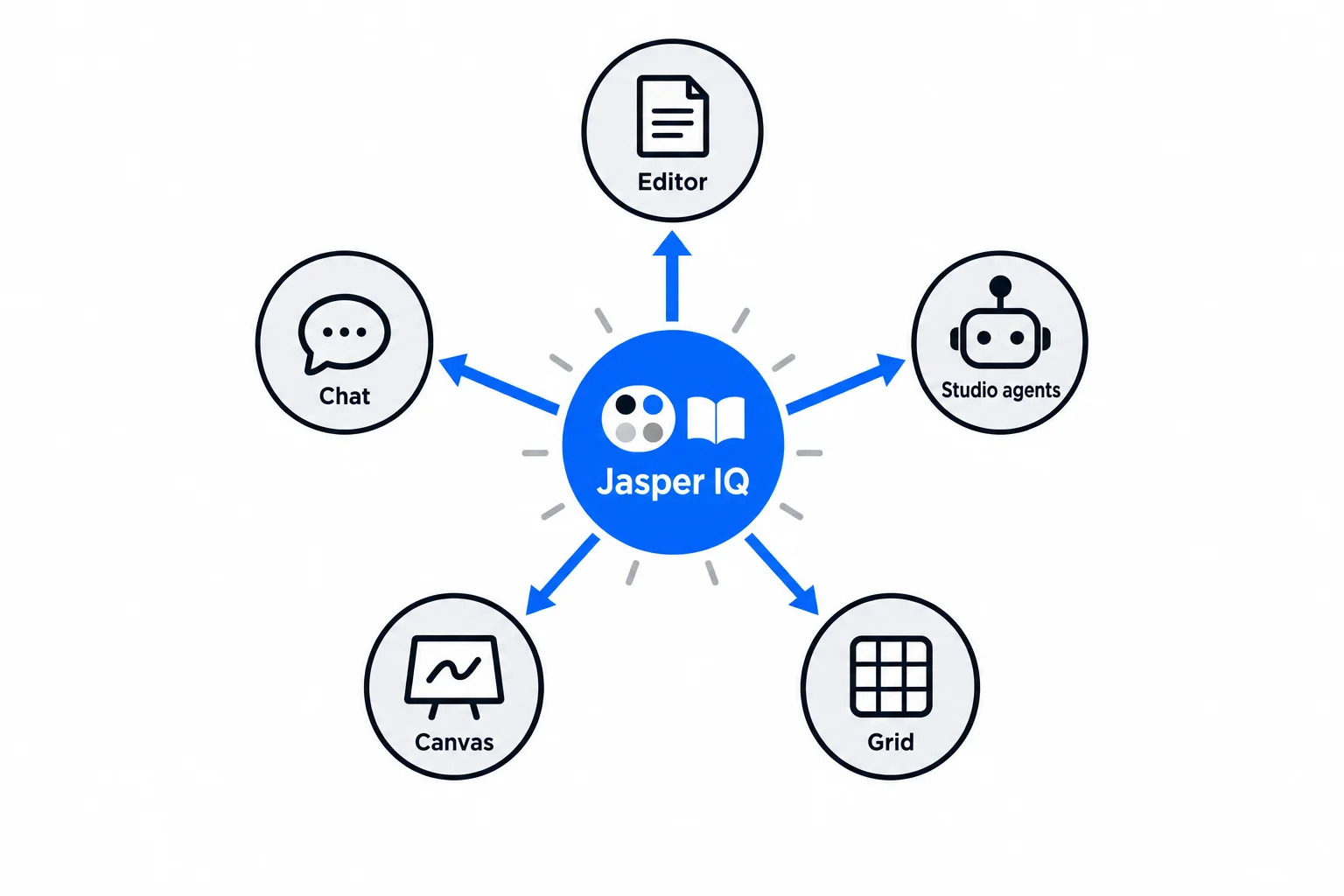
For an agency, every one of these tools comes back to one question: which client is this for? Each client needs its own brand context. A batch of client blog posts runs through the Editor or an SEO agent with that client’s voice and Knowledge attached. Ad variants and social captions fit Grid, where March 2026 updates let you load Brand Voice, Audiences and Style Guides as inputs for each row. Email sequences draw on the same client context.
Campaign packs are the strongest fit. One brief becomes coordinated assets across channels, and since January 2026, Style Guides apply their rules at generation time, with separate guides for different brands. Three clients asking for a launch package in the same week can each get one built on their own guide instead of a shared prompt.
A general assistant such as ChatGPT or Claude starts from a blank chat, and you supply the brand context every time. Jasper stores that context once per client and attaches it to every tool on the platform. Its August 2026 Claude Connector even makes that stored context available inside Claude.
How Jasper Handles Agency Needs
Client brand voices and knowledge
Jasper splits brand context into three parts, and that split works well for agencies. Brand Voice analyzes content you upload and builds a voice from its tone, style and key characteristics. Style Guide enforces specific rules, such as preferred terminology or punctuation. Knowledge Base holds product and company facts. You can attach Knowledge through Project Settings or pick it for a single Chat, App or asset, and up to five pieces can guide one generation in Chat and Agents.
The plan limits decide how many clients fit. Pro includes two Brand Voices, five Knowledge assets and three Audiences; Business is unlimited. Style Guides are Business-only. If you run eight clients, the setup that holds up is one voice, one style guide and one set of Knowledge assets per client, with a project per client so the right context loads by default. Only Business allows that.
Collaboration and seats
Jasper defines Admin, Manager, Member and Developer roles in its user permissions. On Business, Admins control billing, settings, usage and team access, and Admins and Managers are the roles that create or edit Style Guides. With that split, a content lead can lock a client’s rules and writers can only apply them. SCIM provisioning, also on Business, centralizes who gets workspace access and which role they hold, which helps when freelancers rotate on and off accounts.
Content workflows and agents
Jasper Studio is where teams build and run reusable Apps. It is a Business feature, and Admins decide who can publish Apps to the team. For agencies, this means a senior strategist can build a client’s blog-to-social App once and junior staff can run it without rebuilding the prompt for every brief.
Accuracy and research
Jasper’s own guide to writing a factually accurate article tells users to gather supporting facts from Google Search results. Jasper presents fact checking as a step the writer performs. Knowledge grounding improves accuracy about the client’s own products, but statistics and claims about the outside world still need a human check before a client sees them.
Integrations
The integrations list covers where agency work usually happens: Google Docs, Microsoft Word, Webflow, SharePoint and Google Sheets, browser extensions for Chrome and Edge, plus Zapier, Make, Slack and BigQuery. The API is Business-only, so you need that tier to connect Jasper to client CMS pipelines.
Jasper serves agencies best on brand separation and team governance: per-client voices, enforced style rules and role-based control. Nearly all of that sits on Business. On Pro, the two Brand Voices limit you to two clients’ worth of governed brand context.
Where Jasper Falls Short for Agencies
Cost per seat is the first gap. Jasper Pro is $69 per seat billed monthly, against $25 for a standard ChatGPT Business or Claude Team seat. Capterra reviewers note that Jasper costs more than competitors. The gap hurts solo consultants and small shops most, because they pay the premium on every seat and can’t spread it across a big retainer book.
Plan limits compound it. Pro caps you at two Brand Voices and five Knowledge assets, and Business has custom pricing with a 12-month commitment. If you run three or more clients, you have to call sales and sign for a year before your setup fits your roster.
Output still needs a human pass. G2 reviewers describe minor factual hallucinations, missed instructions and oversimplified regulatory points, and some Capterra users mention generic or repetitive copy. Agencies in health, finance or legal feel this most, since one wrong claim can sink client approval.
Setup takes real time. Spike AI’s 2026 B2B review estimates two to four hours to configure a Brand Voice, and says output stays generic without it. Across ten clients, that adds up to a few unbilled days of onboarding.
Some Capterra reviewers also report slow support and trouble with account or subscription issues. That’s a small share of reviews, but it costs you when a billing problem locks a team out on deadline.

The biggest trade-off is that you’re paying for governance and marketing workflow (brand voices, knowledge, style rules and team controls), not for better writing. If you don’t need governed brand voices across several clients, most of what the premium buys goes unused.
What Jasper Costs at Agency Scale
As of November 2026, Jasper’s pricing page lists two plans, Pro and Business. There’s no permanent free plan, but Pro comes with a 7-day free trial.
| Plan | Price | Seats | Brand Voices | Key team features |
|---|---|---|---|---|
| Pro | $69 per seat/month billed monthly, or $59 per seat/month billed yearly | 1 | 2 | 5 Knowledge assets, 3 Audiences, collaboration features |
| Business | Custom pricing, 12-month commitment | Multiple | Unlimited | Unlimited Knowledge and Audiences, API access, admin controls, Groups, role-based permissions, audit logging, SSO, dedicated support |
In agency terms, Pro is a one-person plan. A single seat costs $828 a year on monthly billing or $708 a year billed annually. That buys you two client brand voices and five knowledge assets. If you’re a freelancer with two anchor clients, that fits. If you add a third client, you’re out of brand voices.
Once a second person joins the account, Jasper sends you to sales for Business. The same goes for a third client voice. For most small agencies with two or three staff and a handful of clients, Business is the real entry point. It’s also the tier where the controls agencies rely on become available: Groups to separate client work, role-based permissions, audit logs and SSO.
The catch is that Business has no public price. You can’t model margins on a spreadsheet before the sales call, and you commit for a year once you sign.
Jasper’s pricing works for agencies in two cases. The first is a solo consultant with no more than two clients, who can run on Pro. The second is an agency with enough steady multi-client retainer revenue to absorb a custom annual contract in exchange for unlimited brand voices and team governance.
Alternatives to Jasper Worth Considering
Prices below come from each vendor’s own page as of November 2026.
ChatGPT Business gives agencies a centrally managed workspace with admin controls for users, permissions, seats, billing and usage (OpenAI’s Business FAQ). For multi-client work, Projects and custom GPTs do the heavy lifting. You can set up one shared project per client with common files and instructions, invite collaborators with chat or edit access, and publish a client-specific GPT inside your workspace. A standard Business seat costs $20 a month billed annually or $25 billed monthly, per OpenAI’s pricing page. Unlike Jasper, ChatGPT keeps each client’s voice in project instructions you write and maintain yourself, with no dedicated brand voice, style guide or audience controls. Best for agencies that want a cheaper, flexible general assistant with a project or GPT per client.
Claude Team adds higher usage than Pro, central billing, and admin controls for seats, provisioning, spending limits and usage analytics. Projects keep each client’s chats and documents together, which suits long drafts and heavy editing passes. Team is for 2 to 150 people, and a standard seat costs $20 a month billed annually or $25 billed monthly, per Claude’s pricing page. Unlike Jasper, Claude has no marketing-specific brand voice feature or campaign workflows. Best for agencies whose bottleneck is long-form drafting and editing quality.
Writer has the strictest governance here. Brand controls are split into Voice, Guidelines and Terms, and Terms handles approved, banned and cautionary words. Style guides can enforce grammar, readability and inclusivity rules, include a compliance section, and apply to the whole organization or to specific teams, which maps well to separate client accounts. The Enterprise plan adds HIPAA and SOC 2 Type II reports on request. Writer offers a per-seat Starter plan and a sales-led Enterprise tier, and lists no seat prices for either. For a small agency, that means another sales call and more governance setup than Jasper’s self-serve Pro plan. Best for larger agencies or agencies serving regulated enterprise clients.
Copy.ai’s Chat plan costs $29/month billed monthly or $24/month billed annually and includes 5 seats and unlimited Chat projects, which is cheap for a team. Workflows, the GTM automation Copy.ai is built around, start on Growth at $1,000/month ($12,000 annually), with 75 seats and 20,000 workflow credits a month. Compared with Jasper, a small agency pays enterprise money to reach the automation layer, and the cheaper tier is a chat tool. Best for sales and GTM content workflows at scale.
Writesonic is built around SEO and AI-search visibility. Starter costs $79/month billed annually ($99 monthly) for 15 AI articles, site audits, 1 user and 1 project. Growth costs $399/month billed annually ($499 monthly) for 50 articles, 3 users and 2 projects. One or two projects leaves room for very few client brands, and team size caps out well short of Jasper’s Business governance. Best for agencies whose main deliverable is SEO content.
Who Should Choose Jasper, and Who Shouldn’t
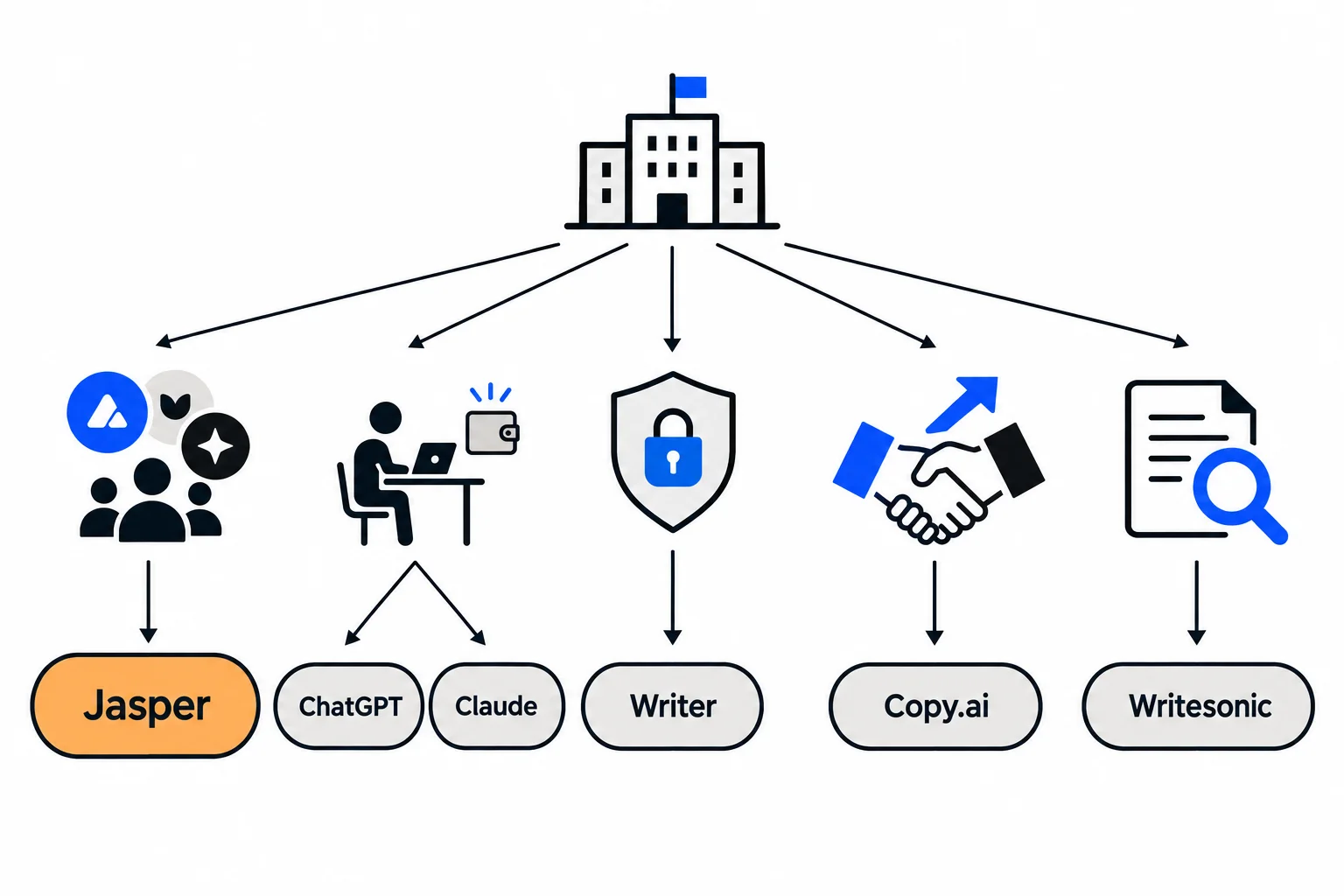
Choose Jasper if you run a mid-size agency with several client brands, repeatable campaign work and more than a couple of people touching each account. The tier you want is Business, which includes unlimited Brand Voices, Knowledge assets and Audiences, plus admin controls, role-based access, an AI audit log and private Groups that keep each client’s resources visible only to the people invited in. Business pricing is custom, so get a quote and price it against your retainers before you commit.
Skip Jasper in these cases:
- You’re a solo consultant or a small shop with tight margins. Pro caps you at two Brand Voices, so ChatGPT Business or Claude Team will give better value.
- You serve regulated enterprise clients. Writer fits better.
- You mostly produce sales and GTM content. Copy.ai fits better.
- You run an SEO-content agency. Writesonic fits better.
Pros:
- Jasper IQ applies voice, knowledge, audiences and style to every piece of content.
- Canvas has shared project context, comments and campaign settings.
- Agents and workflows are built for ads, email, social and product launches.
Cons:
- Pro costs $69 per user per month billed monthly, as of November 2026, and limits you to two voices.
- Business pricing isn’t public.
- Output still needs human editing before it goes to clients.
If you manage several client brands and have the retainers to pay for Business, Jasper is the strongest choice on this list.
Frequently Asked Questions
Is Jasper AI free? No. Jasper has no permanent free plan, but it offers a 7-day free trial of the Pro plan.
How much does Jasper AI cost per month? As of November 2026, Pro is $69 per seat billed monthly or $59 per seat a month billed yearly. Business is custom-priced with a 12-month commitment.
What happened to Jasper AI? It launched in 2021 as an AI copywriting tool and has since repositioned as an AI platform for enterprise marketing teams, built around brand context, agents and governance. Timothy Young has been CEO since 2023.
Is Jasper worth it? Yes, for agencies juggling several client brands that need governed brand voices and team controls. Solo users and tight budgets get better value from a general assistant.
What is Jasper AI used for? On-brand marketing content (blog posts, ads, emails, social posts, campaigns) grounded in each brand’s voice and knowledge assets.
Is Jasper better than ChatGPT? For governed multi-brand marketing, yes. ChatGPT Business costs less but has less built-in brand control.
Can Jasper AI write SEO content? Yes. Its SEO Mode analyzes content against search competitors through a Surfer SEO integration, which requires a separate Surfer subscription. You get optimization recommendations, not guaranteed rankings, and the human checks in an AI SEO workflow still apply.