
The template that kills itself on arrival
Picture this: someone gets your cold email, reads “I hope this message finds you well. I wanted to reach out because I believe our solution could add value to your organization,” and hits delete before finishing the sentence.
Not because they’re busy, although they are. Because they’ve read that exact email dozens of times.
That’s the problem with most cold email templates. The time-saving part works great. The “sounds like a real human” part does not.
A cold email template is a pre-written framework with a subject line, opening line, value proposition, and call to action that you customize before sending. Starting point, not finished product. A cold email goes to someone who has never heard from you. A sales email goes to a warm lead who already knows the product exists. A follow-up nudges someone who didn’t respond to either. The distinction matters because the tone, ask, and personalization level should differ for each.
A B2B starter you can actually customize:
Subject: Quick question about [specific challenge at Company]

Hi [First name],

I noticed [specific thing: recent hire, product launch, article they wrote].

We help [type of company] with [concrete outcome]. Thought it might be relevant given [the specific thing].

Worth a 15-minute call this week?

[Your name]
The rest of this guide covers when to use this structure, when to swap it, and how to write follow-ups that don’t embarrass you.
For the broader system behind list building, automations, segmentation, and ongoing sends, read the email marketing strategy guide. For offer and landing page messaging, the sales copy generator can help once you know what you want the email to sell, and the landing page copywriting guide covers the page your outreach should send people to.
The six parts every cold email needs
That starter template in the previous section has six moving pieces. Here’s what each one does and what a real version looks like.
-
Subject line. Gets the email opened. Keep it specific and short, ideally under eight words. Example: “Question about Acme’s SDR hiring push.”
-
Personalized opener. Signals you did actual research, not a mail merge. Example: “Saw your team just opened three BDR roles on LinkedIn.”
-
Reason for reaching out. Connects the opener to why you’re writing, without burying the lead. Example: “We work with sales teams scaling past 10 reps and help them cut ramp time.”
-
Problem or trigger. Names something they’re likely experiencing right now. Example: “New reps usually take months to hit quota, and that lag compounds fast when you’re hiring multiples at once.”
-
Proof. One concrete signal that you’ve done this before. Example: “We ran a similar onboarding program for a 12-person team at a Series B SaaS company last year.”
-
Low-friction CTA. Asks for something small, not a commitment. Example: “Would a 15-minute call this week make sense?”
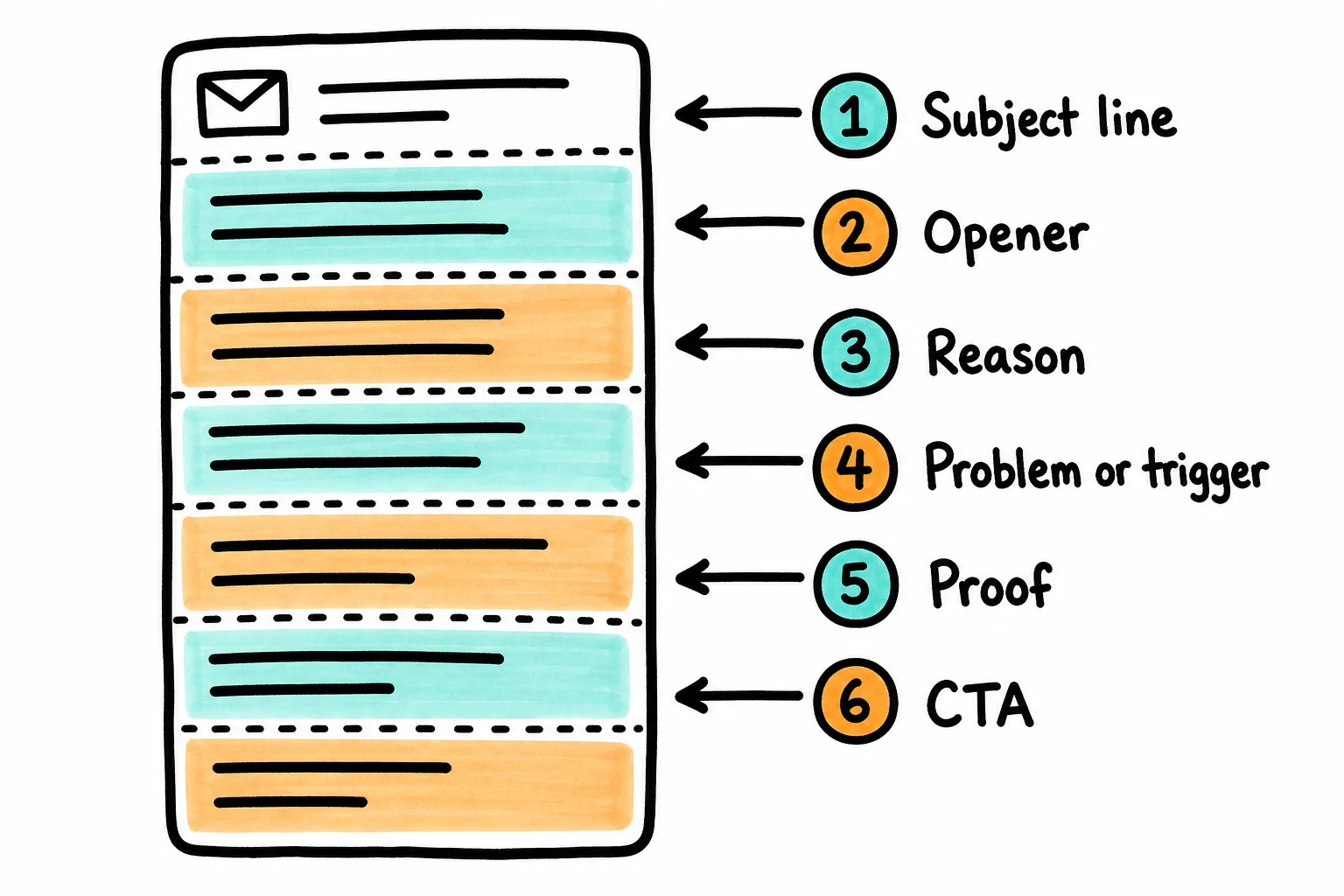
That’s the whole skeleton. The next section helps you pick which version of it to build.
Pick the right template before you write a word
The skeleton is fixed. What changes is how you fill it in, and that depends on four things: whether you share a mutual connection, what triggered the outreach, what you’re offering, and how big a commitment you’re asking for. Run through those four quickly before you open a blank email.
| Variable | Options |
|---|---|
| Relationship | No connection vs. mutual contact or warm intro |
| Trigger | Funding round, job posting, content they published, no trigger |
| Offer | Service, product, partnership, job application |
| Ask size | Quick reply, 15-minute call, download a resource |
A small ask with a clear trigger needs the least setup. A cold pitch with no shared context and a big ask needs more proof and a softer CTA. The six templates below map to the most common combinations: B2B sales, potential client outreach, consultant pitch, partnership, referral, and job or internship outreach.
Six templates, one for every situation
B2B sales email template
Use when you have a specific trigger: a recent hire, product launch, or visible problem.
Subject: [Specific trigger] at [Company]: quick question

Hi [First Name],

I noticed [Company] recently [specific trigger, e.g. expanded into enterprise].

Companies at that stage often run into [one concrete problem you solve].

We helped [similar company] [specific result, e.g. cut onboarding time by three weeks].

Would a 15-minute call next week work?

[Your name, Title, Company]
Personalize: the trigger, the problem, the comparable company, and the result.
Cold email to potential client sample
Use when a prospect fits your profile but hasn’t engaged with you yet.
Subject: Thought of you after seeing [specific detail about their work]

Hi [First Name],

I came across [their website / a talk / a recent article] and noticed [one specific observation].

We work with [type of company] to [outcome]. Looks like [Company] might be dealing with [problem].

Want me to send a quick overview?

[Your name]
Personalize: what caught your attention, the observation, and the offer framing.
Consultant or service provider pitch
Use when you can name a visible, diagnosable gap in their work.
Subject: [Company]'s [specific area, e.g. onboarding flow / paid ads]

Hi [First Name],

I was looking at [Company]'s [specific area] and noticed [one observable gap].

I'm a [what you do] who's helped [type of client] with [relevant outcome].

I can put together a quick breakdown of what I'd do differently. No commitment, just a starting point.

[Your name]
Personalize: the gap, your relevant credential, and the client type.
Partnership pitch
Use when your audiences overlap and you have a concrete collaboration idea.
Subject: Partnership idea: [Your Company] + [Their Company]

Hi [First Name],

I run [Your Company] and we serve a lot of [shared audience type].

One idea: [specific concept].

It would take 30 minutes to figure out if it makes sense. Worth a quick call?

[Your name]
Personalize: the shared audience, the specific concept, and why their company.
Referral or mutual connection
Lead with the name. That’s the whole advantage.
Subject: [Mutual contact] suggested I reach out

Hi [First Name],

[Mutual contact] mentioned you might be dealing with [specific problem or goal].

I've helped a few companies in [their space] with exactly that.

Would a 20-minute call this week work?

[Your name]
Personalize: the contact’s name, the problem they flagged, and your relevant experience.
Job or internship outreach
Short. One specific thing. One small ask.
Subject: Interested in [team or role type] at [Company]

Hi [First Name],

I've been following [Company]'s work on [specific project] and would love to be part of it.

I'm a [brief description] with experience in [relevant area].

Is there someone I should talk to about upcoming openings?

[Your name]
Personalize: the project, your background, and the team you’re targeting. Keep job and internship outreach respectful, brief, and specific.
What the same email looks like when you actually try
Example 1: SaaS pitch
Bad:
Hi there,

I wanted to reach out about our solution that helps companies like yours grow faster.
Better:
Hi Priya,

Saw the three new AE hires on LinkedIn. Companies scaling that fast usually hit a ramp-time wall around month two.

We helped a similar Series B team clean up onboarding and get new reps productive faster.

Worth 15 minutes next week?
The trigger makes it feel timed. The problem is concrete, the proof is specific, the ask is small.
Example 2: Freelance pitch
Bad:
Hi,

I'm a freelance designer looking for new clients. My rates are competitive.
Better:
Hi Marco,

Your contact form throws a mobile layout error on iOS. Screenshot attached.

I fixed the same issue for a local service business last month.

Want me to send the fix?
A real observation earns attention before you ask for anything.
Most deals die in the silence after email one
Wait three to five business days, then run a short, disciplined sequence.
Follow-up 1: day 4 or 5
Subject: Re: [original subject]

Hi [First Name],

Bumping this up in case it got buried.

Happy to send more context if useful.

[Your name]
Follow-up 2: day 9 to 11
Subject: Another thought on [specific problem]

Hi [First Name],

Wanted to share [case study / observation / quick idea] relevant to [specific thing at their company].

Still happy to connect if the timing works.

[Your name]
Break-up email: day 16 to 20
Subject: Should I close the loop?

Hi [First Name],

I won't follow up after this.

If priorities shift, my contact info is below.

[Your name]
Three touches, no response: stop. Pushing past that point rarely helps and occasionally burns the relationship entirely.
What actually kills cold emails
Most templates fail for the same reasons:
- Too long. If it takes more than 30 seconds to read, it is probably too long.
- No real personalization. “I came across your company” tells them nothing.
- A CTA that asks too much. A stranger does not owe you a demo.
- The wrong list. Even good copy fails when the recipient has no reason to care.
- A deceptive subject line. It might get the open, but it burns trust before anyone reads word one.
CAN-SPAM basics
In the US, cold emailing is legal when it follows CAN-SPAM requirements. At minimum:
- Use accurate sender information.
- Use a subject line that reflects what’s actually inside.
- Include a physical mailing address.
- Include a clear opt-out mechanism.
- Honor opt-out requests promptly.
This is not legal advice. Talk to an attorney about your specific situation, especially if you send across jurisdictions or operate in regulated industries.
Questions people actually ask before hitting send
What makes a good cold email example? It references something specific about the recipient, states a clear reason for writing, and asks for one small thing. If you could send it to 500 people unchanged, it needs more work.
How do you write a cold email? Pick a trigger, write a subject line that reflects it, open with one specific observation, state why you’re writing, hint at proof, end with a single low-friction ask. Keep it short enough that someone can understand it in one scan.
What is the 30/30/50 rule? It is a practitioner heuristic: list quality, offer quality, and personalization all matter. Do not treat it as a scientific formula. Treat it as a reminder that copy cannot save a bad list or irrelevant offer.
Is cold emailing legal in the US? Yes, with conditions. CAN-SPAM requires accurate sender info, an honest subject line, a physical address, and a working opt-out. This is not legal advice.
How long should a cold email be? A useful cold email is usually 50 to 150 words. Shorter wins when the reason for reaching out is clear.
What makes a great subject line? Specificity. “Question about your onboarding flow” beats “Thought this might interest you” because it tells the recipient what the email is actually about.
If writing every one of these from scratch sounds exhausting, the Email Pitch Generator builds a personalized sequence based on your offer, your audience, and your ask.