
Your past clients like you. They’re just not thinking about you.
NAR data shows the median homeowner now stays put for 11 years before selling, and ATTOM puts the average even higher heading into 2026. Do the math on your past client list and most of those people are comfortably mid-tenure. They’re not shopping. They’re not Zillowing at midnight. They closed with you, moved in, and got on with their lives.
That’s the actual problem with most agent newsletters: they’re written for people who are actively thinking about real estate, when almost nobody on your list is. Market reports, rate updates, new listing announcements — useful to maybe 3% of recipients at any given moment, deleted by the other 97%.
A newsletter worth sending costs you almost nothing per contact compared to farming mailers or paid ads. The return comes from staying present long enough that when someone on your list does move, or knows someone who is, your name is already there.
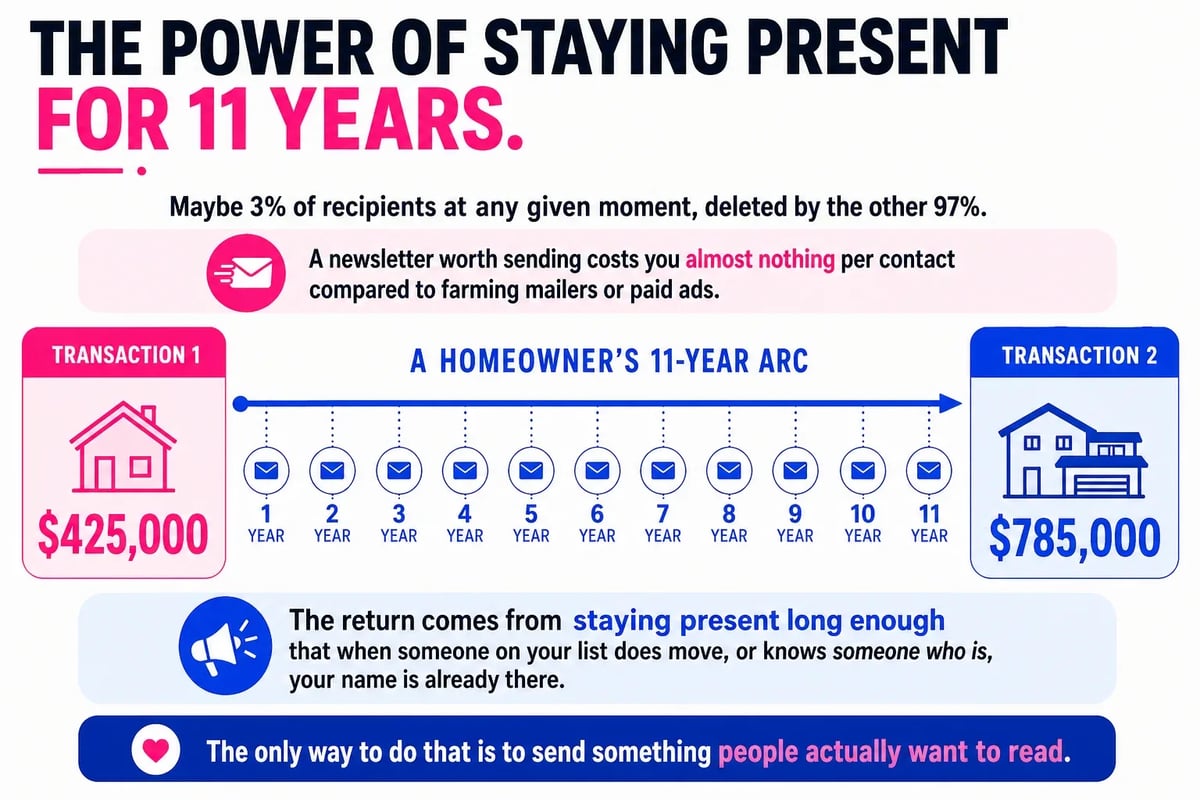
The only way to do that is to send something people actually want to read. (For the broader email playbook this realtor newsletter plugs into — automations, deliverability, segmentation — see our email marketing strategy guide.)
The three formats that get deleted before the first scroll
Most agent newsletters fail the same three ways.
The MLS stat dump is the most common offender: median days on market, list-to-sale ratios, closed volume. That data matters when someone is actively buying or selling. For a homeowner in year four of an eleven-year tenure, it reads like a spreadsheet someone accidentally CC’d them on.
The listing announcement is just an ad. Your past clients know you sell houses. They don’t need a flyer about a three-bed in Brentwood they’ll never buy.
The holiday email is noise with a pumpkin on it. “Happy Thanksgiving from the [Your Name] Team!” communicates nothing except that you have a CRM that scheduled something in November.
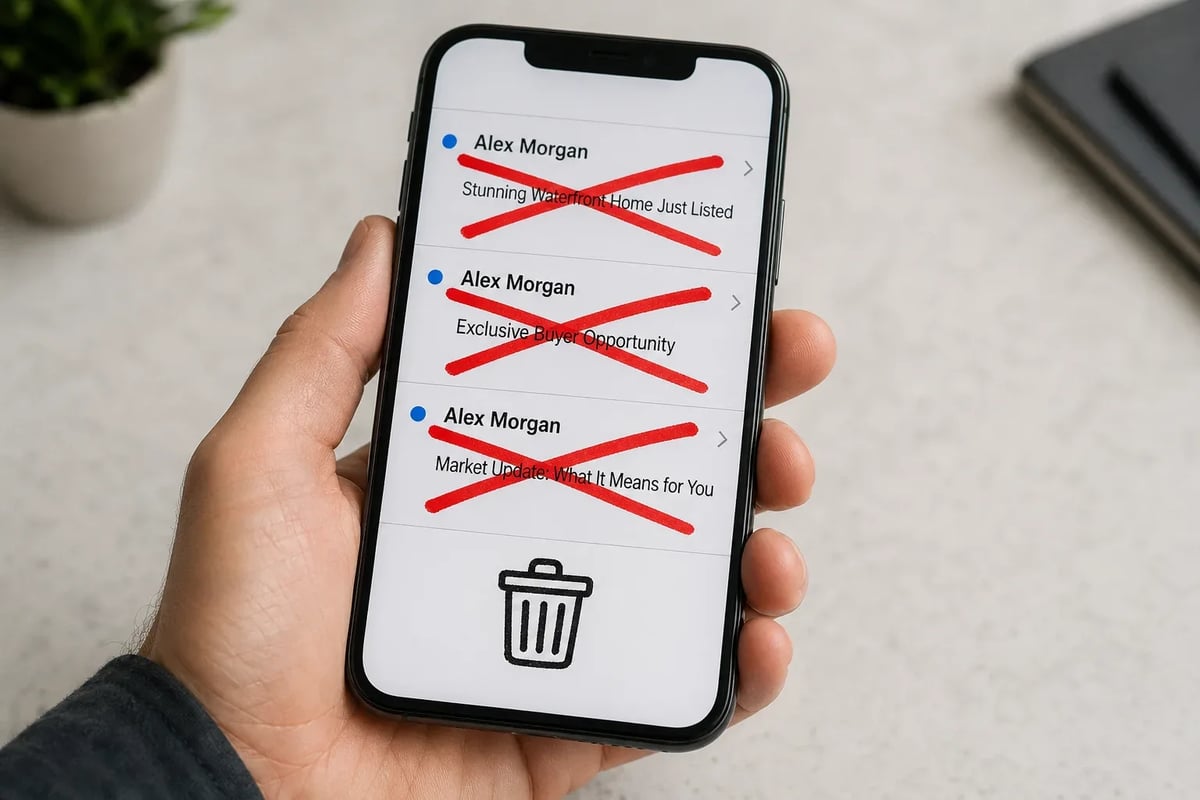
The newsletter that actually earns a read does one thing differently: it’s useful to someone who owns a home and isn’t going anywhere anytime soon.
25 content ideas that work whether your reader is buying, selling, or just living there
The five categories below aren’t equally weighted. Use the first three heavily, rotate through the fourth, and treat the fifth like hot sauce.
Market insight
Hyperlocal data beats broad summaries every time. A homeowner in your zip code wants to know what’s happening on their street, not their metro.
- Price-per-square-foot trends in a specific neighborhood, year-over-year
- A “what sold last month” roundup: sale price, days on market, one sentence on what drove the number
- An interest-rate explainer tied to real buying-power math (“at 6.8%, a $400k loan costs $X/month more than at 6%”)
- Inventory watch: how many homes are listed within one mile of your typical buyer’s target
- A “would I sell now or wait?” breakdown for a specific home type in your market
Homeowner value content
This is the category that makes people glad you’re in their inbox. None of these require anyone to be thinking about moving.
- How to file a property-tax appeal, with the specific deadline for your county
- What a homestead exemption is, how to claim it, and how much it typically saves
- Annual HVAC service: what it costs ($200-$500), what gets missed without it, and whether a home warranty makes sense for older systems
- How to read your home insurance renewal and three things worth shopping around on
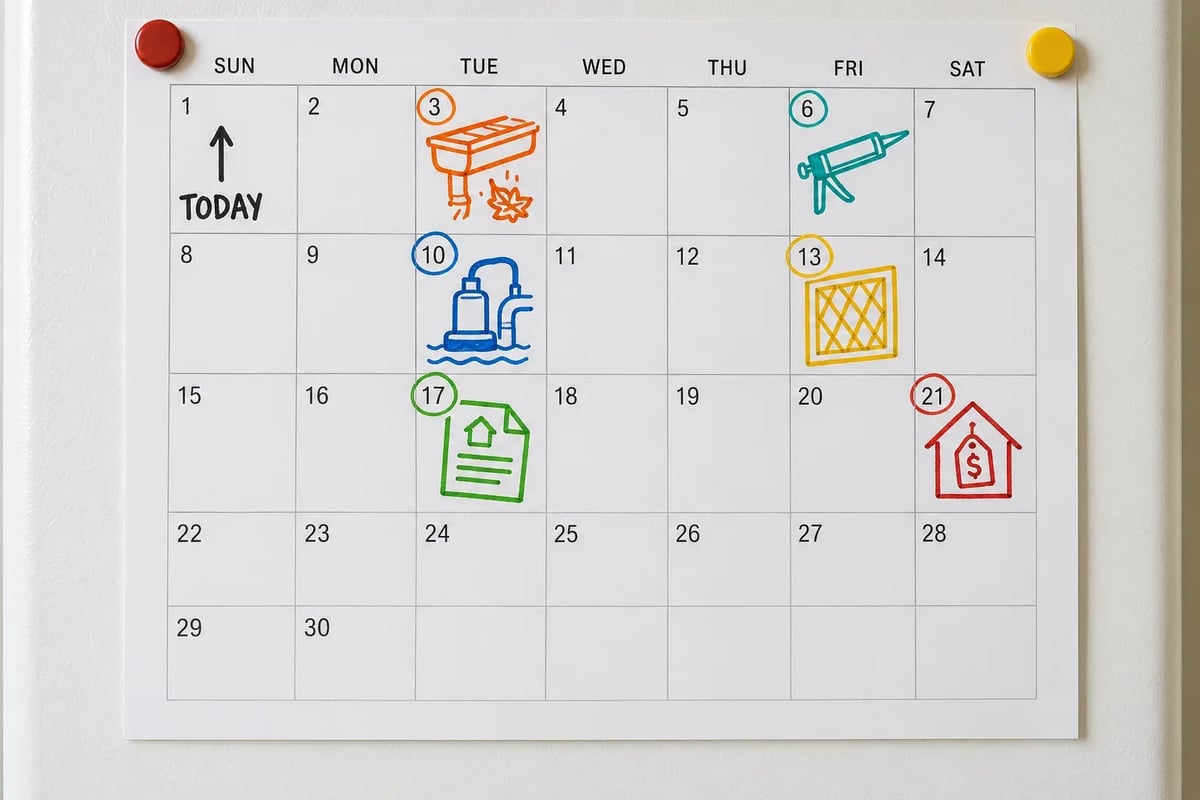
- A seasonal maintenance checklist: gutters, caulking, sump pumps, whatever fits the month
Neighborhood and community
This is what Zillow cannot replicate. You know the neighborhood.
- A new restaurant or shop that just opened, written like you’d describe it to a friend
- A short interview with a local business owner: two or three questions, kept tight
- An upcoming event worth knowing about: farmers market opening weekend, street festival, school fundraiser
- A “then vs. now” on a specific block that’s changed in the last five years
Stories and social proof
Real transactions told like stories remind your list what you actually do without reading like a press release.
- A buying story: what the clients wanted, what the market gave them, how it worked out
- A “toughest negotiation I had this year” write-up, anonymized if needed
- A before/after on a listing where staging or pricing made a measurable difference
- A client question you keep getting, answered properly
Light promotional content
Use this roughly one out of every five issues. More than that and the newsletter starts to feel like the thing it’s supposed to replace.
- A mention that you’re taking on new clients, with one sentence on what you’ve been working on
- A referral ask: “if anyone you know is thinking about making a move, I’d love an intro”
- A recent testimonial, the client’s words doing the work
Monthly beats quarterly, and the math is why
Quarterly feels manageable. Twelve emails a year sounds like work. But four touchpoints a year means if someone misses one issue, you’ve spoken to them twice. That’s not a relationship, that’s a quarterly earnings call. Send monthly, and you get 12 chances to be useful, funny, or genuinely interesting before someone in your list decides to move or refers a friend who is. Referral and repeat business often takes three or four years to materialize from a single closed transaction, which means you need a cadence that holds up over years, not one that quietly fades out by spring.
The honest case for writing it yourself
FastNewsletters, HomeActions, and ProspectsPLUS! all solve a real problem: if the choice is between a done-for-you template and nothing, send the template. But the tradeoff is worth naming. These services send the same nationwide content to agents across competing zip codes, and Inman noted years ago that the content quality often lags behind the platform quality. Your past clients already know roughly how you talk, what neighborhoods you care about, and whether you’re the type to mention the new taco place on Fatherland Street. A generic template can’t fake that. If you’re willing to write even 300 words in your own voice once a month, you’ll produce something a service can’t replicate.
The subject line is the whole game
Your email’s content doesn’t matter if nobody opens it. Three types of subject lines consistently work for past-client lists.
Neighborhood-specific lines feel targeted rather than broadcast:
- “Just sold on Chickasaw: what it means for your block”
- “East Nashville prices shifted again in April”
- “A 37206 home just closed $40k over ask”
Helpful, tip-based lines earn opens because they promise something immediately useful:
- “The HVAC filter schedule most homeowners skip”
- “Before you appeal your property tax bill, read this”
- “Three things that quietly hurt your home’s value”
Personal and story-driven lines feel like they came from a person, not a drip campaign:
- “My clients couldn’t believe what their neighbor got”
- “Thought of you when I saw this one sell”
One rule worth keeping: if the subject line could have come from any agent in any city, rewrite it.
Here’s what one good issue actually looks like
Below is a real May 2026 newsletter for East Nashville homeowners. Steal the structure.
East Nashville Real Estate | May 2026
What’s happening in 37206 right now
Prices have pulled back from last fall’s peak. The median sale price hit around $700,000 in September; it’s closer to $646,000 now, down roughly 9% year over year. Price per square foot dropped about 6% to around $366, and homes are averaging 69 days on market versus 56 this time last year.
That’s a correction, not a crash. Buyers have more time, sellers who priced aggressively in 2024 are adjusting, and if you bought here a few years ago you’re still well ahead. Five Points and Gallatin Avenue keep drawing new businesses, and the bungalow blocks between Shelby and Riverside stay in demand.
May homeowner tip: your HVAC before the heat hits
Book your tune-up before Memorial Day. Technicians fill up fast once temperatures climb. A seasonal check runs $80 to $150 and usually catches a failing capacitor before it becomes a $1,500 emergency call in July.
Neighborhood spotlight: Inglewood
Just north of Five Points, Inglewood has become one of the more interesting pockets in 37206. The Gallatin Avenue strip anchored early, and the stretch between Dew and Douglas has filled in steadily since. Historic bungalows got gut-renovated in 2024 and 2025. It still feels like a neighborhood rather than a destination, which is exactly why buyers ask about it first.

A client story
Marcus and DeShawn bought on Shelby Avenue in 2021 and spent two years convinced they’d overpaid. When I ran their numbers in March, they were up about $90,000 net of everything they’d put in. They weren’t selling, just wanted to know where they stood before refinancing. That call took 20 minutes and kept them from making a decision based on anxiety instead of data. That’s most of what I do between transactions.
Frequently asked questions
What should a realtor newsletter include?
A realtor newsletter should include hyperlocal market insight, homeowner value content, neighborhood updates, client stories, and light referral reminders. The goal is to be useful to past clients even when they are not actively buying or selling.
How often should real estate agents send newsletters?
Monthly is the best cadence for most agents. It creates enough touchpoints to stay remembered between transactions without turning the newsletter into a constant sales broadcast.
What real estate newsletter topics work for past clients?
Past clients respond best to homeowner maintenance tips, property tax reminders, insurance or renovation guidance, neighborhood openings, and simple explanations of what local market changes mean for their home.
Should realtor newsletters include listings?
Listings can appear occasionally, but they should not be the main content for a past-client list. Most subscribers are not actively buying, so homeowner value and neighborhood insight usually earn more attention.
The blank doc is the problem, not the writing
If the newsletter above took you an hour to write, you’d send it. Most agents don’t send anything because starting from scratch every month is genuinely tedious. The Newsletter Generator handles the research and first draft, writing in your voice based on an initial setup that takes about six minutes. You review, adjust for your market, and send. It won’t replace what you know about East Nashville or wherever you work, but it removes the part that actually stops people: the blank page at 9pm on a Tuesday.