
The advice is fine. Your pipeline is still empty.
Picture a consultant with ten years of real expertise, a roster of happy clients, and genuinely useful things to say. They Google “how to market a consulting practice.” They read six articles. The advice: post on LinkedIn consistently, start a newsletter, ask for referrals, write case studies.
This consultant-specific plan fits into the broader marketing strategy template and digital marketing strategy guide.
All true. All useless as stated.
None of it answers the questions that actually matter. Post about what, aimed at whom, and why would that person hire you instead of someone else? Ask for referrals from which clients, how, and what do you do when that network stops growing?
The problem with most consultant marketing advice is that it skips the strategic layer entirely and hands you a checklist. Checklists feel productive. They rarely fill pipelines. Consultants who rely on referrals and sporadic tactics tend to ride a feast-or-famine cycle that has nothing to do with their skill level.
This piece treats marketing as a set of decisions with real tradeoffs, not a to-do list with a color-coded spreadsheet attached.
Awareness vs. credibility: you probably need to pick one
Before you choose a channel, a posting schedule, or a content format, there is one question worth answering: are you trying to reach people who have never heard of you, or are you trying to convince people who have already heard of you to actually hire you?
Those are different problems. They need different tactics, different timelines, and honest expectations about what success looks like.
Here is the pattern that kills a lot of consulting pipelines. A consultant spends six months writing sharp LinkedIn posts. The posts get traction. Comments roll in, follower count climbs, and the whole thing feels like marketing is working. Then a warm lead shows up, asks for examples of similar work, and the consultant has nothing concrete to send. No case studies, no documented outcomes, no specifics. The deal stalls, or goes to someone who has all three. The awareness was real. The credibility infrastructure was not.
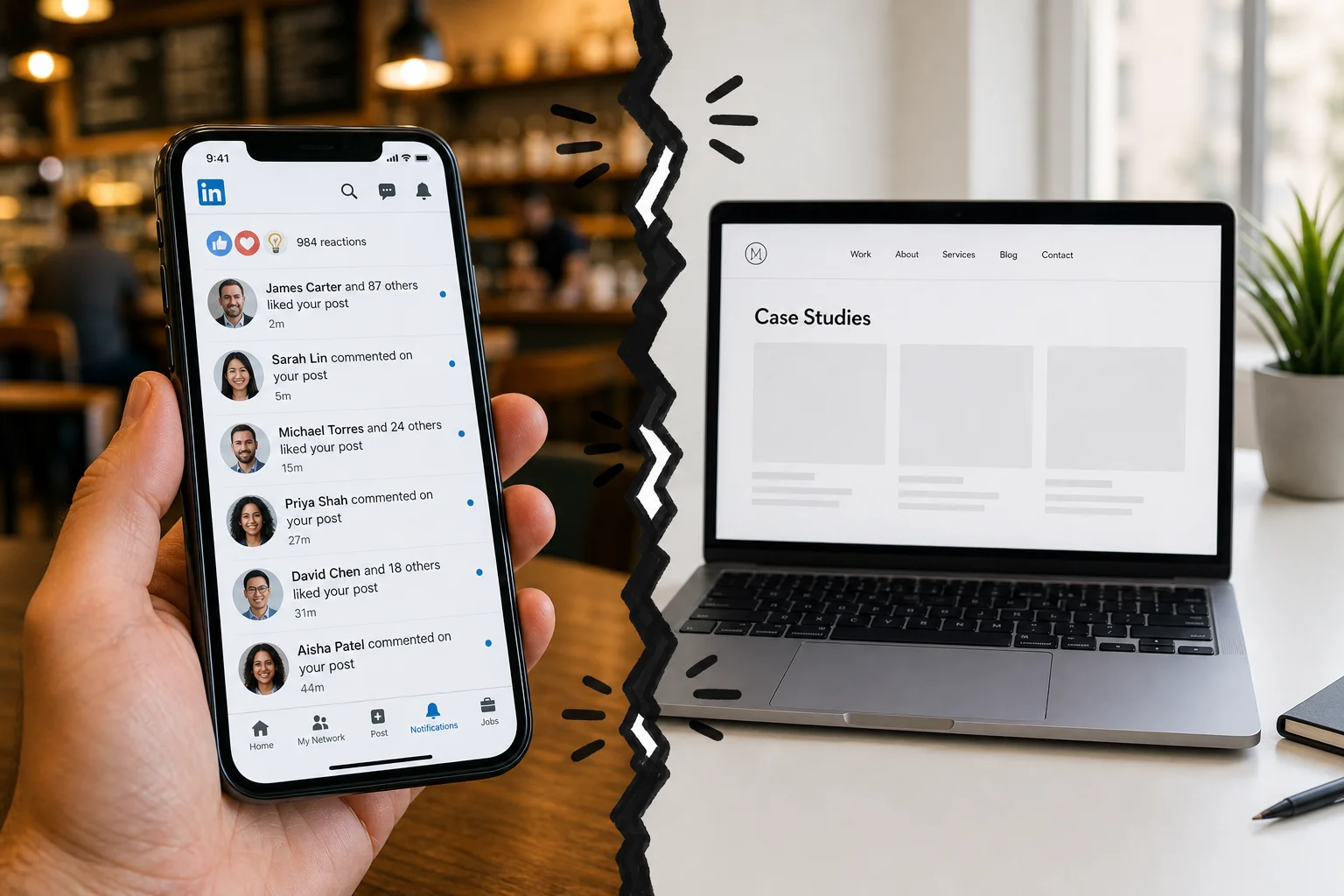
The tradeoff runs in both directions. Awareness without credibility is reach that does not convert. You can get in front of the right people and still lose to a less visible competitor who has better proof. But credibility without awareness is equally limiting: it only helps you with people who already know you exist. Consulting sales cycles average around 103 days even after a lead is warm, which means the gap between “someone found you” and “someone paid you” is long enough that what they find when they look you up matters enormously.
For most solo consultants and small firms, the smarter starting point is credibility. The reason is not that awareness is unimportant. It is that most consultants already have a thin referral network producing occasional warm leads, and those leads are going cold because there is nothing authoritative to hand them. One well-documented case study, written with real specificity about the outcome, does more for those conversations than six months of LinkedIn posts.
Once you can convert the leads you already get, scaling awareness has an actual return.
One channel, done well, beats five channels done badly
Every channel available to you — writing, speaking, LinkedIn, email, referrals, partnerships — has a real cost. Not just money. Time, consistency, and the willingness to keep going for months before anything converts.
Writing (blog posts, articles, SEO-driven content) builds a durable asset, but organic search takes 6 to 12 months to produce meaningful inbound. Speaking at conferences can generate qualified inquiries the same week you’re on stage, but getting on the right stages takes months of relationship-building first. LinkedIn and social content can show engagement signals within a few weeks, though sustained lead generation typically takes 6 to 9 months of consistent output. Email works fast if you already have a list, and slowly if you don’t.
The decision isn’t which channel is best. It’s which channel matches three things: where your specific buyers actually pay attention, what you can sustain for a full year without burning out, and where you already have any foothold at all.
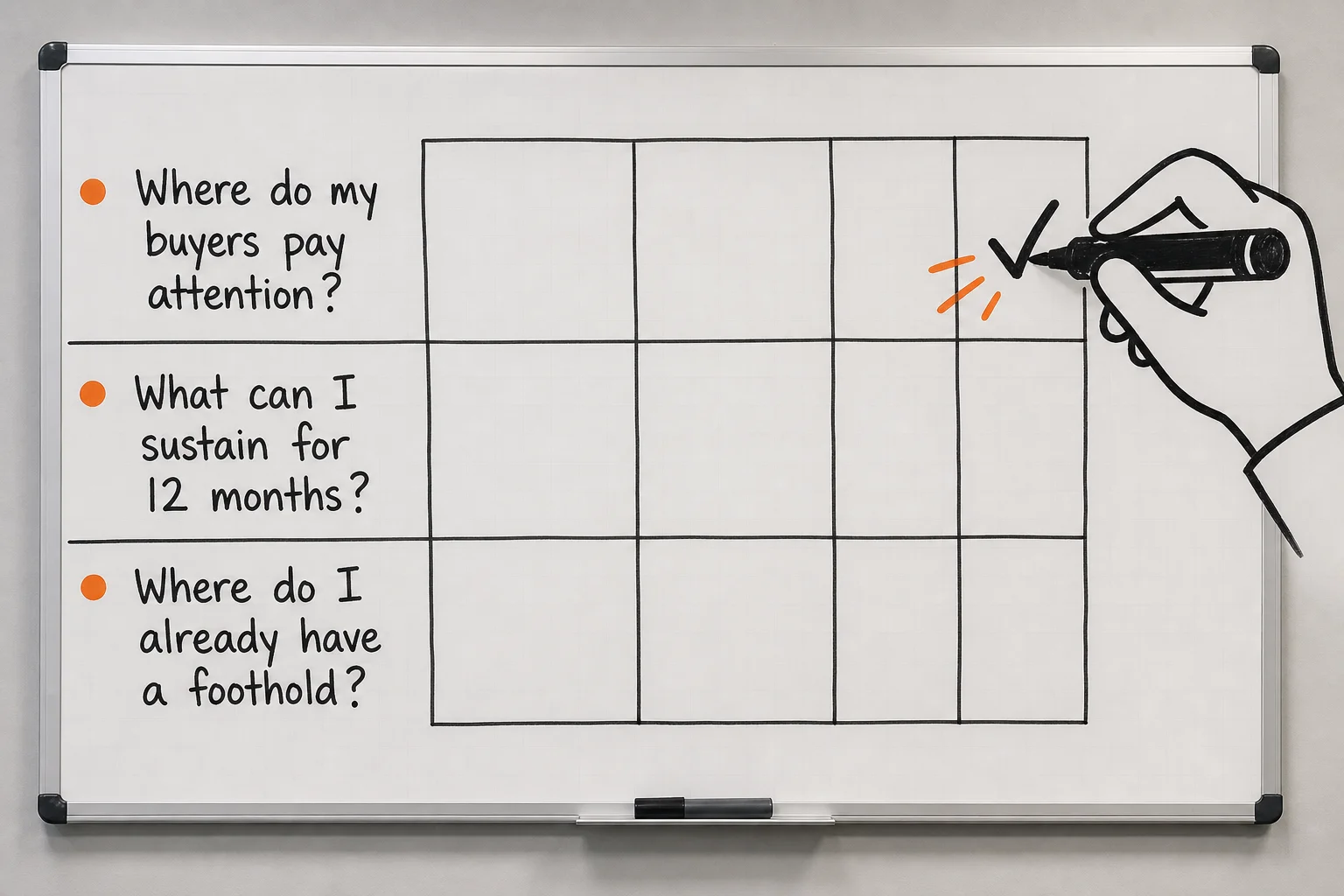
The most common mistake is picking three channels at launch because each one seems reasonable. What happens is that all three stay shallow, none build momentum, and the whole effort stalls by month four. Pick one. Get traction. Then expand.
Buyers decide before you pitch. Here’s what changes that.
Authority, in practical terms, is the condition where a buyer has already formed a positive opinion of your judgment before your first conversation. The call isn’t them evaluating you. It’s them confirming what they already believe.
Three things produce that condition. A specific point of view. Proof that the point of view has produced results. Repeated visibility to the right people. All three matter. Any two without the third leaves a gap.
The mistake most consultants make is treating volume as the engine. Post daily, comment everywhere, stay active. But volume without a clear position just creates noise. Buyers’ research shows that 74% want content that challenges assumptions, and 66% won’t engage a provider whose thinking feels generic. Being everywhere doesn’t fix that. Being specific does.
Think of it this way: imagine two cardiologists. One has published 200 general wellness posts this year. The other has written twelve pieces arguing that a specific diagnostic protocol is being systematically misapplied, with data showing worse patient outcomes as a result. You need heart surgery. You’re calling the second one. You’re not even Googling the first.
That’s the positioning gap most consultants live in. Busy, visible, generic.
The proof component is where most people stall. A point of view without evidence is just an opinion. A case study, a client outcome, a before/after example tied to your specific approach — these turn the opinion into something a buyer can evaluate.
Edelman’s research found that 86% of buyers who encountered trust-building thought leadership would be likely to invite that organization into an RFP. The thought leadership opened the door. The proof kept it open.
Here’s the test: Google your name plus your specialty. What comes up? If the answer is nothing, or a LinkedIn profile and a website with a generic tagline, you’re starting from zero in every sales conversation. If the answer is three or four pieces that argue a consistent, specific position with real evidence attached, you’re starting from trust.
Smart consultants, dumb pipeline habits
Stopping outreach when you get busy is the most common pipeline mistake and the most predictable. A project lands, the calendar fills, marketing stops. Then the project ends. The 60 to 90 day lag between stopping outreach and feeling the consequences means you rarely connect cause to effect. The fix is mechanical: keep a minimum weekly rhythm of three to five new conversations regardless of how slammed you are.
Positioning too broadly is the other structural error. “I help organizations improve performance” is not a position. Generic positioning makes you hard to refer, hard to find, and easy to price-shop. Cascade Insights found their exclusive B2B tech focus produced faster client ramp-up and higher margins than generalist competitors.
Abandoning follow-up too early kills more warm leads than bad positioning does. Most consultants stop after three or four touches. Qualified leads often need twenty or more before they convert.
Treating LinkedIn as a static resume gives prospective buyers no reason to reach out. A profile that only lists job history argues nothing.
Running tactics without per-tactic targets lets bad habits survive indefinitely. Set a specific goal per channel, ten conversations from LinkedIn in ninety days, and audit it monthly.
90 days to a foundation, not a pipeline
The goal here is not to build a full marketing machine. It is to have something real by day 90: a positioning statement you can say out loud without flinching, one credibility asset you can send a warm lead, one channel you are actually using, and a simple follow-up habit.
Days 1 through 30 are for deciding who you help and what problem you solve. Write the positioning statement before you publish anything.
Days 31 through 60: produce one credibility asset, a case study, a detailed guide, a specific point of view in writing. This comes before outreach, because outreach without a destination wastes the conversation.
Days 61 through 90: start contacting warm leads, batch your outreach into one or two focused blocks per week, and track every response.
This plan excludes paid ads, SEO, and a podcast deliberately. Those require time horizons and budgets that conflict with the goal of a working foundation in 90 days.
Expect conversations by day 90, not signed contracts.
Stay the course, or actually change something?
The 90-day window is for building signal, not panicking. If you haven’t run the same approach consistently for 90 days, you don’t have a strategy problem yet.
After 90 days, the diagnostic is simple. Visitors but no conversations means a credibility problem: rewrite your positioning to name a specific buyer problem instead of describing what you do. Conversations that don’t convert point to a trust gap, and adding third-party proof (a case study, a client quote, a credible byline) moves the needle faster than more outreach.
If both are absent, you likely have a channel mismatch. Try one different channel for 30 days before drawing conclusions.
The goal is signal. You’re trying to find which part of the system is weak.