
Your Marketing Strategy Template Is Just a Very Official-Looking Blank Page
You find a template, download it, and spend an afternoon filling it out. Target audience: “small business owners aged 25–45.” Value proposition: “high-quality, affordable solutions.” Channels: “social media, email, and content marketing.” You hit save. It looks professional. It could also describe literally any company selling anything to anyone.
If you came here looking for a ready-made download, start with the generator below, then use the sections in this guide to pressure-test the plan. For a broader planning document, see the marketing plan template. For the channel-level version, use the digital marketing strategy guide.
This is the actual problem with most marketing strategy templates: the prompts assume you already know what to decide. They give you a box labeled “positioning” without telling you what a positioning decision actually requires you to choose. They put KPIs at the end, as an afterthought, instead of treating measurement as something you define before you start spending money. The template fills in, but nothing gets decided.
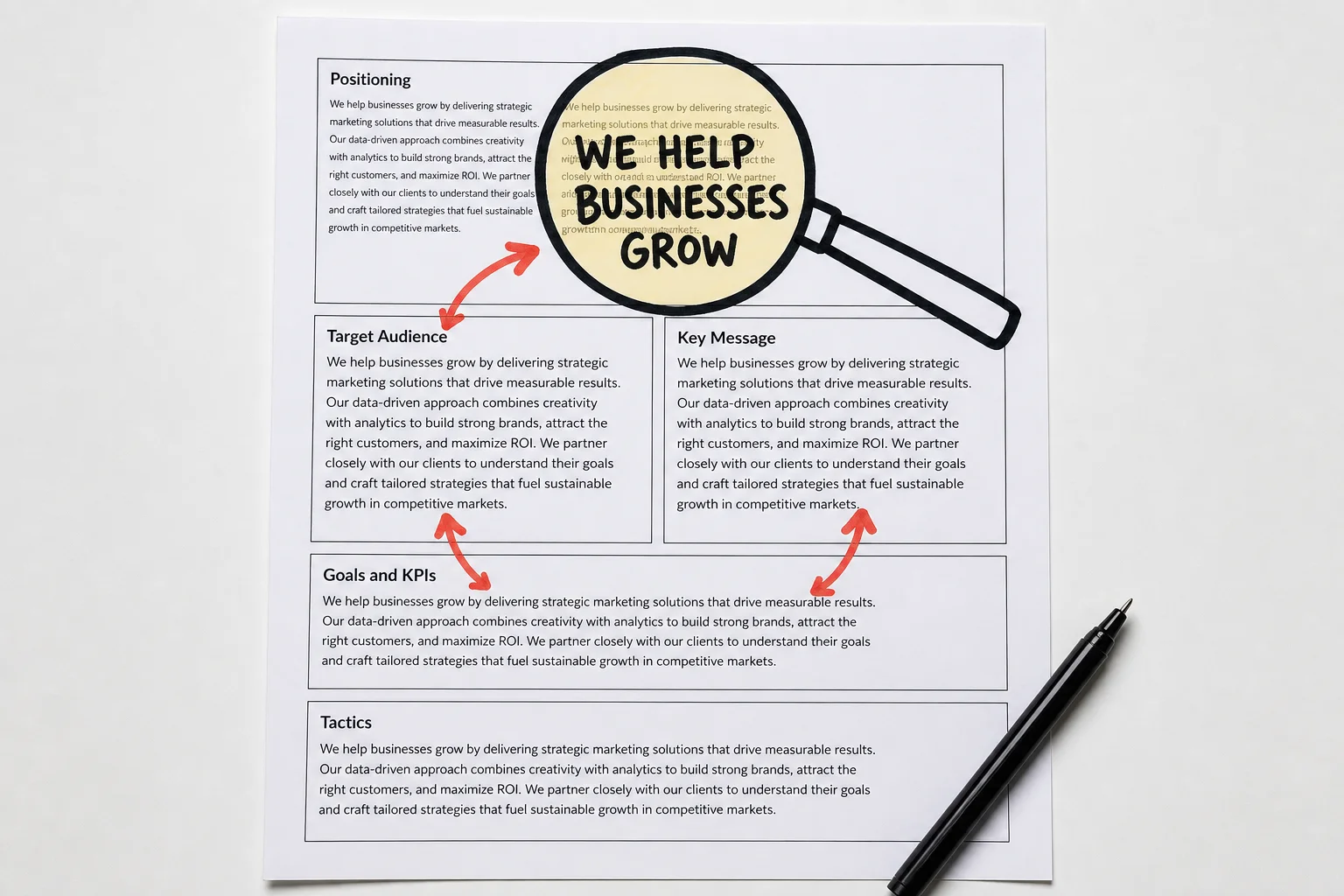
What this guide does differently: it treats each section of a template as a decision to make, with real tradeoffs, not a field to populate. You’ll get a worked example, the mistakes most teams skip past, and a checklist to tell whether what you have is actually a strategy.
A Template’s Job Is to Force a Decision, Not File One
There’s a useful distinction hiding inside the phrase “marketing strategy,” and most templates bury it completely.
A marketing strategy answers the choices that are hard to reverse: who you’re targeting, what position you’re claiming, and which customers you’re explicitly not chasing. A marketing plan answers execution questions: which channels, what budget, what timeline, who owns which tasks. Both matter, but they’re different things, and confusing them is how you end up with a document that lists a Q1 LinkedIn campaign without ever establishing why LinkedIn, for whom, toward what end.
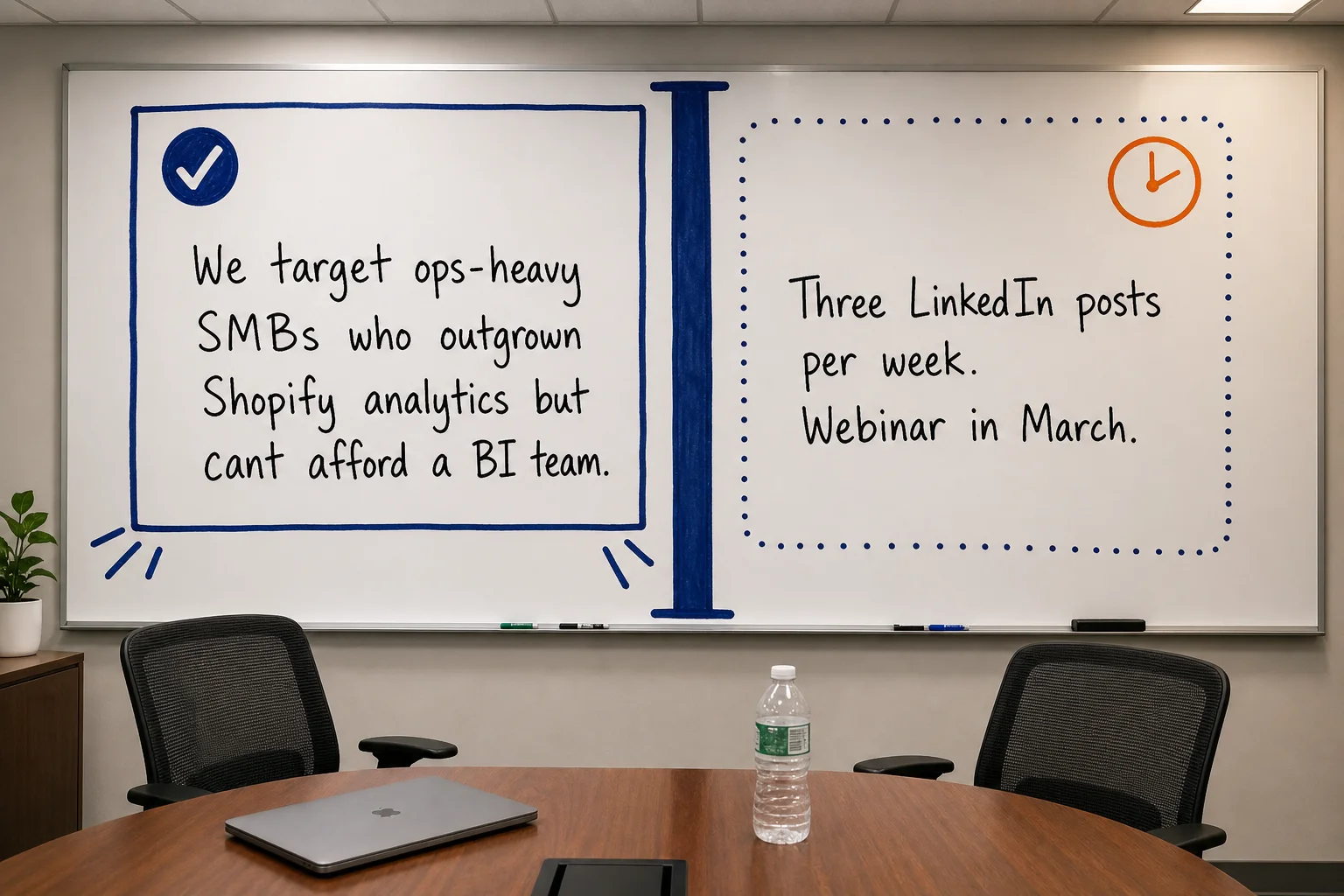
Concrete version: “We serve mid-market e-commerce companies that have outgrown Shopify’s native analytics but can’t afford a full BI team” is a strategy statement. “We’ll run three LinkedIn thought leadership posts per week and a webinar in March” is a plan. The plan is fine, but it’s arbitrary without the first sentence anchoring it.
Roger Martin’s Playing to Win argues that real strategy only exists when choices are mutually reinforcing AND when they rule things out. Trying to be both the low-cost option and the premium option is not a bold strategy; it’s an avoidance of one.
A good template uses that logic as its operating principle. Every prompt should push you toward a choice with a real “no” attached. If you can fill in a section without eliminating any options, the prompt isn’t doing its job.
Each section is a question you have to actually answer
Five components. Each one sounds like a category but forces a real choice.
Positioning: which fight are you picking?
Positioning sets the category you compete in and the one thing that makes you win there. Default positioning lets buyers compare you to whatever they already know. April Dunford’s case study on a struggling database startup shows what changing that answer does: positioned against Oracle, it had no traction. Repositioned as a BI tool for fast queries on large datasets, it got meetings. Same product, different comparison, suddenly the differentiator was obvious.
Weak: “A flexible, powerful data platform for modern teams.” Stronger: “The only BI tool that runs ad-hoc queries on 100M+ rows without a data engineer.”
Specific positioning excludes buyers. That exclusion is what makes it work.
Target audience: how small is too small?
This section decides who you’re writing for when you write anything. Intero Digital’s guidance uses “mid-level marketing managers at wearable tech companies with $50M-$100M revenue” as the right specificity level.
Weak: “Marketing professionals at growing companies.” Stronger: “Marketing managers at Series B SaaS companies who own paid acquisition but have no dedicated analyst.”
Narrowing means some real humans won’t feel spoken to. Accept that.
Key message: one claim, not a list
Pick the single most important thing a prospect should believe after encountering your brand.
Weak: “We’re fast, affordable, and easy to use.” Stronger: “Setup takes 20 minutes and your first report runs the same day.”
The first is a wish list. The second is a claim someone can actually evaluate.
Channels: where does your buyer actually decide?
Channel selection decides where you spend attention before you spend money. The question is where your target audience goes when they’re deciding, not where you’re comfortable posting. Two channels done well beats six done badly, and badly means you learn nothing.
Success metrics: revenue or activity?
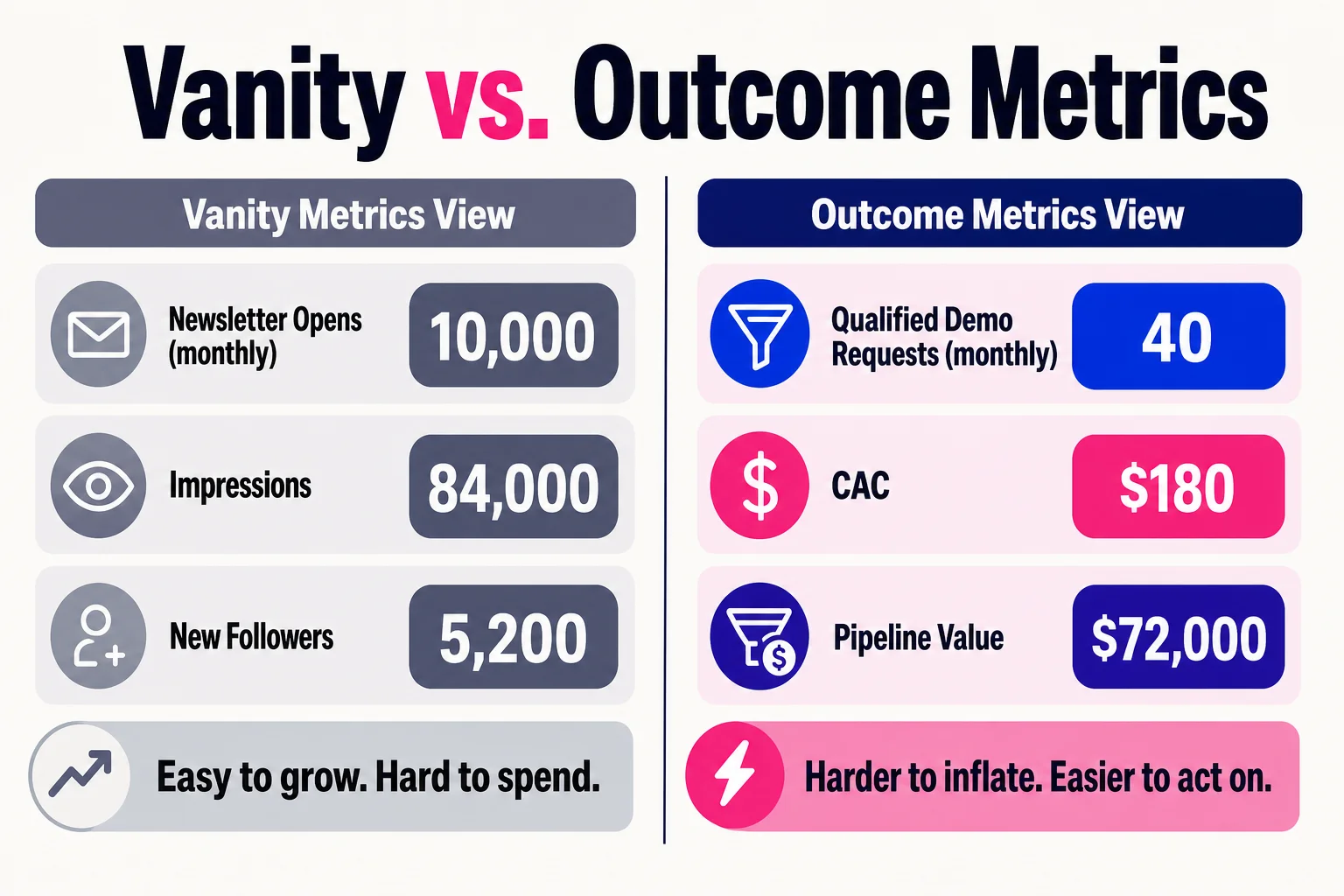
This section decides what “working” means. Vanity metrics like impressions are easy to grow without moving any business result. Qualified leads, CAC, and pipeline are harder to inflate accidentally.
Weak: 10,000 newsletter opens per month. Stronger: 40 qualified demo requests per month at or below $180 CAC.
Outcome metrics require more setup to track. Set them anyway.
Here’s what those five decisions look like when a real team makes them
Meet TaskFlow, a fictional B2B SaaS tool for project management. Three-person founding team, $8K/month marketing budget, selling to someone.
That last part is the first problem. Their initial target audience read: “project managers at growing companies.” Every competitor could say the same thing. Their positioning was “flexible and powerful,” which is what you write when you haven’t decided anything yet.
After one quarter of negligible pipeline, they narrowed. New target: operations leads at creative agencies with 10–50 people who were managing client work in spreadsheets. That specificity cost them a wider addressable market on paper. In practice, narrow positioning to a specific niche can roughly double conversion by making the messaging feel written for the reader rather than vaguely aimed at them. TaskFlow rewrote every page with that buyer in mind.
Their key message shifted from “the all-in-one project tool” to “the project tool agencies use to stop losing billable hours to status emails.” One claim. Checkable.
For channels, they initially wanted to run paid ads, host webinars, AND build SEO content. With three people, that plan would have spread them too thin to do any of it well. They dropped paid entirely for the first six months and focused on content targeting niche pain points plus a freemium trial. Paid ads stayed off the table until they had enough conversion data to bid intelligently.
Success metrics: 40 qualified trials per month, trial-to-paid conversion above 20%, CAC below $150. Not impressions, not followers.
The first draft had “grow brand awareness” as a metric. They cut it when nobody could agree on what would count as proof.
Three places where good strategies quietly fall apart
TaskFlow got most of this right. But even their first draft kept one line that should have been cut: “grow brand awareness.” Nobody could agree on what would count as proof. That’s the first skipped decision.
If you don’t define success before launch, you’ll measure what’s easy afterward. Impressions. Followers. Page views. These rise even when nothing real is working, which is how campaigns report green dashboards while producing no pipeline. The fix is blunt: write down a specific number and a specific date, and decide in advance what “not working” looks like.
The second is not choosing a primary channel. Teams list four or five because cutting any feels like leaving money on the table. Spreading budget evenly dilutes performance across all of them. Pick one channel for 70% of your effort and run the others as experiments.
The third is skipping the “who this is NOT for” line. Teams hate writing it because it feels like turning away revenue. But low-fit customers raise CAC and churn without improving anything that matters. One exclusion sentence saves months of wasted sales cycles.
Fill it out together, not alone
Send every participant the blank template to fill in solo before the session. This sounds redundant. It isn’t. When people arrive with their own answers already written, disagreements surface in the first ten minutes instead of getting smoothed over by whoever speaks first.
During the session, keep it to three hours for a team of five to ten people. Compare answers section by section. Ask directly: “Where are we making different assumptions here?” That question does more work than any agenda item, because it names the real thing stopping the room from committing.
Before anyone leaves, spend thirty minutes converting agreed answers into the final document. Wait a week and the consensus dissolves. One person owns each section and names a specific number as the success metric.
The tradeoff is real: solo prep takes two hours, the full session takes a day. Solo gets you a document. The session gets you a team that knows what they agreed to and why.
Seven questions your strategy document should be able to answer
Run these against any strategy doc, including your own. Yes or no only.
- Can you name the audience and explain who you chose not to target?
- Does your positioning make a claim a competitor would disagree with?
- Have you listed two or three channels and explained why you skipped the others?
- Are your objectives ranked, not just listed?
- Do your success metrics include a number that would trigger a change in direction?
- Have you named three to five assumptions the strategy depends on?
- Is budget allocated to specific choices, not spread evenly across everything?
Six or seven yes answers: you have a strategy. Fewer than four: you have a document that looks like one.
A completed template with vague answers is just a blank one with worse handwriting.