
A quiet email that keeps working while you sleep
Picture a former client you did good work for, three years ago. They’ve just been hired somewhere new, there’s a problem they recognize, and they need someone fast. They don’t Google it. They think of you — because your name landed in their inbox last Tuesday, and the Tuesday before that, and you said something that stuck.
That’s the whole game.
A consultant newsletter isn’t a content marketing project. It’s a direct line to people who already have some reason to trust you, kept warm over time, with no algorithm deciding whether they see it.
The tension is real, though. You don’t want to give away the actual work. You don’t want to sound like you’re selling. And you have paying clients already, so who has time for this?
Those three problems are solvable, and the rest of this guide works through each one. No posting strategies, no “thought leadership” frameworks. Just what to write, who to send it to, and how to keep it going. (For the wider email playbook this consultant newsletter plugs into — automations, deliverability, segmentation — see our email marketing strategy guide. For the broader client acquisition plan around it, see the consultant marketing strategy guide.)
The math that makes cold outreach look embarrassing
Send 1,000 cold emails to people who’ve never heard of you. At an average response rate around 3–5%, you’ll get maybe 30–50 replies. Of those, a fraction become real conversations, and roughly one in 464 cold emails eventually closes as a deal. That’s the game. It’s a volume game, and volume is the one thing a solo practitioner doesn’t have.
A newsletter with 500 engaged readers who opted in, who already associate your name with something useful, operates on completely different numbers. Warm, opted-in outreach converts at rates five to ten times higher than cold. The people on your list already know what you do. You don’t have to introduce yourself every time.
The referral dynamic matters too. Subscribers forward issues to colleagues, often with a line like “this person really gets it.” That introduction carries more weight than anything you could write about yourself in a cold pitch.
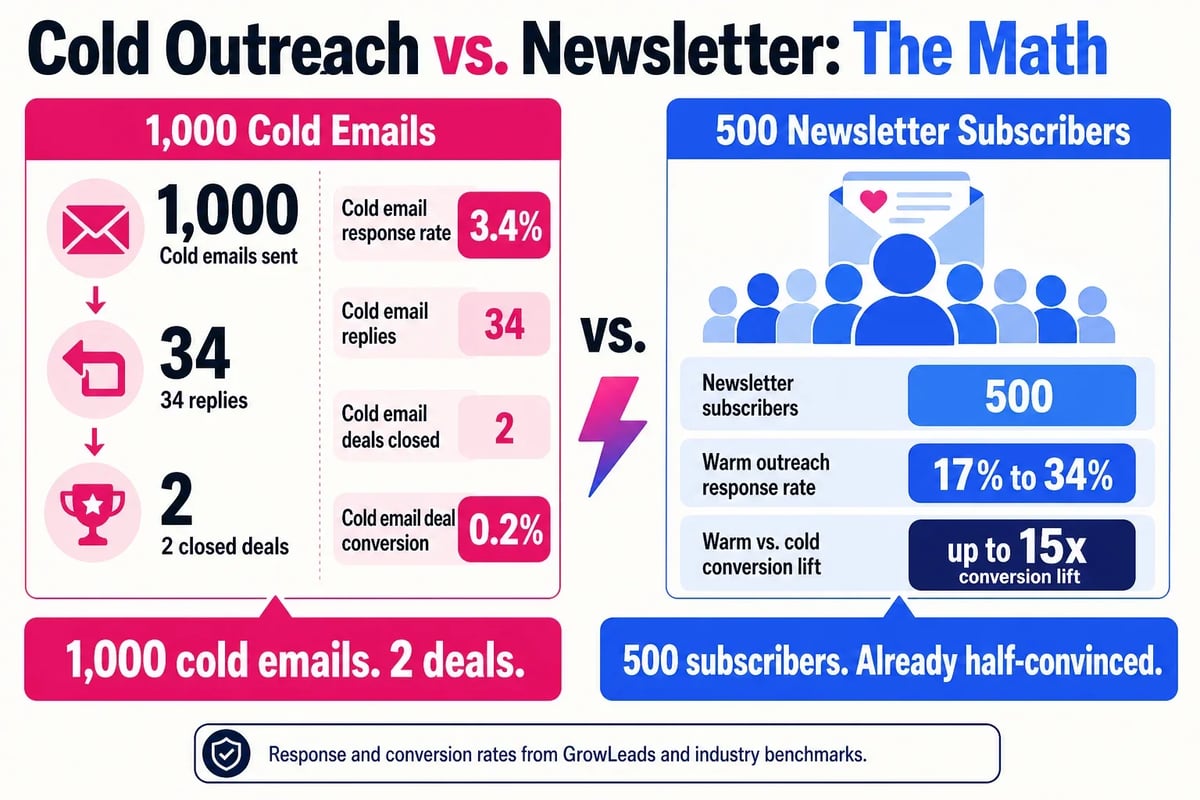
The pre-qualification effect is real. By the time someone replies to your newsletter, they’ve read several issues. They already believe you know what you’re talking about. Half the sales conversation has happened before you speak a word.
Cold outreach isn’t useless. But as a compounding strategy, a newsletter wins by a distance.
Five formats that actually do the selling
Most consultant newsletters feel hollow because the content is either too vague to be useful or too specific to be safe. These five formats thread that needle. None require you to hand over your methodology wholesale. All of them signal you know what you’re doing.
A framework or model you use
Name it, explain it in a paragraph, show where it applies. You’re not giving away a deliverable, you’re showing readers how you think. That’s what clients are actually buying.
Subject line: “The three-stage audit I run before any change management engagement”
An anonymized client case study
What was broken, what you did, what changed. Use numbers where you have them (“reduced review cycles from 14 days to 4”), attribute quotes by role only (“the CFO said…”), and blur anything identifying. Get sign-off before you publish. The anonymity isn’t a weakness — it’s what lets you be specific without burning a relationship.
Opening line: “A mid-size logistics company came to me convinced their forecasting problem was a technology problem. It wasn’t.”
An unpopular opinion
Pick something your industry treats as settled that you think is wrong, or at least more complicated than people admit. State your position and explain why. Readers who agree will forward it. Readers who disagree will reply. Both are good.
Subject line: “The 90-day onboarding plan is a crutch, not a strategy”
A question you keep getting asked
Write down the ten questions clients ask you most. Each one is a post. Answer it the way you’d answer it on a call. The format works because it signals, without stating it, that you’re the person people come to with this problem.
Opening line: “I get asked almost every week whether to hire a full-time ops lead or bring in a fractional. Here’s how I think about it.”
An industry observation
Something you’re noticing across clients or in the market, paired with your read on what it means. Not a trend piece — just: here’s what I’m seeing, here’s what I think it’s telling us.
Subject line: “Three clients in different industries all hit the same wall last quarter”
The content nobody actually hired you to write
Most consultant newsletters fail for the same reason: the writer is talking to peers, not to buyers.
Announcements are the clearest example. “I’m speaking at [conference]” tells other consultants something mildly interesting and tells a potential client nothing useful. Every reader silently asks why does this matter to me? Announcements don’t answer it.
Article summaries have the same problem, with the added insult that your readers have the internet. Curating links signals that you read a lot, which is not the same as signaling that you know what to do.
Generic tips are the subtler failure. “Five ways to improve stakeholder communication” sounds substantive until you realize anyone could have written it. Surface-level advice doesn’t show how you think; it shows you know how to write a listicle.
The deepest failure is writing for your professional community instead of for clients. A post that impresses other consultants often bores buyers completely. They don’t care about your methodology’s theoretical underpinnings. They care whether you’ve solved the problem they’re sitting with right now.
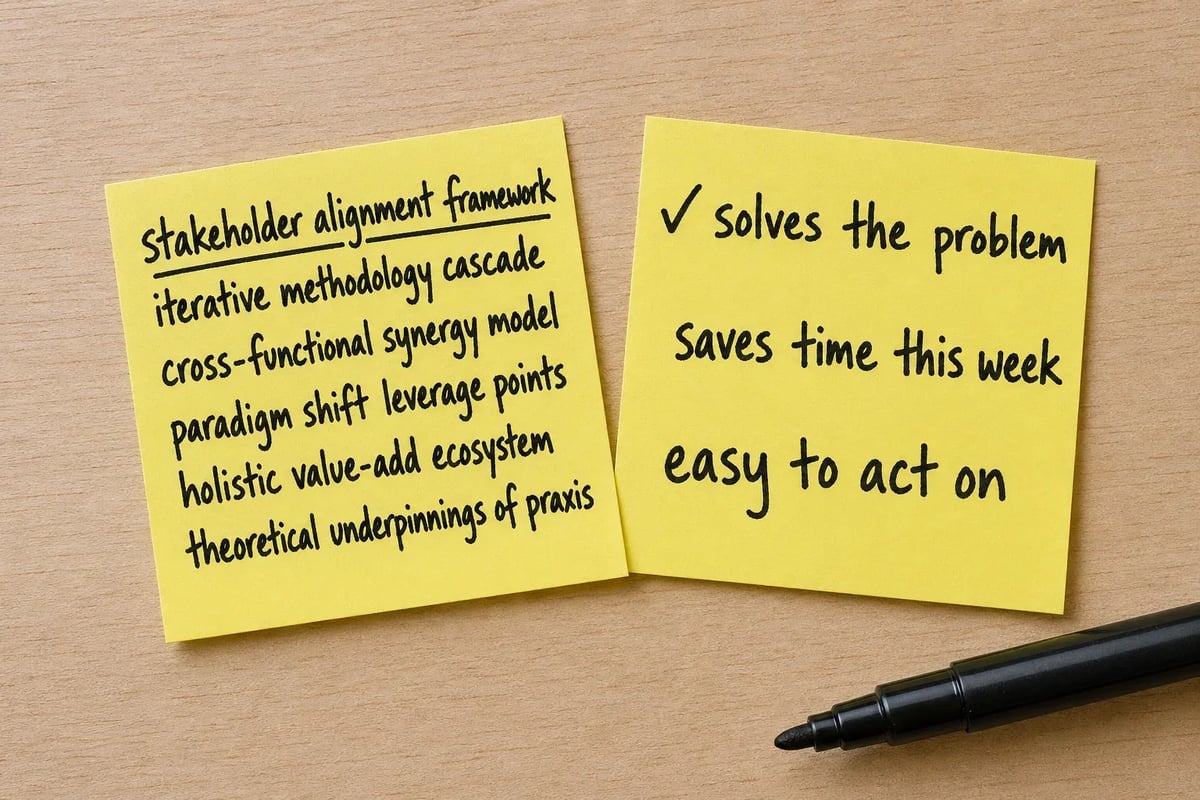
Write for the person who might email you next month.
Start with the people who already know you
Your first 50 subscribers aren’t strangers. Email past and current clients directly, tell them what you’re sending and why, and ask individually. Not a mass BCC. That personal ask converts at a rate a signup form never will.
LinkedIn does real work if you use it right. Add your newsletter link to your featured section, then mention it in actual conversations — replies, comments, direct messages — rather than posting and hoping. Roughly 5 to 10% of connections you message directly will subscribe.
Speaking slots and podcast appearances extend that. Mention the newsletter in the episode or from the stage with one simple URL. Someone who just heard you work through a problem for 40 minutes is already pre-sold.
A lead magnet handles everyone else. One specific, useful thing — a diagnostic, a checklist, a short planning template — gives a first-time visitor a reason to hand over their email. A single data-driven report added 620 net subscribers to a list of 2,800. It doesn’t need to be long. It needs to be exactly what your ideal client would Google at 11pm.
Skip buying lists. Skip ads. The goal is 200 to 500 people who actually read what you send.
Consistency beats cadence every time
Send every two weeks. That’s the answer. Frequent enough that subscribers don’t forget who you are, infrequent enough that a client emergency on a Tuesday doesn’t blow up your schedule.
Monthly works fine if you’re just starting out, and it’s genuinely better than committing to weekly and then going dark for six weeks. Weekly is sustainable for some people, but irregular sending hurts engagement more than a slower consistent cadence — missing issues trains readers to stop expecting you.
Pick a pace you can hold when a client engagement goes sideways. Then hold it.
The newsletter doesn’t close deals. It just makes sure you’re still in the room
Most consultants send a few issues, hear nothing back, and conclude the newsletter isn’t working. That’s almost always wrong and almost always premature.
The realistic timeline from first issue to first client is three to twelve months. That’s how considered B2B purchases work. Your reader finds you in January, thinks “I should talk to this person,” and doesn’t have budget or urgency until September. The newsletter’s only job is to make sure you’re still credible and present when September arrives.
The mechanics are simple. One CTA per issue, and put it in the P.S. so the content reads cleanly and the ask comes after. Keep it low-friction: “Reply if you want to talk through this,” or a link to your services page.
The readers who eventually hire you are often the ones who never clicked anything and seemed completely inert. Then one day they email you directly. That’s the newsletter working exactly as it should.
Frequently asked questions
What should a consultant newsletter include?
A consultant newsletter should include frameworks, anonymized client stories, industry observations, strong opinions, and answers to questions prospects already ask. The goal is to show how you think without giving away the full engagement.
How often should consultants send newsletters?
Every two weeks is a strong cadence for most consultants because it is frequent enough to stay remembered and slow enough to survive client work. Monthly is better than an ambitious weekly schedule that disappears after a few issues.
Can a consultant newsletter actually generate clients?
Yes, but usually on a three-to-twelve-month timeline. The newsletter keeps you credible and present until a reader has budget, urgency, or a referral opportunity.
What should consultants avoid writing about?
Consultants should avoid generic tips, peer-facing announcements, shallow article summaries, and jargon-heavy pieces written for other consultants. Buyers want useful thinking about their problem, not professional performance.
The newsletter you actually send beats the one you’re still perfecting
A paying client will always win the Tuesday morning time slot. That’s not a discipline problem; it’s just how consulting works. The newsletters that die aren’t usually bad ones. They’re abandoned ones, killed by a deliverable that couldn’t wait.
If you want a tool that helps with the blank-page problem, The Newsletter Generator is worth a look. You bring the thinking; it handles the drafting. Useful when you have ninety minutes between calls and no appetite for staring at an empty document.
The rest is just math. A newsletter you send reliably every two weeks for a year will do more for your pipeline than a brilliant one you quit after six issues.