
The blank page problem (and why it’s so absurd)
It’s Sunday night. The newsletter goes out Monday morning. You’re staring at a blank document, the cursor blinking at you like it personally has it out for you, and you cannot think of a single thing to write.
Here’s the part that makes this genuinely ridiculous: you work at a church. You have sermons, baptisms, volunteer stories, answered prayers, community meals, and a dozen people who did something worth mentioning this week alone. A lifestyle blogger would kill for your raw material. And yet — blank page.

The problem isn’t content. It’s the absence of a system. This guide gives you one: a six-pillar framework that turns your church newsletter from a weekly crisis into a repeatable process, starting with what goes in every issue and ending with a full example you can use right now. (For the broader email playbook — list growth, deliverability, automations — see our email marketing strategy guide. For the wider outreach plan around the newsletter, see the church marketing strategy guide.)
Email first, print when you need it
Email is the right default for most churches. It’s free to start (Mailchimp’s free tier covers up to 2,000 subscribers), delivers instantly, and tells you exactly who opened it and what they clicked. If your congregation skews younger or mixed-age, email handles the job well on its own.
Print still earns its place when older members make up a significant share of your regular attenders. A one-page bulletin handed out on Sunday morning reaches people who won’t open an inbox, and there’s something about a physical piece of paper that gets left on a kitchen counter instead of buried in a thread.
The hybrid approach many churches land on is sensible: email goes out weekly, and a condensed print version runs on Sundays. More work, yes, but it avoids cutting anyone off.
Pick the format that fits your congregation now. You can always add the other one later.
Six content types that end the blank-page problem
The answer to “what to include in a church newsletter” isn’t a mandatory list you tick off every week. It’s a menu. Pick three or four per issue, rotate based on what’s happening, and you always have a place to start.
Here are the six pillars:
The pastoral message is a short note from the pastor, 100 to 150 words. Not a sermon excerpt. A brief, personal observation tied to the week, the season, or something real happening in the congregation. Its job is tone-setting, not teaching.
Upcoming events are the practical core of most issues. Every event entry needs a date, a time, a location, and a name to contact. If any of those four things are missing, the event is half an announcement.
The community spotlight profiles a member, a ministry team, or a volunteer. A simple Q&A format works well. Keep a running list of nominees so you’re never scrambling for a subject.
The volunteer or service ask is where a lot of newsletters go vague. A general “we need helpers” gets ignored. A specific role, a specific date, and a specific person to contact gets results. Treat it like a job posting, not a prayer request.
Prayer requests give the congregation something to act on between Sundays. Keep the list current and brief, four to six items at most.
The scripture or reflection is a short passage tied to the current sermon series, the liturgical calendar, or a theme running through the issue. It doesn’t need commentary. The passage can stand on its own.
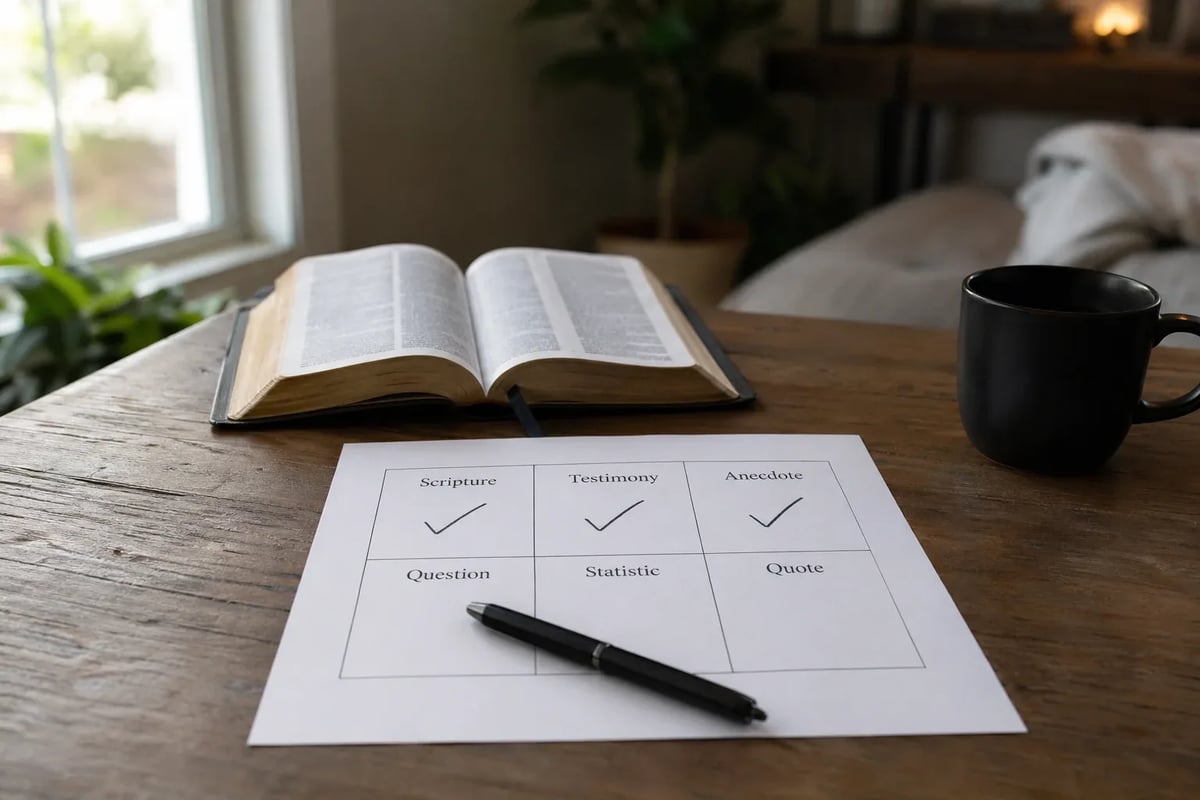
Once these six exist in your head as a menu, you stop writing from nothing. You’re choosing from options.
The church calendar is basically a content calendar — use it
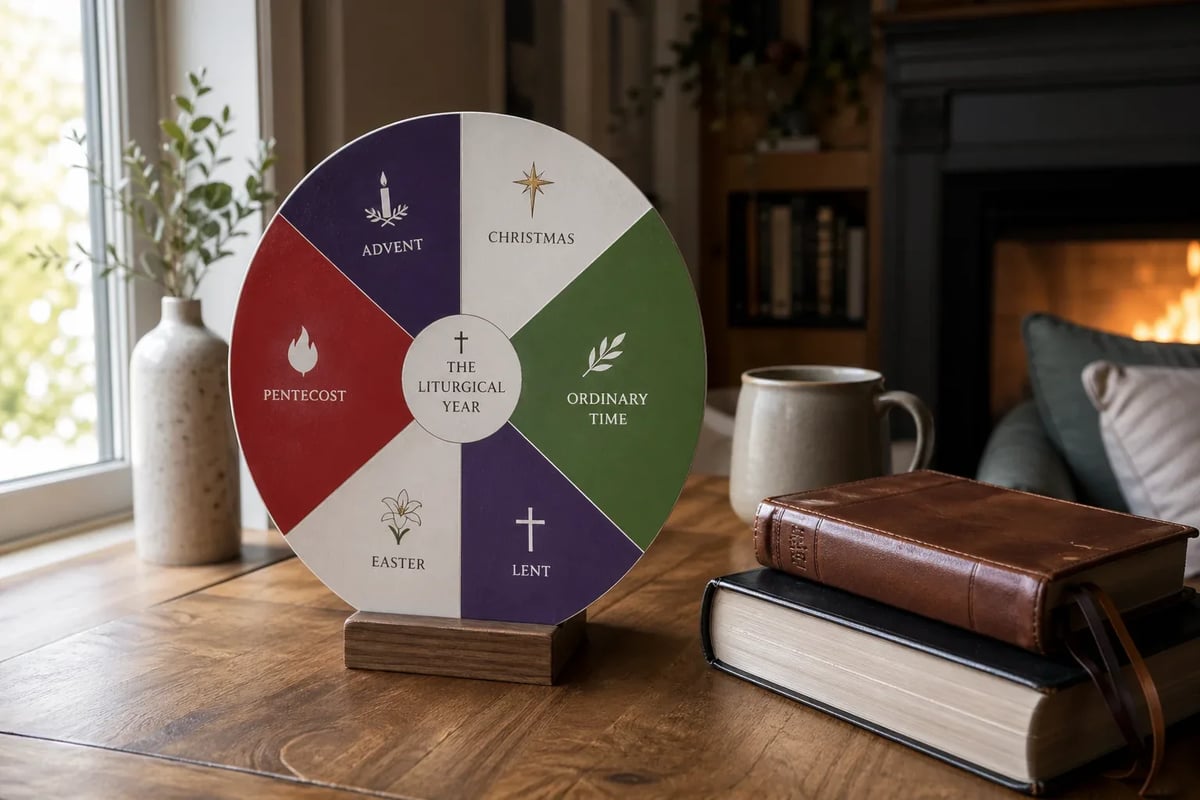
The liturgical year gives you a ready-made editorial plan. Here’s how to work each season into your church newsletter ideas rotation.
Advent and Christmas. Run a four-week series built around the traditional themes: hope, peace, joy, love. One theme per issue, each tied to a specific service or event that week. Finish December with a “Christmas in Review” piece, a short recap of attendance, outreach, and moments worth celebrating. That content rolls naturally into a January giving update.
Lent and Easter. Structure Lent as a weekly reflection series tied to the liturgical calendar. For Holy Week, go day-by-day: a brief note for Holy Thursday, Good Friday, and Holy Saturday. Families with kids appreciate a practical resource here, a simple activity or dinner-table question.
Summer. Focus on what’s actually happening: VBS registration, mission trip updates, outdoor services. A short prayer for students and teachers as August arrives is low-effort and consistently well-received.
Fall and Thanksgiving. Back-to-school is a natural hook for spotlighting teachers, school staff, and college students leaving the congregation. Thanksgiving week works well for a member gratitude piece or a short ministry-year recap before Advent begins again.
The quiet week in February is actually your best opportunity
Every church communicator knows this week. No holidays, no big events, no obvious hook. Just a blinking cursor and a deadline.
Here’s the thing about quiet weeks: the content that fills them often gets more engagement than a standard event roundup, because it’s about people rather than logistics.
Five evergreen types carry you through. Member milestones are the easiest starting point: a 100-word note on someone’s 50th anniversary as a member, with a photo, lands better than most announcements. Ministry spotlights are the workhorse of inspirational articles for church newsletters: two paragraphs on how the sound team prepares for Sunday morning, most members having no idea what that actually involves, with a photo of the setup crew at 7 a.m. Behind-the-scenes glimpses work the same way. FAQs cover practical questions people ask but never get answered in writing, like how to join a small group or set up recurring giving. Church history moments, a photo from 1987 with a caption about what’s changed, round out the five.
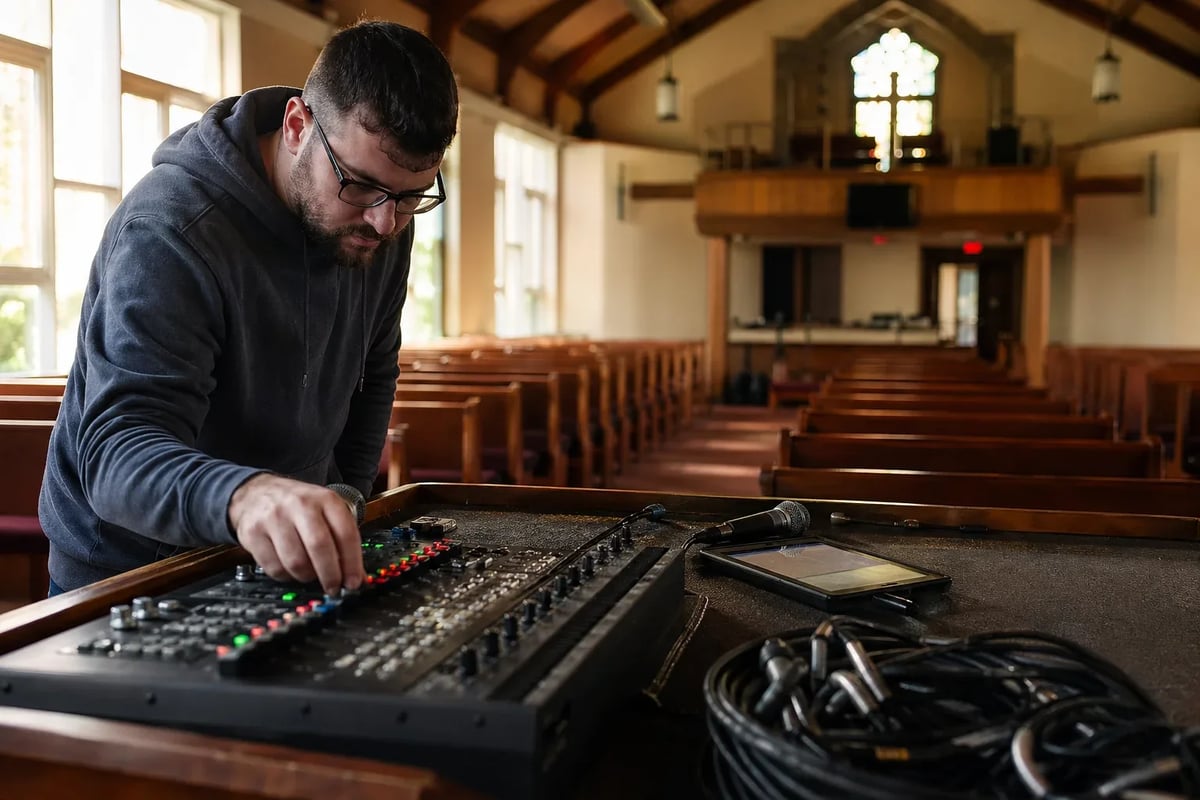
Build a simple recurring slot for these in your template and you only swap in new names and photos each week.
The subject line is the whole game
“Newsletter — Week of April 28” tells a reader exactly nothing and gives them zero reason to open. It’s the email equivalent of a manila envelope with no return address. Church newsletter templates almost never address this, which is why so many congregations are sitting on 20–25% open rates when they could be doing better.
Six formulas carry most of the weight.
A direct question creates an itch: “Did you hear what happened Wednesday?” A specific promise earns the click: “3 ways to serve this month.” Personalizing with your pastor’s name borrows their credibility: “Pastor Mike: Something happened at Wednesday’s prayer group.” Urgency works when it’s real: “Last day to sign up for the retreat.” A curiosity gap makes people lean in: “We need to tell you about the Garcias.” A story hook signals that something worth reading is inside: “Ruth almost didn’t volunteer. Then she did.”
Keep lines under 50 characters when you can. If a subject line reads fine as a sentence, it will read fine in an inbox.
Send weekly. Here’s why
For most congregations, weekly is the right cadence. A newsletter that arrives every Tuesday or Wednesday builds a rhythm members can rely on, and it keeps events, volunteer needs, and prayer requests from going stale before Sunday.
Bi-weekly works if your team genuinely can’t sustain a weekly pace. You get more room for longer stories. The tradeoff is that time-sensitive items can expire before anyone acts on them.
Monthly is mostly a report. Half the events have passed by the time it lands. It can work for a large, low-activity list, but for an active congregation it’s too slow to feel like community.
Pick one cadence, stick to it, and aim for open rates above 20%. After a couple months, ask your members if it feels like too much or not enough. They’ll tell you.
What a real church newsletter looks like, pillar by pillar
Here’s a complete issue for a fictional mid-size Protestant congregation, each section labeled.
Grace Fellowship Church | Weekly Update May 4, 2025 | Vol. 12, Issue 18 *Pastor David Chen | 417 Maple Grove Drive, Riverside, CA | [email protected]*
Pastoral reflection *(Pillar 1)* This Sunday begins “Faith in Action,” a four-week series through James 2:14-26. James is uncomfortably practical. He wants to know what you did on a Tuesday afternoon. Come ready. — Pastor David
Announcements *(Pillar 2)* Sunday services at 9:00 and 11:00 a.m. Midweek Bible study, Thursday at 6:30 p.m., Room 4. Spring outreach BBQ, May 10 at Riverside Community Park; volunteers needed. Youth car wash fundraiser, May 17, east lot.
Member spotlight *(Pillar 3)* Margaret Osei has stocked the church pantry every other Tuesday for three years, starting during the pandemic. Contact: [email protected].
Volunteer opportunity *(Pillar 4)* Four people needed for May 10 BBQ setup, 8:00-10:00 a.m. Email [email protected] by Wednesday.
Prayer requests *(Pillar 5)* Tom Brewer, recovering from knee surgery. The Nguyen family, who lost a loved one this week. Mission team departing May 9. Submit at [email protected].
Closing scripture *(Pillar 6)* *“May the God of hope fill you with all joy and peace as you trust in him.”* — Romans 15:13
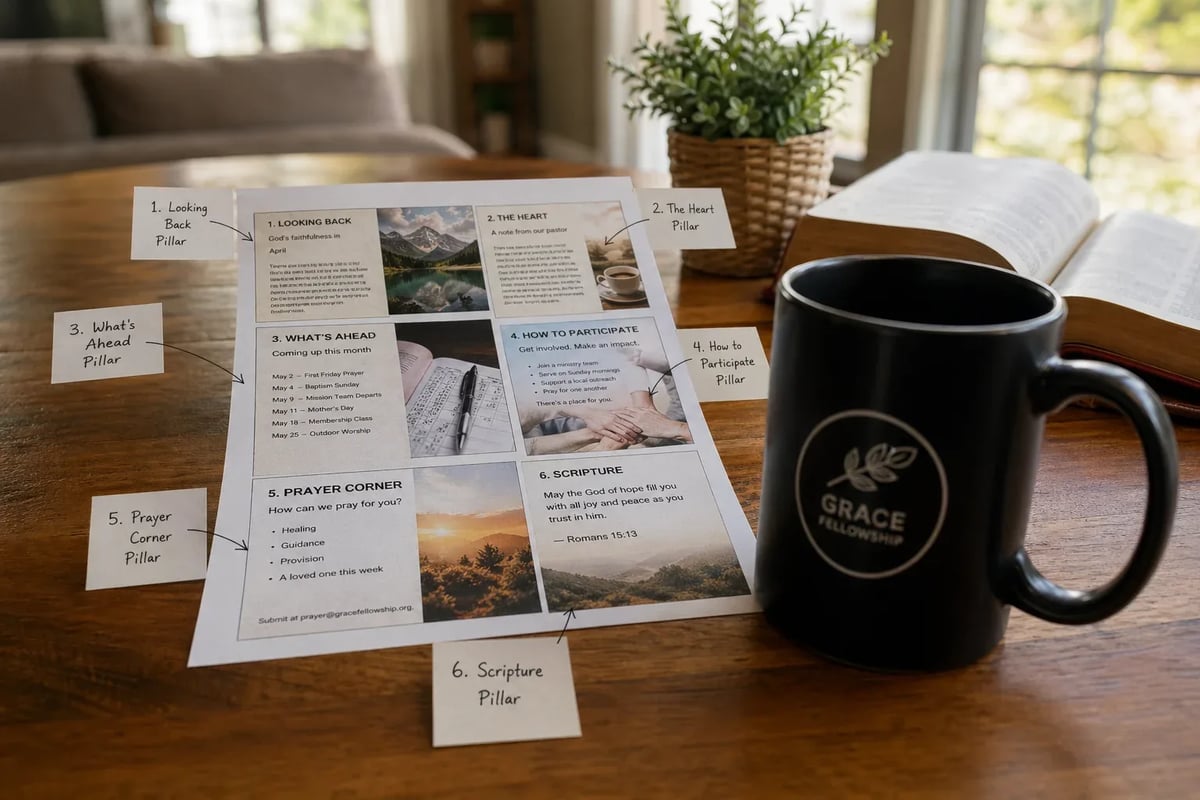
The whole issue takes about 20 minutes to assemble once the framework is in place.
Frequently asked questions
What should a church newsletter include?
A church newsletter should include a short pastoral note, upcoming events, community spotlights, volunteer needs, prayer requests, and a scripture or reflection. Most issues only need three or four of those elements, rotated based on the week.
How often should a church send a newsletter?
Weekly is the best cadence for most active congregations because events, volunteer needs, and prayer requests expire quickly. Bi-weekly can work for smaller teams, while monthly usually feels more like a report than a community update.
What are good church newsletter ideas for quiet weeks?
Good quiet-week ideas include member milestones, ministry spotlights, behind-the-scenes glimpses, practical FAQs, church history moments, and short reflections tied to the sermon series or liturgical calendar.
Should church newsletters be email, print, or both?
Email is the best default because it is fast, inexpensive, and measurable. Print still matters for congregations with older members or Sunday bulletin habits, so many churches use email weekly and a condensed print version when needed.
Save the 20 minutes you just spent on that example
Most church newsletters are written by one person who also answers the phones, coordinates volunteers, and somehow remembers to order communion supplies. If that’s you, the Newsletter Generator is worth a look. You paste in your sermon topic, upcoming events, and any announcements, and it returns a structured draft you can edit down to your voice. You still make the calls on tone and accuracy, but you’re editing instead of staring at a blank page, which is a significantly more tolerable way to spend a Monday morning.