
Your clients hear from you once a year. Here’s what that costs you.
For most clients, contact with their accountant follows a simple pattern: silence, then a flurry of emails in February and March, then silence again. The accountant newsletter exists to break that pattern, not because staying in touch is virtuous in some abstract sense, but because clients who hear from you only at tax time tend to think of you as a filer, not an advisor.
That distinction matters more than it sounds. A filer gets called when a deadline is coming. An advisor gets called when a business decision is brewing, when a client’s kid starts a freelance side job, when someone inherits money and doesn’t know what to do next. Those calls are where the relationship deepens, and they don’t happen if you’ve been quiet for ten months.

Referrals follow the same logic. A client who heard from you in October, November, and December is more likely to mention your name at a dinner party in January than one who filed with you nine months ago and hasn’t seen your name since. According to ClearlyRated, top-performing CPA firms generate the majority of their referrals from existing tax clients. Visibility is what keeps you in that conversation.
For the broader email playbook this client newsletter sits inside — list growth, automations, deliverability — see our email marketing strategy guide. And if you haven’t launched a newsletter at all yet, how to start a newsletter covers the platform setup.
The line between useful content and billable advice
The accountant newsletter works because it stays on one side of a clear boundary: general awareness versus specific recommendation. Cross that line and you’ve either given away work that should be a paid engagement or created liability you didn’t intend. Stay on it and you’ve given clients something genuinely useful without doing their planning for them.
What belongs in a newsletter: upcoming deadlines, explanations of how a new rule works, reminders that a particular filing window is opening, context on a regulatory change and who it generally affects, answers to common questions your clients ask every year. The defining feature is that none of it requires knowing anything about the reader’s specific situation.
What doesn’t belong: telling a reader to accelerate deductions before year-end, recommending they convert their IRA, or suggesting they adjust their estimated payments. Those aren’t general observations. They’re recommendations, and making them without context about someone’s income, filing status, or existing positions is where newsletters stop being educational and start being advisory.

The practical test is simple. Read the sentence back and ask whether it could appear in a general-audience tax guide written for no one in particular. If yes, it belongs. If it only makes sense for someone in a specific situation, it belongs in a paid engagement.
Framing helps enforce this. Phrases like “this may be worth reviewing with your advisor” or “check whether this applies to your situation” signal that the content is informational. Section labels like “What changed” or “Who this affects generally” do the same work structurally. They position the newsletter as a heads-up, which is exactly what it should be.
A content calendar for every month of the tax year
The tax calendar does most of the work for you. Each quarter hands you a natural hook, which means a well-run CPA newsletter almost never needs to invent a topic from scratch.
January and February
Filing season opens and clients are gathering documents. Good topics: what’s new in the 2025 tax year, the 2026 IRA and 401(k) contribution limits ($7,500 and $24,500 respectively), which forms to expect in the mail and when, and the RMD rules under SECURE 2.0 for clients who turned 73 in 2025 and have a first RMD due by April 1, 2026.
March and April
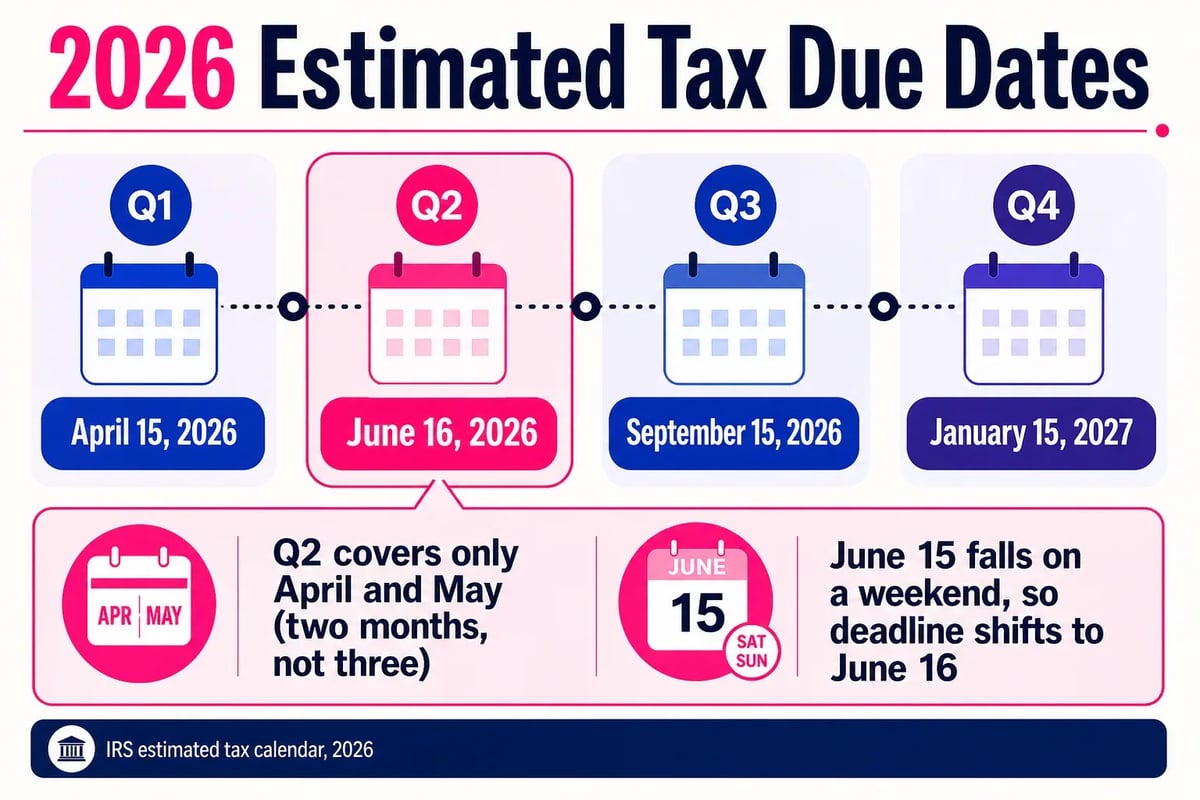
The April 15 deadline dominates, but the issue most clients miss is what an extension actually does. Form 4868 extends the filing deadline to October 15 but not the payment deadline. Tax owed is still due April 15. That distinction alone is worth a full newsletter item. Q1 estimated tax payments are also due April 15 for self-employed clients and others paying quarterly.
May and June
The Q2 estimated payment is due June 16, 2026 (shifted from June 15, which falls on a weekend). This is a good issue to explain why Q2 covers only two months of income (April and May) while other quarters cover three, a quirk that regularly confuses clients. Mid-year is also a reasonable time to flag life changes that affect withholding: a new job, a spouse returning to work, a business revenue shift.
July through September
The Q3 estimated payment is due September 15. Between now and then, the newsletter has room for less deadline-driven content: a primer on the wash-sale rule ahead of fall loss-harvesting, how capital gains rates work at different income levels, or a reminder that the October 15 extension deadline is coming for anyone who filed Form 4868 in April.
October through December
The October 15 extension deadline opens this window, then year-end planning takes over. Key topics: the December 31 deadline for Roth conversions (which cannot be reversed after 2017), the December 31 deadline for annual RMDs, and reminders that retirement contributions and charitable giving decisions close with the calendar year.
Evergreen topics (any month)
Some content fits any issue regardless of timing: how to read an IRS notice without panicking, what actually triggers an audit, the difference between a deduction and a credit, and how long clients should keep their records. These answer questions clients are already searching for and fill any month with no obvious deadline hook.
Monthly is right; quarterly is the floor
Send monthly. The calendar section above is the argument: there is a relevant, timely topic available in every single month of the year. An accountant newsletter sent monthly fits naturally against that structure without forcing topics that don’t belong.
Quarterly is acceptable if monthly isn’t realistic for your firm, but treat it as a minimum rather than a strategy. Four issues per year means you’ll miss months where clients are actively thinking about taxes and would benefit from hearing from you. The off-season visibility gap that quarterly creates is exactly the problem a newsletter is supposed to solve.
One practical note: consistency matters more than frequency. A monthly newsletter that arrives reliably on the first Tuesday of the month sets a client expectation. An irregular send schedule, even at high volume, trains clients to ignore it. Pick a cadence you can sustain and hold it.
Here’s what an October issue actually looks like
The following is a complete example issue. Use it as a template for structure, tone, and content depth.
Subject line: 3 year-end moves worth a look before December
Hi [First Name],
October is the right time to start thinking about year-end. The decisions that affect your 2026 tax return are mostly made by December 31, so the next few weeks are when they’re worth reviewing.
Three year-end moves to consider
Tax-loss harvesting. Selling investments that are down from your cost basis lets you use that loss to offset capital gains elsewhere. Losses beyond your gains can offset up to $3,000 of ordinary income per year. The sale must settle by December 31, so execute a day or two early. Buying back the same or a substantially identical security within 30 days before or after the sale disallows the loss under the wash-sale rule.
Required minimum distributions. If you turned 73 in 2026, you must take your first distribution from a traditional IRA or 401(k) by December 31, 2026. You can delay until April 1, 2027, though that may not help your situation. Missing the deadline carries a 25% penalty on the amount you should have withdrawn.
Retirement account contributions. The 2026 IRA limit is $7,500 if you’re under 50, and $8,600 if you’re 50 or older. IRA contributions can go in until April 15, 2027; 401(k) contributions must go in by December 31.
Is a Roth conversion worth a look this year?
A Roth conversion moves money from a traditional IRA into a Roth IRA. You pay income tax on the converted amount now; future growth and qualified withdrawals are tax-free. October and November are practical months to consider it because your 2026 income picture is clearer than it was in January and you still have time to act. Whether it makes sense depends on your current bracket, your expected bracket in retirement, and other factors specific to your situation. Reply if you want to run the numbers.
Q4 estimated payment reminder
The fourth-quarter payment covering September 1 through December 31, 2026 is due January 15, 2027. You can skip it if you file your full 2026 return and pay any balance by February 1, 2027.
From the office
We’ve moved to appointment-only scheduling for the rest of the year. Reply and we’ll find a time.
Until next month, [Your Name] [Firm Name] | [Phone] | [Email]
This newsletter is for general informational purposes only and does not constitute tax or financial advice specific to your situation. Consult your tax advisor before taking action.
Frequently asked questions
What should an accountant newsletter include?
An accountant newsletter should include deadline reminders, tax-law changes, document checklists, estimated payment notes, and explanations of common client questions. The content should stay educational rather than giving advice for a specific reader's situation.
How often should accounting firms send client newsletters?
Monthly is the strongest cadence for most accounting firms because the tax calendar creates useful topics throughout the year. Quarterly is acceptable if monthly is not realistic, but it leaves visibility gaps.
What accountant newsletter topics work outside tax season?
Outside tax season, good topics include estimated payment reminders, extension deadlines, recordkeeping, IRS notice explanations, deduction versus credit basics, retirement contribution limits, and year-end planning concepts.
How can accountants avoid giving specific advice in a newsletter?
Keep the content general, explain who a rule may affect, and point readers back to an advisor for situation-specific decisions. Avoid telling readers to take an action that depends on income, filing status, entity structure, or other personal facts.
The newsletter you never send costs more than the one that takes two hours
Every hour you spend writing is an hour you’re not billing, and that math is hard to argue with. But a client who receives nothing from you between March and March is also a client who has no particular reason to mention your name at dinner. At an average of roughly $2,800 in annual revenue per client, one referral that converts covers a year’s worth of tooling with room left over. The Newsletter Generator is built for exactly this constraint: give it your topics and it produces a ready-to-send draft, so the writing doesn’t come out of your billable hours.