
Traffic losses require a better SEO scoreboard
Traffic charts dropped. Screenshots hit X. The familiar funeral procession began.
The panic followed Ahrefs’ “Is SEO Dead?” analysis, which examined organic traffic across roughly 40,000 large U.S. sites using Ahrefs’ keyword and traffic estimates, with Similarweb data for context. The analysis found modest declines overall, distributed unevenly across sites and topics. That scope matters. It cannot describe every small business, local market, or country, and its observational data cannot prove what caused each decline.
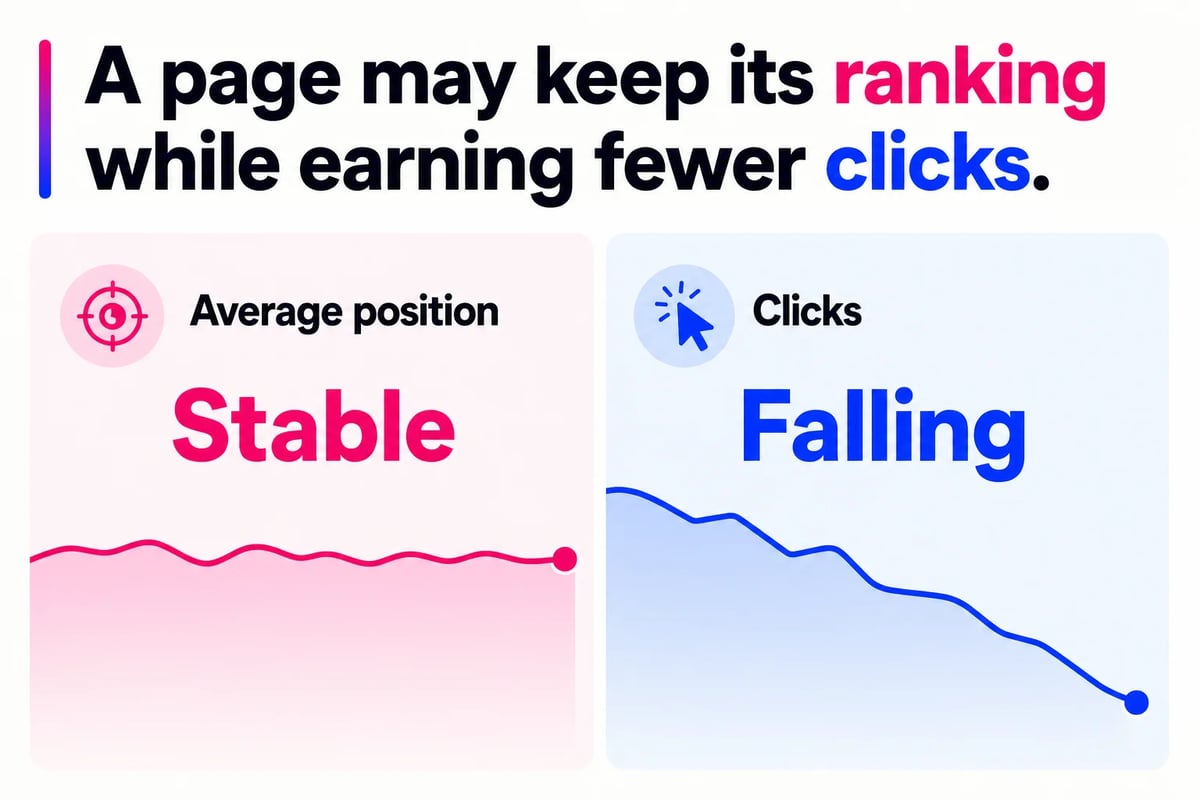
Some losses are painfully real. Publishers, affiliates, informational sites, and pages answering simple questions have taken meaningful hits. AI Overviews, featured snippets, knowledge panels, and other search features can satisfy a query before the user visits a website. A page may keep its ranking while earning fewer clicks.
Calling every decline temporary would be denial. Calling the entire practice dead turns a difficult channel change into an X-friendly binary: SEO must be thriving, or SEO must be useless. Neither conclusion follows from the evidence.
Clicks can fall while search visibility remains. Search demand can remain while Google captures more of the interaction. A company can lose informational sessions yet retain qualified leads, branded searches, and sales. The reverse can also happen: rising impressions may produce little commercial value.
Ahrefs reaches a blunt conclusion in its analysis: “SEO. Is. Not. Dead.” The useful part sits beyond the slogan. Search behavior and result pages have changed, so the old scoreboard now misses a growing share of discovery and influence.
SEO isn’t dead, but rankings and clicks are no longer the whole game. The commercial objective now includes being found, cited, trusted, and ultimately chosen, wherever customers research a purchase.
Diagnose the decline before changing strategy
A traffic graph is a symptom report, not a business diagnosis. Before rewriting your content plan, separate five possible failures: visibility, click-through rate, demand, conversion performance, and measurement.
Search Console defines impressions, clicks, CTR, and average position differently, and each metric can move for different reasons. Average position can also hide changes across queries, pages, devices, and countries. Compare like-for-like periods and segment the data before blaming AI Overviews, an algorithm update, or your agency.
| Observed symptom | Likely explanation | How to verify | Business response |
|---|---|---|---|
| Impressions and clicks both fall | Rankings, indexation, demand, or query mix declined | Check page and query segments, indexing, seasonality, and multi-year category interest | Fix technical or ranking losses when demand holds. Adjust forecasts when category demand has cooled |
| Impressions hold while clicks fall | Lower CTR caused by weaker snippets, changed intent, competitors, ads, or SERP features | Compare CTR by query, page, device, and country. Inspect the live results | Improve titles and descriptions, then review whether the page still matches the query |
| Traffic holds while conversions fall | Landing-page friction, weaker traffic quality, broken forms, pricing changes, or tracking errors | Test forms and calls, compare conversion rate by landing page, and check CRM outcomes | Repair the conversion path before publishing more content |
| Nonbranded traffic falls while branded demand rises | Generic discovery weakened while brand interest or returning demand grew | Separate branded and nonbranded queries, then compare brand searches, direct visits, and leads | Protect high-intent brand pages and investigate the generic-query losses |
| Reported organic traffic falls while leads remain stable | Attribution, consent, channel classification, or cross-device gaps may be understating organic influence | Reconcile GA4 with Search Console, CRM records, call tracking, and form submissions | Fix measurement and judge the channel by qualified outcomes |
Use Google Trends carefully. Its 0 to 100 values show relative interest within the selected geography and period, rather than absolute search volume. A plumber can compare several years of interest in a stable generic query with Search Console impressions. Flat category interest plus falling impressions points toward lost visibility. Falling interest across both sources supports a demand explanation. Neither pattern alone proves that AI caused the change.
Build visibility across the full discovery path
A prospect may discover a business through a blue link, a local result, a Google AI Overview, a ChatGPT citation, a YouTube video, or a recommendation repeated across several channels. A click remains valuable, but discovery can begin before anyone reaches the website.
SEO isn’t dead, but rankings and clicks are no longer the whole game. The wider objective is to be found, cited, trusted, and ultimately chosen.
| Stage | What it means | Business outcome |
|---|---|---|
| Found | Your pages are eligible and visible when a relevant search or question occurs. Search engines and AI systems can access, understand, and retrieve the content. | More qualified discovery across Google Search, Google AI Overviews, ChatGPT, and other discovery channels |
| Cited | An answer uses, links to, or mentions your business or content as a source. | Brand exposure, referral opportunities, and influence before a website visit |
| Trusted | The business presents credible evidence and consistent signals, including clear ownership, accurate claims, customer proof, and third-party recognition. | Greater confidence among prospects comparing possible providers |
| Chosen | The prospect takes a commercial action, such as calling, booking, requesting a quote, subscribing, or buying. | Leads, pipeline, and revenue |

The first stage still depends heavily on familiar SEO requirements. Google says pages must be indexed and eligible for snippets before they can appear as supporting links in AI Overviews or AI Mode. ChatGPT Search can pull current information from the web and present clickable inline citations plus a Sources panel. Visibility now has more possible surfaces, while the basic requirement remains machine access to useful pages.
Answer engine optimization, or AEO, shapes content so answer systems can understand and retrieve it. Generative engine optimization, or GEO, applies that idea to AI-generated responses and citations. Both are extensions of SEO. They carry new labels because consultants do enjoy a fresh acronym, but they retain the same underlying work of access, relevance, evidence, and authority.
No tactic guarantees a citation. AI outputs vary by model, prompt, location, available sources, and time. A citation may also produce awareness without a measurable visit. Small teams should focus on becoming eligible, useful, credible, and commercially convincing across the places where customers research decisions.
What still compounds in search and AI discovery
Search engines cannot rank, quote, or recommend pages they cannot process. Keep important pages crawlable and indexable, use canonicals for duplicates, connect pages with internal links, submit a sitemap, and make sure essential content survives JavaScript rendering. Structured data must match the visible page.
Google says pages must be indexed and eligible for a Search snippet before they can appear as supporting links in AI Overviews or AI Mode. There is no secret AI schema or special file. Existing SEO controls still govern access and previews.
Generic explainers are now cheap enough to produce before lunch, which makes mass-produced AI articles interchangeable rather than valuable. Useful pages contain material competitors cannot reproduce by changing a prompt: original comparisons, customer questions answered from experience, local details, tested recommendations, pricing context, photographs, examples, and documented methods. Keep time-sensitive claims current. Descriptive titles and clear sections help Google understand the page, while direct answers and supporting detail give AI systems passages they can retrieve and cite.
Backlinks still help search engines assess authority, but evidence on the page matters too. Name the author, link to a credible profile, explain how conclusions were reached, and cite primary sources for claims that need verification. A legal guide should identify its qualified reviewer and link factual claims to courts, regulators, or government sources. Independent reviews, trade associations, local coverage, and relevant mentions also corroborate your claims beyond your own marketing copy.
Use a consistent business name, service description, address, phone number, and author identity across your website, Google Business Profile, directories, social profiles, and third-party listings. Add accurate Organization or LocalBusiness structured data where appropriate. This supports local and branded search while helping AI systems connect a company with its people, location, and services.
Visibility has limited value when visitors must hunt for pricing, proof, or the contact button. Give each commercial page one purpose, a clear value proposition near the top, relevant testimonials or case studies, pricing guidance where possible, and an obvious next step. AI-assisted discovery may send fewer but better-informed visitors, so service, product, location, and pricing pages should help them call, book, request a quote, start a trial, or buy without restarting their research.
Six SEO actions a small team can execute
A small team should concentrate effort on pages and assets closest to a buying decision. Six actions deserve priority.
- Refresh a small set of high-value pages
Choose five to ten service, product, location, comparison, or pricing pages with existing visibility or clear commercial value. Update outdated claims, answer the questions prospects ask before buying, improve internal links, and remove filler. A meaningful revision to one proven page beats another generic article added to a neglected blog.
- Add first-party evidence and named expertise
Mine customer surveys, support tickets, sales-call notes, chat transcripts, project records, and staff experience. Turn recurring questions into answers attributed to a named employee who knows the subject. Add original photos, anonymized results, price ranges, test findings, or local details where consent and confidentiality allow.
This does not require a research department. A contractor can summarize common project delays from completed job records. An agency can publish patterns from client discovery calls. A retailer can use checkout responses to explain how customers choose between two products. Competitors can imitate the format, but they cannot reproduce the underlying evidence.
- Clarify entities and business facts
Keep the business name, address, phone number, services, locations, and key people consistent across the site, Google Business Profile, relevant directories, and trusted industry profiles. Connect author pages to real biographies and professional profiles.
Add accurate Organization or LocalBusiness structured data to one authoritative page, usually the homepage or About page. Prioritize the correct subtype, name, URL, logo, description, address, and relevant sameAs links. Use Person markup for genuine authors or experts when appropriate. Do not create or control reviews about your own business and mark them up as independent endorsements.
- Make useful answers easy to extract
Use descriptive headings, concise passages, comparison tables, definitions, and explicit sourcing. Put the direct answer near the question, then add qualifications and evidence. This citation-friendly formatting improves comprehension and retrieval. It does not guarantee inclusion in Google AI Overviews, ChatGPT, or any other answer system.
- Distribute assets where customers already gather
Share the useful part, rather than dropping a link and fleeing the scene. Offer a pricing benchmark to a trade publication, contribute expert commentary to a local reporter, post a practical excerpt in an industry community, or discuss original findings on a relevant podcast. Distribution can create referral traffic, mentions, links, and corroborating brand signals.
- Improve calls to action and conversion paths
Match each high-value page to one useful next step: book, call, request a quote, check availability, start a trial, or buy. Reduce unnecessary fields, explain what happens after submission, and place proof near the decision point.
Do not prioritize Skip generic content volume, prompt-chasing, dozens of low-value schema types, rank tracking without commercial context, and expensive AI-visibility tools before the basics are measured. Those activities consume a small team’s budget faster than they resolve customer questions.
Build a scorecard around commercial outcomes
A traffic report cannot tell you whether SEO helped sell anything. Replace the familiar wall of rankings, impressions, and sessions with a three-level scorecard.
| Level | Track | Use it to decide |
|---|---|---|
| Business outcomes | Qualified leads, sales, pipeline, revenue, conversion rate | Whether discovery activity produces commercial value |
| Demand and trust indicators | Branded demand, direct visits, repeat visits, mentions, reviews, assisted conversions | Whether more people know, remember, and consider the business |
| Diagnostic visibility | Rankings, impressions, organic sessions, referral traffic, AI citations or mentions | Where visibility rose or fell and which pages need investigation |
Configure three to five GA4 key events tied to actual outcomes, such as a qualified form submission, booked call, trial signup, purchase, or meaningful phone inquiry. Existing events can be marked as key events with the star icon. A confirmation-page visit can also become a derived event without new site code.
Then compare key-event counts and conversion rates by channel and landing page. Check assisted conversions and paths too. A prospect may discover you through Google Search, see your company mentioned in ChatGPT, return directly three days later, and finally book after reading reviews. Last-click reporting gives the final visit all the applause.
Track branded queries in Search Console, using query filters where needed, and compare broader interest in Google Trends. Record relevant AI citations and mentions through periodic manual checks or a modest tracking tool. Citation results vary by prompt, location, model, and timing, so treat them as directional evidence rather than a new trophy counter.
A small team needs a light cadence:
- Weekly: check tracking failures, sharp changes, and lost visibility on commercial pages.
- Monthly: review leads, pipeline, revenue, conversion rate, branded demand, and assisted journeys.
- Quarterly: decide which topics, pages, channels, and partnerships deserve continued investment.
Put the scorecard to work over the next 30 days
Keep the first cycle small: choose no more than ten pages with commercial potential, then improve the best three to five. A giant audit sitting in a folder converts nobody.
| Week | Tasks | Deliverables | Complete when |
|---|---|---|---|
| 1. Baseline and diagnose | Connect Search Console, GA4, CRM, and Google Business Profile reporting where relevant. Export Search Console data for a consistent period. Prioritize pages by commercial value, visibility, gaps, and effort. Classify losses as ranking, CTR, demand, conversion, or tracking problems. Test fixed buyer questions across Google Search, AI Overviews, ChatGPT, and one or two customer channels. | Baseline, priority pages, issue backlog | Each page has a commercial goal, baseline, loss classification, and next action. |
| 2. Improve key pages | Fix crawl, indexing, canonical, mobile, or rendering problems. Match intent, add direct answers, improve titles and internal links, clarify authorship and business entities, and repair forms, calls to action, booking flows, or phone tracking. | Three to five upgraded pages and change log | Each page is indexable, useful, attributable, linked, and able to convert. |
| 3. Add evidence and distribution | Interview an internal expert or customer-facing employee. Add first-party examples, data, comparisons, photos, or customer language. Publish one substantial refresh or citation-worthy asset, then share it through relevant partners, communities, email, profiles, or focused PR. | Differentiated asset, outreach list, distribution log | The asset contains evidence competitors cannot copy from the same search results, and relevant contacts received it. |
| 4. Measure and systematize | Compare visibility indicators with leads, pipeline, revenue, and conversion rate. Recheck the fixed prompts as variable observations, document changes, and select next month’s pages by commercial opportunity. | Scorecard, lessons, next backlog | The team can explain what changed, what produced value, and what comes next. |
Stop interchangeable content and vanity reporting. Continue technical maintenance, authority building, useful content, and conversion work. Start consistent discovery testing, first-party proof, and prioritization by commercial impact.