
Your retail marketing is probably three things that don’t talk to each other
Picture a store running Instagram ads for a weekend sale, a “we miss you” email going out to a list that hasn’t been cleaned in two years, and a Google Business Profile still showing the old address from when they moved locations in 2022. Each one represents effort. None of them know the others exist.
That’s the version of retail marketing most stores are actually running: a pile of tactics assembled over time, each living in its own silo, none feeding the others.
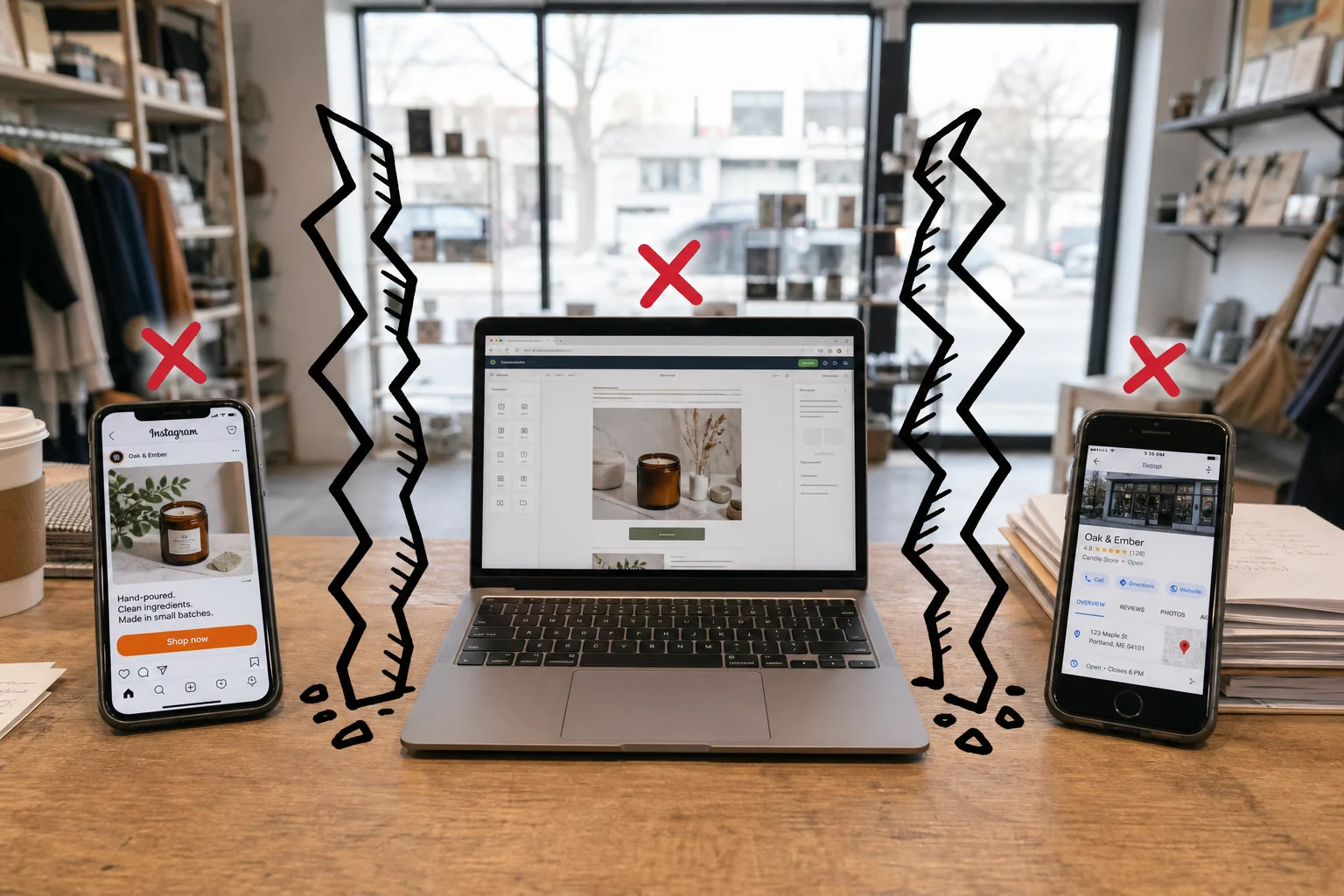
A retail marketing strategy is different. It connects your audience, your channels, your promotions, and your measurement into a single plan where each piece reinforces the rest. The goal isn’t to do more things. It’s to make the things you’re doing point in the same direction.
This guide walks through that plan in six steps: audience, channels, foot traffic, promotions, content, and measurement.
Your customers aren’t one person, and your marketing can’t pretend they are
Before you pick a single channel or write a single ad, you need a clear picture of who actually buys from you, and where they are in the process when they first encounter your brand.
Start with three segments that cover most retail buyers: the foot-traffic shopper who discovers you locally, the online researcher who finds you through search before ever setting foot inside, and the seasonal deal-seeker who shows up around holidays and big promotions then disappears.
The middle segment is the one most stores underestimate. Around 86% of shoppers research products online before buying in-store, and roughly 73% use more than one channel to complete a single purchase. That customer is not an online shopper or an in-store shopper. She’s both, often within the same hour.
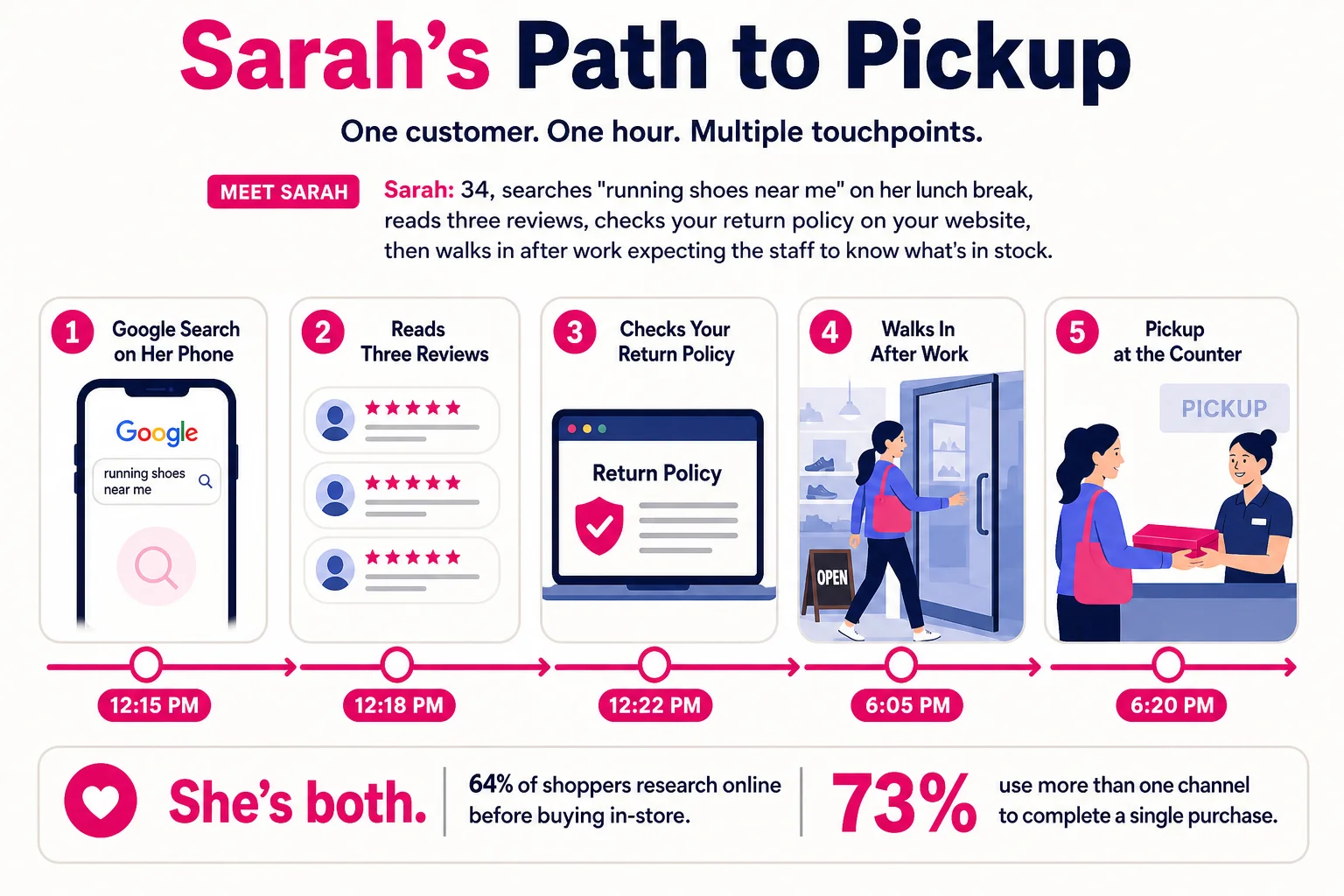
Put a name to her. Call her Sarah: 34, searches “running shoes near me” on her lunch break, reads three reviews, checks your return policy on your website, then walks in after work expecting the staff to know what’s in stock. If your Google Business Profile is outdated or your product pages don’t show inventory, you lost her before she left her desk.
That single persona sketch changes what you prioritize: local search visibility, accurate product information online, and staff who can reference what the website says. The segments you build here are what the next steps plug into.
Don’t market everywhere. Market where Sarah actually goes.
Once you know who your customer is, the channel question gets easier. The instinct is to be everywhere. The smarter move is to be in the two or three places that match how your specific buyer actually shops.
Here’s a rough map. For brick-and-mortar discovery, Google Business Profile is the starting point, not a nice-to-have. Complete listings get roughly 7x more clicks than incomplete ones, and that gap closes before a single ad dollar is spent. More on this in Step 3.
For retention and repeat purchase, email is the highest-return channel most retailers under-invest in. Retail and ecommerce email delivers an average ROI around $45 per $1 spent, with abandoned-cart flows reaching roughly $3.65 revenue per recipient versus around $0.11 for a standard campaign send. The gap between “sent a newsletter” and “set up an automated flow” is where most stores leave money.
SMS works best as a complement to email for high-intent moments: flash sales, restock alerts, cart recovery. Open rates sit around 97-98%, but the opt-out rate matters too, so reserve it for genuinely time-sensitive messages.
Paid social and organic content earn their place for awareness and new customer acquisition, but they belong later in the build, after your owned channels are set up.
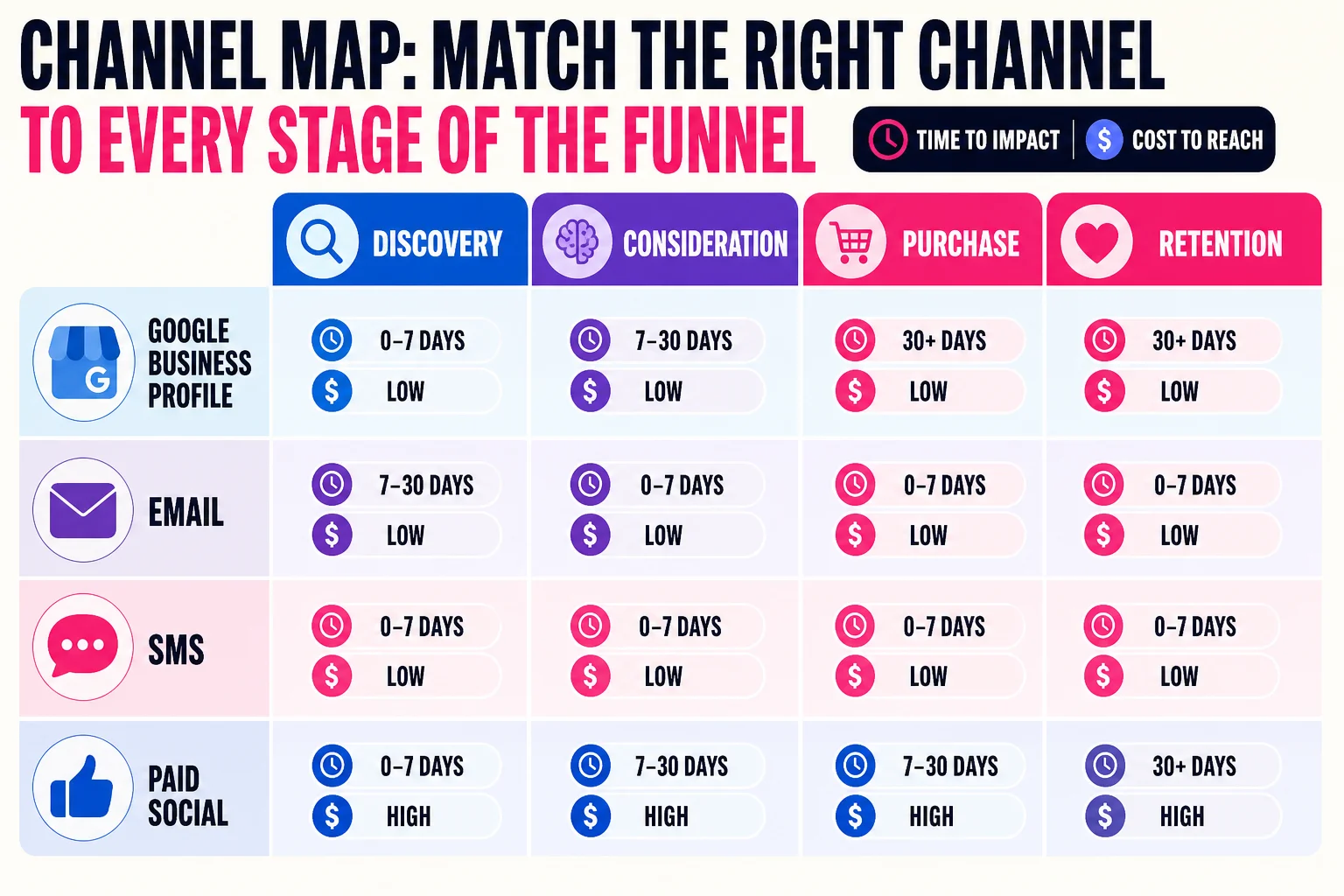
If you want a channel map built around your specific store type and audience, the generator in this guide can do that work for you.
Google knows where your customers are. Does your listing?
Around 46% of all Google searches carry local intent, and 76% of people who run a “near me” search visit a business within 24 hours. That is not ambient interest. That is someone who has already decided to buy and is picking a winner from the first screen they see.
The businesses that win those searches are almost always in the local pack, the three map results that appear above organic listings. Getting there starts with your Google Business Profile, and the gap between a complete profile and an incomplete one is not subtle. The checklist that actually moves the needle: accurate hours including holiday exceptions, at least ten photos of your storefront and interior, a primary category that matches your actual business type (not a vague parent category), responses to every review whether positive or negative, at least one GBP Post per week, and a populated Q&A section where you answer the questions customers would otherwise call about.
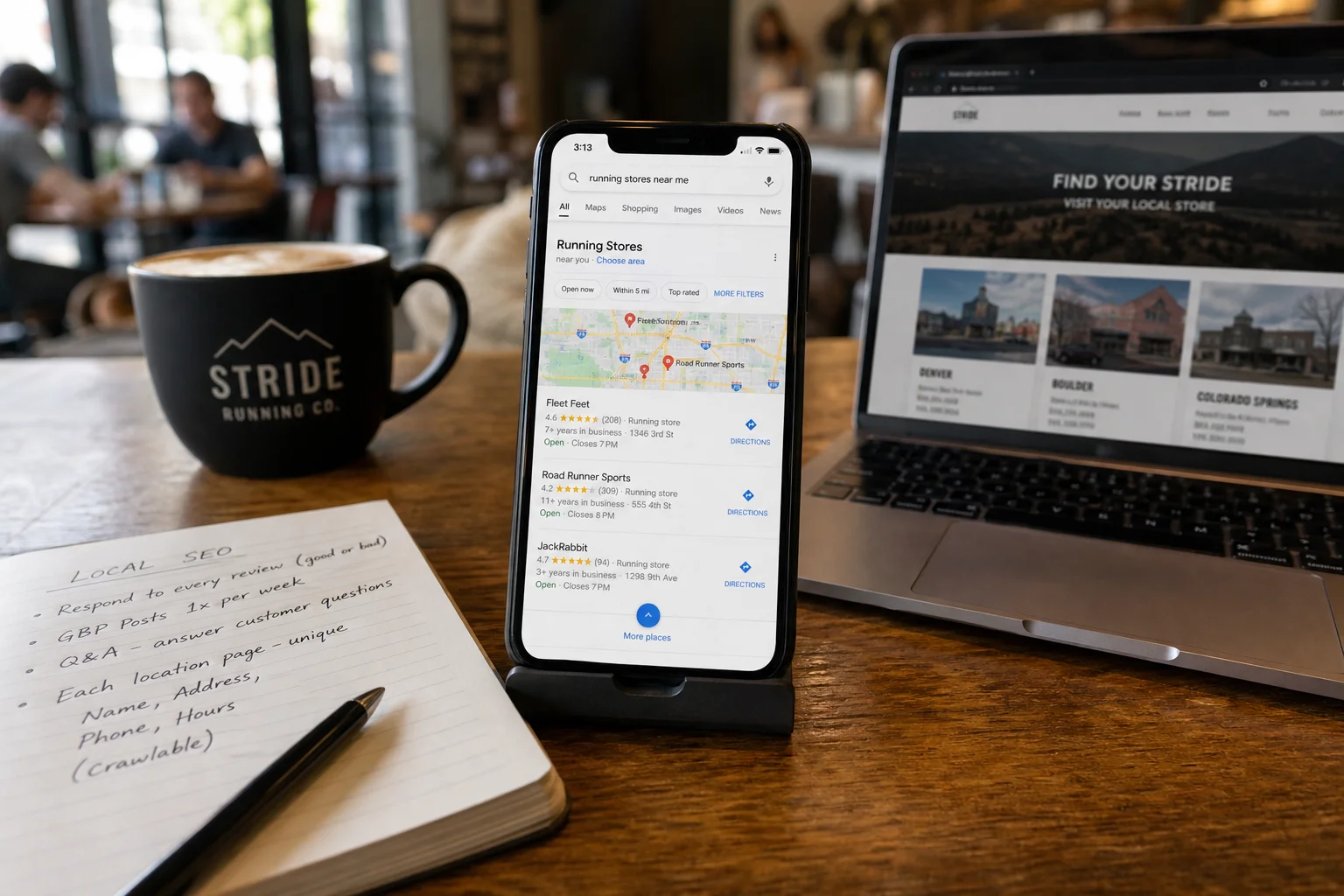
For multi-location retailers, each location needs its own landing page on your site with the store’s name, address, phone number, and hours in crawlable text. A shared contact page does not rank for “[city] + [product]” queries the way individual location pages do.
Community tactics compound this. A co-hosted event with a neighboring business or a free in-store workshop gives locals a reason to show up that no ad budget can fully replicate, and Google’s own data ties increased Maps and Search visibility directly to in-store visit growth.
Stop leading with the discount
A promotion that moves units at 30% off is not a growth strategy. It’s a margin transfer. The customers it attracts are optimizing for price, and the next sale down the street will take them from you just as easily.
The alternative is a lifecycle that earns repeat purchases instead of buying them. Here’s what that looks like in practice: a customer buys online, and within minutes a welcome email lands. That single message generates roughly $2.35 in average revenue per recipient and converts at around 3%, compared to 0.10% for a generic promotional send. A two-message welcome series can lift revenue by around 51% over a single message. Three days later, a loyalty program invite goes out. At day 60 with no second purchase, a win-back offer fires automatically. That sequence is how a one-time buyer becomes part of the top 5% of customers who, benchmarks suggest, drive roughly 35% of ecommerce revenue.
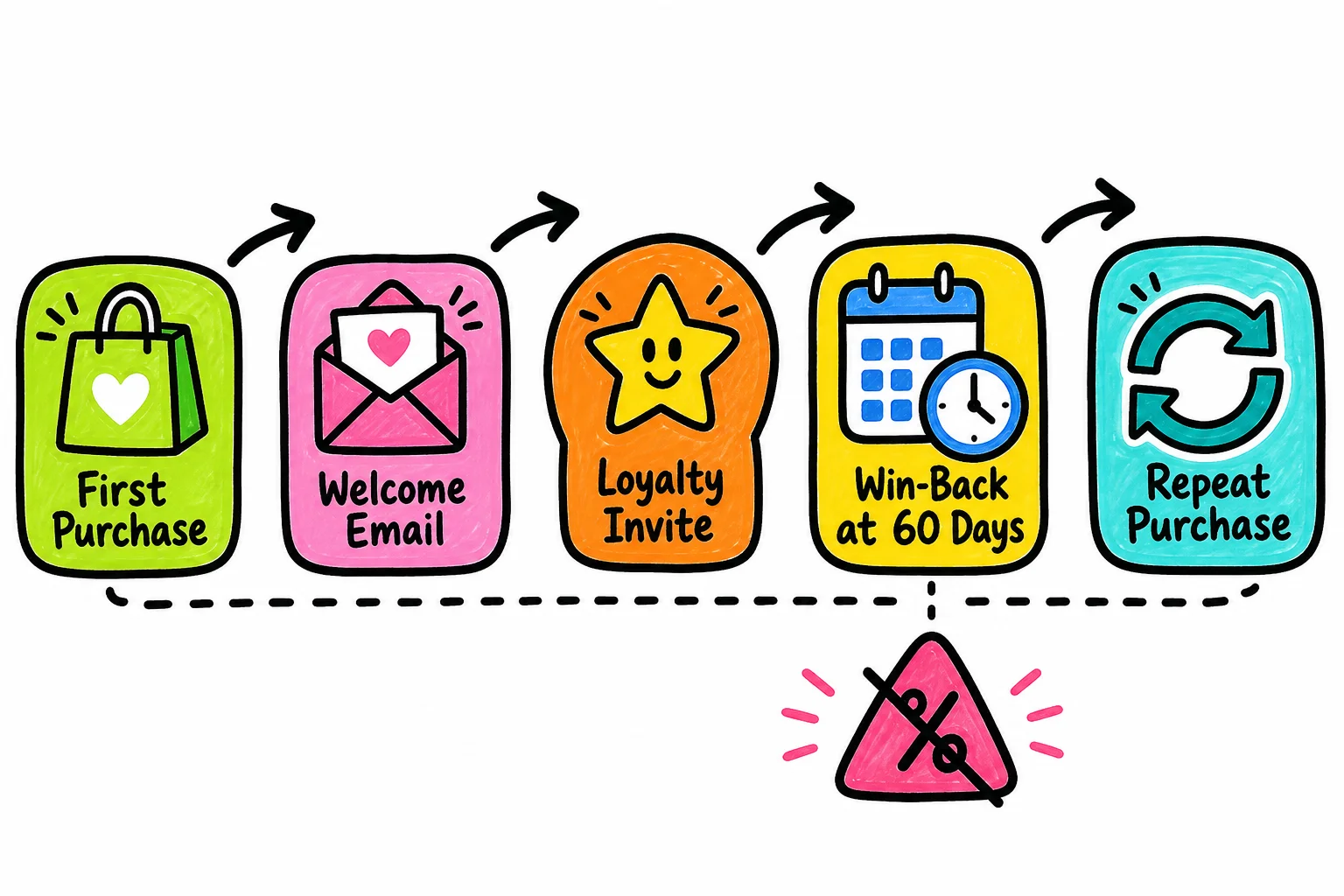
The trap to avoid is the always-on discount, where 20% off becomes the price of admission and customers simply wait for it. Lifecycle automations do the same retention work without training shoppers to hold out.
Step 5: Use content and product marketing to win search and social
Most retail sites are digital brochures: product grid, price, add to cart. That works for shoppers who already know what they want. It does nothing for the larger group still figuring it out.
Content fixes that. A buying guide targeting “best running shoes for flat feet” captures shoppers early and routes them to the right SKU. A seasonal roundup like “gifts under $50 for outdoor enthusiasts” earns organic traffic every November from people who’d never search your store name. A “how to style” post answers the question people actually type before they buy.
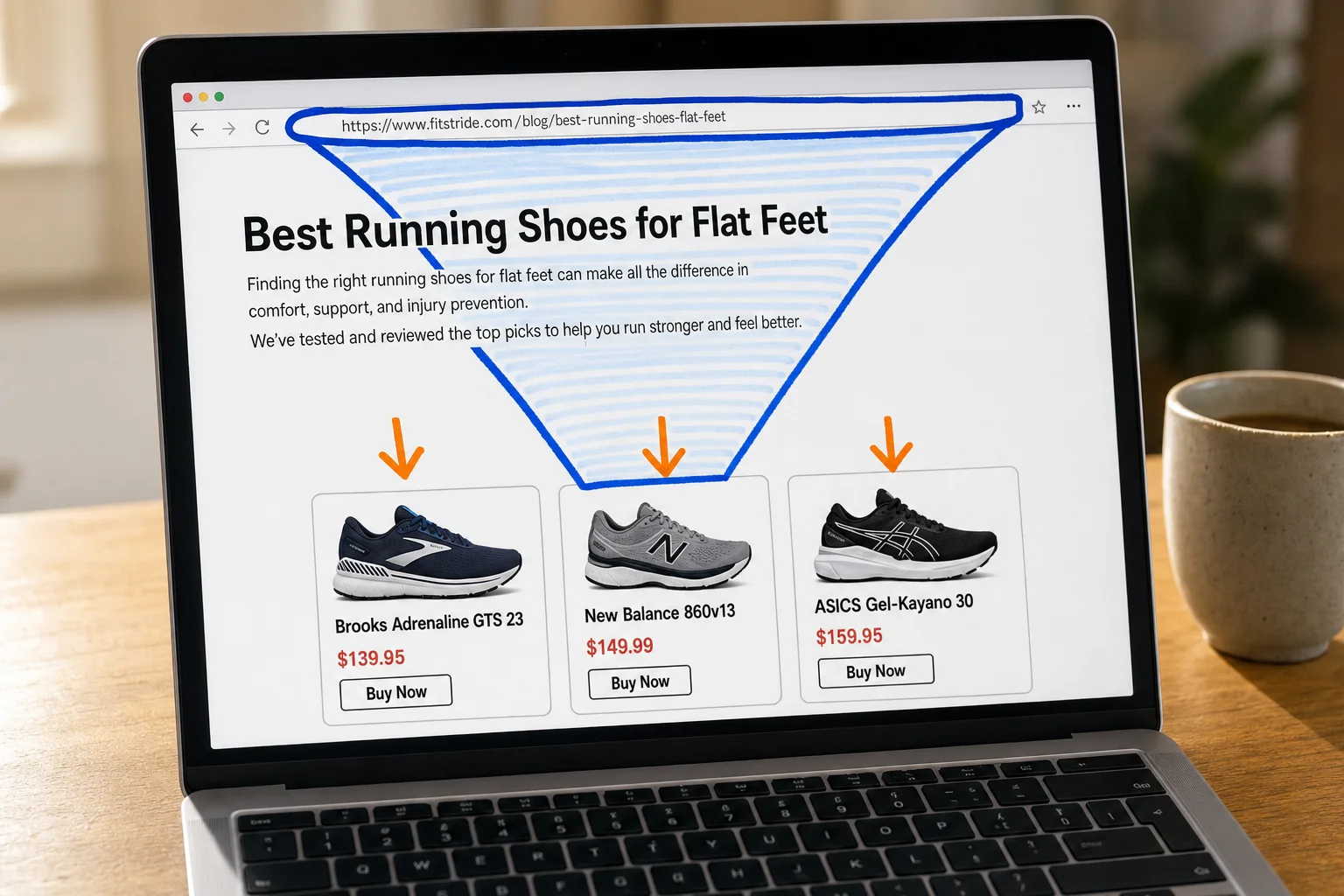
These formats work because they target long-tail queries: specific, lower-competition searches that collectively drive most retail search traffic. Most stores chase short generic terms they can’t rank for and leave the specific stuff wide open.
One practical starting point: map your top five product categories to three buyer questions each, then publish one piece per category per month. That’s a real content calendar.
Your starter dashboard (pick five, ignore the rest)
Five numbers tell you whether the plan is working:
| Metric | What it tracks | Cadence |
|---|---|---|
| Foot traffic (or GBP direction requests) | Store awareness and local intent | Weekly |
| Website sessions + conversion rate | Online discovery to purchase | Weekly |
| Average order value | Cross-channel spend per transaction | Weekly |
| Repeat purchase rate | Retention and loyalty program health | Monthly |
| Customer lifetime value | Long-term revenue per customer | Monthly |
GBP’s “Customer actions” tab gives you direction requests, calls, and website clicks with no extra setup. Direction requests are the closest free proxy for actual store visits.
The honest caveat: connecting an online touchpoint to an in-store purchase is hard. Only around 29% of retailers fully integrate sales, marketing, and operational data. A loyalty program that ties a customer ID to both channels closes most of that gap without enterprise infrastructure.
Turn this guide into your actual plan
The six steps above form one connected system: audience, channels, local presence, promotions, content, and measurement. Reading them is the easy part. Putting them together for your store, your product mix, and your customer base is where most retailers stall.
The generator below does that work in minutes. Answer a few questions about your business and it outputs a custom retail marketing plan you can act on today.