
You’re Busy, But Your Pipeline Is Empty
Picture this: you close two deals in March, post about it on Instagram, get a flood of “congrats!” comments, and then spend April wondering where the next lead is coming from. The problem isn’t effort. You’re posting, maybe running a Zillow ad, attending networking events. The problem is that none of it connects into anything that compounds.
Common real estate agent lead gen struggles tend to follow the same pattern: wrong audience, weak follow-up, and too much reliance on one channel. Most agents stop outreach after two contact attempts, even though most sales close somewhere around the fifth.

This guide isn’t a tactics list. It’s a structured plan: audience, positioning, channels, budget, a 90-day action framework, and the metrics that tell you if any of it is actually working.
The old ClickMinded page on this topic pulled 155 impressions and zero clicks over 16 months. Visible enough for Google to index, invisible enough to never help anyone. That’s what a page without a real strategy looks like. This is the replacement.
Spend $0 on Marketing Until You Can Answer This One Question
Who, exactly, are you trying to reach?
That sounds obvious. It isn’t. Most agents default to “anyone buying or selling in [city],” which is the targeting equivalent of throwing a handful of business cards into the wind and hoping for the best.
The NAR’s 2025 Profile of Home Buyers and Sellers shows the market has three meaningfully different groups right now. First-time buyers are just 21-24% of purchases, the lowest share since NAR started tracking in 1981, and their average age has risen to 38. Repeat buyers make up roughly 76-79% of transactions and average around 61 years old. Multigenerational buyers, families combining households, are now 17% of all buyers, a record high, and they search specifically for in-law suites, separate entrances, and accessibility features.
Each group needs different content, different channels, and a different pitch.
| Audience | What they actually need | Where to reach them |
|---|---|---|
| First-time buyer (avg. age 38, $60-80k income) | Education on process, down payment programs, neighborhood comparisons | Instagram, YouTube explainers, local SEO |
| Repeat buyer / downsizer (avg. age ~61) | Speed, trust signals, net-proceeds clarity | Email, referrals, direct mail |
| Multigenerational buyer | Floor plans with dual living options, accessibility details | Facebook Groups, targeted display ads |
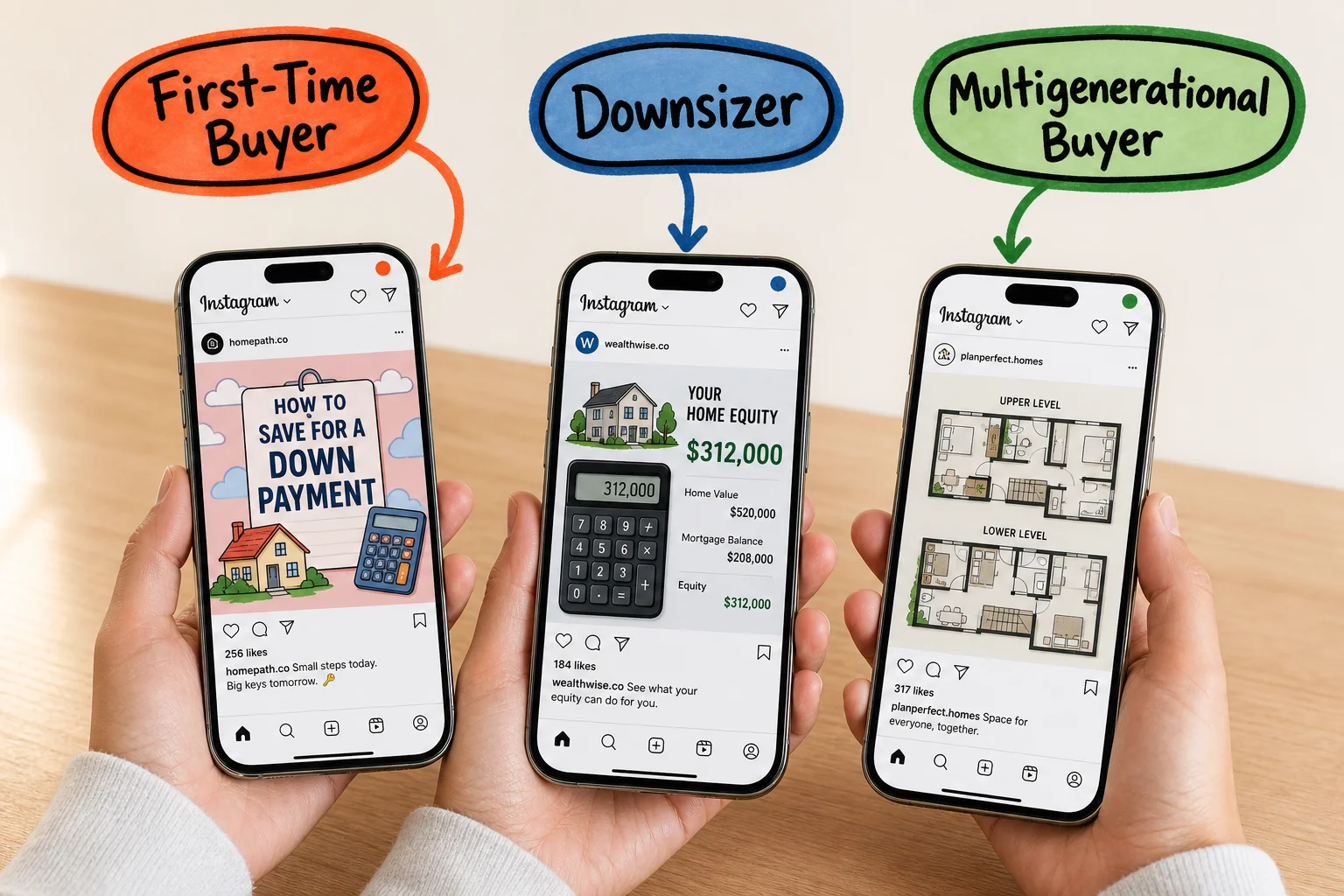
Before you book a single ad or schedule a single post, decide which row in that table describes your market. Everything else in this guide builds on that answer.
”Local Expert” Is the Khaki Pants of Real Estate Positioning
Once you know who you’re talking to, the next question is why they should call you specifically. And “I’m a local expert with 10 years of experience” is not an answer. Every agent in your market says that. It’s table stakes, not positioning.
Real differentiation comes from specificity. Practitioners on r/realtors consistently point to niche focus over broad claims: the agent who specializes in investor acquisitions, the one who works specifically with immigrant first-time buyers, the one who offers a close-in-30-days guarantee. These aren’t gimmicks. They’re claims a stranger can actually evaluate.
A simple framework that works:
I help [specific audience] [solve specific problem] by [what makes you the right person for that].
Fill it in before you write another bio, post another listing, or run another ad.
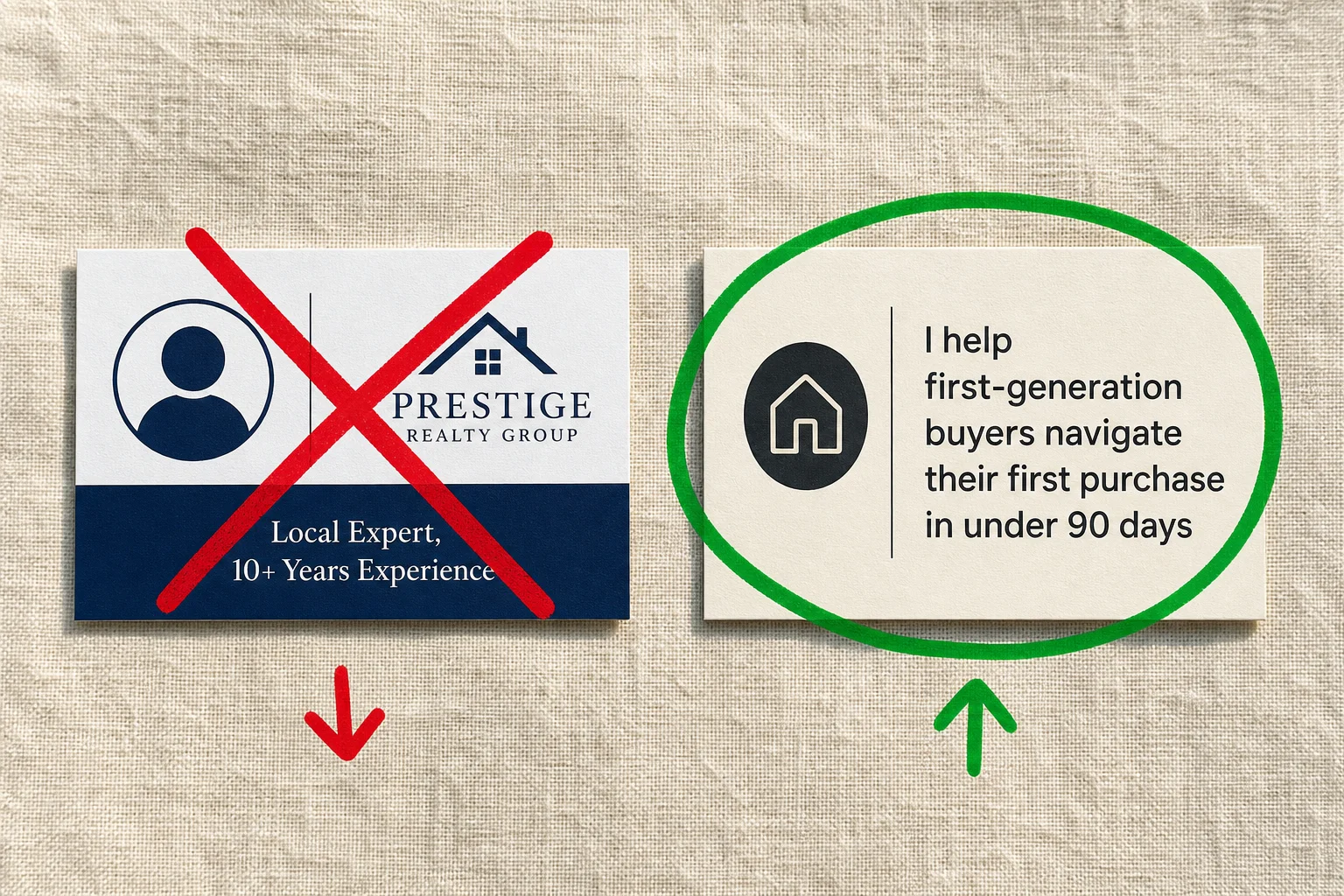
Here’s the difference in practice:
Weak: “Experienced agent serving the greater metro area. Call me for all your buying and selling needs.”
Strong: “I help repeat buyers downsize out of family homes in the suburbs, handling estate coordination and senior move management so the transition isn’t a second job.”
The strong version turns away some readers. That’s the point. The self-reported numbers from niche-focused agents are compelling enough to take seriously, even if they aren’t independently verified: better referral rates, more repeat clients, fewer tire-kickers. The mechanism is obvious even without controlled data. A specific promise attracts people who need exactly that.
Pick Two Channels and Actually Work Them
Once you have a positioning statement, the temptation is to be everywhere: Instagram Reels, a YouTube channel, a weekly email, Google ads, Zillow Premier Agent, and a podcast you keep meaning to start. That temptation is how agents end up with six half-maintained channels and leads from none of them.
The better move is to pick one or two channels that match your audience and budget, get consistent on those, then expand.
Here’s a practical starting framework:
| Channel | Best for | Estimated effort | Realistic outcome |
|---|---|---|---|
| Referrals + past clients | All agent types | Low ongoing | Highest close rate; cheapest cost per lead |
| Segmented email | Agents with an existing list | Medium setup, low ongoing | Repeat and referral reactivation |
| Hyperlocal SEO | Patient agents in defined neighborhoods | High upfront, low ongoing | Compounding organic leads over 6-12 months |
| Video (YouTube) | Agents comfortable on camera | Medium-high, consistent | Search-driven traffic gains plus SERP visibility via rich results |
| Social (Instagram/Facebook) | Buyer-facing agents, new construction | Medium, very consistent | Brand awareness; indirect lead gen |
| Paid ads (Google/Meta) | Agents with $1k+/month budget | Low setup, ongoing management | Measurable but variable ROI |
| Virtual tours / 3D media | Listing-focused agents | Per-listing cost | 87% more views and significantly more inquiries per listing |
The evidence behind virtual tours is worth pausing on, even if the headline numbers come from vendor-affiliated sources. Listings with 3D tours reportedly receive 95% more phone inquiries than those without, and buyers spend about 31% more time on those listings. Treat those exact figures with some skepticism given the sourcing, but the directional signal is consistent enough to act on.
For most solo agents, referrals, email, and one owned content channel deliver better ROI than paid ads at the early stage. Paid ads make sense once you have a working conversion path, because spending $800/month to send traffic to a generic contact form is just a donation.
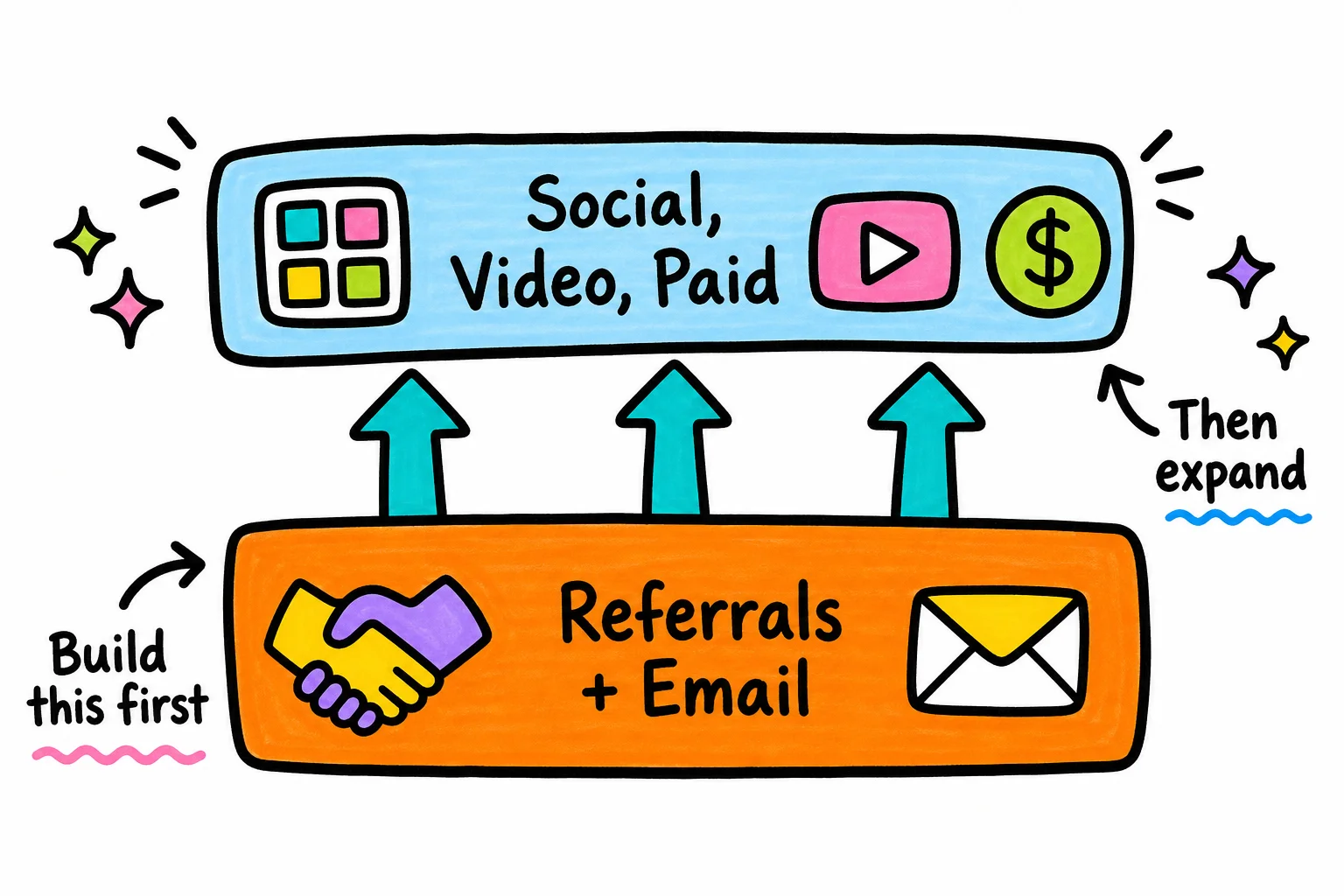
Add the expansion layer after the foundation is generating consistent activity, not before.
How Much to Spend, and What to Do First
Most budget guidance you’ll find uses dollar amounts that go stale fast. A more durable approach: tie your marketing spend to a percentage of gross commission income. Industry benchmarks commonly land between 7 and 12% of GCI, which for an agent earning $250k works out to roughly $17,500–$30,000 annually. NAR’s 2025 data puts median agent income at $58,100 with median total business expenses around $8,010, so a meaningful chunk of that expense line is already marketing-adjacent whether agents track it that way or not.
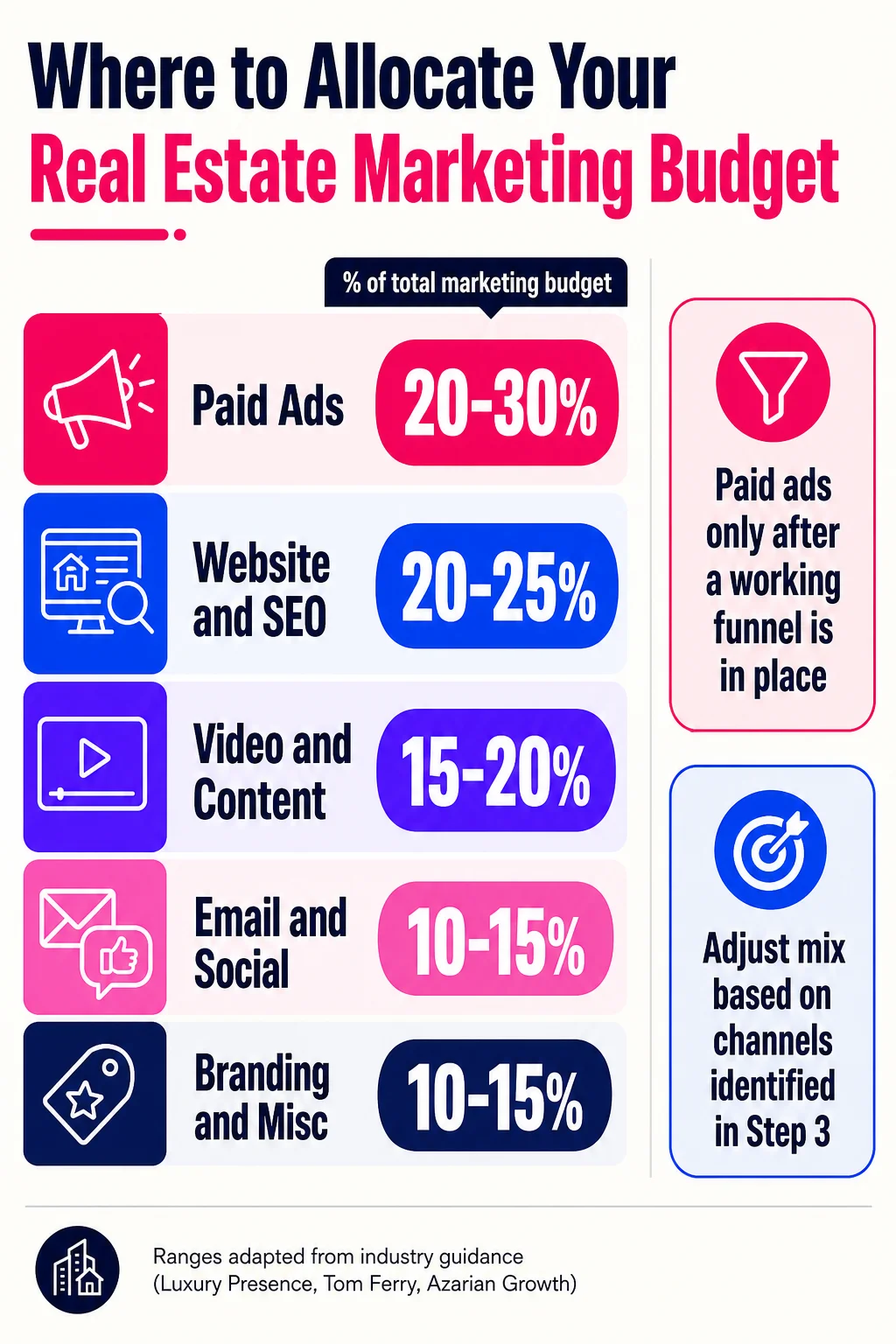
On channel allocation, a reasonable starting split looks something like: 20–25% toward website and SEO, 20–30% toward paid ads once you have a working funnel, 15–20% toward video and content, and the remainder across email, social, and branding. Adjust based on the channels you identified in Step 3.
For the 90 days after you commit to a plan, most practical templates converge on three phases. Days 1–30: clean up your CRM, audit your website, and nail down your positioning. Days 31–60: execute consistently on one or two content channels and reconnect with your existing database. Days 61–90: review what generated actual conversations, cut what didn’t, and double down on the one channel showing traction.
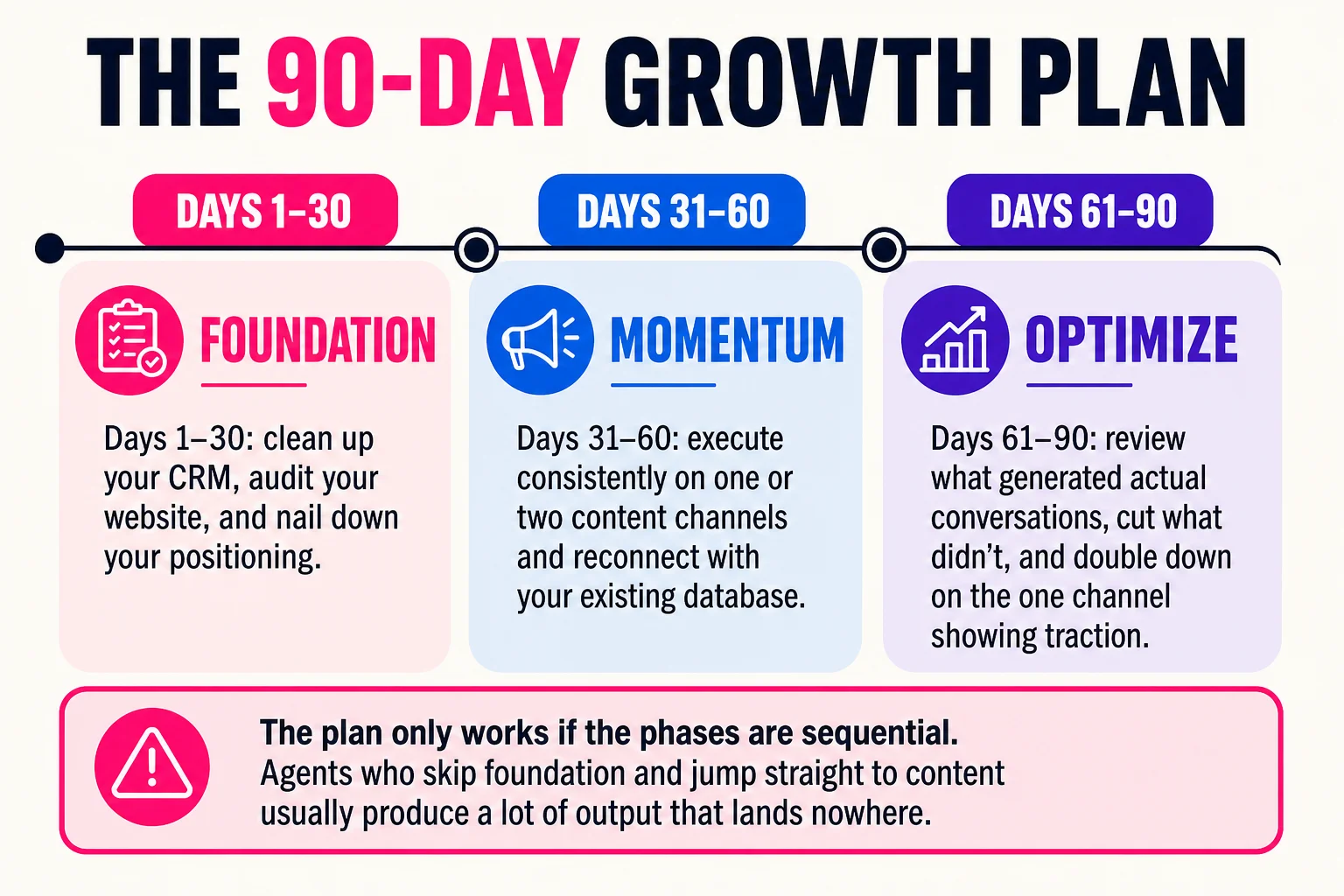
The plan only works if the phases are sequential. Agents who skip foundation and jump straight to content usually produce a lot of output that lands nowhere.
Stop reporting followers. Start tracking these instead.
Impressions and follower counts don’t pay commissions. The metrics that connect marketing spend to closed deals are fewer, and more specific.
| Vanity metric | What to track instead |
|---|---|
| Total impressions | Cost per lead by channel — which channel earns leads most cheaply |
| Follower count | Lead-to-appointment rate — how many leads actually get on a call |
| Total leads generated | Appointment-to-close rate — where deals die or survive |
| Click-through rate | Cost per acquisition — a high CTR campaign can still cost more per closed deal |
| Likes and shares | Referral rate — percentage of clients who send someone new |
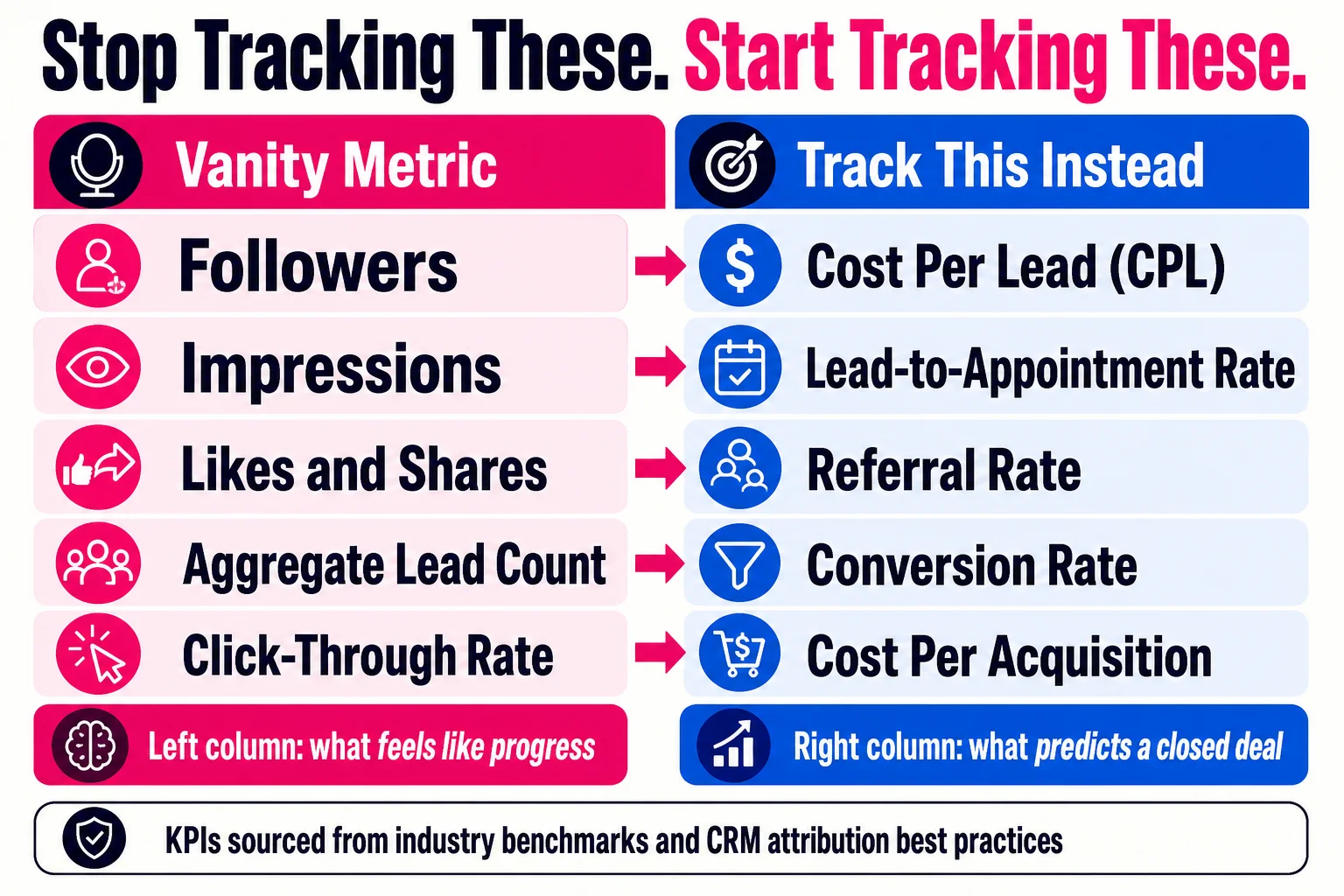
If your CRM isn’t recording which channel each lead came from, none of these numbers are calculable. Attribution first, everything else second.
Put the whole plan together in about four minutes
You now have the pieces: a defined audience, a positioning statement, a channel priority list, a budget split, and the KPIs that tell you whether any of it is working. The part most agents skip is assembling those pieces into a single document they’ll actually follow.
The generator below does that assembly. Enter your URL, and it maps your angle, channel mix, and a 90-day roadmap into an exportable, white-labeled plan.
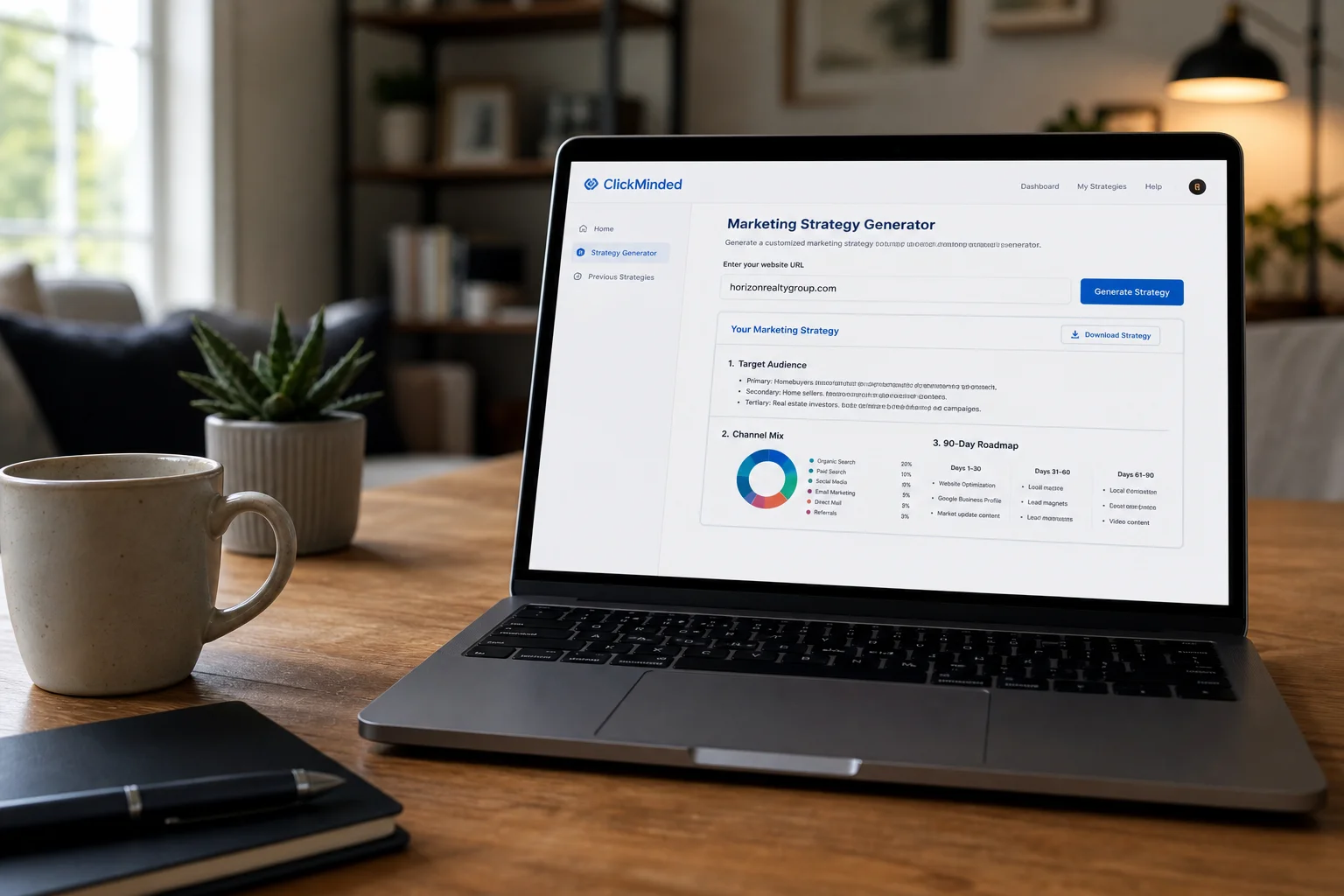
No credit card required to generate your first plan.