
Most Mobile Games Don’t Fail Because They’re Bad
Picture this: you’ve spent eight months building your game. The core loop is solid. Monetization is wired up. Launch day is two weeks out, and your marketing plan is basically “post it on Reddit and hope.”

That’s not a hypothetical. It’s how most mobile game launches actually go, and the numbers are rough. An AppMagic analysis of nearly 140,000 released games found only 2.7% ever crossed one million downloads. About 43% of projects never even reach launch.
The audience searching for a real mobile game marketing strategy is large. The legacy page sitting at this URL collected nearly 20,000 impressions over 16 months with zero clicks, because nobody was giving searchers a concrete answer. This guide does that. It covers positioning, ASO, paid UA, retention, and community, in order, with the logic behind each step.
Know Exactly Who You’re Building For Before You Touch a Single Channel
Positioning isn’t branding homework. It’s the thing that prevents you from spending three months on TikTok ads aimed at nobody in particular.
Start with your ideal player. Not “mobile gamers aged 18-35” but something you can actually act on: busy adults who play in 5-minute sessions during commutes, already spending money on puzzle games, and frustrated that most of them run out of content in a week. That specificity changes every decision downstream, from your store screenshots to which subreddits you post in.
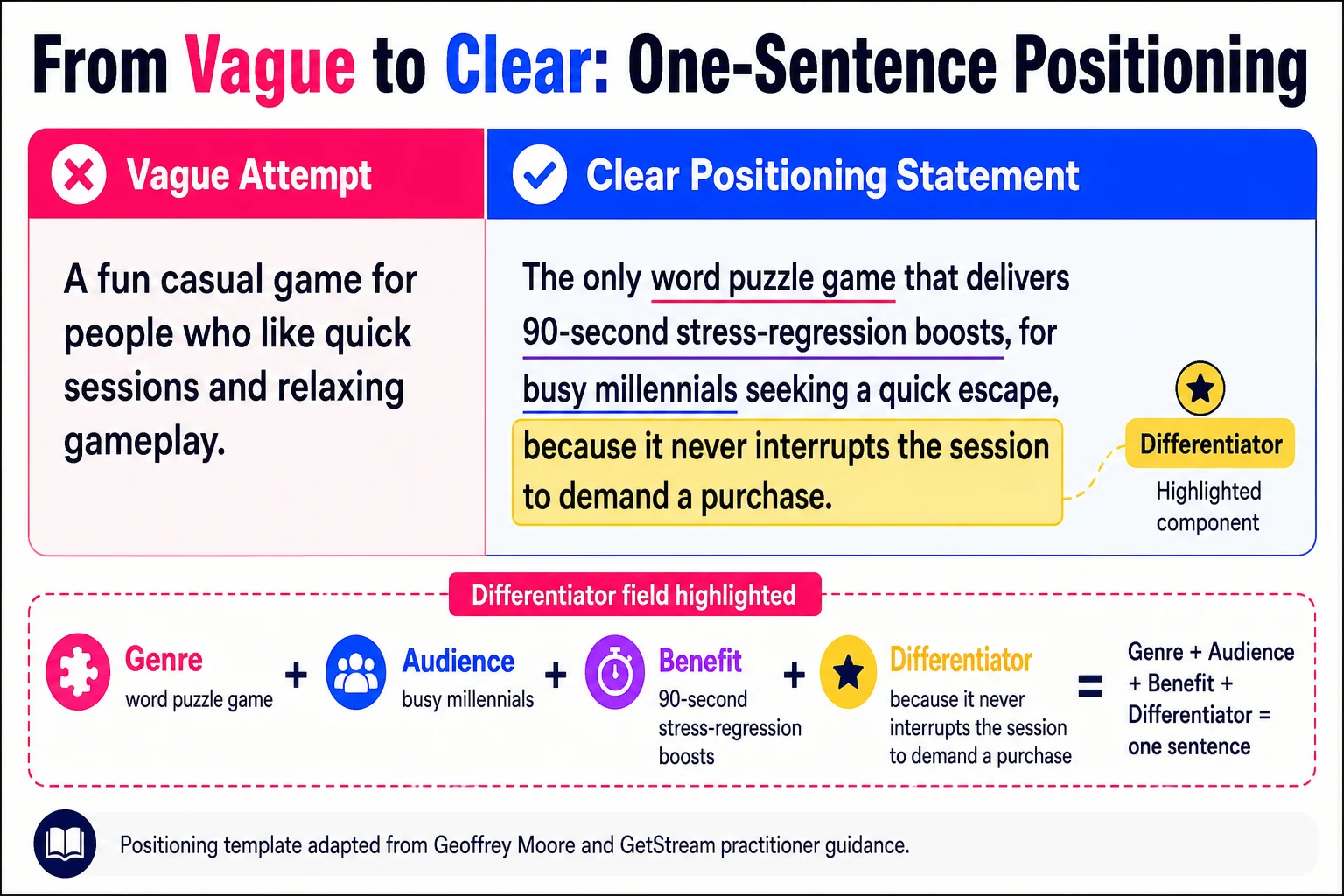
Once you know who that person is, write one sentence that forces you to commit. Using GetStream’s adapted template, a hyper-casual runner might read: “Runner Rush offers endless runner gameplay with opt-in rewarded ads for instant progression boosts, for busy millennials seeking a quick escape, because it never interrupts the session to demand a purchase.” Genre, audience, benefit, differentiator. One sentence. If you can’t write it, your game’s positioning isn’t clear enough to market yet.
With positioning locked, the pre-launch checklist has five non-negotiables: app name and subtitle, icon and screenshots (prepare two to three listing variations to test as complete units), a 15-to-30-second preview video, social handles claimed, and attribution SDKs verified before a single install gets counted. Your press kit and a pre-registration page round it out. These aren’t nice-to-haves; they’re what the next steps, ASO and paid UA, run on.
Your Store Listing Is a Search Engine. Treat It Like One.
If you’re asking how to market a mobile game without paying for every install, ASO is the answer. It’s also the only channel where the work you do before launch keeps compounding afterward.
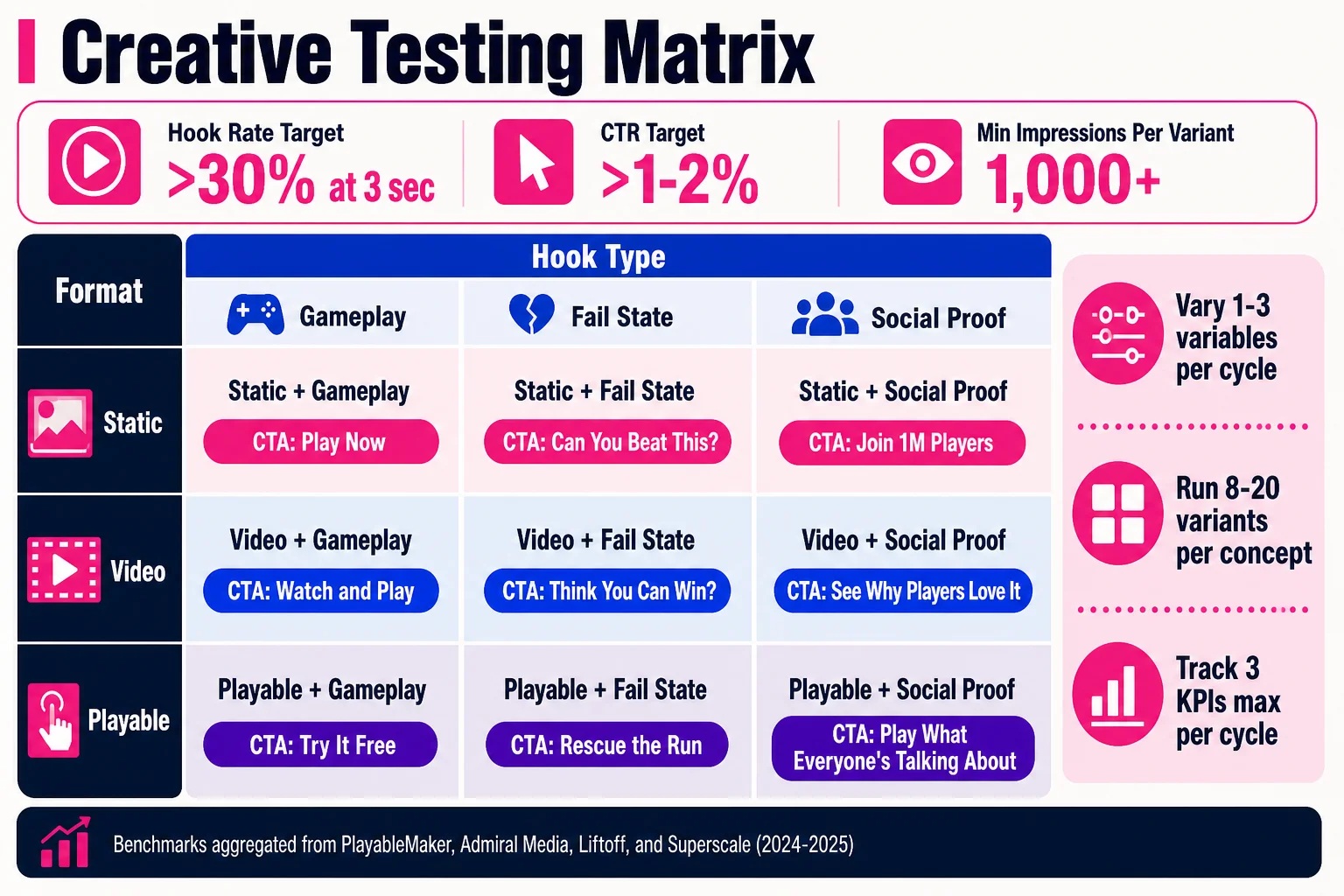
The metadata hierarchy matters more than most developers expect. Keywords in your title carry more algorithmic weight than the same keywords anywhere else in your listing. iOS gives you roughly 30 characters for the title and another 30 for the subtitle; Google Play gives you 50 for the title. The subtitle (iOS) or short description (Google Play) is your second-highest-weight field, so use it to reinforce title keywords without repeating them word-for-word. The iOS keyword field, 100 characters total, is tertiary: save it for synonyms and long-tail terms you couldn’t fit above.
For research, AppFollow and Sensor Tower are the paid standards. Free alternatives include AppFigures’ keyword tools and AppMagic’s limited free tier.
Screenshots do real conversion work. A SplitMetrics case study on Bubble Birds 4 reported a 32% CVR lift after a screenshot redesign, and platform-level benchmarks put the median winning variant at around an 11.8% lift. Given that games overall convert at roughly 4.47%, every percentage point here is meaningful. Get all of this in place before paid UA starts, because paid traffic landing on an unoptimized listing is just money leaving faster.
Creative Testing Is Where Paid UA Actually Lives or Dies
Paid UA on Meta, Google UAC, and TikTok follows the same basic logic: the channel delivers the audience, but the creative determines whether anyone installs. Most indie teams run three or four ads and call it a test. That’s not a test; that’s a guess.
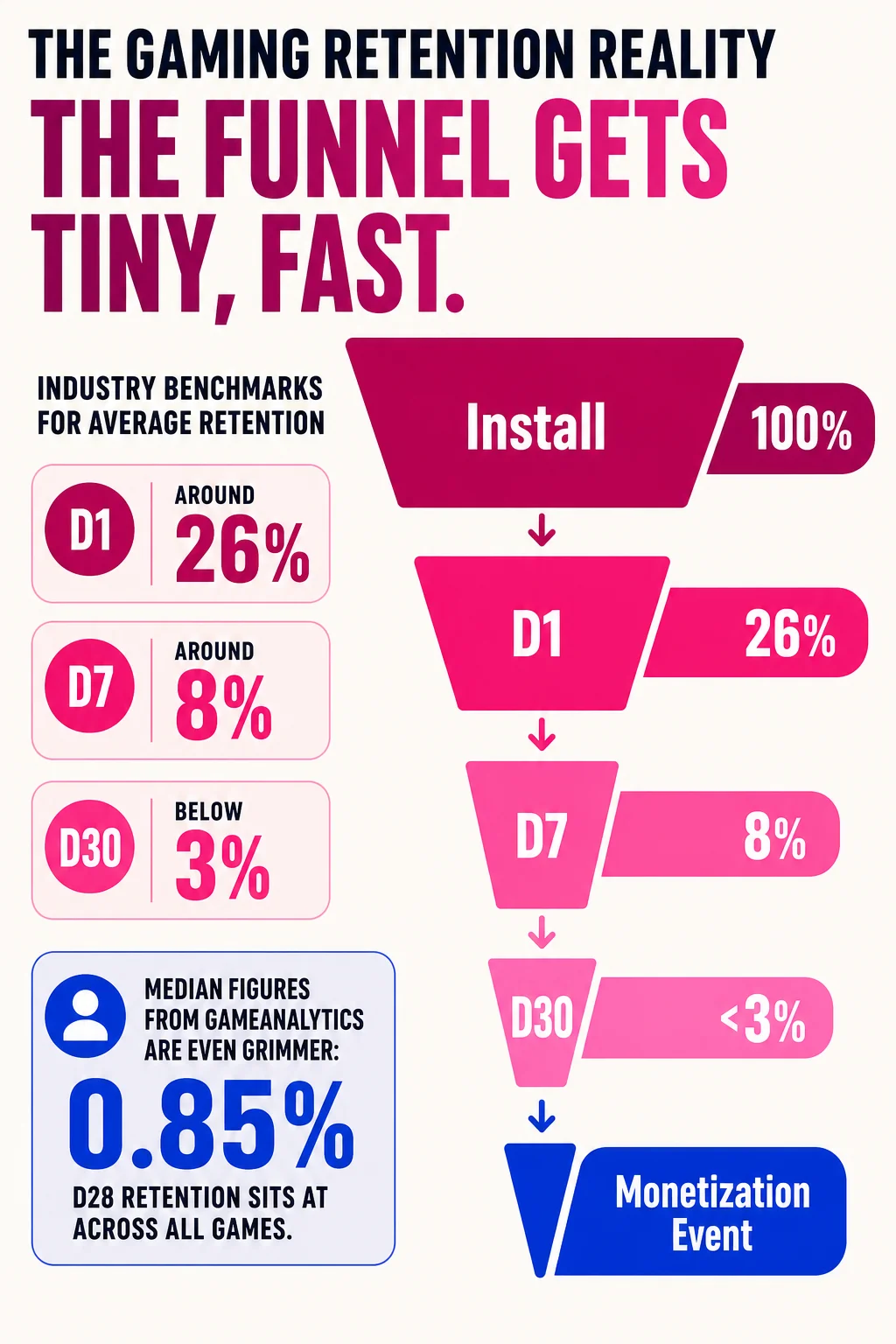
A creative testing matrix gives you a real framework. Across one concept, vary the hook type (gameplay vs. fail state vs. social proof), the format (static vs. video vs. playable), and the CTA copy. From those three variables, you can generate 12 to 20 variants without producing 12 to 20 completely different ads. Each variant needs at least 1,000 impressions before you draw any conclusions, and you should track no more than three KPIs per cycle: hook rate (target above 30% at three seconds), CTR (above 1 to 2%), and CPI relative to your genre baseline.
Genre benchmarks vary widely: hyper-casual CPIs can run $0.25 to $1.50, while midcore and RPG titles often land between $4 and $12. iOS costs roughly 1.5 to 2 times more than Android across genres. If your mobile game marketing plan has a paid budget under $10,000 per month, reserve 5 to 10% specifically for testing and run initial batches in Tier 1 markets where data quality is cleanest before scaling winners to evergreen campaigns.
D7 and D30 retention are your real quality signals. A low CPI means nothing if D30 sits below 3%, because every retained user becomes more expensive in effective terms. Find the creative that attracts players who stick around, then scale that.
The Install Is Not the Win
Getting someone to download your game is, unfortunately, the easy part. Industry benchmarks put average D1 retention around 26%, D7 around 8%, and D30 below 3%. Median figures from GameAnalytics are even grimmer: D28 retention sits at 0.85% across all games.
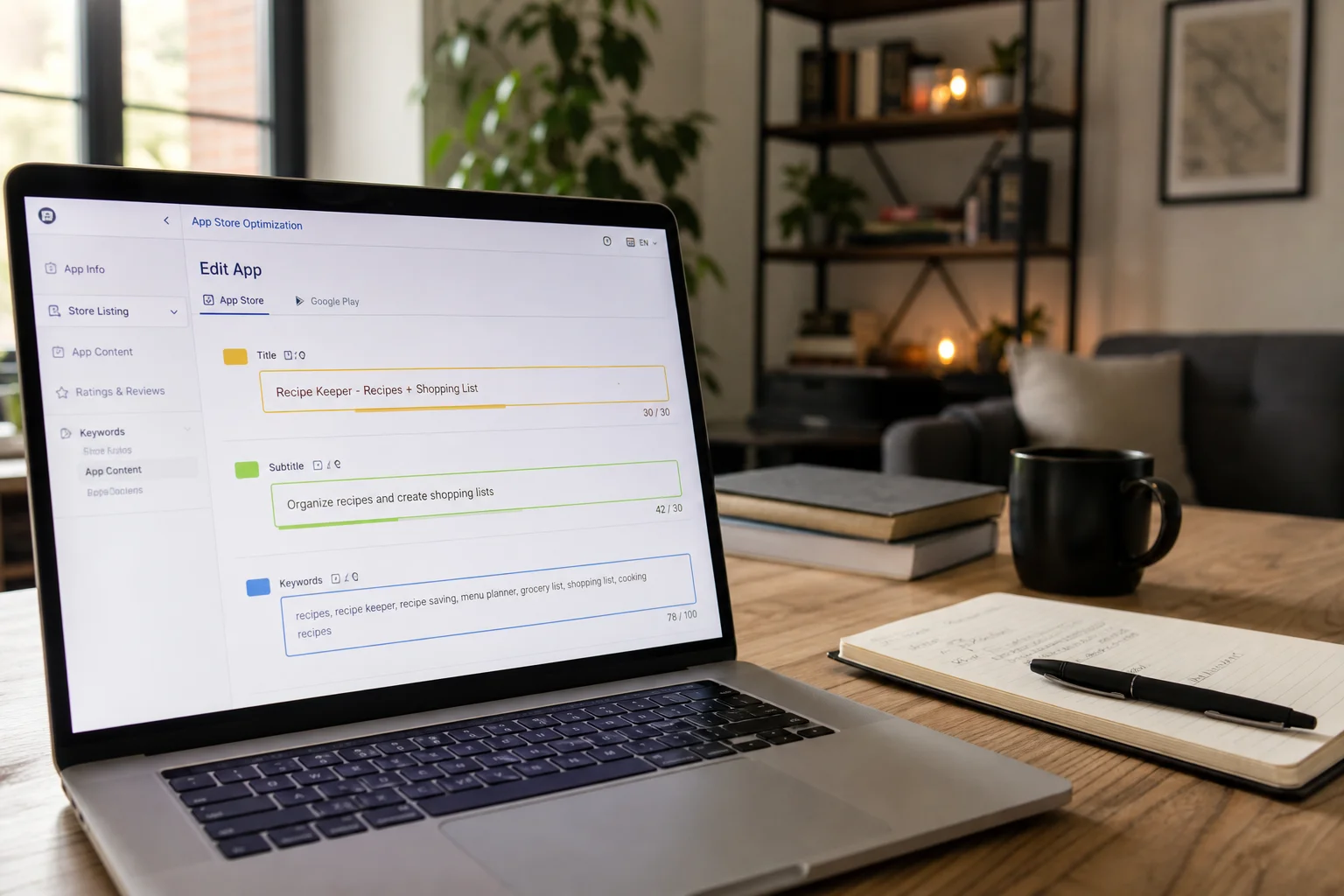
Those numbers matter for paid UA directly. If your D7 retention is near the bottom quartile, scaling spend is impossible: you are paying to fill a bucket with a hole in it. Every retained user effectively costs more as the cohort shrinks.
The fastest D1 fix is onboarding. Long tutorials kill Day 1; short, skippable, interactive flows with an early reward keep players past the first session. For D7, push notifications tied to a specific in-game trigger (not a generic “come back!”) move the needle. On monetization, hybrid models combining IAP, rewarded ads, and subscriptions now outperform single-model setups. Rewarded ads monetize non-payers at roughly $0.80 to $2 ARPDAU with minimal UX friction. If D30 reaches even 5% and ARPDAU is $1, a 10,000-install cohort generates $500 daily from retained players alone, which changes what you can afford to pay per install.
Slow Burn, Real Returns: Community Channels That Compound
A Reddit thread ranks first for the exact query your readers just searched. That is not an accident. It signals that people researching mobile game marketing want candid, peer-level answers, not vendor guides. Your content strategy should reflect the same impulse: be genuinely useful in the spaces where your players already talk.
On TikTok, gaming hashtags pull roughly 30 billion monthly video views in the US alone. Survivor.io reached $200M in total revenue with influencer seeding and UGC as the primary engine. The algorithm rewards authentic, trend-aligned clips over polished ads.
On Reddit, 70% of gaming Redditors report using the platform to discover new titles. Participate in existing subreddits before posting your own content. Run an AMA. Share a build sneak peek. The trust is already there; you just have to not squander it by self-promoting too early.
Discord works best when you track active-member ratios rather than total size. A server of 400 people where 40% post monthly beats 5,000 lurkers every time.
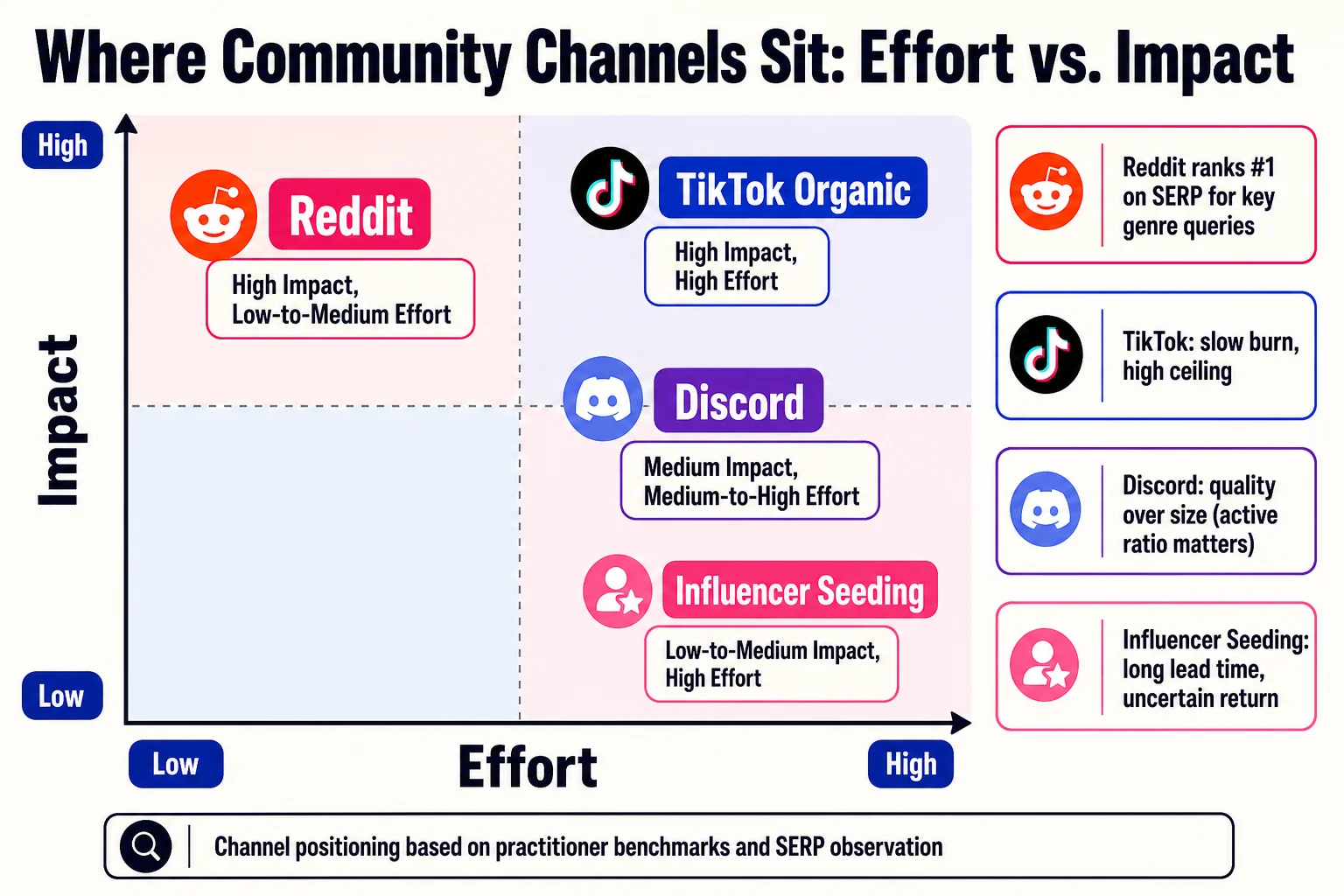
None of this moves fast. Budget six to twelve weeks before community channels show measurable installs.
Your mobile game marketing plan: a 12-week launch timeline
All those channels need a sequence. Here’s how to run it.
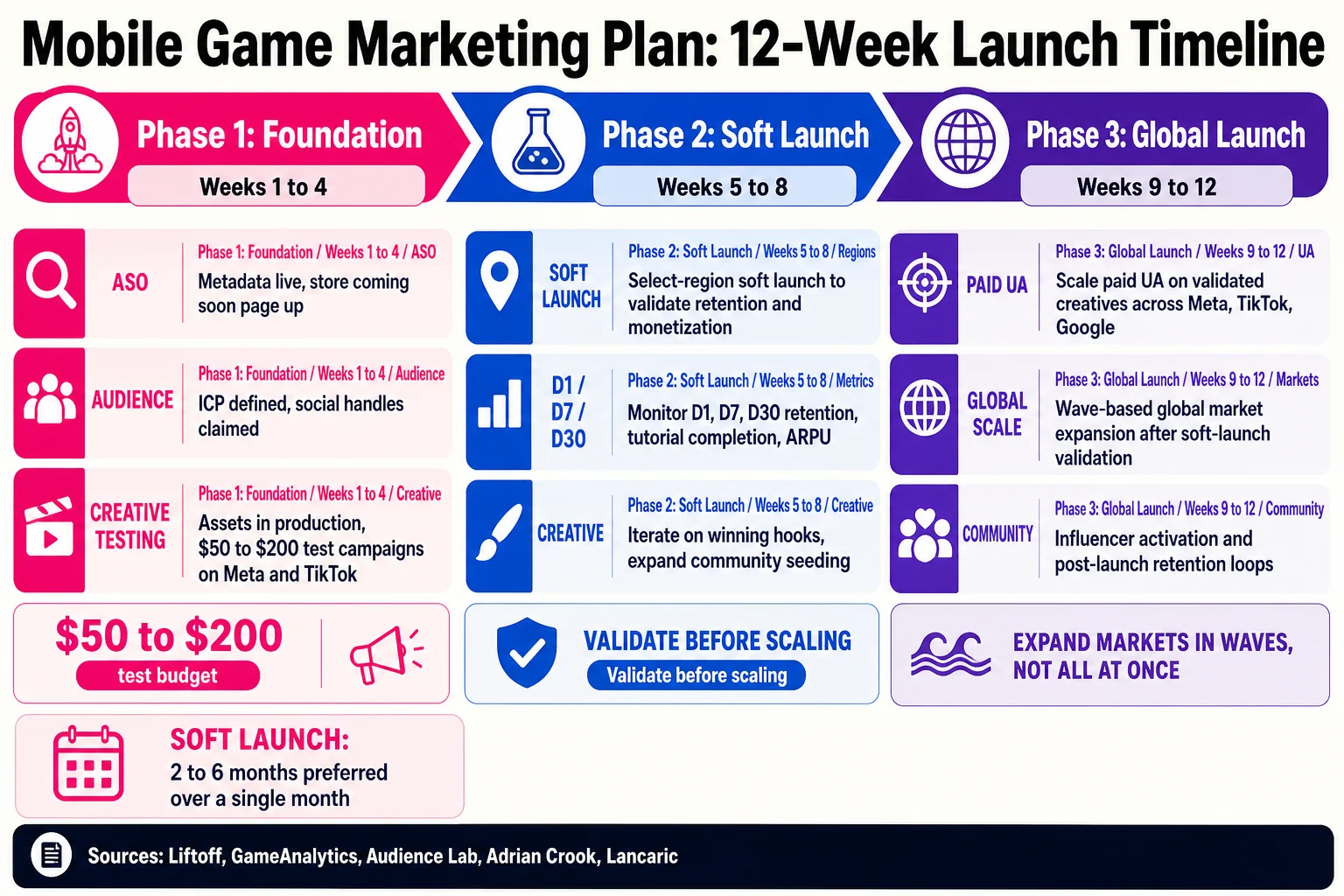
| Phase | Weeks | Focus |
|---|---|---|
| Phase 1: Foundation | 1-4 | ASO metadata live, store “coming soon” page up, ICP defined, social handles claimed, creative assets in production. Run $50-$200 test campaigns on Meta and TikTok to find your hook before you spend real money. |
| Phase 2: Soft Launch | 5-8 | Go live in 2-3 Tier 2 markets. Track D1, D7, and D30 retention daily. A D1 benchmark of 35-40% is the threshold most use before expanding. At $0.50 CPI and 5% D7 retention, your cost per retained user hits $10, so fix retention before scaling spend. Seed Reddit and TikTok organically. |
| Phase 3: Global Rollout | 9-12 | Expand in waves: major English-speaking markets first, then developed markets, then emerging. Scale winning creatives. Activate push notifications and in-app messaging based on soft-launch behavioral data. |
One-month soft launches rarely produce statistically significant data, so resist rushing Phase 2. Brawl Stars soft-launched for roughly 18 months before going global and hit 500 million downloads. You probably don’t have 18 months, but eight weeks beats four every time.
Turn this guide into an actual plan
Everything above is the strategy. The generator below is where you build your specific version of it. Answer a few questions about your game, genre, budget, and target player, and it outputs a prioritized mobile game marketing plan you can hand to a developer, a media buyer, or yourself at 11pm the night before soft launch. It takes about four minutes and skips the part where you stare at a blank spreadsheet.