
When the plan is “we’ll figure it out as we go”
Picture a personal injury attorney who spends $3,000 on Google Ads in January, gets some calls, signs two clients, and has no idea whether those clients came from the ads, a referral, or the firm’s Avvo profile. February’s budget question is a guess. March’s is another guess. By April, the whole thing quietly stops.
That’s not a story about a bad attorney. It’s the default setting for small firm marketing when there’s no plan behind the spend.

Even ClickMinded’s own legacy page on this topic had the same problem, just from the other direction. The page sat at position 52.9 in Google search results and collected 491 impressions and zero clicks between January 2025 and April 2026. The topic had real search interest. The page had nothing useful to say.
This guide is an attempt to fix that. It covers the channels that actually move the needle for solo attorneys and small firms, why guides from Clio, MyCase, and Lawyerist are a decent starting point but skip channel prioritization entirely, and how to measure whether any of it is working.
The rules your marketing agency has never read
Most industries have guidelines. Legal has rules with teeth. ABA Model Rule 7.1 prohibits any communication about a lawyer’s services that is false or misleading, including truthful statements that omit material facts. Rule 7.2 restricts paid endorsements and requires verifiable content across advertising channels. State bars layer their own variations on top of those. New York, for instance, restricts testimonials from clients with pending cases and requires firms to keep advertising records for three years.
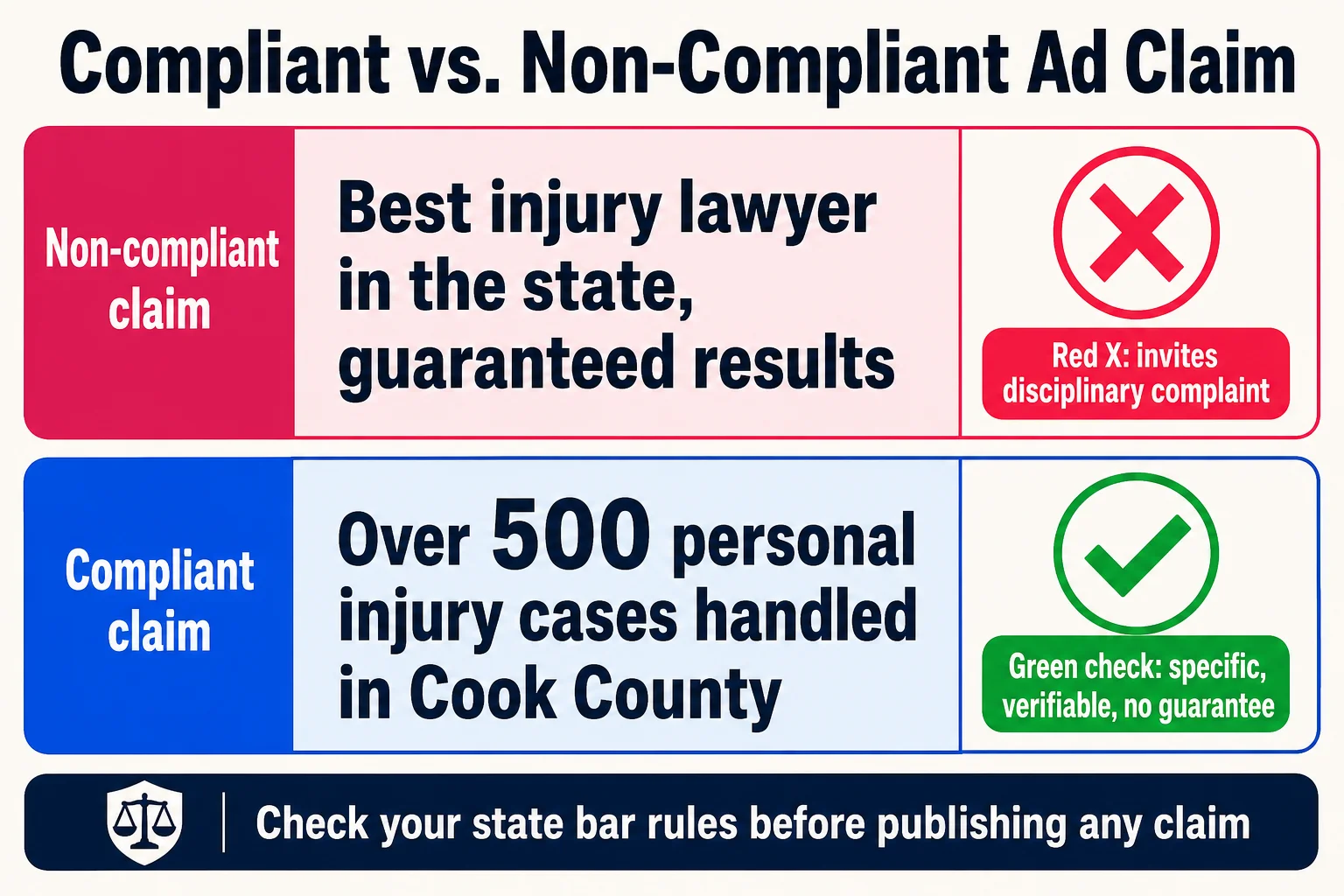
In practice, this kills a lot of standard marketing moves. “Best DUI attorney in Phoenix” is a problem. “We win every case” is a bigger one. A compliant version sounds more like “We have handled more than 300 DUI cases in Maricopa County.” Specific, verifiable, no guarantees. Check your state bar rules before publishing any claim, because the gap between those two sentences can be a disciplinary complaint.
Then there is the referral reality. Referrals are the dominant acquisition channel for most small firms, and referred clients tend to be around 16% more profitable than other leads. That does not mean digital is optional. A Scorpion report found that 74% of legal clients research a firm online after receiving a referral, which means a weak website or missing reviews can cost you a client someone else already sent you.
Where to actually put your marketing time and money
Given that referrals still dominate legal client acquisition but 74% of referred clients research the firm online before calling, your website and your Google presence are not optional extras. They are the floor. Here is what to build on top of them.
Google Business Profile
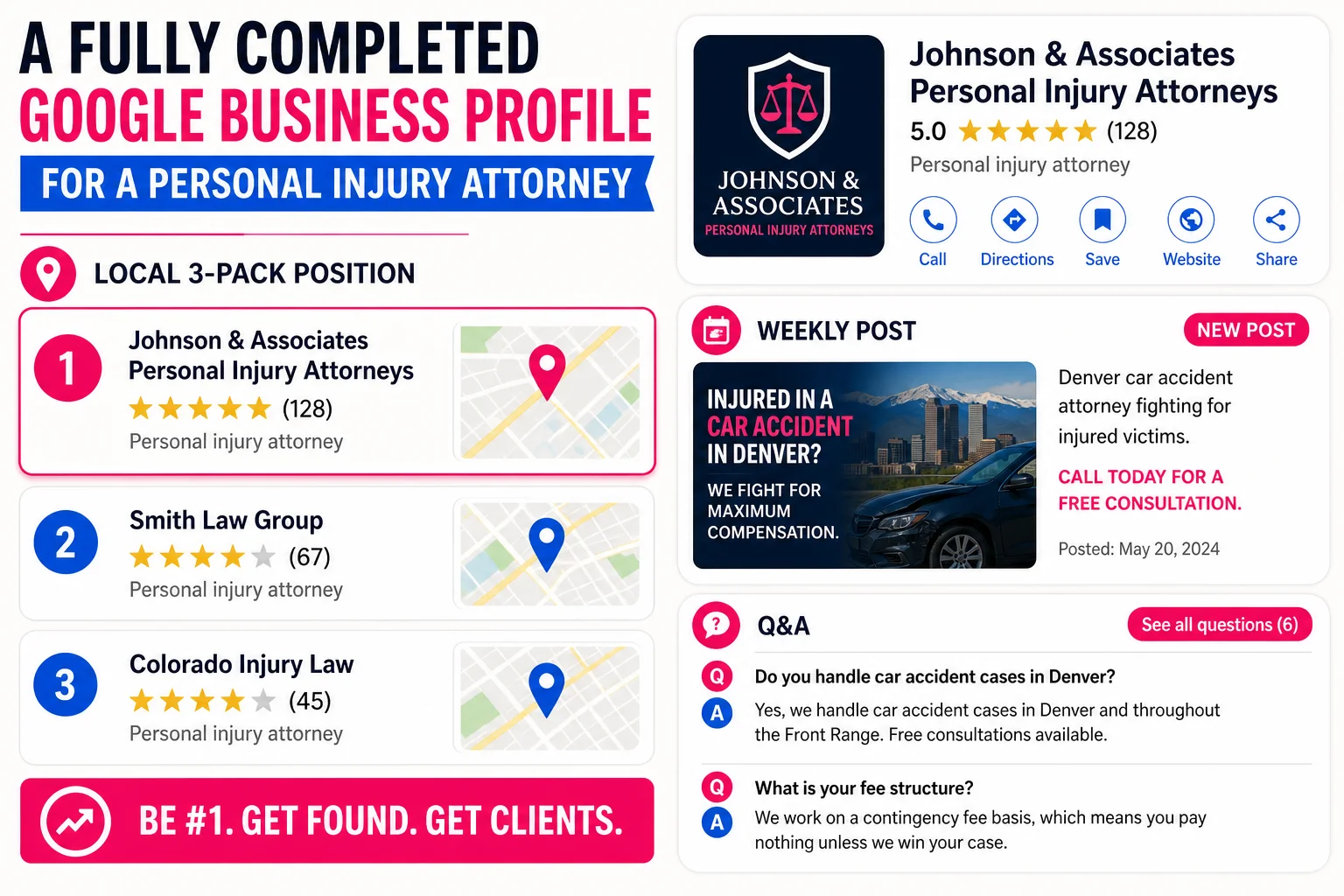
Your GBP listing is free and, when it ranks in the local 3-pack, it can deliver leads that would cost $50 to $200+ each through Google Ads. The three moves that matter: pick the most specific primary category available (not just “Law firm” but “Personal injury attorney” or “Criminal justice attorney”), post to your profile weekly with local keywords and a clear call to action, and actively manage your Q&A by seeding common questions yourself before strangers answer them incorrectly. The common mistakes are generic descriptions with no city or practice-area mentions, and ignoring GBP Insights entirely.
Content and practice-area pages
A small Colorado firm grew from 92 ranked organic keywords to roughly 1,300, and from about 6 monthly organic visitors to 2,900, through targeted content and SEO with no paid traffic. The engine was practice-area pages built at 700+ words, location-specific, with trust signals. One page per service, one page per city if you operate across several. FAQs tied to real client questions help too, and they tend to surface in AI Overviews.
Referral systems
Referrals are already your best channel. The work is making them consistent rather than random. A quarterly email to past clients, a short thank-you process when a referral comes in, and a list of complementary professionals (CPAs, therapists, real estate agents) to stay in contact with will do more than most paid programs.
Paid search
Legal keywords are among the most expensive in Google Ads, with personal injury terms running $150 to $400+ per click and some high-competition phrases exceeding that significantly. The move for small firms is narrow, local, and case-specific: “car accident lawyer [city]” rather than “personal injury attorney.” Expect CPCs in the $50 to $400 range depending on practice area and market, and target a 5 to 15% conversion rate from click to contact. Broad bidding on terms like “mesothelioma lawyer” or “truck accident attorney” will drain a small budget in days.
Your Google footprint is probably lying about where you practice
Before content or ads do anything, your name, address, and phone number need to match exactly across every directory that mentions your firm. Not approximately. Exactly. A Milwaukee family law firm that fixed its NAP across Google Business Profile and 15 directories moved from position 7 to position 3 in local results and saw a 37% lift in local search visibility, before publishing a single new page.
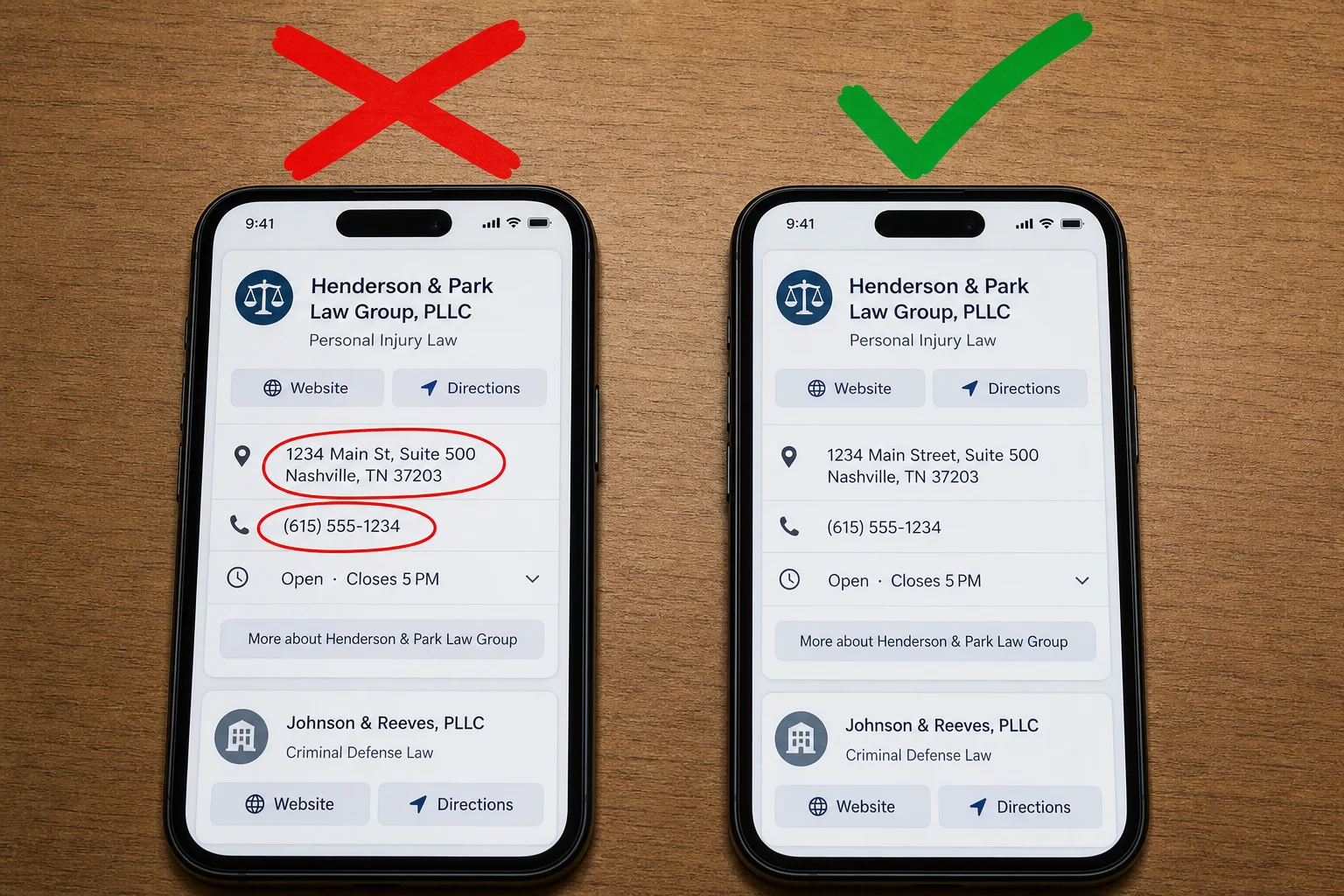
Start with six directories: Google Business Profile, Yelp, Bing Places, Facebook, Avvo, and FindLaw. Make the name, address, and phone number character-for-character identical to what’s on your website. Then treat it as ongoing infrastructure, because even one inconsistent phone number can suppress your local pack ranking.
For landing pages, map one page to each practice area and city combination you actually serve. “Divorce attorney Chicago” and “divorce attorney Evanston” are different pages with different content. Neighborhood-level targeting lets smaller firms outrank bigger ones on terms where the large firm has only a generic city page.
On reviews: BrightLocal’s local ranking factor research puts review recency as a meaningful local pack signal, with reviews accounting for roughly 20% of ranking influence. Firms picking up four to eight new reviews per month tend to see movement within 30 to 45 days. Ask every satisfied client right after the matter closes.
Once your local presence pulls in inquiries, the question becomes what happens when they arrive.
Where most small firms leave money on the table
Most law firm marketing guides stop at “get more leads.” This one doesn’t, because leads you can’t trace back to a source are just noise with a phone number attached.
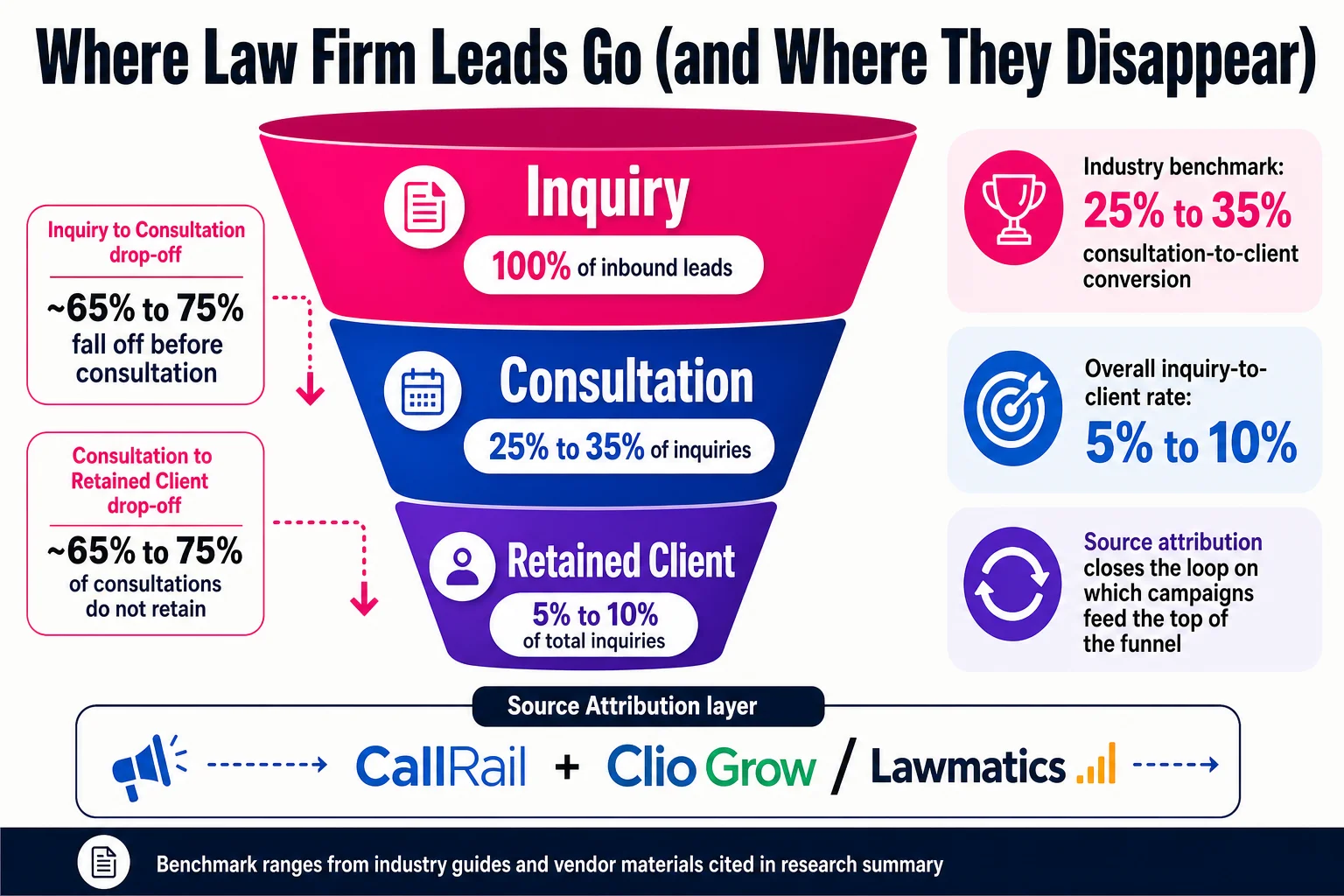
The minimum viable setup for a two-attorney firm has two parts. First, CallRail or a similar call tracking tool assigns a unique number to each channel. Your Google Ads campaign gets one number, your Google Business Profile gets another, your website gets a third with Dynamic Number Insertion handling the swap automatically. Every call gets tagged to a source, and that data feeds directly into Google Analytics and your ad campaigns so phone calls show up as conversions alongside clicks.
Second, a CRM like Clio Grow or Lawmatics connects that call data to an actual lead record. You can then track how many inquiries become consultations, and how many consultations become signed clients. Industry benchmarks put consultation-to-client conversion somewhere between 25% and 35%, with overall inquiry-to-client rates closer to 5% to 10% for most firms. If your numbers sit below those ranges, the problem is visible now instead of invisible forever.
That’s the whole system. Two tools, one spreadsheet to review monthly.
Put it on paper: your 90-day marketing plan
Four steps, done once, revised quarterly.
Step 1: Set one specific acquisition goal. Not “get more clients.” Something countable: four new retained clients per month, or eight consultations booked. Pick the number that hits your revenue target.
Step 2: Choose two or three channels, no more. That probably means Google Business Profile, one content channel (a blog or FAQ page), and either referral outreach or Local Service Ads if your practice area qualifies.
Step 3: Build a 90-day sprint. Month one is setup: claim and optimize GBP, publish two foundational pages, identify five referral contacts. Month two is execution: one post per week, follow up with referrals, run LSAs if the budget allows. Month three is review: cut what isn’t generating calls, double what is.
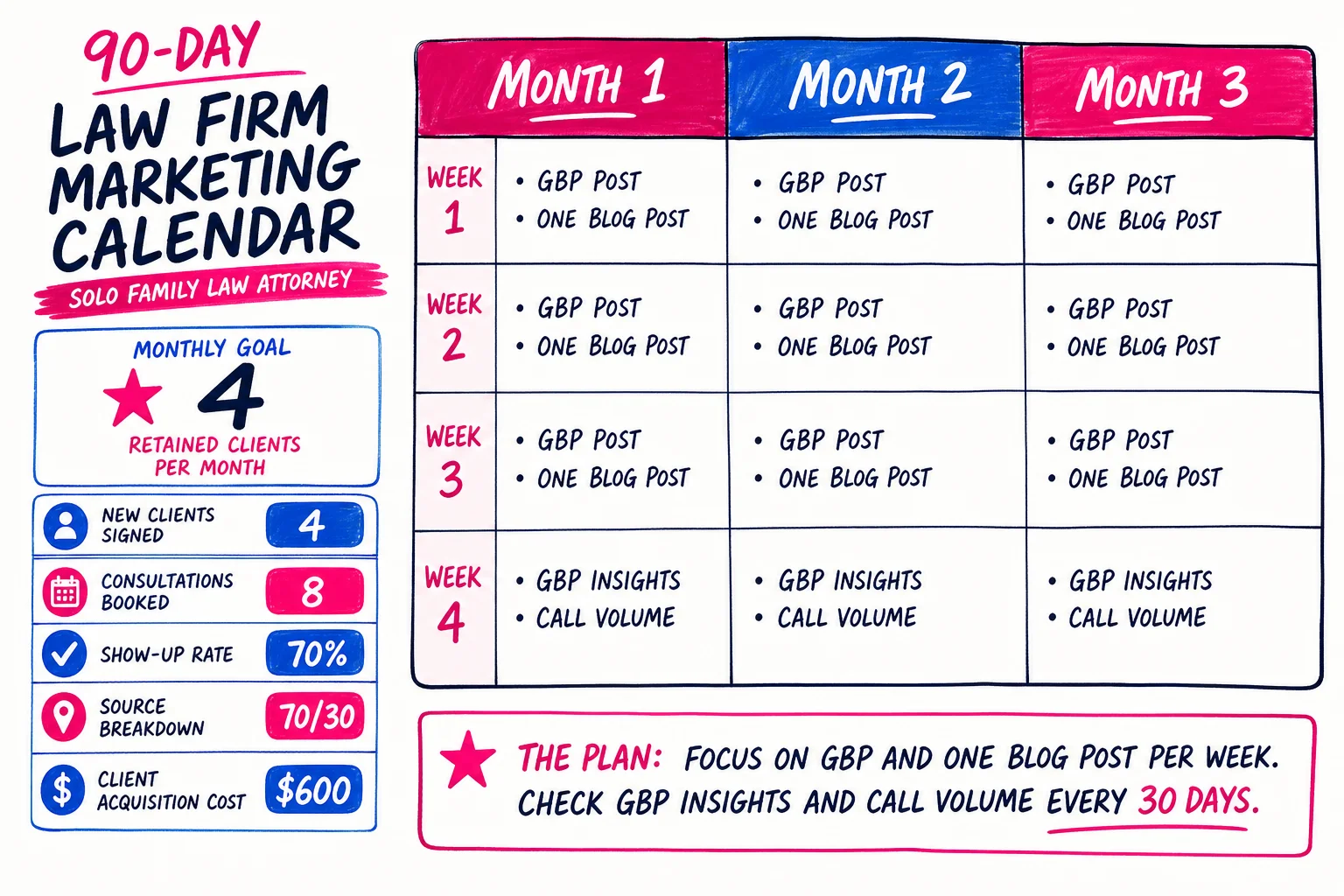
Step 4: Hold a monthly review. One hour, five numbers: new clients signed, consultations booked, show-up rate, source breakdown, and client acquisition cost.
A solo family law attorney might set a goal of four retained clients per month, focus on GBP and one blog post per week, and check GBP insights and call volume every 30 days. That’s the whole plan.
Skip the blank template
That 90-day framework only works if the inputs are right for your firm. The generator below asks for your firm size, practice area, and geography, then produces a roughly 1,400-word strategy in under five minutes, no credit card required. You get a plan built around your actual situation, not a generic checklist you have to manually adapt. Export it as a slide deck or document, hand it to a team member, or use it as the starting point for your monthly review.