
Most advisors already know they need a marketing plan. Getting one is the problem.
Picture an independent advisor on a Sunday afternoon, a blank document open, cursor blinking. They know they need more clients. They’ve searched “financial advisor marketing strategy” and clicked through a few results. Most pages offer twelve tips or a generic funnel diagram that could apply to a dog groomer or a dentist.
The search data backs this up. ClickMinded’s own page on this topic pulled 10,463 impressions between January 2025 and April 2026, average position 57.9, and zero clicks. Demand exists. Useful answers are scarce.
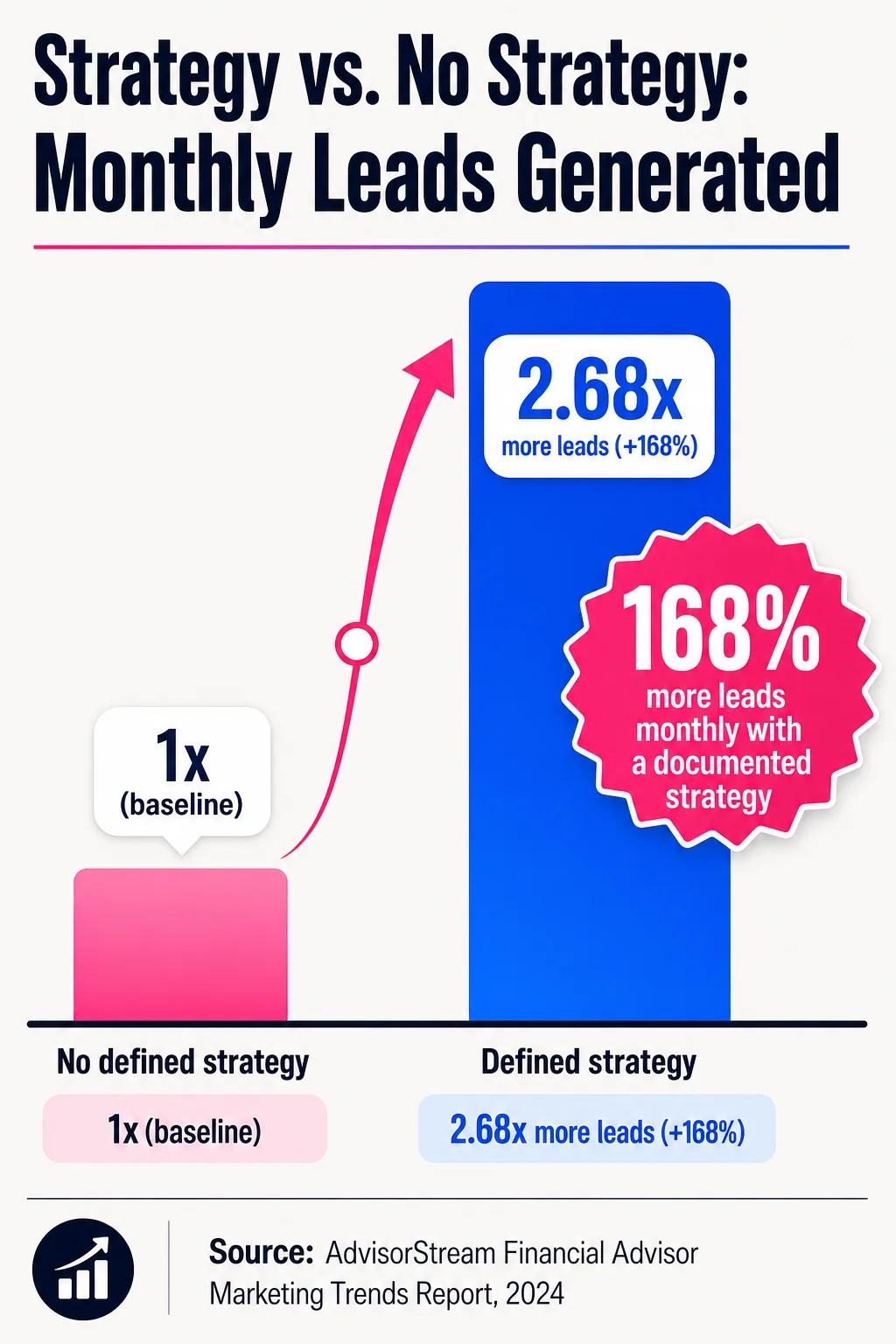
The supply problem isn’t just a content gap. According to an AdvisorStream survey, 80% of advisors handle marketing entirely on their own, averaging about 2.1 hours per week, and fewer than 30% have a defined strategy. That same survey found advisors with a documented strategy generate roughly 168% more leads monthly than those without one.
The rest of this guide covers what a real strategy actually requires for this specific profession, which is different enough from generic small-business marketing that the distinction matters.
Five things every financial advisor marketing plan has to get right
Generic small-business marketing advice skips the constraints that define this profession. A financial advisor can’t just run a testimonial ad, promise a return, or cold-email a prospect list without hitting a compliance wall first. The marketing plan has to account for that from the start, not as an afterthought.
FMG Suite research found that more than 60% of investors think financial advisors all make the same promises. That perception is the actual marketing problem. Standing out requires more than a better tagline.
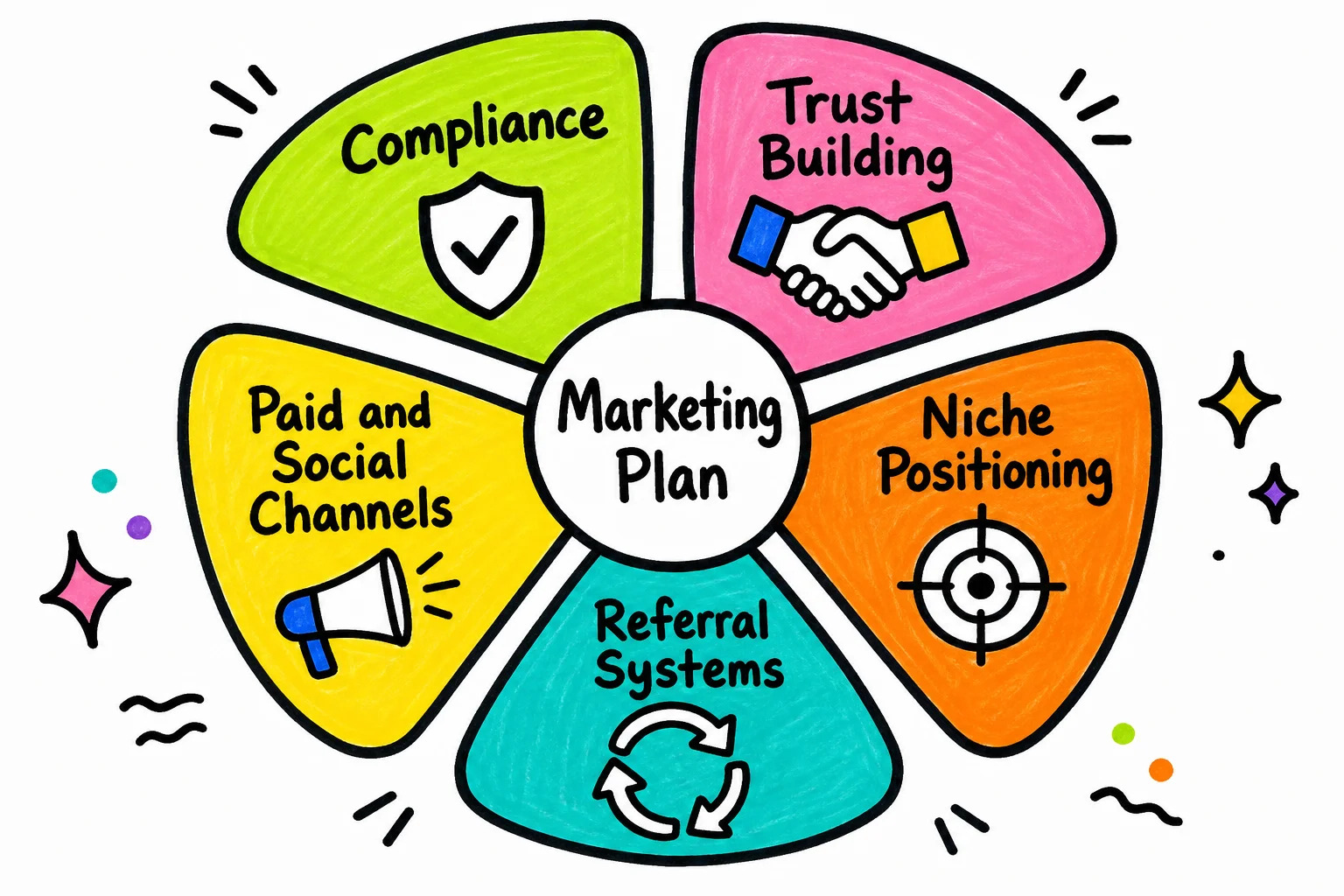
The five pillars this guide covers:
- Niche positioning — choosing a specific audience instead of marketing to everyone with money
- Compliance-first content — building an educational content engine within FINRA/SEC guardrails
- Local SEO and digital presence — showing up when a prospect searches your name or your city
- Referral systems — turning the leads you already get into a repeatable, structured process
- Paid and social channels — using ads and LinkedIn as supporting tools, not the foundation
Each pillar reinforces the others. Referral leads convert in roughly 1.7 months versus 3.6 months for cold prospects, but content and SEO are what convert the cold ones at all. None of these work in isolation.
The sections below take each pillar in turn.
The highest-ROI marketing decision costs nothing to make
Every advisor says they work with “individuals and families navigating complex financial decisions.” It means nothing, because everyone says it. The homepage that tries to speak to retirees, young professionals, business owners, and divorce cases simultaneously ends up speaking clearly to none of them.
Michael Kitces has argued that splitting focus across multiple audiences doesn’t just dilute marketing effort proportionally; it collapses it. One focused niche outperforms two half-hearted ones by a wide margin.
Here is what a niche actually looks like in practice:
A tech employee niche built around RSUs has a concrete value proposition: “I help software engineers at pre-IPO and public companies avoid the tax mistakes that cost them 30-40% of their vesting event.” That’s a specific problem, a specific person, and a specific dollar amount at stake.
A women-in-transition niche has a different one: “I help divorced and widowed women over 50 take control of finances they’ve never had to manage alone.” The RFI Global research on advisor churn shows roughly 70% of widowed women fire their advisor within a year of their spouse’s death, which means the market is there and largely unserved.
A small-business exit niche looks like: “I work with owners selling businesses between $2M and $10M who need to turn a one-time payout into 30 years of income.”
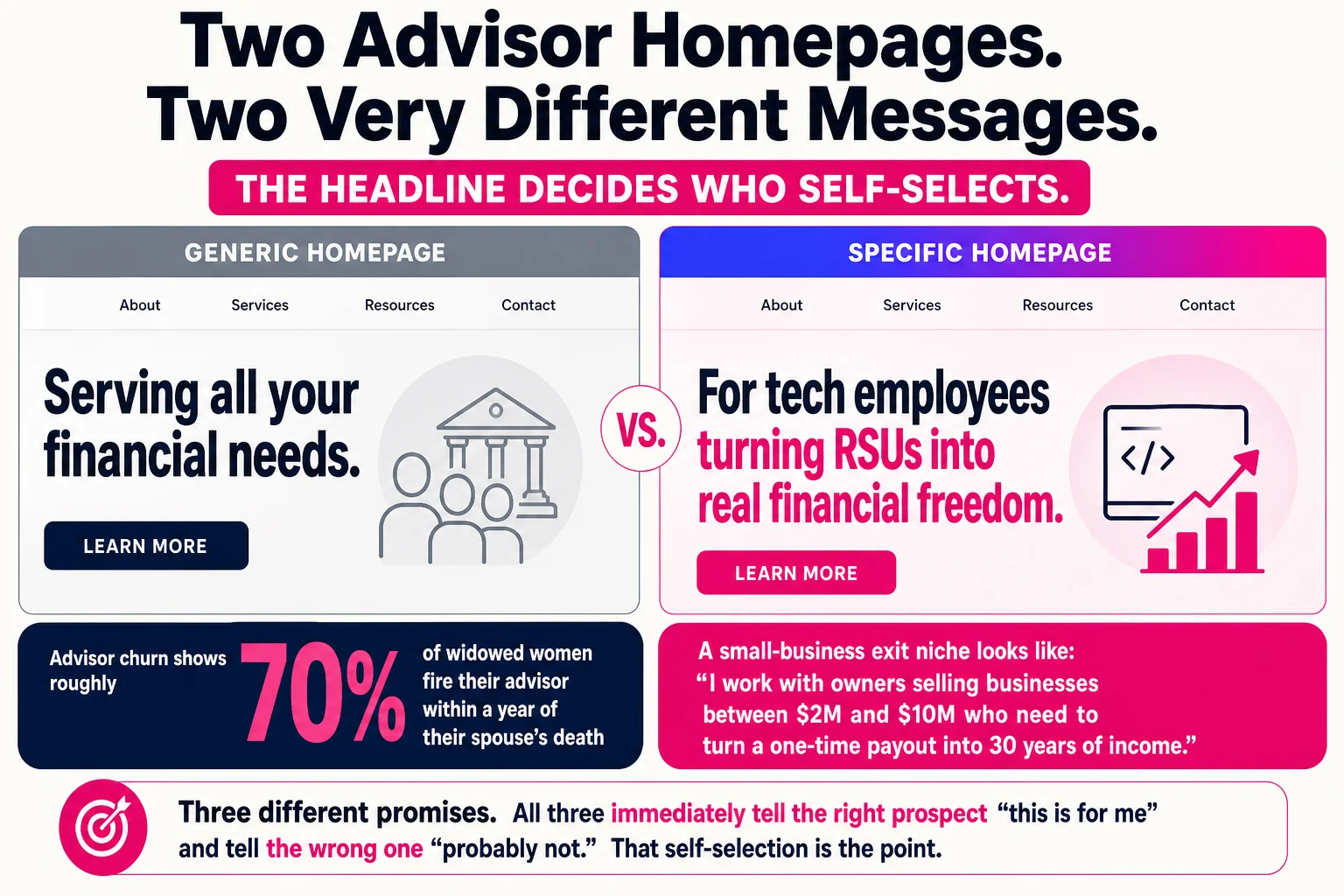
Three different promises. All three immediately tell the right prospect “this is for me” and tell the wrong one “probably not.” That self-selection is the point.
Your content calendar is already a compliance document — treat it that way
Once you have a niche, you need content that proves you understand it. The good news: educational content is exactly what FINRA Rule 2210 and the SEC’s Marketing Rule are most comfortable with. Explainer articles, FAQ pages, email newsletters, and YouTube walkthroughs all work well because they teach rather than pitch. What gets advisors in trouble is specific performance claims, cherry-picked returns, and testimonials without required disclosures.
The formats that hold up under review: blog posts explaining how a tax concept works, short videos walking through a common client scenario, and segmented newsletters tied to life events your niche actually faces. None of those require predicting markets or guaranteeing outcomes.
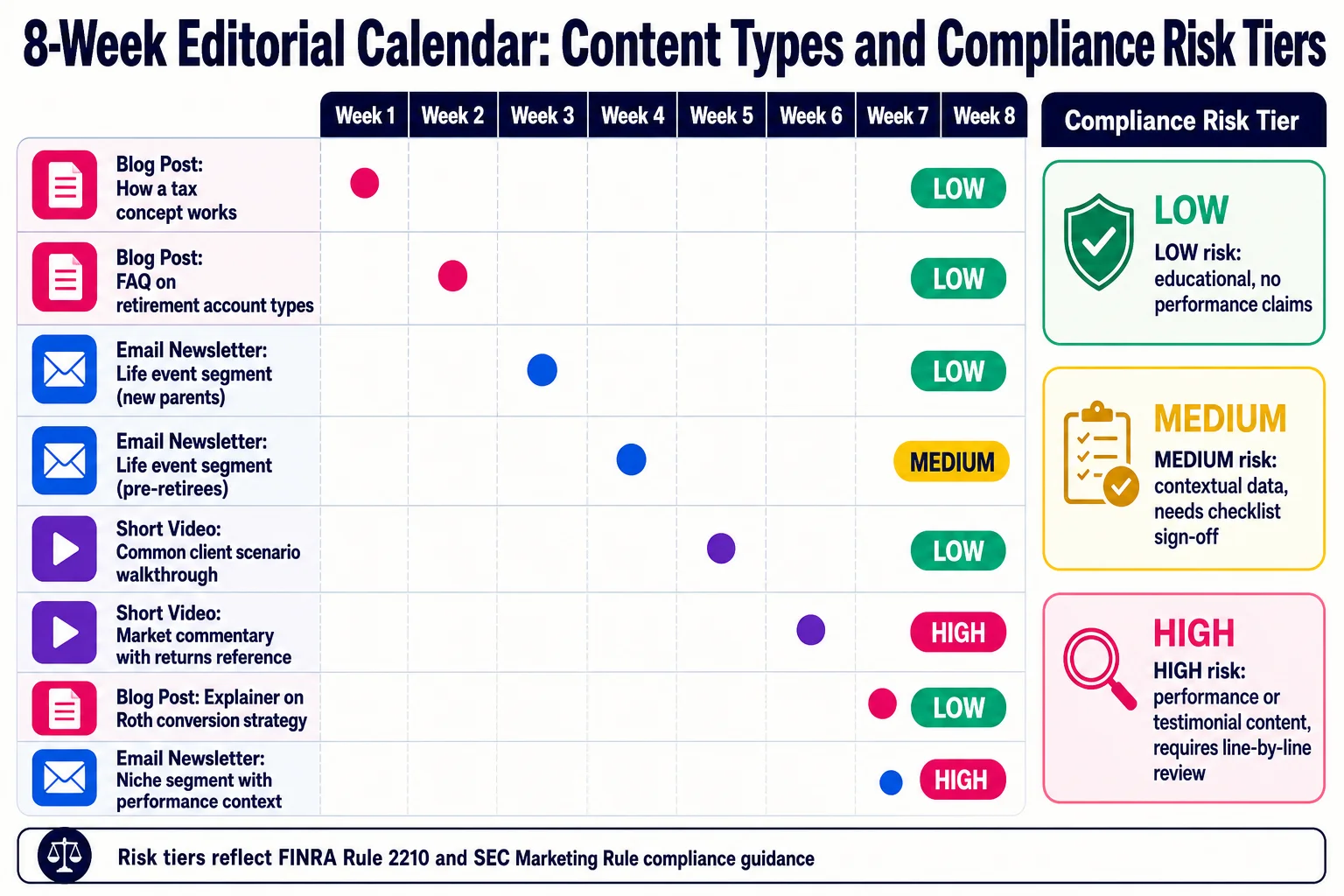
The workflow question matters as much as the content itself. Under the SEC rule, your website posts, social content, and emails are all records that firms must retain. The practical fix most RIA compliance teams use is batch pre-approval: submit a 60 to 90 day editorial calendar, get line-by-line review on high-risk pieces and checklist sign-off on standard ones, with a named approver and date on each item. That keeps the calendar moving without turning every LinkedIn post into a two-week negotiation.
Most advisor prospects Google you before they call you
Before a prospect fills out your contact form, they search your name. If your Google Business Profile is unclaimed or incomplete, that search ends the conversation before you have it.
Google’s local ranking algorithm weighs proximity (how close you are to the searcher), relevance (how well your profile matches the query), and prominence (your reviews, backlinks, and overall web presence). You can’t control proximity, but you can control the other two.
Here’s what to actually do:
- Claim and verify your Google Business Profile at business.google.com. Verification usually arrives by postcard within five days.
- Complete every field: legal business name, primary category (“Financial Planner” or “Financial Consultant”), address or service area, hours, website URL, and a booking link if you have one.
- Write a description that names your city and niche in the first sentence. “Fee-only financial planner serving tech employees in Austin” beats “helping clients achieve their financial goals.”
- Ask recent clients for Google reviews and respond to every one. Reviews are a direct local prominence signal.
- Add a location-specific page on your website (e.g.,
/financial-advisor-austin/) with compliant copy that mirrors your profile.

Results typically take three to six months, with compounding gains around twelve months. Slow, yes, but the leads arrive pre-qualified: the prospect already knows your name and where you work.
Referrals run your practice whether you manage them or not
The 2024 Schwab RIA Benchmarking Study puts referrals at roughly 67% of new clients and new assets for independent advisors. A YCharts survey from the same year found 51% of clients chose their advisor through a referral. Those numbers don’t come from running a great referral program. They come from advisors who happened to do good work and got lucky with timing. A system just makes the luck repeatable.
The process has three steps. First, identify your happiest clients, specifically the ones who have mentioned results, thanked you after a review, or stayed through a rough market without calling to panic. Second, build the ask into an existing moment, a quarterly review, a milestone like a paid-off mortgage or a retirement date, rather than a cold follow-up email that reads like a sales script. Third, make the introduction easy. Give the client a short paragraph they can forward, or offer to send a brief LinkedIn message they can approve first.

The friction point is usually step three. Most clients are willing to refer; they just don’t know what to say. A one-paragraph email template removes that obstacle entirely.
Ads can work, but they are the last thing to build
Paid search and LinkedIn ads support the system you’ve already built. They don’t replace it.
FINRA’s social media guidance and the SEC Marketing Rule require pre-approval workflows, five-year recordkeeping, and no unsubstantiated performance claims in paid content. In September 2024, the SEC fined nine firms over $1.2 million for social media violations. Budget $5,000 to $20,000 per year on compliance tooling before you spend a dollar on clicks, and expect three to six months to get approval workflows running.
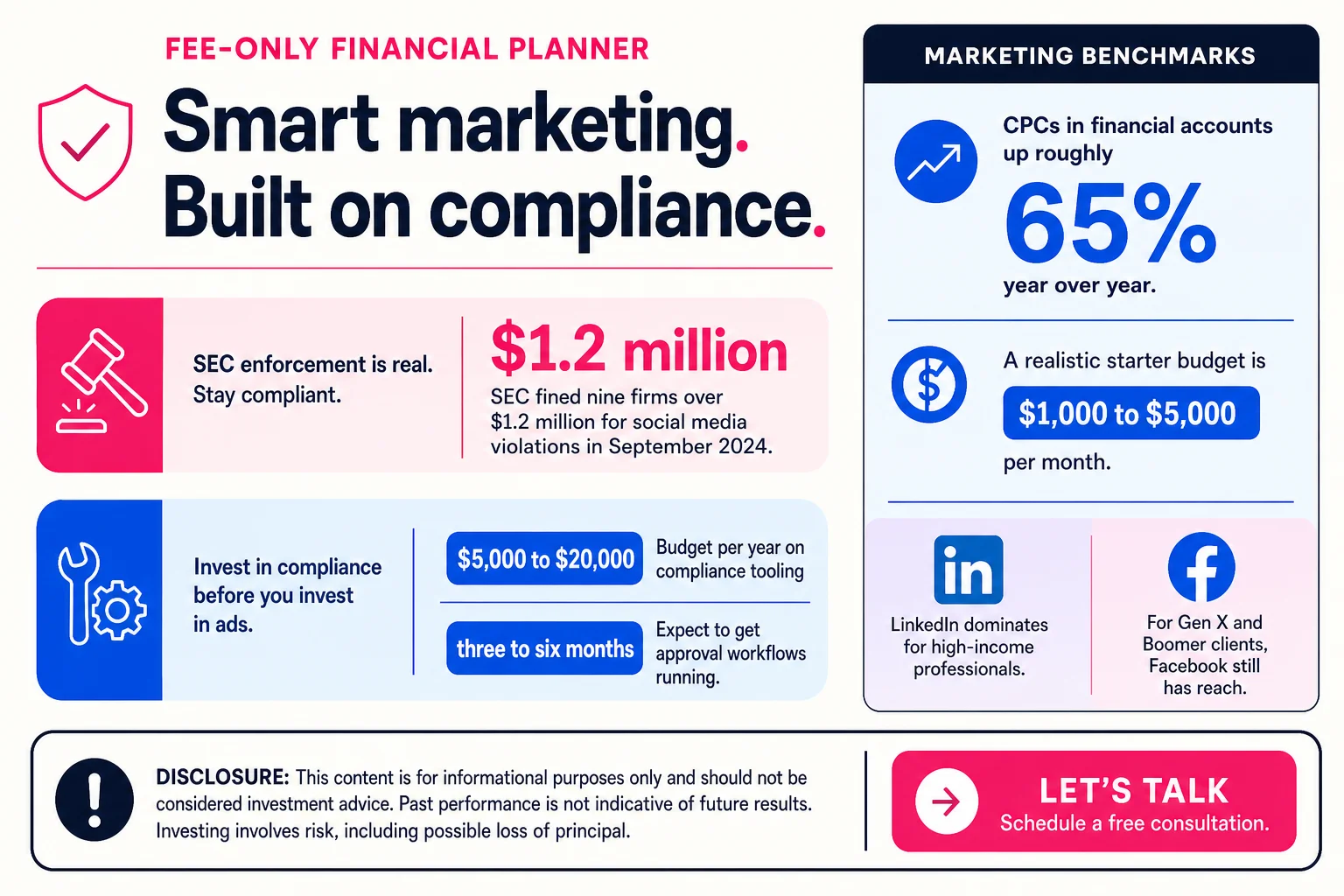
MDM PPC’s 2024-2025 benchmarks show CPCs in financial accounts up roughly 65% year over year. A realistic starter budget is $1,000 to $5,000 per month. LinkedIn dominates for high-income professionals. For Gen X and Boomer clients, Facebook still has reach.
Now put it together
The five pillars covered here — niche positioning, compliant content, local SEO, referral systems, and paid channels as a finishing layer — form a complete plan. Each one builds on the last, and none of them work well in isolation.
The fastest way to turn this framework into something specific to your practice is to run it through the generator below. Enter your URL, and it produces a 1,400-word strategy covering positioning, audience, channel mix, and a 90-day roadmap in under five minutes, with no credit card required.