
Running Ads, Email, and SEO Is Not a Strategy
Picture a store owner on a Tuesday morning: Google Ads running, a Klaviyo sequence firing, a blog post half-optimized for some keyword their agency suggested. Revenue is coming in. The dashboard looks fine. But nothing connects to anything else. The ads bring in customers who never buy again. The email list grows but the repeat purchase rate sits flat. The blog drives traffic that doesn’t convert.
That’s not a strategy. That’s a pile of tactics wearing a strategy’s clothes.
An actual ecommerce marketing strategy ties acquisition, conversion, retention, and margin together into one coherent plan, where decisions in one area deliberately support the others. Most stores don’t have that. They have channels.
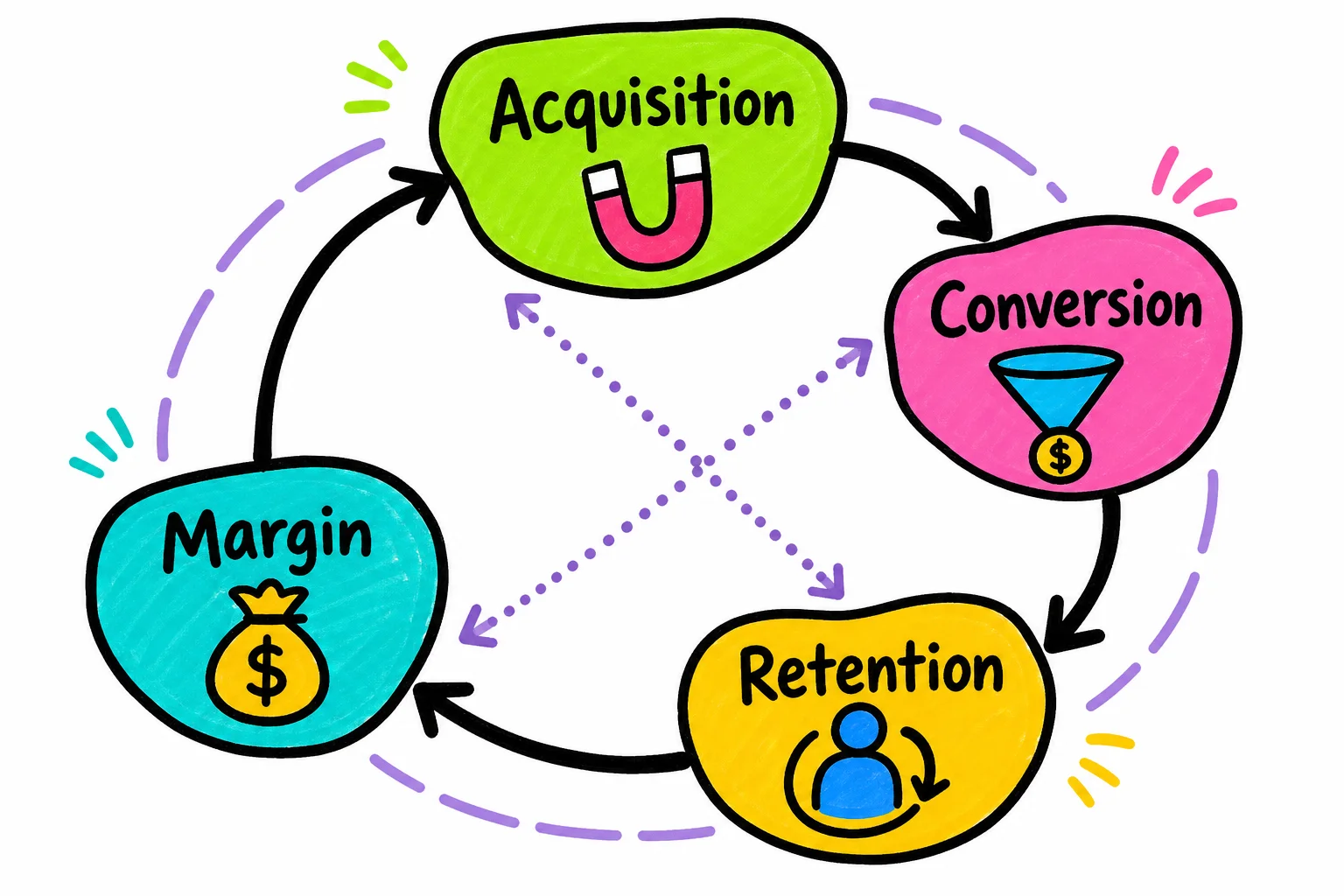
This guide is built for operators who want the full picture: what to prioritize, where channels fit, how to measure progress, and how to build a plan that compounds over time instead of just spending money to stay in place.
The Math That Makes Ecommerce Marketing Different
Generic digital marketing advice mostly ignores unit economics. Ecommerce cannot afford to.
Here’s a situation that plays out constantly: a store spends $30 to acquire a customer, that customer buys once at $35, and the product carries a 40% margin. The gross profit on the sale is $14. Subtract the $30 CAC and the store just lost $16 on a “successful” transaction. The ads worked. The sale happened. The business bled money.
That’s the core problem. Every ecommerce marketing decision sits inside a four-way tension between CAC (what you spend to get a customer), AOV (what they spend when they arrive), margin (what you keep after costs), and LTV (how much they’re worth over time). Pull one lever without accounting for the others and the math breaks somewhere.
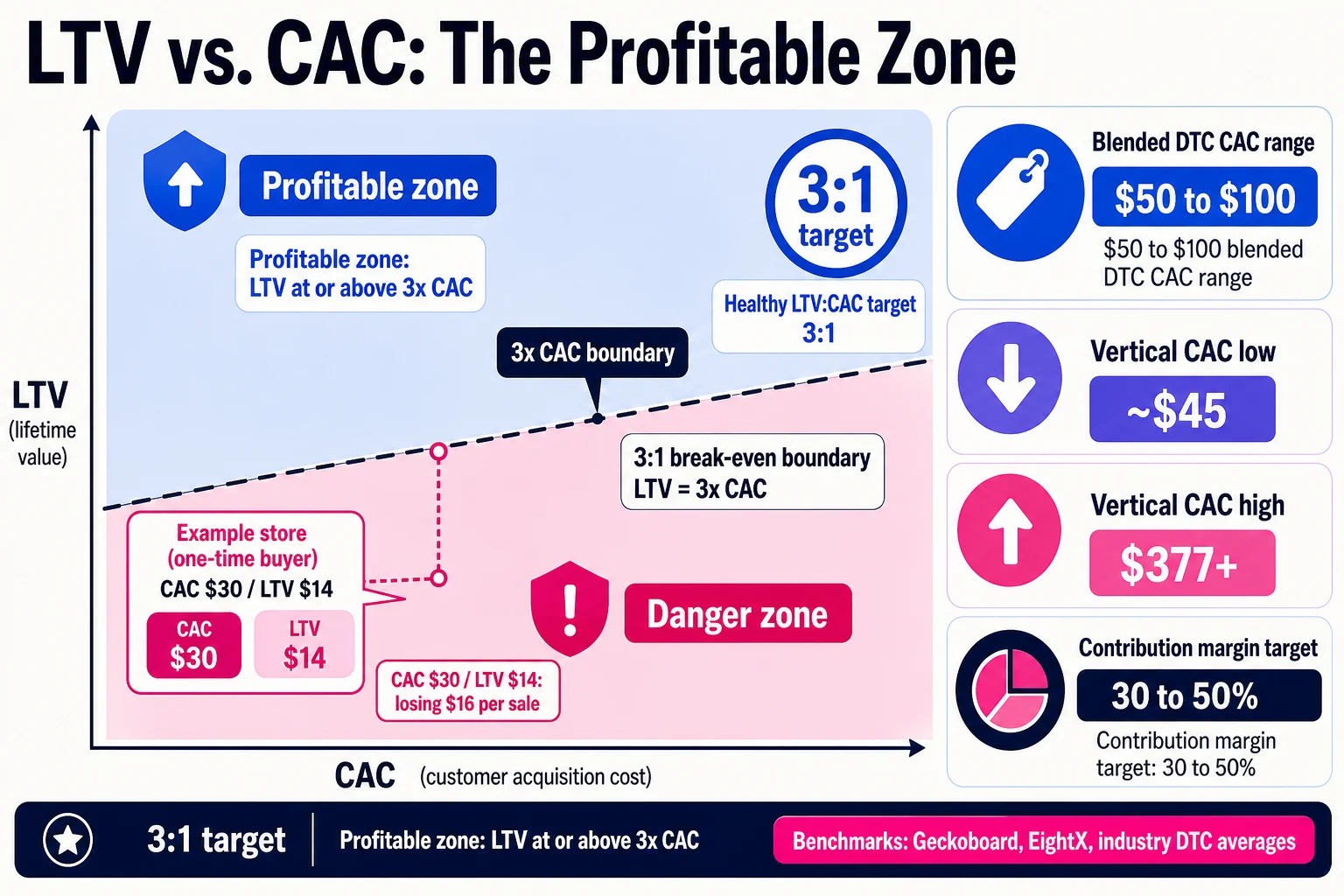
Benchmark data suggests a healthy LTV:CAC ratio sits around 3:1. Blended CAC for DTC brands commonly falls between $50 and $100, though vertical extremes range from roughly $45 to over $377 depending on category. Those numbers only matter once you know your own margin, because contribution margin is what actually caps how much you can profitably spend to acquire anyone.
Strategy, in this context, means knowing which lever moves first given where your numbers currently sit.
One Framework, Four Levers
The four-way tension described above has a practical solution: stop treating acquisition, conversion, retention, and margin as separate campaigns and start treating them as a single system where each layer feeds the next.
Acquisition is where most budgets go and where most money disappears. The goal is not just traffic, it’s profitable traffic. A fashion brand running broad Meta campaigns might hit a $60 CAC while a tightly targeted Google Shopping campaign pulls customers at $38. The difference is whether the acquisition layer was designed around margin constraints or just optimized for volume.
Conversion is the multiplier nobody charges enough attention. Average ecommerce conversion rates sit around 2.5 to 3 percent, which means 97 cents of every dollar spent on acquisition leaves without buying anything. A 10 to 20 percent improvement through CRO, better product pages, or checkout optimization doesn’t cost more ad spend. It just makes every existing dollar work harder.
Retention is where the math finally tips in your favor. Research attributed to SimplicityDX suggests brands lose an average of $29 on the first transaction after accounting for CAC. The second and third purchases are where the business actually makes money. Repeat customers, who often make up roughly 21 percent of a store’s base, can account for around 44 percent of its revenue.
Margin is the layer most stores skip entirely. Optimizing for ROAS instead of contribution margin means you can run a technically profitable campaign that still shrinks your bank account, because ROAS doesn’t account for fulfillment costs, returns, or discounts. Switching ad bidding to profit-based targets rather than revenue targets is one of the fastest ways to fix this.
Each layer depends on the one below it. Great retention means nothing if conversion is broken. Efficient conversion is wasted if the acquisition channel brings in the wrong buyers.
Not every channel deserves your budget right now
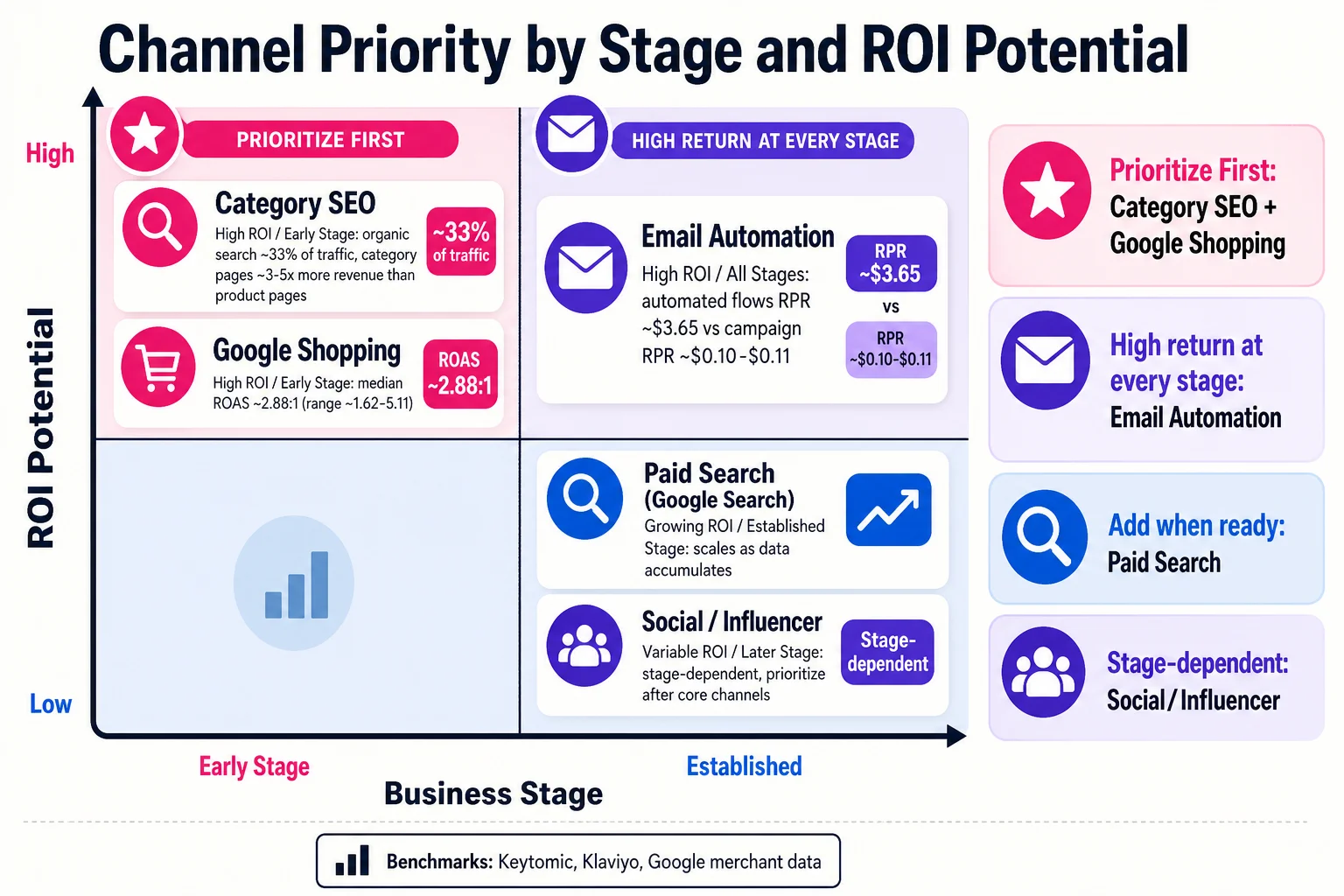
SEO: the channel that keeps paying. Organic search drives roughly 33% of ecommerce traffic, more than paid, email, or social in most accounts. Target category pages first. Well-optimized category pages can generate 3 to 5x more organic revenue because they rank for broader, higher-volume terms. Add 150 to 400 words of intent-matched copy per category page, implement Product and BreadcrumbList schema (linked to ~30% higher click-through rates), and use canonical tags or noindex on faceted navigation to protect crawl budget. Start early. It compounds.
Google Shopping: fastest paid ROI for most stores. Median ROAS sits around 2.88:1, ranging from 1.62 to 5.11 depending on category and feed quality. Shopping gets products in front of buyers faster than Search campaigns, which need conversion history to optimize. Start there, then expand to Search once you have enough data to bid on high-intent terms profitably.
Email automation: the multiplier hiding in your ESP. Broadcast campaigns average $0.10 to $0.11 per recipient. Automated flows average around $3.65. Automations are roughly 2% of email volume but generate about 37% of email revenue. Build the flows before the broadcast calendar.
Social and influencer: real, but stage-dependent. Social works for brands with strong visual identity or community. CAC is already high and attribution is murky early on, so treat it as a brand-building and remarketing layer first, primary acquisition later.
Your most profitable customers are already in your database
Acquiring a new ecommerce customer costs roughly 5 to 7 times more than keeping an existing one, and in some verticals that gap reaches 25×. Repeat buyers convert at 60 to 70% compared to 5 to 20% for cold prospects, and they account for roughly 65% of revenue. The math is not subtle.
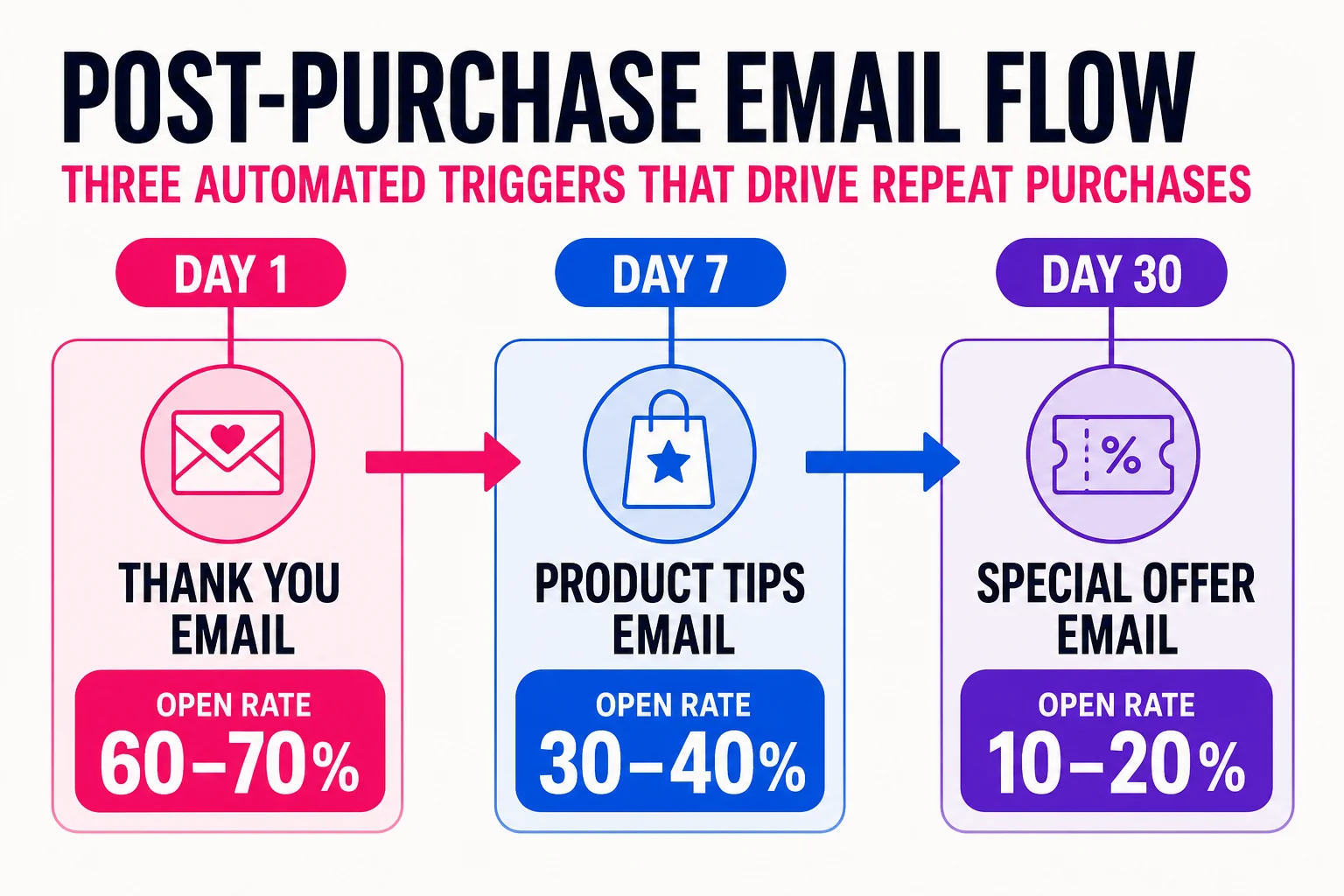
The two flows that move the needle fastest are post-purchase sequences and win-back campaigns. A post-purchase sequence starting within 24 hours of the first order, covering product education, a cross-sell at day 7, and a replenishment nudge at day 30, generates open rates around 40 to 45% and repeat-purchase rates of 10 to 15%. A win-back sequence triggered at 60 to 90 days of silence typically recovers 5 to 15% of lapsed customers, with conversion rates between 1 and 2.5%.
Loyalty programs add another layer. Customers who redeem points purchase at roughly a 50% repeat rate versus 10.7% for non-redeemers. Tiered programs deliver about 1.8× higher ROI than flat ones. If your product has a natural repurchase cycle, a subscription option with pause and skip controls can push retention from around 20% to 45% over the same period.
The numbers that tell you if any of this is actually working
Tie your metrics to the four layers, and they stop being a random dashboard and start telling a story.
| Layer | Metric | Benchmark |
|---|---|---|
| Acquisition | CAC | Varies by category; check against LTV |
| Acquisition | ROAS | ~4:1 average; higher if margins are thin |
| Acquisition/Retention | LTV:CAC | 3:1 minimum; above 5:1 may signal underinvestment |
| Conversion | Conversion rate | 2–3% for most stores |
| Conversion | Cart abandonment rate | Lower is better; track directionally |
| Retention | Repeat purchase rate | 25–40% in non-subscription ecommerce |
| Margin | AOV | Track against CAC to confirm unit economics |
Keep your working dashboard to 8–12 metrics. Analysis overload is real, and a 20-row spreadsheet reviewed once a month produces worse decisions than a tight scorecard reviewed consistently.
Run two cadences: a weekly 15-minute check on CAC, ROAS, and conversion rate to catch anything bleeding; a monthly or quarterly review of LTV:CAC and repeat purchase rate to see whether the strategy is actually compounding. The weekly review fixes. The monthly review decides.
Put the framework to work on your actual store
The four layers, the channel matrix, the KPI scorecard — those are only useful if you apply them to your specific store, not a hypothetical one. The generator below takes a URL or a few details about your business and produces a personalized ~1,400-word strategy with a 90-day roadmap in under five minutes, free, no credit card required. The output maps across acquisition, conversion, and retention, and exports as a white-labeled document you can hand to a client or a team.

It won’t replace the judgment calls this guide covered, but it gives you a structured starting point instead of a blank page.
Pick one leak and fix it
Every tactic in this guide competes for the same budget and attention. The stores that grow aren’t running more things — they’re running fewer things well. Pick the one layer of the framework where your store is losing the most money right now: acquisition costs you can’t sustain, a conversion rate that doesn’t justify your ad spend, a repeat purchase rate that sits near zero, or margins too thin to survive a slow month. Start there. Fix that layer until the numbers move, then expand. That’s the whole plan.