
You have a good coffee shop. Nobody knows it exists.
Your espresso is dialed in, your space is comfortable, and the regulars love you. But new faces are rare, and most weeks feel like you’re waiting for word-of-mouth to do work it was never going to do alone.
That’s the situation this guide is built for. The ClickMinded page this replaced had nearly 7,000 search impressions over 16 months and zero clicks, sitting at an average position of 39. People are searching for exactly this kind of plan. They just weren’t finding anything useful here yet.
What follows is a concrete local marketing plan covering the five areas that actually move the needle for neighborhood coffee shops: local search visibility, repeat visits, social content, events, and community partnerships. If you want a version customized to your specific shop, the generator below can build that out for you. But start here.
Your shop doesn’t serve “people who like coffee”
Before you touch a single marketing channel, answer one question: who actually walks through your door, and when?
Crimson Cup’s STP framework for small operators recommends picking 2–3 core customer types and building every promotion around them. That’s not a corporate exercise. It’s how you stop wasting money on Instagram posts that reach the wrong people at the wrong time.
Most neighborhood shops serve some version of these three:
| Customer type | Visit motivation | Best channel to reach them |
|---|---|---|
| Morning commuter (7–10 AM) | Speed, consistency, mobile order | Google Maps, SMS offer |
| Remote worker (12–5 PM) | WiFi, outlets, long dwell time | Instagram, local Facebook groups |
| Weekend browser (evenings/weekends) | Leisure, food pairing, seasonal specials | Instagram, neighborhood events |
Afternoon traffic is among the fastest-growing dayparts for coffee shops, which means remote workers are a real segment worth building around, not an afterthought.
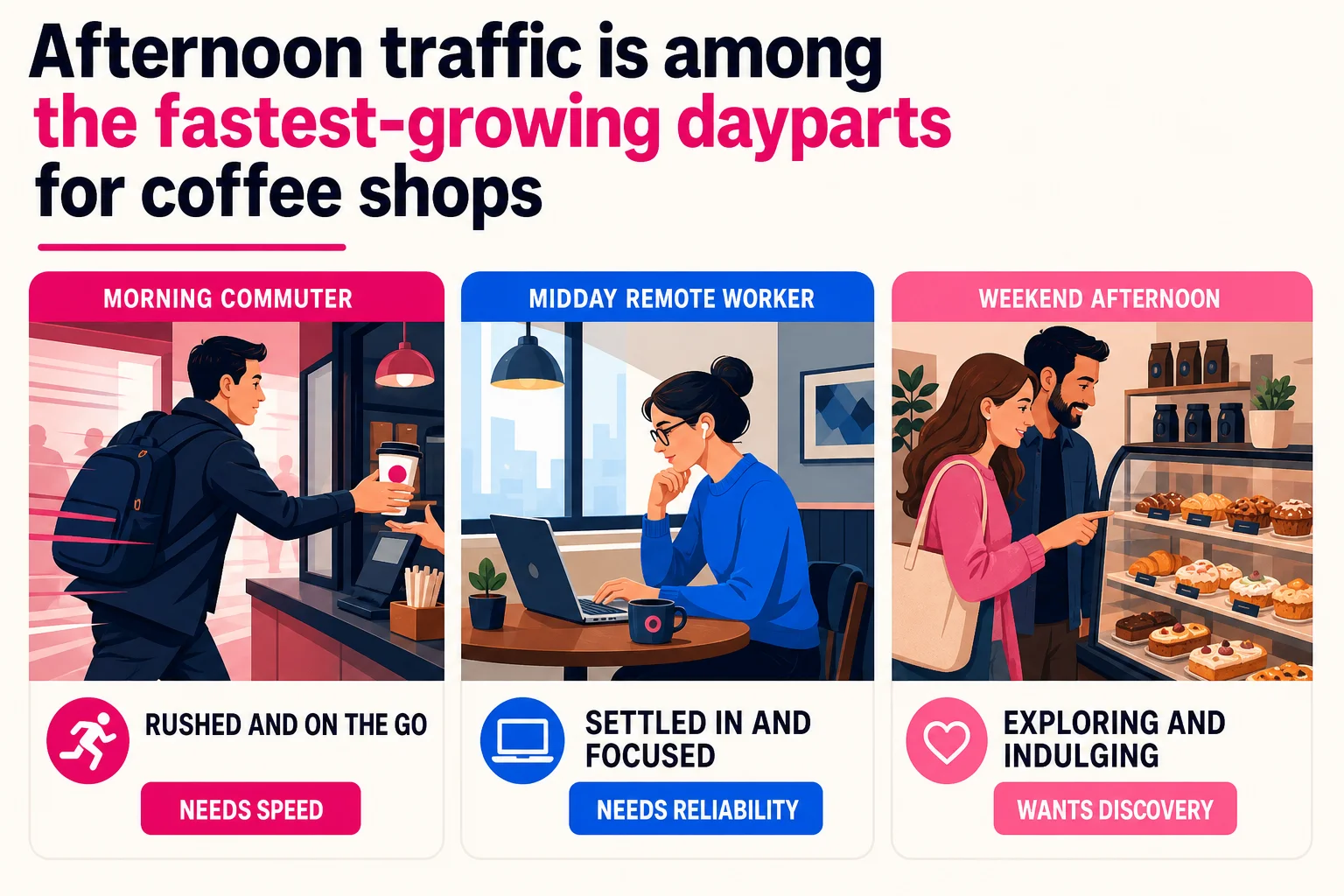
The profile you pick changes everything downstream. A shop targeting morning commuters needs fast throughput and a reason to pre-order. A shop targeting remote workers needs reliable WiFi and a midday promotion. Same coffee, completely different plan.
Your Google Business Profile is doing more work than your Instagram
Once you know who you’re targeting, the next question is whether those people can even find you. The answer, for most independent coffee shops, is probably not as often as you’d think. This page alone had nearly 7,000 impressions over 16 months and zero clicks, which is a good illustration of how much local search traffic goes uncaptured when a profile or page isn’t optimized.
Your Google Business Profile is the single highest-return action here. A fully filled-out profile with photos gets significantly more direction requests and website clicks than a sparse one, and the gap compounds over time. Here’s how to close it:
- Set “Coffee Shop” as your primary GBP category, then add secondary categories like “Brunch Restaurant” or “Cafe” to catch adjacent searches.
- Complete every field: hours, phone, website, menu URL, accessibility features, WiFi availability, outdoor seating. These attributes show up in filtered local searches and influence which profiles surface.
- Add new photos at least once a week. Drinks, the room, the counter at 8am. Profiles with active photo uploads consistently outperform static ones.
- Respond to every review, positive or negative, and work in a natural local reference (“Thanks for stopping by on your way through the Eastside”). This affects both ranking and how new visitors read the profile.
- Seed your Q&A section. Answer the questions people actually ask: parking, WiFi password policy, whether you take walk-ins for large groups.
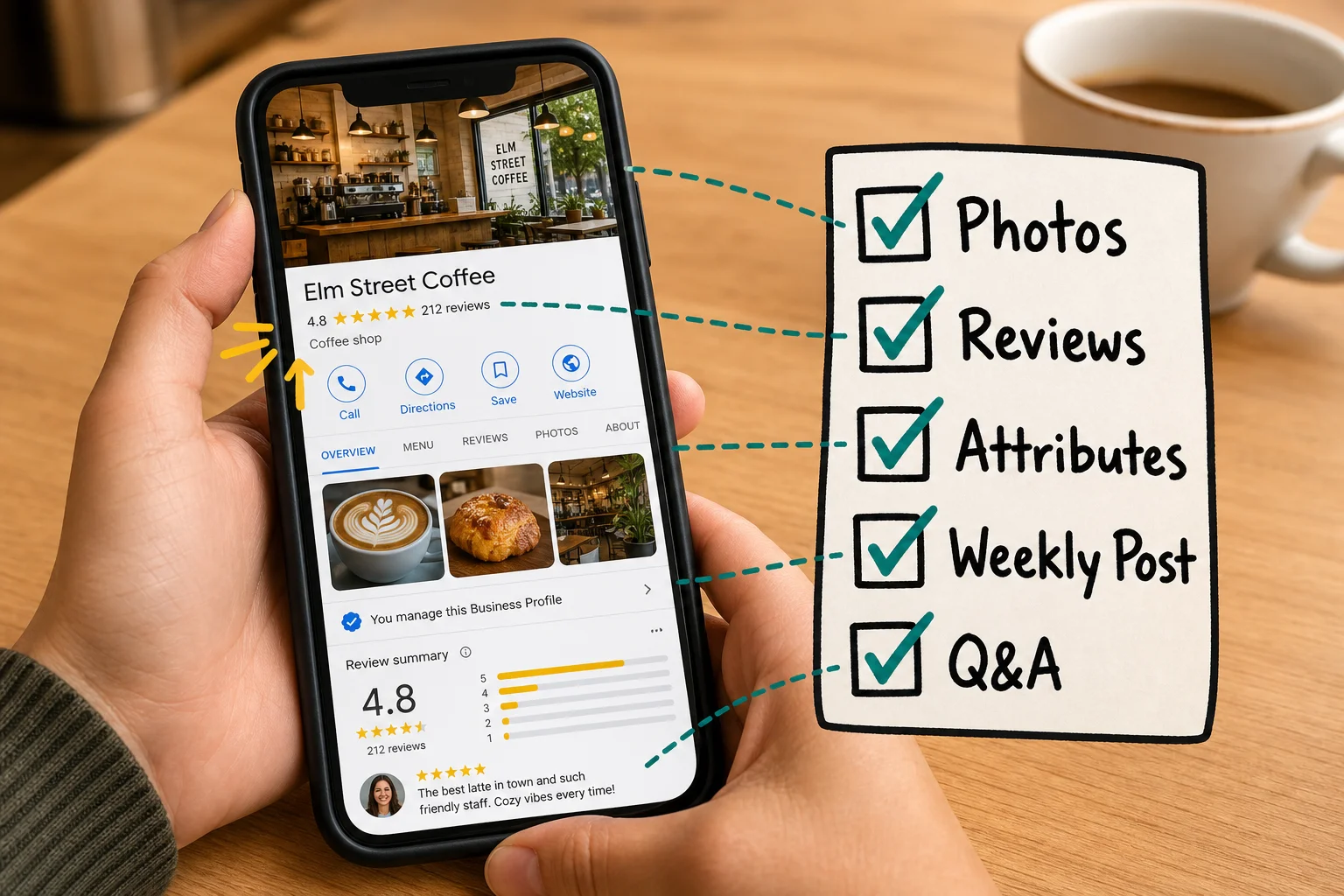
For reviews specifically, two methods work reliably: staff asking in the moment after a good interaction, and QR-code cards at the checkout counter. Aiming for five or more new reviews per month keeps your profile active in Google’s eyes.
On your actual website, put location-specific phrases (“coffee shop in [neighborhood name]”, “best espresso near [landmark]”) in your homepage title tag and your menu page. “Near me” searches are high-intent and happen constantly on mobile. If your site doesn’t mention where you are, Google has less reason to surface you for them.
Getting someone to come back is cheaper than getting them in the first time
Retaining a customer costs roughly five times less than acquiring a new one. For a coffee shop, that math points directly at your loyalty program.
Paper punch cards are free to print and require zero setup. The problem is that somewhere between 20% and 45% get lost before they’re ever redeemed, which means you’ve given away the goodwill without getting the return visit. A basic digital app like Stamp Me or Square Loyalty lives on the customer’s phone, eliminates the lost-card problem, and gives you actual data: who visits, how often, when they lapse. Vendor reports put visit-frequency lifts from digital programs in the 23–40% range, though those numbers come from platform providers rather than independent studies, so treat them as directional.
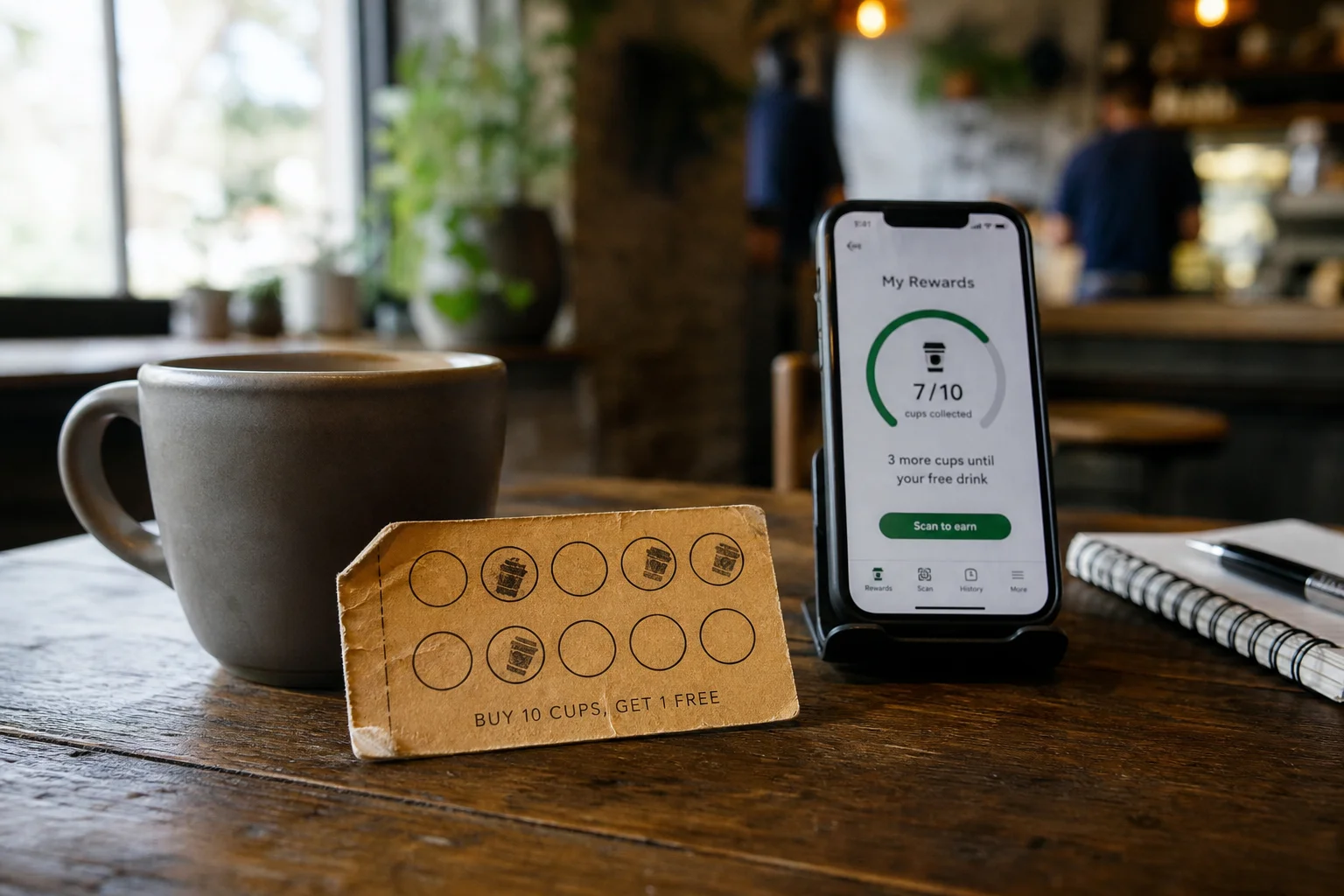
If you’re doing fewer than 100 transactions a day, a paper card is a fine starting point. Scale to digital when the volume justifies it.
For immediate repeat visits, SMS beats email. A simple offer works: “Show this text for a free flavor shot on your next visit.” Collect numbers at the register with a QR code or a sign-up sheet. Klaviyo and Mailchimp both have entry-level SMS tiers with low or no monthly cost to start.
Stop posting for the algorithm and start posting for your block
Most coffee shop social content gets likes from people two states away. Fine for the ego, useless for Tuesday’s revenue. The goal is local browsers who see a post at 8 AM and walk in at 8:15.
Five content types that give someone a reason to show up, not just double-tap: a 15-second Reel of your brewing process (builds curiosity in a way a latte photo never does); a “last 10 of today’s single-origin” tease (scarcity works); a collab announcement with a nearby bakery or bookshop (their audience becomes yours); a regular customer’s named drink special, with permission (visit-worthy story); and morning prep content posted between 7 and 9 AM, when commuters are close enough to detour.
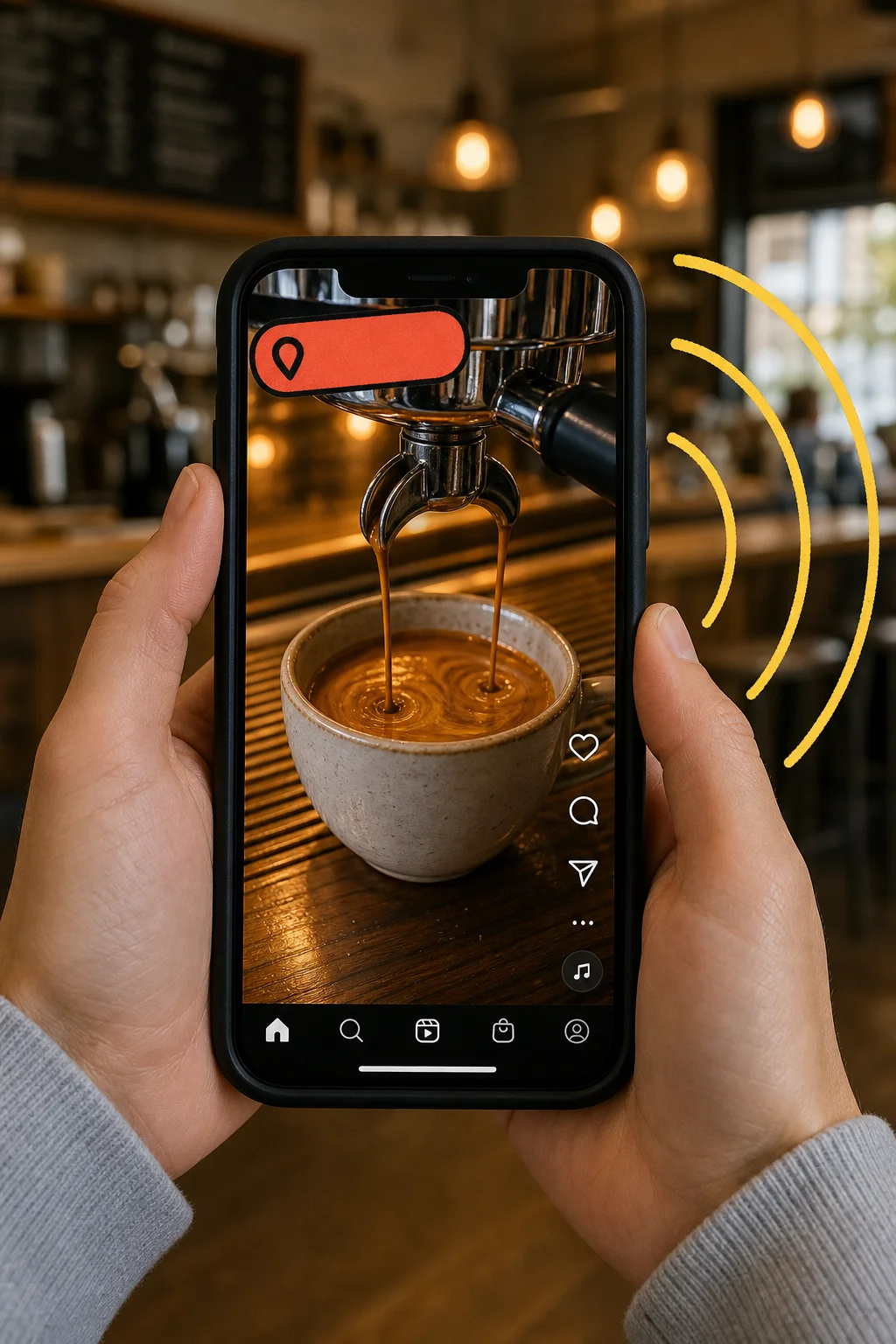
On Instagram, add a location tag to every post and Story, then pair it with a geotargeted paid post set to a one-to-three mile radius. Five dollars a day reaches several hundred local accounts. Facebook’s neighborhood groups are worth a separate post whenever you run an event or limited offer — that audience is older, local, and more likely to plan a visit than someone who found you through a trending sound.
Your shop is the third place, so act like it
Home, work, coffee shop. Sociologist Ray Oldenburg called it the “third place,” and it’s the reason events work: people aren’t just coming for the drink, they’re coming for somewhere to be.
That framing makes the business case obvious. A monthly local artist wall rotation costs nothing except wall space and a conversation. Bovaconti Coffee ran a limited-edition cup series with nine artists; the rotations sell out and bring in customers who’d never have walked in otherwise. An open-mic night costs maybe $50 in sound equipment rental and turns a slow Tuesday into a higher-margin evening with a specialized drinks menu to match.
Cross-promotion is even cheaper. Ask the bookstore two doors down to leave discount cards on your counter; leave theirs on yours. Both audiences overlap almost perfectly, and neither business spends a dollar on advertising.
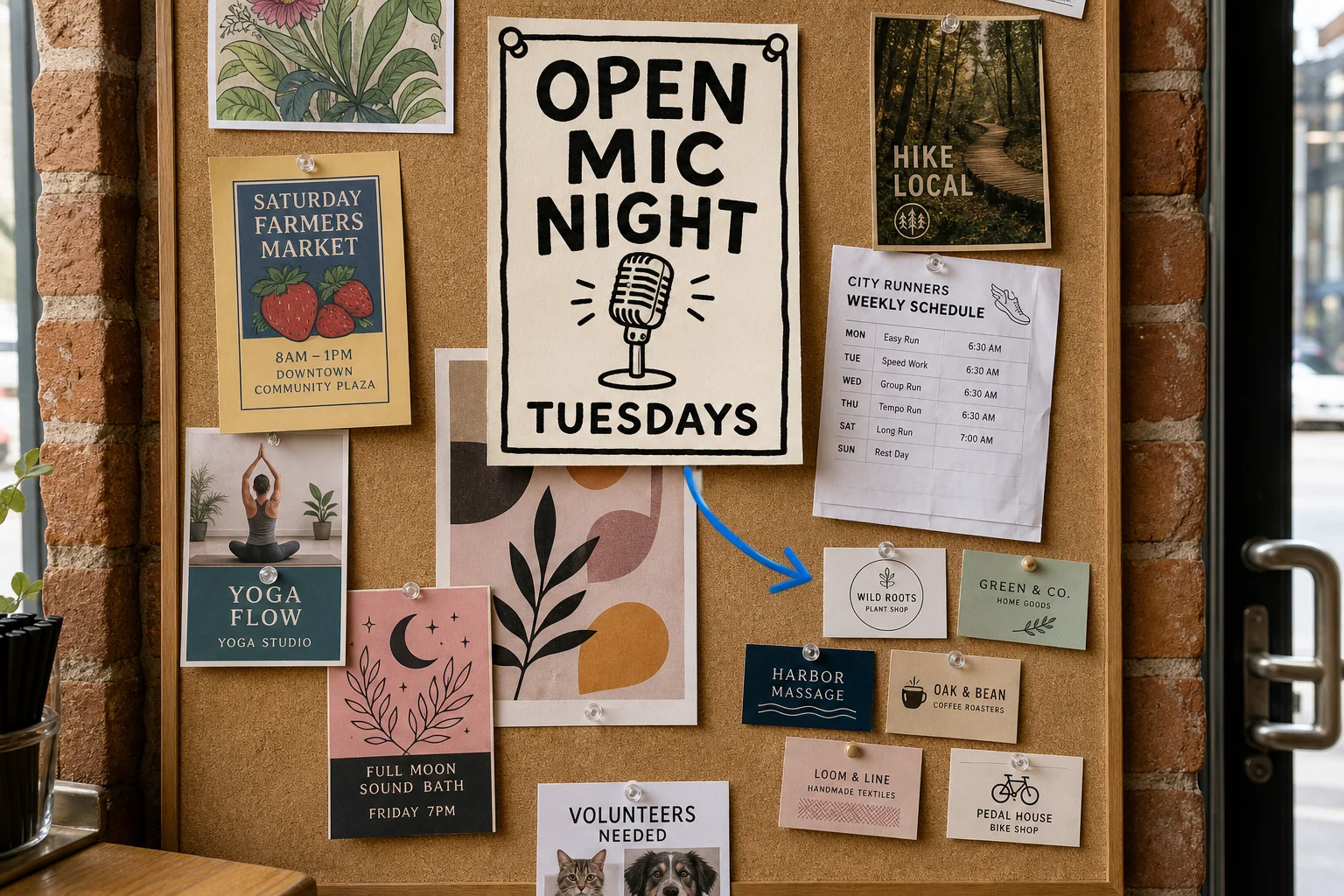
A community board near the door handles the rest. Local running clubs, yoga studios, and neighborhood groups all need somewhere to post. Let them, and they bring their members with them.
A 90-day plan you can actually tape to the wall
Days 1–30: Get found 1. Claim and fully complete your Google Business Profile 2. Add 10+ photos and a keyword-friendly business description 3. Ask five regulars for a Google review this week 4. Make sure your website has a menu page with local keywords
Days 31–60: Build loyalty and social 1. Launch a digital stamp card and train staff to mention it at checkout 2. Start collecting emails or SMS opt-ins at the counter 3. Post three times a week on Instagram, at least one Reel per week
Days 61–90: Fill seats 1. Schedule one in-shop event (open mic, tasting, artist rotation) 2. Set up a cross-promotion swap with one neighboring business 3. Review what worked, cut what didn’t, set goals for the next quarter
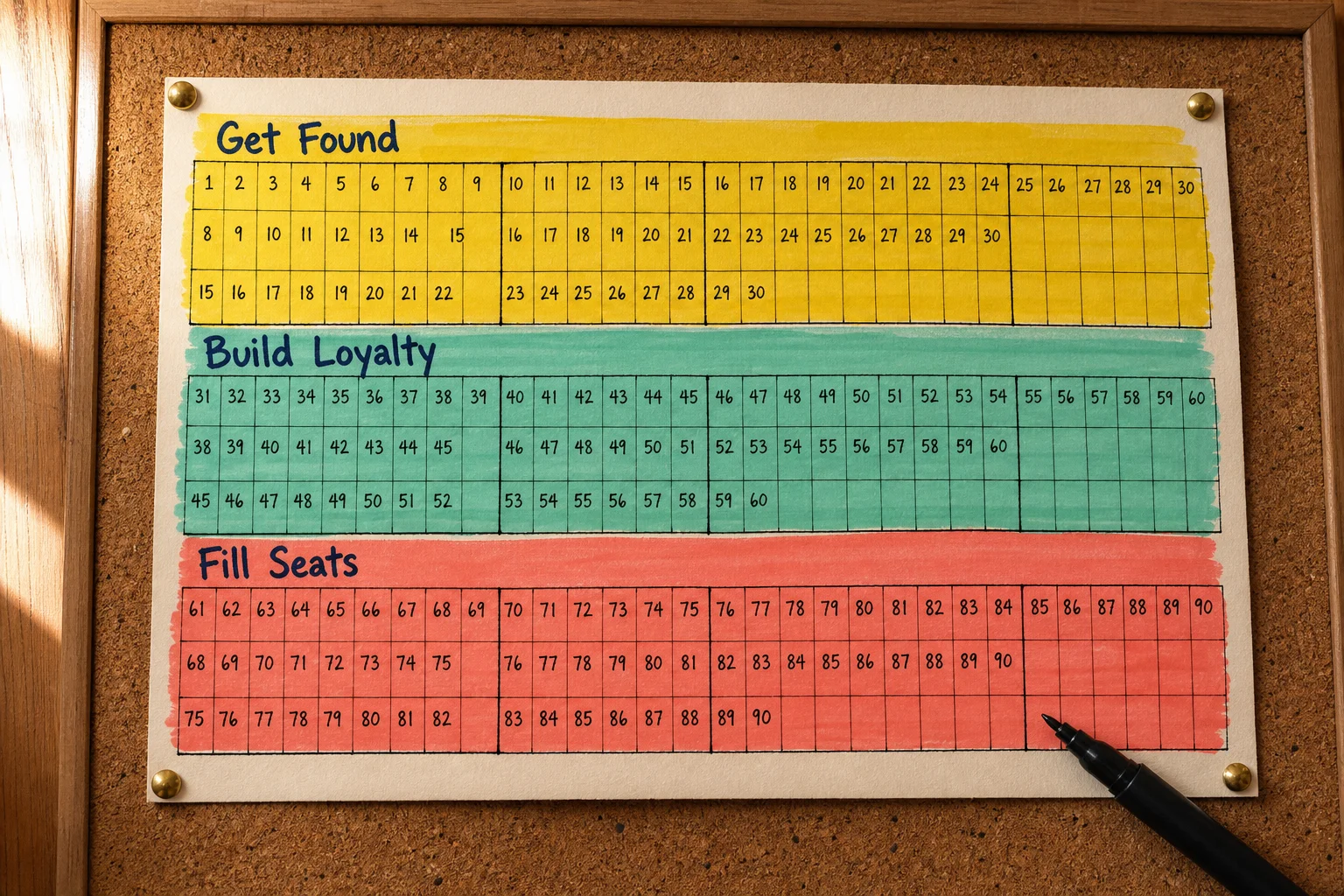
If you’d rather build this around your specific shop and neighborhood, the generator below takes a few minutes.
Want a custom coffee shop marketing plan in five minutes?
The 90-day framework above works as a starting point, but it’s generic by design. The generator below takes your actual business URL, researches your positioning and local competitors, and builds a full coffee shop marketing plan around your specific shop. It’s free and takes about five minutes.