
Zero downloads, day one
Picture this: you’ve shipped. The app is live, the build is clean, crash-free sessions are sitting near the target 99.95%, and you are staring at an installs dashboard that reads zero. Not “slow start” zero. Just zero.
The code wasn’t the problem. The plan was.
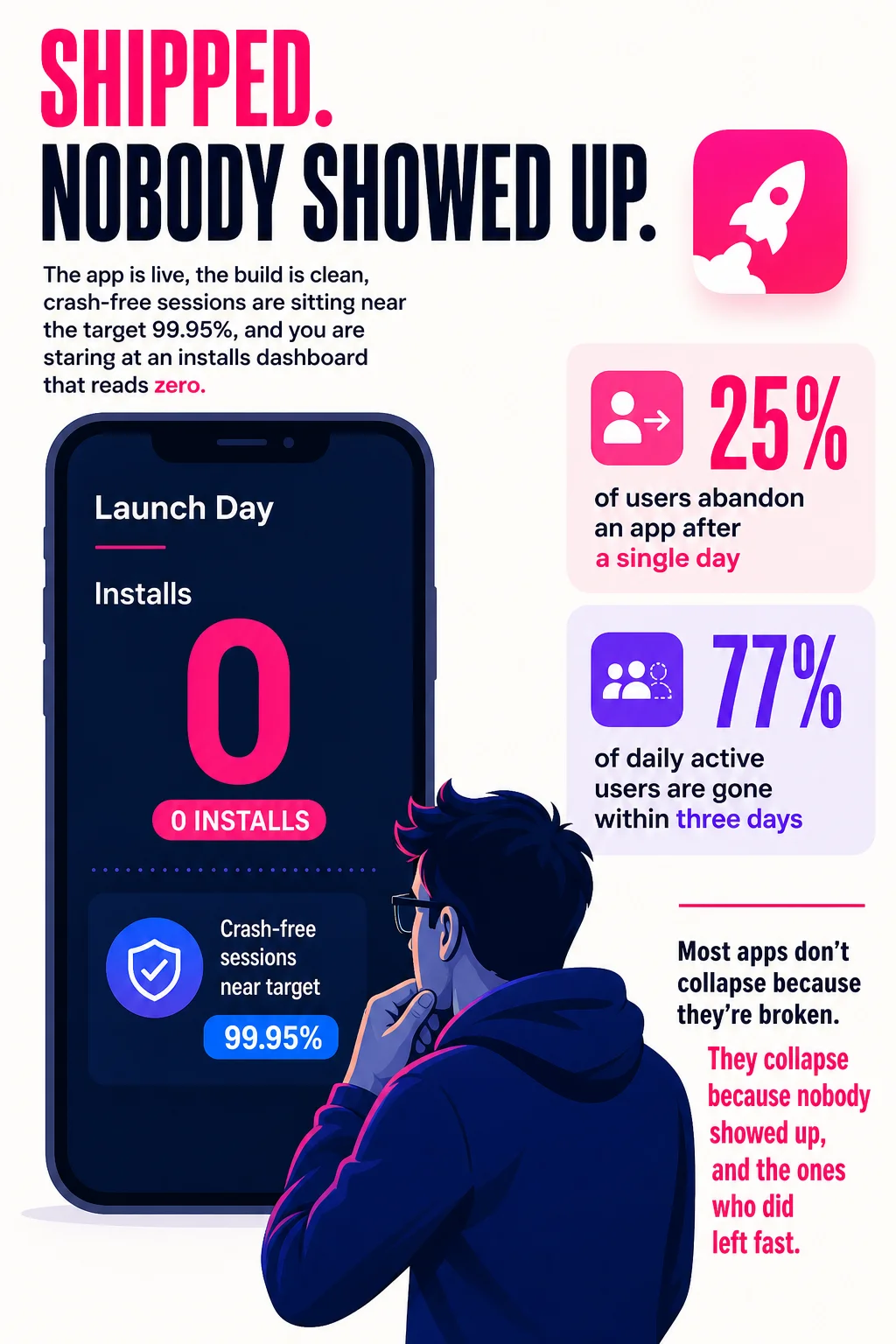
Most apps don’t collapse because they’re broken. They collapse because nobody showed up, and the ones who did left fast. About 25% of users abandon an app after a single day, and roughly 77% of daily active users are gone within three days. By day 30, that number is closer to 90%.
A real app marketing strategy addresses that full arc, not just the launch spike. This guide covers the six areas that matter: ASO, acquisition, activation, retention, monetization, and measurement. Work through them in order or jump to wherever your current numbers hurt the most.
The difference between “run some ads” and an actual plan
An app marketing strategy is a structured plan that covers what you do before the app ships and what you do after. Those are genuinely different jobs. Pre-launch work focuses on building an audience, capturing waitlist emails, validating your positioning, and setting up your store listing so day-one downloads have somewhere to land. Post-launch work shifts to acquiring users at scale, getting them to a moment where the app clicks for them, keeping them around, and eventually earning revenue from them.
Most teams skip the pre-launch half entirely. They treat the whole thing as “run some ads after we launch,” which is a reasonable instinct if you’ve never watched your install curve flatline. The problem is that paid ads alone don’t fix a store listing nobody clicks, an onboarding flow that loses people in the first 60 seconds, or a retention rate that drops below 10% by day 30.
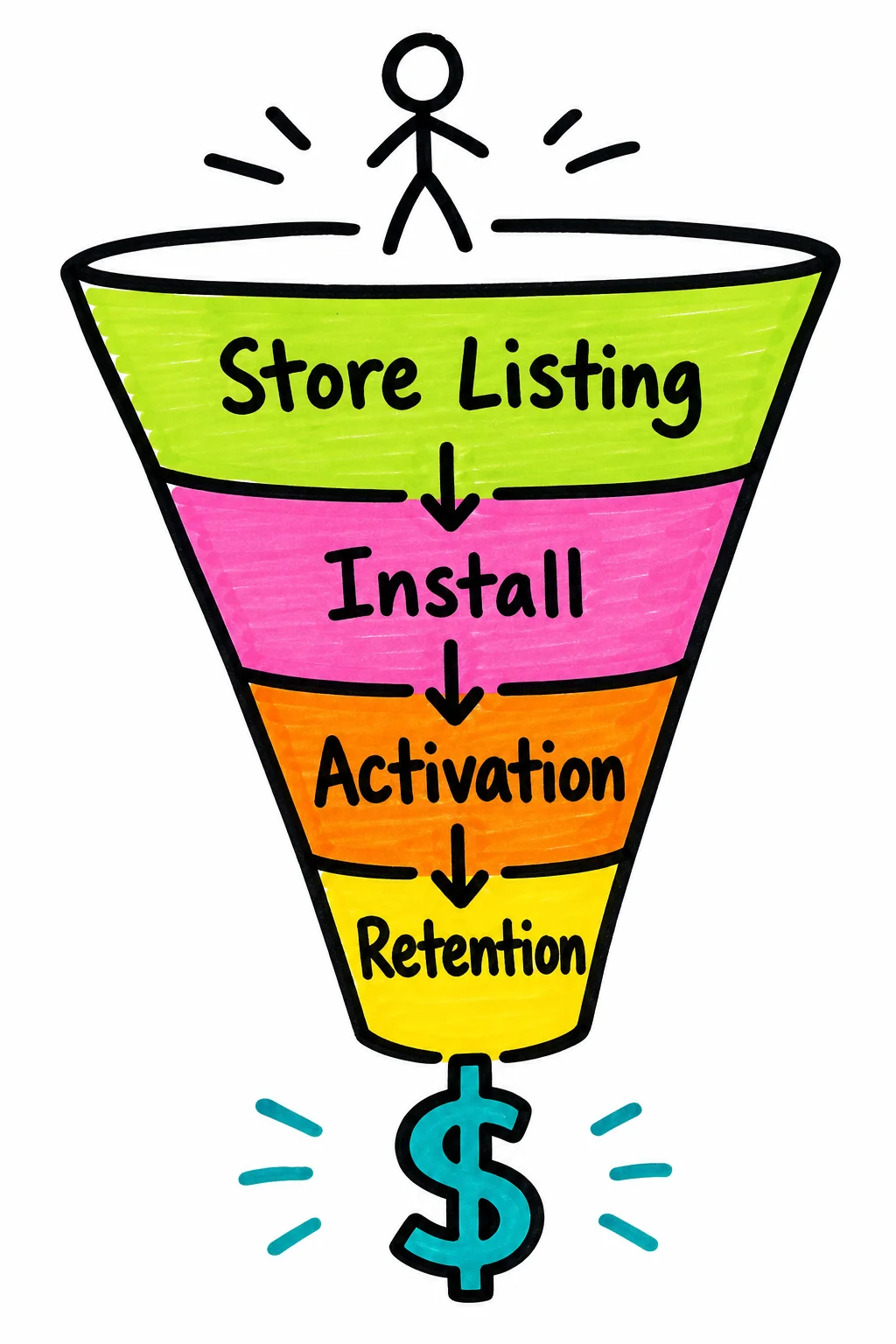
A full mobile app marketing strategy connects those pieces. ASO (app store optimization, the practice of improving your store listing so it ranks and converts) feeds installs. Onboarding converts installs into active users. Retention keeps those users long enough to generate LTV, which stands for lifetime value and is simply the total revenue one user produces before they leave. Each stage depends on the one before it.
An app marketing plan isn’t a channel list. It’s a sequence.
Your store listing is basically a search result
ASO is on-page SEO for app stores. The same logic applies: the right keywords in the right fields help the algorithm surface your app, and better visuals convert more of the people who see it into people who actually tap “Get.”
The two platforms index different things, so treat them separately.
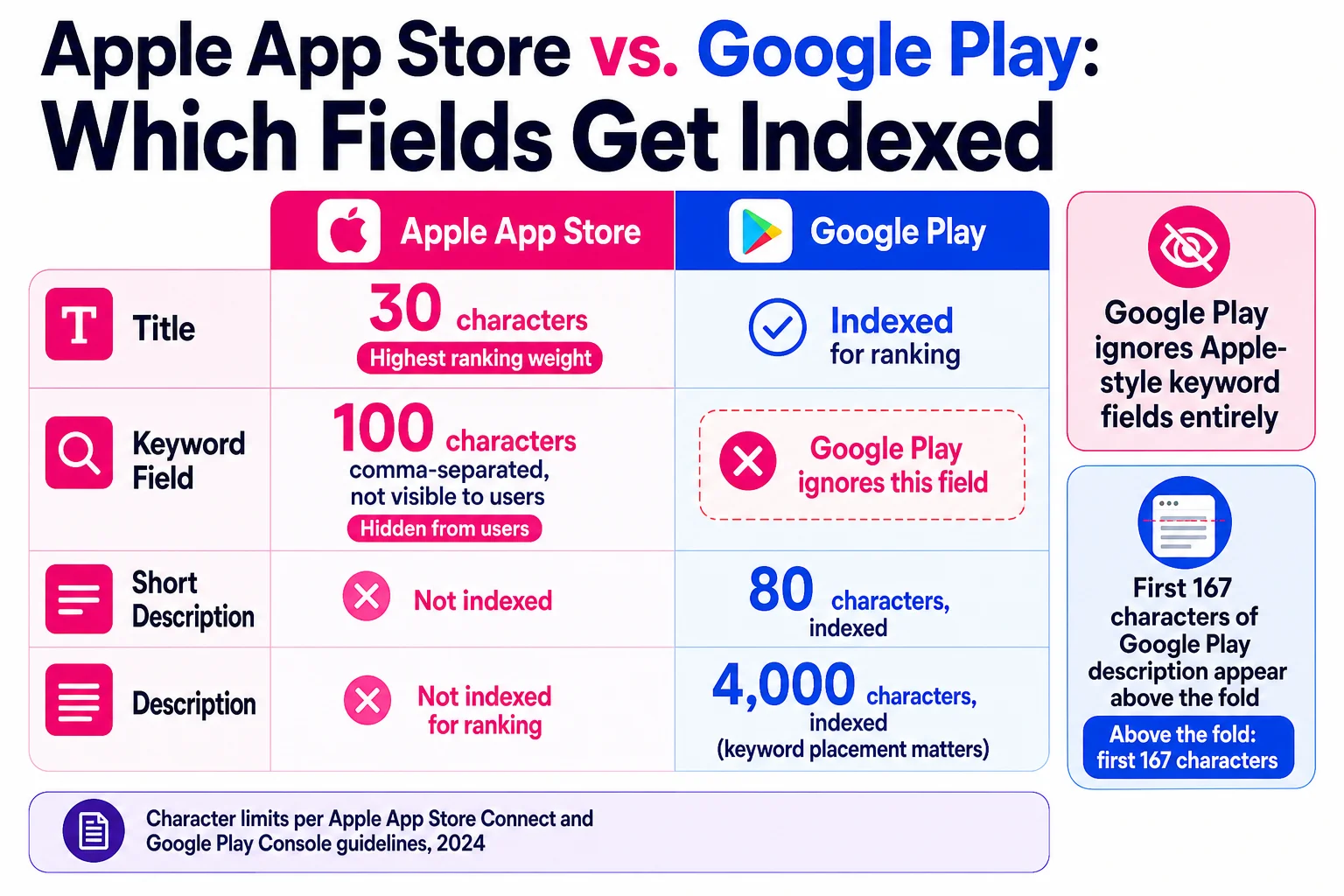
On the Apple App Store, your title (30 characters, highest ranking weight) and the hidden keyword field (100 characters, comma-separated, no spaces) are the main metadata levers. Google Play ignores that keyword field entirely and instead indexes your full long description up to 4,000 characters, so keyword placement in that copy matters.
Run through this checklist before you launch, and revisit it every quarter:
- Title: include your primary keyword, stay within the character limit, and keep it readable
- Apple keyword field: 100 characters, comma-separated, no repeated words from your title
- Google Play description: weave target keywords naturally into the first 167 characters (above the fold) and the full body
- Screenshots: test at least five variants; localized and A/B-tested creatives consistently show double-digit conversion lifts
- Ratings: target 4.5 or above and respond to reviews; RevenueCat’s analysis shows ratings are a strong ranking and conversion signal
Metadata gets you ranked. Screenshots and ratings get you installed.
Now you need people to actually find it
Every forum thread about app marketing eventually collapses into the same panic: “I set up Meta ads, Apple Search Ads, Google UAC, and TikTok simultaneously, spent $3,000, and have no idea which one worked.” That’s not a budget problem. That’s a sequencing problem.
A practical mobile app marketing strategy treats paid channels as a priority stack, not a simultaneous launch.
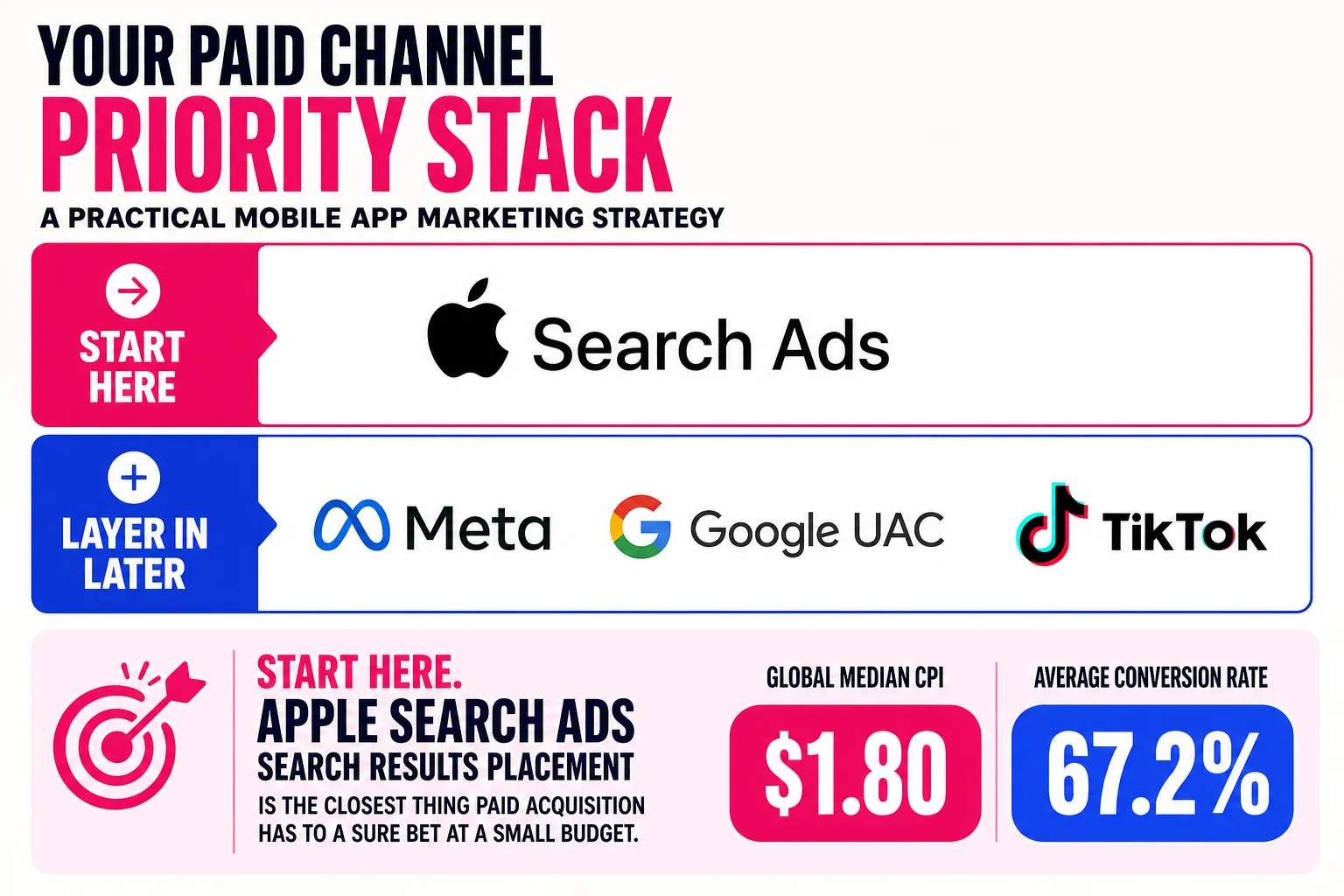
Start here. Apple Search Ads search results placement is the closest thing paid acquisition has to a sure bet at a small budget. The 2025 SplitMetrics benchmarks put the global median CPI at $1.80 and the average conversion rate at 67.2%, because you’re reaching people who are already searching for something your app does. The global median cost per tap is $0.92, though U.S. inventory runs closer to $1.91. Category matters: casual game CPIs sit between $0.60 and $1.60, while ecommerce apps can hit $2 to $8. On Android, Google App Campaigns operate across Search, Play, YouTube, and Display from a single campaign and are the equivalent starting point.
Layer in later. Meta Advantage+ App Campaigns and TikTok Smart+ App Campaigns are volume channels, not precision channels. They work once you know which mid-funnel event (registration, first core action) predicts a retained user. For TikTok specifically, best practice guidance calls for four to six creatives minimum and weekly refreshes to prevent fatigue.
Organic acquisition — ASO, content, PR, editorial placements — runs underneath all of this. Paid installs push your store ranking up, which lifts organic installs, which lowers your average CAC. The two channels are connected, not separate budgets.
Getting an Install Is Not the Same as Getting a User
An install is a file on someone’s phone. That’s it. Day 1 retention averages around 25% across app categories, and by Day 3 roughly 77% of new users are gone. Most of them never reached the moment where the app did something useful for them.
That moment has a name: activation. For a fitness app, activation might be logging a first workout. For a fintech app, it’s linking a bank account and seeing a balance. The install means nothing if the user never gets there.
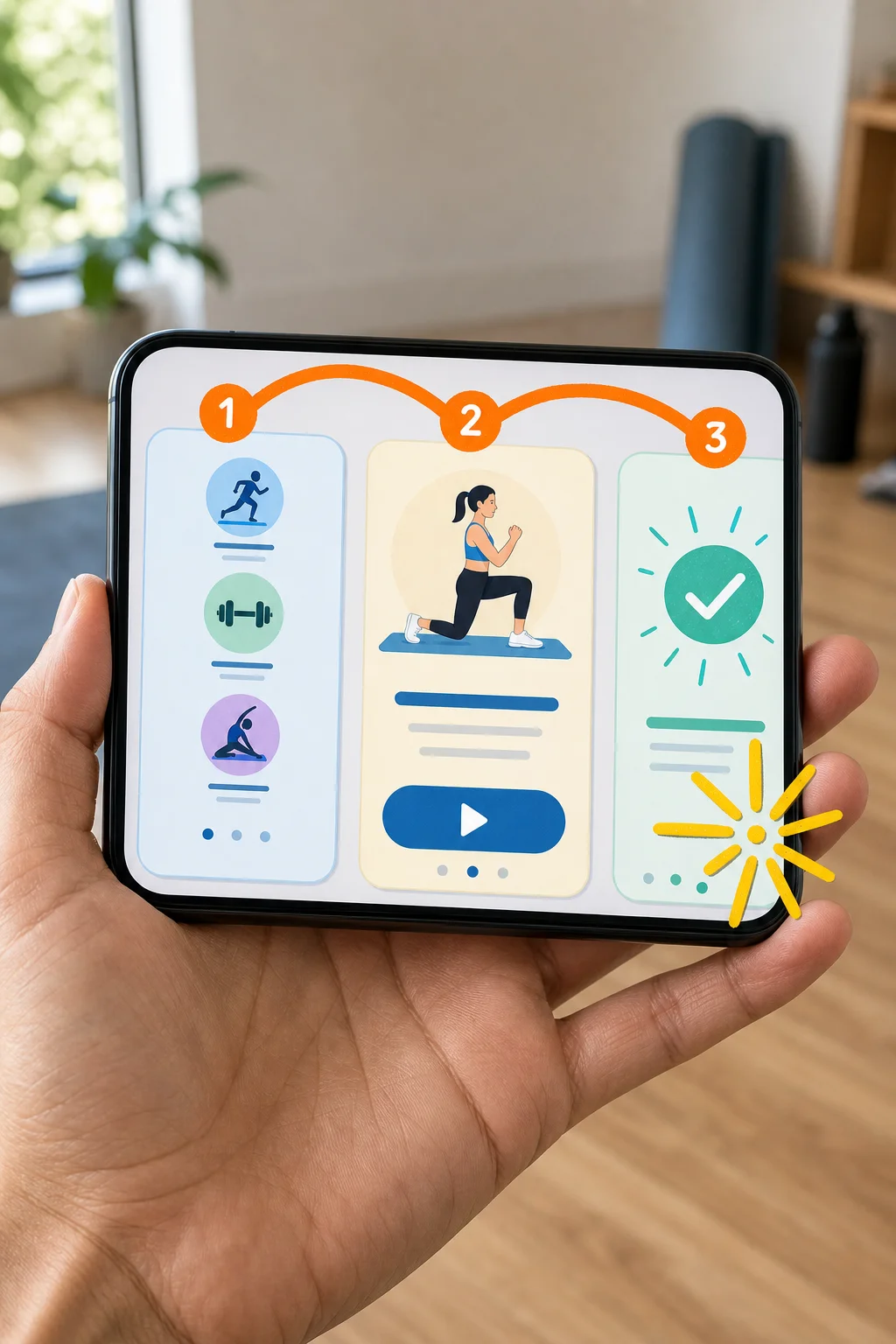
Getting users to that first moment of value is mostly a sequencing problem. Three-step onboarding tours complete at roughly 72%; seven-step tours drop to around 16%. Keep the first session short and pointed. Show demo data or a sample result so the screen isn’t empty. Use progress indicators. Skip the permission requests until after the user has done something worth protecting, since delaying permissions until after demonstrating value can lift opt-in rates by around 40%.
For push notifications, behavior-triggered sends outperform fixed schedules by roughly 2.6x on open rates. A welcome push one to three days after install, tied to an action the user already started, does more work than a generic “Come back!” blast.
Retention is the multiplier on everything you just spent
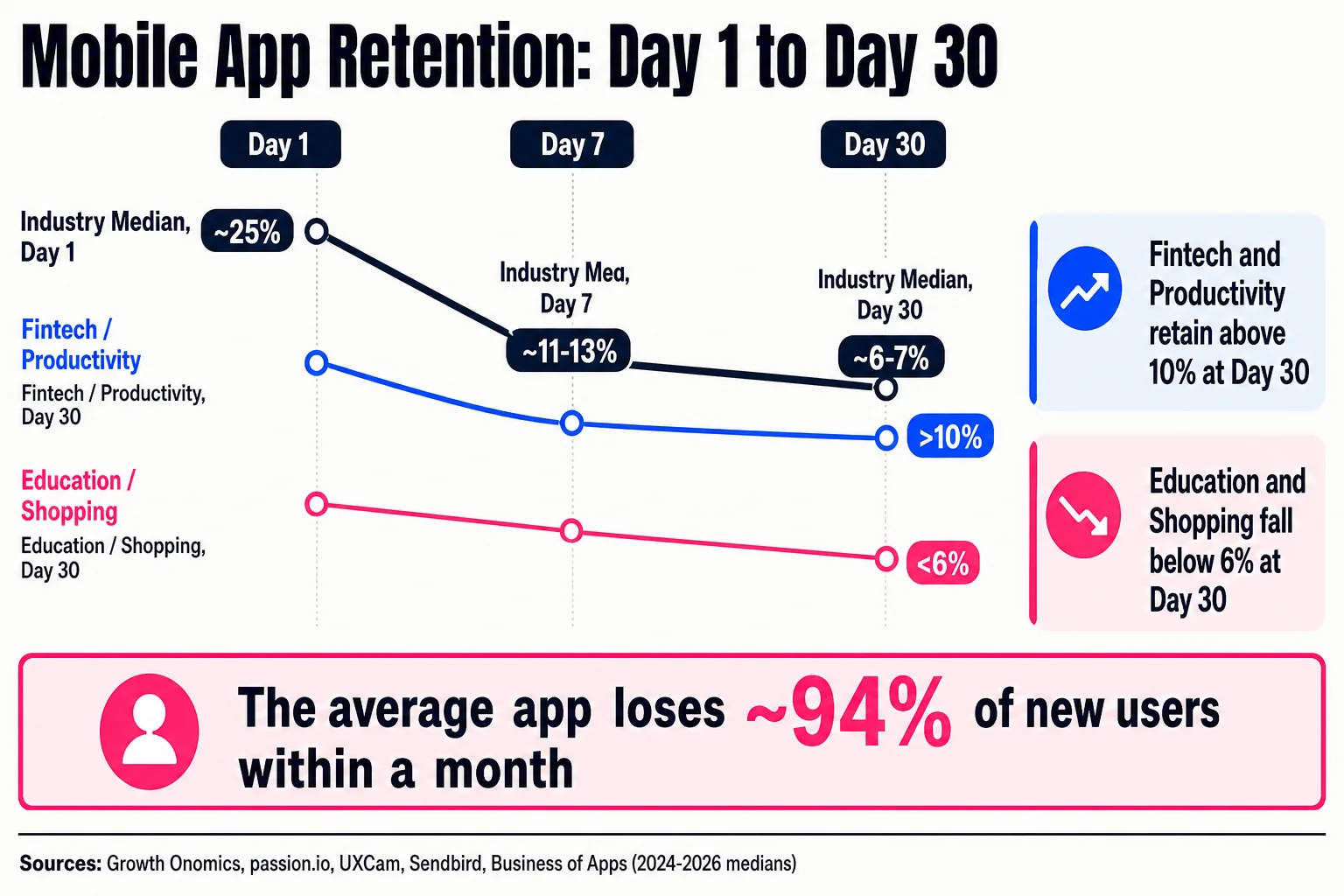
Acquisition fills the bucket. Retention determines how fast it drains. Industry medians sit around 25% on Day 1, dropping to 6–7% by Day 30 across app categories — meaning the average app loses roughly 94% of new users within a month. Fintech and productivity apps tend to hold better (Day 30 often above 10%). Education and shopping apps frequently fall below 6%.
The instinct when those numbers look bad is to send more push notifications. That usually accelerates uninstalls. Generic broadcast pushes train users to associate your app with noise. Segmented, behavior-triggered sends — timed to what a user actually did or skipped — report CTR roughly 2–3x higher than broadcast campaigns.
Platform also matters: Android opt-in rates run 68–91%, iOS around 44–51%, so the permission prompt is a higher-stakes moment on Apple. For users who never opted in, in-app messaging and email re-engagement are your remaining levers.
Every percentage point held at Day 30 raises the lifetime value of every user your acquisition budget brought in.
What you actually earn, and how to know if the strategy is working
Retention buys you time. Monetization converts that time into revenue, and your metrics tell you whether the math works.
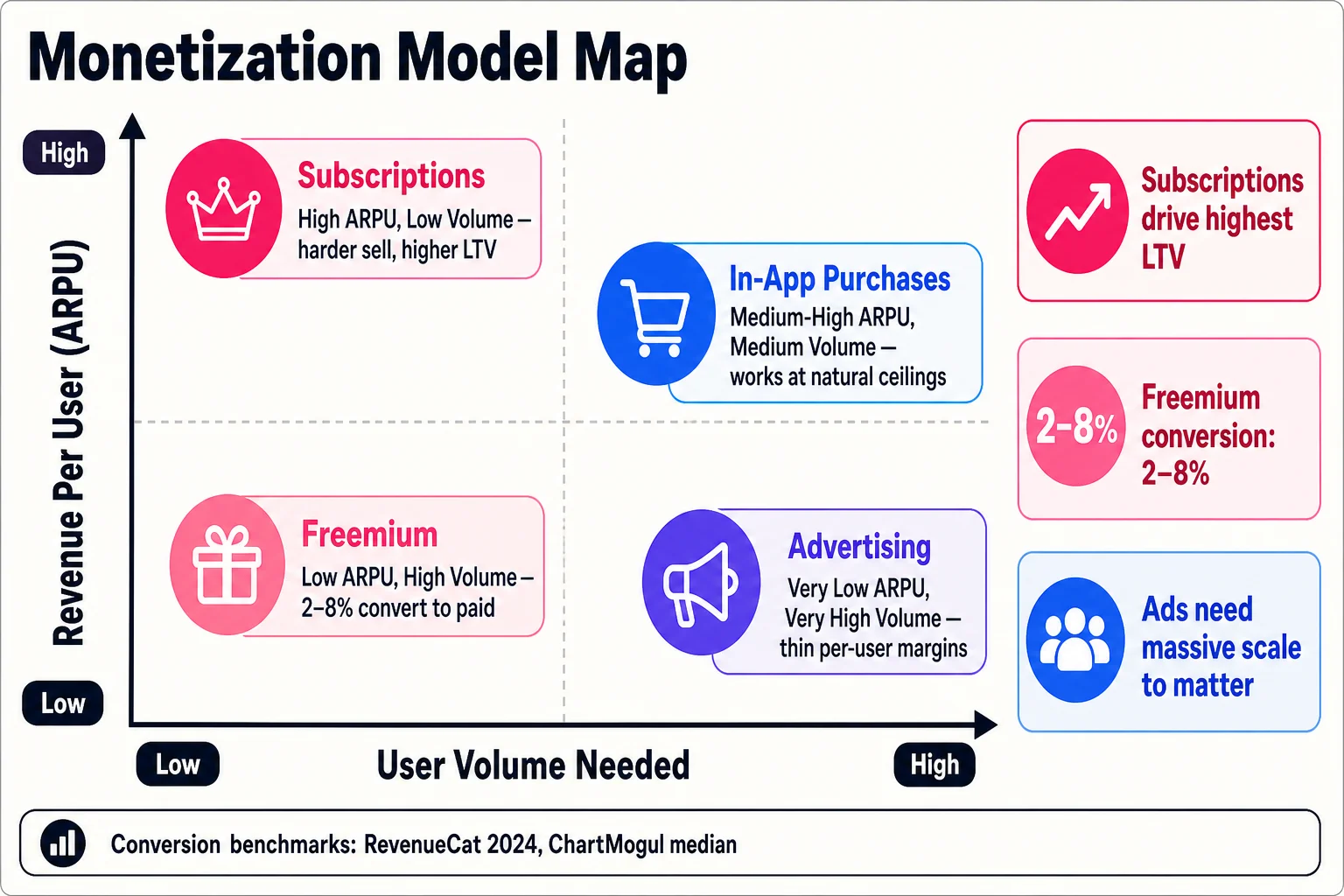
Four models dominate. Freemium gets users in the door cheaply but converts only 2–5% of free users to paying customers in consumer apps, so the free experience has to retain the 95% who never pay. Subscriptions demand a harder upfront sell but produce higher lifetime value. In-app purchases work best where users hit a natural ceiling. Advertising suits high-volume, low-engagement apps, though per-user margins stay thin.
The metrics are your feedback loop. RevenueCat’s 2024 data puts median 30-day conversion to paid at 1.7%, with top performers near 4.2%. CAC for mobile typically runs $1–$5 per install and $20–$80 per paying user. A healthy LTV:CAC ratio sits around 3:1. Below 1:1, your acquisition spend is a money pit regardless of what the download count says.
Day 1, Day 7, and Day 30 retention tell you where users leave. Low Day 1 means onboarding is broken. Decent Day 7 with low Day 30 means the habit loop never formed. CAC tells you what you paid. LTV tells you whether it was worth it.
Turn the framework into your actual plan
The six steps above — ASO, acquisition, activation, retention, monetization, measurement — only work when they run together as a written plan rather than a checklist you revisit when growth stalls. Use the generator below to build your own app marketing plan: it walks you through each pillar and outputs something you can share with a team or revisit every quarter. Apps that grow consistently do so because their marketing runs on a schedule, not on inspiration.