The advice you’ve probably already read (and why it didn’t help)
Search “how to write a newsletter” and you’ll find the same content recycled at scale: numbered steps, tip lists, checklists with items like “define your audience” and “include a clear CTA.” HubSpot, Mailjet, half a dozen beginner guides. Most of them are genuinely fine at what they do, which is teach someone how to set up a newsletter. Platform walkthroughs, drag-and-drop editor tips, subscription form placement. Useful, once.
What they don’t cover is the actual writing problem. The one you face every single week.
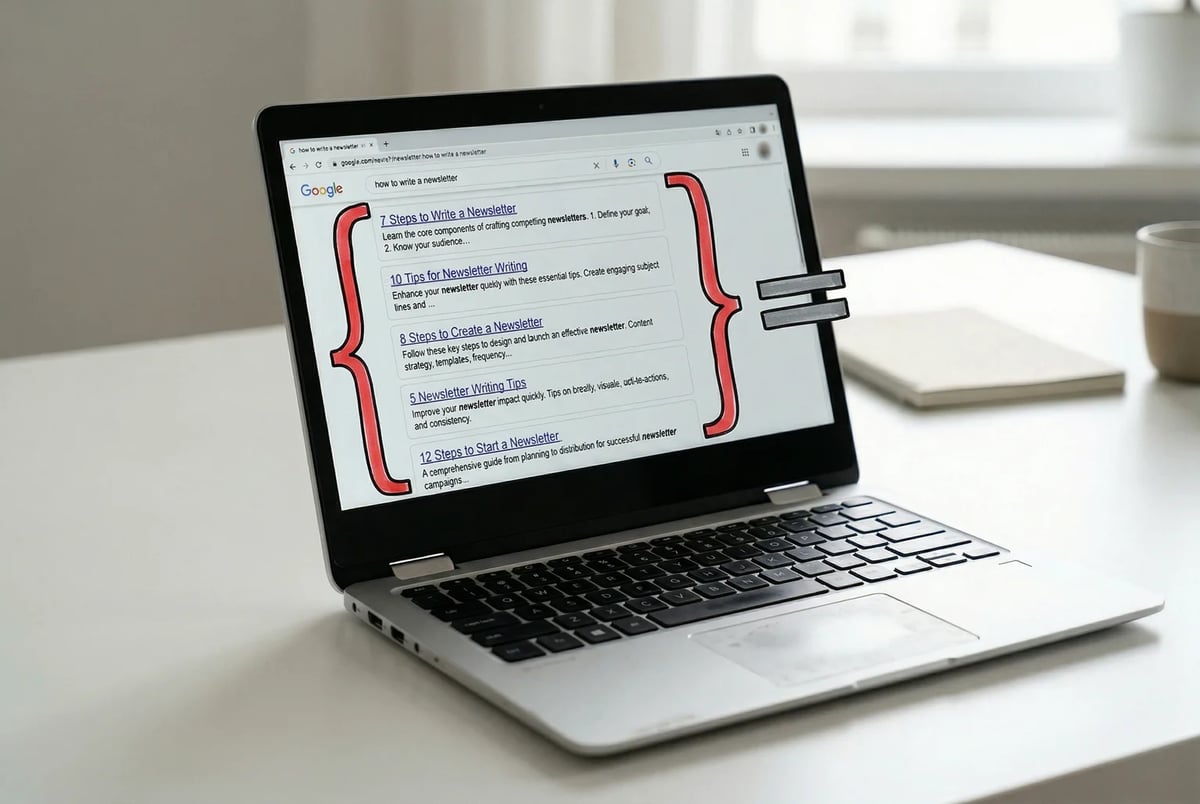
Because the real solution isn’t found in ‘tips’ and ‘hacks.’ You’ve read all of those already. The problem is that you need to publish 52 issues a year that sound like you, not like a press release, not like a company announcement, not like whatever comes out when you’re staring at a blank doc at 9pm on Tuesday wondering what you even have to say this week. Writers who try to sustain weekly output without a system report it consistently: the mental load accumulates, the voice flattens, and eventually the frequency drops as self-protection.
There are two specific things that make newsletter writing hard at any consistent publishing cadence, and almost no mainstream advice addresses either of them directly.
The first is structure. Without a repeatable format, every issue starts from zero, which is exhausting and produces inconsistent results.
The second is voice. Specifically, keeping it intact when you’re tired, rushed, or reaching for AI to help fill the gap.
Everything in this guide is about those two problems. Nothing else.
The blank page is a format problem, not a creativity problem
Every Tuesday (or Thursday, or whenever your send day is), you open a doc and face the same question: what goes in this issue, and in what order? If the answer changes every week, that question costs you thirty minutes before you’ve written a single word. Multiply that by 52 issues and you’ve lost a full workday just deciding how to start.
The fix isn’t inspiration. It’s a named section structure you don’t re-decide.
Look at how Morning Brew’s format works: the opener, the market snapshot, the main stories, the quiz, the closer. Subscribers don’t just read it — they navigate it. They know where to look for what they want. That predictability builds a habit on the reader’s side and removes a decision on the writer’s side. Both things matter.
For a business newsletter sending weekly, a format that actually works in practice tends to have five or six named sections:
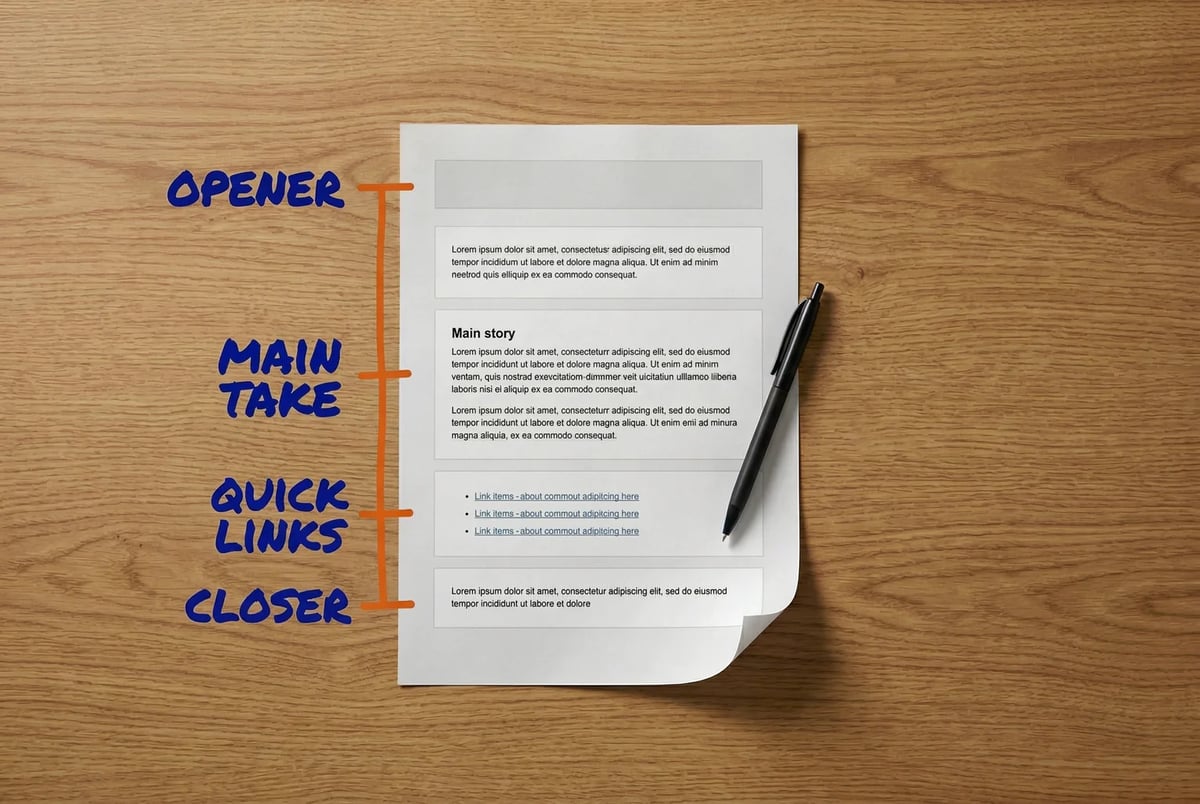
An opener — your voice, your angle, one thing that happened or that you noticed this week. Two to four short paragraphs. This is where you sound like yourself or you don’t.
A main take — one idea developed with some depth. Not a list of observations. One thing you actually think, with a reason you think it.
Curated stories — three to five links with a sentence or two on each. Not summaries. Your reaction. Why it matters to this specific audience.
Quick links — two or three things that didn’t need a full paragraph. Headlines with a line of context.
A tool or resource — one recommendation, rotated weekly. This becomes a section readers look forward to, which means they scroll for it.
A closer — a question, a quote, or one sentence that gives people something to carry out of the issue. Short.
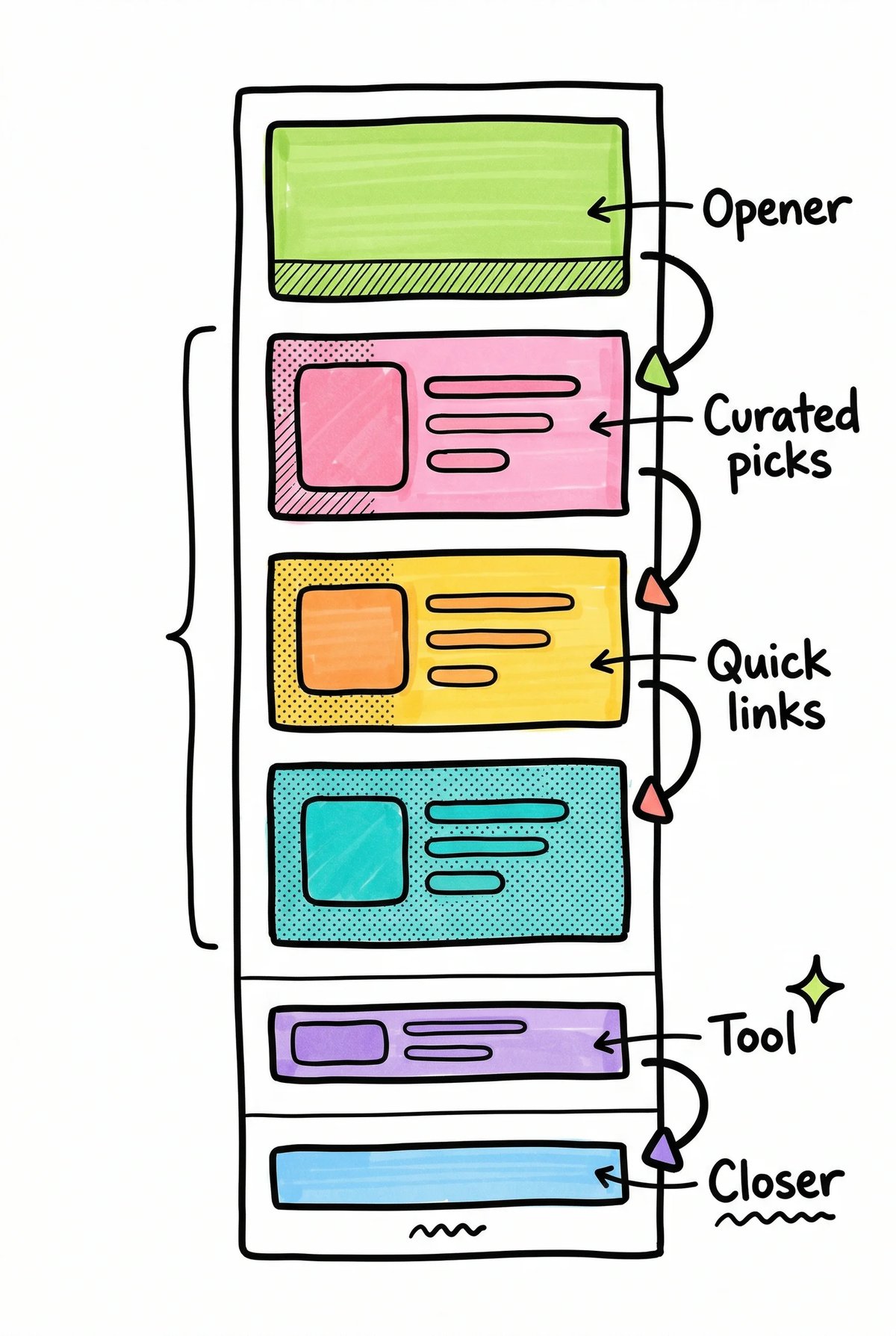
That’s the scaffold. What you fill in changes every week. The scaffold doesn’t.
On length: there’s reasonable industry consensus that 200 to 600 words is the right range for a weekly send, with shorter issues often outperforming longer ones on click-through. The honest version of that data is: don’t pad. If your main take runs long, cut the quick links. If you’ve got three strong curated stories, you don’t need five.
The practical step here is concrete. Look at your last three issues. Find the sections that got replies, clicks, or forwards. Name them. Cut what nobody responded to. Write that down as your template. You now have a format you built from evidence rather than borrowed from a blog post.
Including this one.
Good writing dies in the inbox if nobody opens the email
The format problem is solved. Now the smallest piece of copy you write determines whether any of that work gets seen: the subject line.
Most subject line advice lands in one of two useless camps. Camp one: “be clever, use humor.” Camp two: “be clear, not clever.” Both are right sometimes and neither tells you anything actionable. The actual principle is specificity. Specific subject lines feel real. Vague ones feel like marketing.
Mailchimp recommends keeping subject lines to 60 characters or fewer to reduce mobile truncation, but the more useful framing from Twilio’s SendGrid research is to front-load the first 33 characters with your actual point, since that’s roughly what many mobile inboxes show before the cutoff. Write the subject as if everything after character 33 might not exist.
Here are six examples with brief annotations:
- “The client said no. Here’s why I was relieved.” — Curiosity gap with emotional specificity. You want to know what happened. The emotion (“relieved”) is unexpected, which is the thing that earns the click.
- “3 things I stopped doing in Q1 (and what changed)” — Number plus concrete timeframe plus implied result. Doesn’t overpromise. Delivers a before/after with no hype.
- “Agency pricing is broken. This is how we fixed ours.” — States a position, implies a practical answer. Works because it’s an opinion, not a feature announcement.
- “What I got wrong about email frequency” — Admission lines are underused. Readers trust someone who admits a mistake more than someone who only broadcasts wins.
- “One tool that replaced three others last month” — Concrete, time-bounded, implies a decision was made. Doesn’t need a superlative.
- “You asked about onboarding. Here’s the full answer.” — Signals that this is a response, which makes it feel personal even to people who didn’t ask.
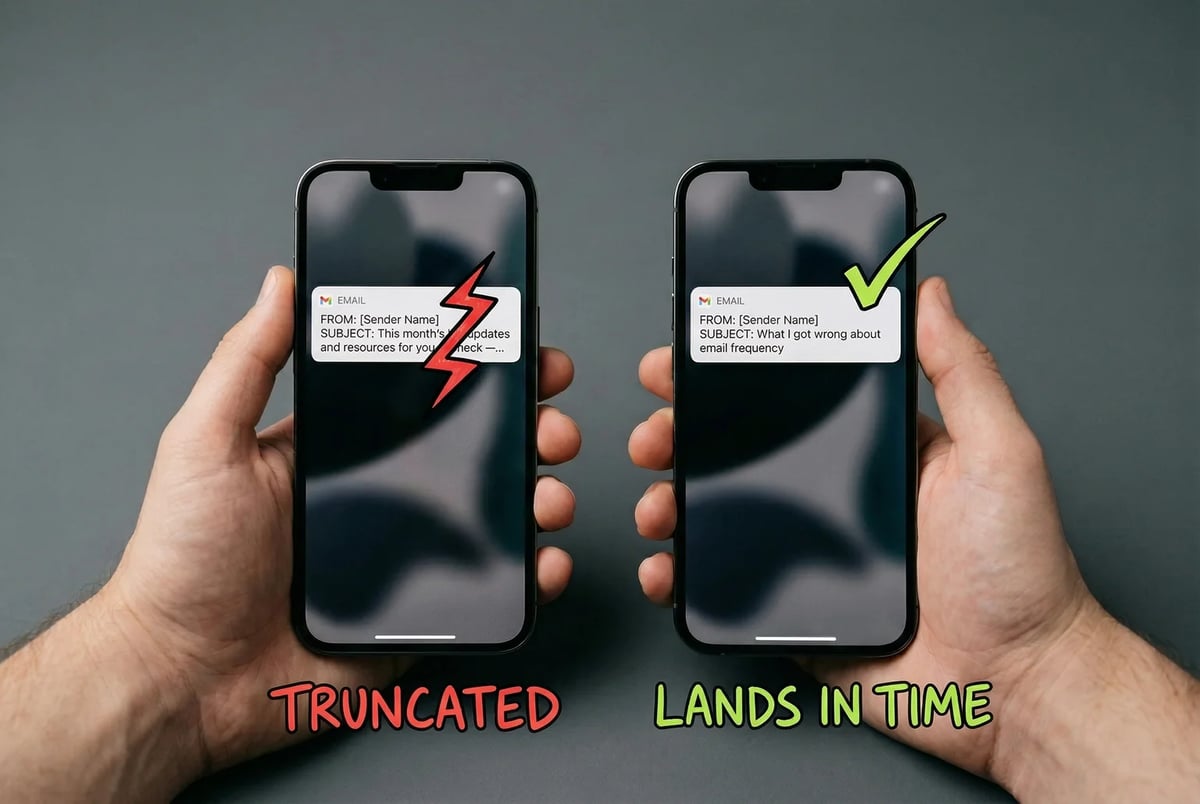
Preview text is the second shot most senders waste. It defaults to “View this email in your browser” if you don’t set it. Litmus recommends 40 to 60 characters and, critically, copy that extends the subject line rather than repeating it. If your subject is “What I got wrong about email frequency,” your preview might read: “Turns out less often would have worked better.” Same idea, more complete picture, still under 60 characters.
One practical note on measurement: open rates are less reliable than they used to be since Apple’s Mail Privacy Protection inflates them. Track clicks instead. If people open but don’t click anything, the subject line sold a product the issue didn’t deliver.
Voice isn’t a vibe: it’s three specific things you can measure
Getting people to open the email is the first problem. The second is what happens when they do.
A lot of newsletters pass the open test and fail the reading test. The copy is fine. It’s organized. It’s clear. It sounds like nobody. That’s the problem.
Voice, when you strip away the mystical framing, is three things: rhythm, specificity, and opinion. All three are learnable. All three are also things that AI writing, by default, destroys.
- Rhythm is the shape of your sentences across a paragraph. Read your last newsletter issue out loud. If every sentence is roughly the same length and structure, you’ve lost it. Real rhythm means short sentences earn their brevity because something longer preceded them. It means the occasional fragment. It means that someone who’s read six issues of your newsletter could close their eyes and hear you speaking.
- Specificity is the difference between “we ran a campaign that didn’t work” and “we ran a Google Ads campaign in March targeting ‘marketing agency software,’ spent $3,400, got eleven clicks, and zero trials.” Generic examples could have been written by anyone, which means they feel like they were. Named details, real numbers, actual time periods — these make writing feel like it came from a person with a specific experience, not a tool averaging across millions of them.
- Opinion is the part most business newsletters skip because it feels risky. But a stated point of view is the thing that makes readers feel like they’re hearing from someone rather than reading a document. “Here’s what happened this week” is a summary. “Here’s what happened this week and why I think it’s a bad sign for mid-market agencies” is a newsletter worth reading.
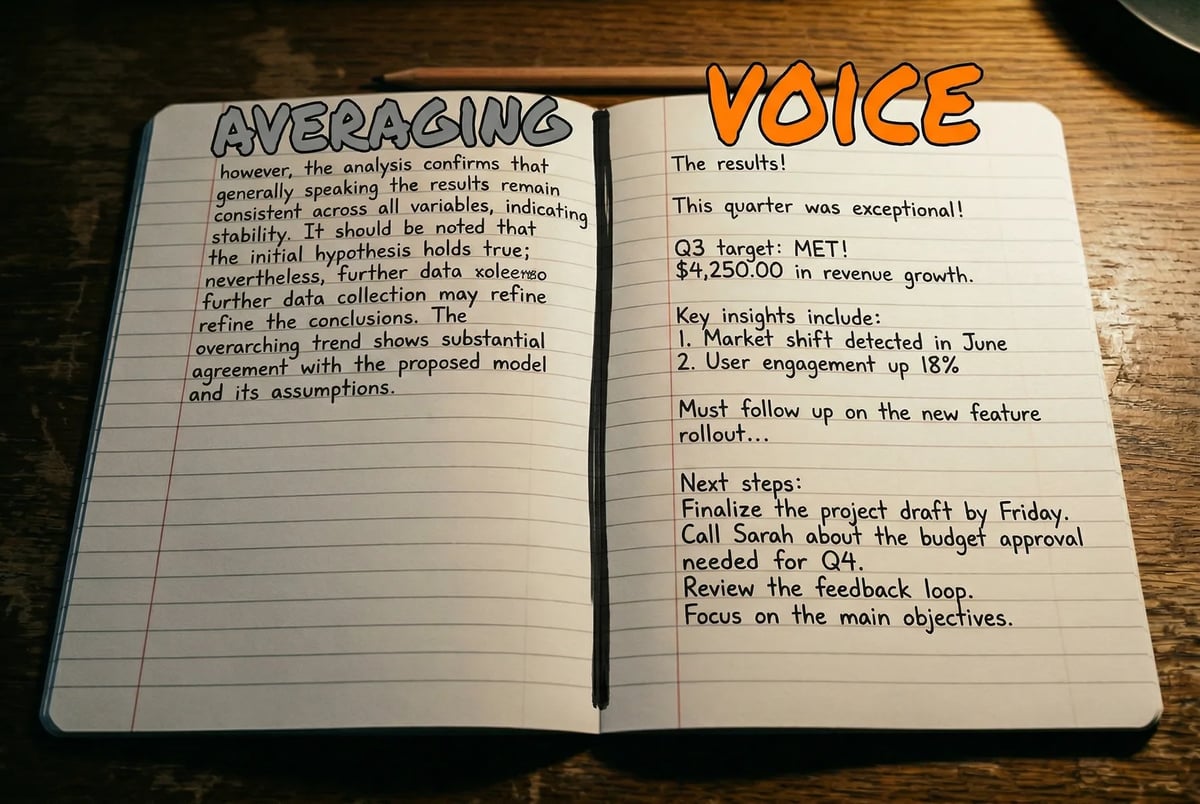
Now the honest version of the AI problem.
Large language models are trained to be agreeable. They optimize for the response that offends no one and pleases most people in most contexts. That’s a useful default for a lot of tasks and a disaster for newsletter writing. The output is polished but emotionally empty: correct sentences arranged in correct order, stripped of the specific friction that makes writing feel real.
Readers don’t run your newsletter through a detector. They just feel something slightly off, the way you notice when a restaurant has switched from fresh pasta to frozen. The rhythm is too uniform. There are no edges. The opinions are gestured at rather than stated. The specificity is fake-specific (“a mid-sized B2B company” instead of a company you can actually picture).
The fix isn’t to avoid AI tools. It’s to use them for the work they’re suited for — structure, outlines, research synthesis — and write the actual sentences yourself. Or if you do use AI for drafts, treat every output as a first pass that needs your rhythm, your named details, and your actual take added back in before it goes out.
Matt Giaro frames this well: practice is what builds a recognizable voice, not planning. You can’t document your way to it. You write it into existence, issue by issue, until the rhythm is automatic.
That’s a process problem as much as a craft problem. Which means it can be systematized.
The blank-page problem is actually a sourcing problem
Most newsletter writers don’t stall because they can’t write. They stall because they sit down on publishing day with no material and try to research, decide, and write in the same session. That’s three different cognitive tasks, and doing them simultaneously is why newsletters either come out late or come out sounding like a press release.
The fix is simpler than most sourcing guides make it sound: separate the finding from the writing. Spend 30 minutes earlier in the week scanning and capturing, and by the time you open a blank document on publishing day, you’re choosing from a list, not building one from scratch.
The five sources worth checking weekly are Reddit threads and X conversations in your niche, competitor newsletters, audience feedback (replies, DMs, comments), industry blogs and news, and search trends. None of this is revolutionary. The part most people skip is the capture step: write one sentence next to every item explaining why it matters to your specific reader. Without that note, you’ll revisit the link three days later with no memory of why you saved it.
The more underused source is internal. Customer questions from sales calls, support tickets, and Slack threads surface the exact problems your audience is trying to solve right now. A troubleshooting issue built entirely from recurring support questions is more relevant than anything you’ll find by scanning Twitter, and you didn’t have to curate a single link.
When you capture, tag immediately: educational, story, curated, or Q&A. That tag tells you what kind of issue each idea wants to become, so you’re not making structural decisions at write time.
The goal is an idea bank with 10 to 15 filtered items going into each week. Not every item becomes an issue. Most of them sit there. But having five options on publishing day instead of zero is the difference between a newsletter that ships consistently and one that goes quiet for three weeks because you “didn’t have anything good to write about.”
How a single issue actually fits together
You have the sourcing system. Now the question is what to do with everything you’ve captured once you open the document.
The structure that works isn’t complicated, but it has to be fixed. Same sections, same order, every issue. Not because readers consciously notice the architecture, but because you stop rebuilding it from scratch each time.
A complete issue moves through six pieces:
- Opener. Two to four sentences. One observation, one story hook, or one direct statement of what this issue is about. No warmup sentences. Readers spend roughly 51 seconds scanning before deciding whether to keep going, so this section does the most important work.
- One longer take. Your actual opinion or analysis — something a quick search won’t surface. Three to six paragraphs with a point of view, not just a summary.
- Curated stories. Three to five items from your sourcing bank. Each gets a headline, two or three sentences on what it is, and one sentence on why your specific reader should care. The “why it matters” note from capture becomes that third sentence directly.
- Quick links. Two or three bare links, one sentence each. Good for things that are interesting but don’t need your commentary.
- Tool or resource of the week. Optional, but readers remember it. One recommendation, one reason.
- Closer. One short paragraph: a question, a next-issue preview, or a reply prompt. This is where reply rate lives or dies.
Commonly searched:* “What is the format for writing a newsletter?” and “What are the five parts of a newsletter?” * The standard five: subject line, header, body, CTA, footer; describe the container, not the content. The six-section structure above is what fills the body repeatably. The six layout rules are: visual hierarchy, white space, single-column width around 600–650px, readable font sizes (14px body, 18px+ headers), mobile responsiveness, and strategic CTA placement.
The footer handles legal and unsubscribe requirements. Everything above it is writing. Keep that distinction clear and the technical parts stop feeling like they’re competing with the creative ones.
Replies are the only number that doesn’t lie
Open rate used to mean something. Now it mostly measures whether an email client preloaded your images. Reported open rates have drifted above 40% in recent years, largely because of privacy changes and client behavior, not because writing got better.
Replies are different. A reader has to stop, open a compose window, and type something. That only happens when the writing actually landed.
The floor worth aiming for: one to three replies per issue on a list of 500 or more. That’s a small number, but it’s a real one. It means your closer prompt worked, your opinion was specific enough to provoke a reaction, or someone recognized themselves in what you wrote. Zero replies after several issues isn’t a distribution problem. It’s a writing problem.
If your newsletter is generating replies at that rate, the structure and voice are working. That’s the whole system. The Newsletter Generator can help you build the first few issues inside that system, so the replies you’re chasing have something worth responding to from issue one.