You’ve Tried AI for SEO. Some of It Worked. Most of It Didn’t.
You opened ChatGPT, typed “write me an SEO blog post about [topic],” and one of two things happened: either you got a surprisingly decent post and spent the next week trying to replicate the quality on other posts. Or you got 800 words of confident-sounding filler that ranked for nothing and said less than a Wikipedia stub. Probably both, on different days, with no clear explanation for why.
This is the experience most marketers describe when they say AI for SEO “kind of works.” The tool isn’t broken. The output isn’t random. What’s missing is sequence.

A blank prompt gives AI nothing to work with: no keyword data, no competitive context, no search intent, no brief, no structure requirements. You get whatever the model considers a reasonable average. Which is, almost by definition, average.
The marketers who get consistent results from AI and SEO aren’t using better tools. They’re using a sequence: keyword research feeds into a gap analysis, which feeds into a brief, which drives the draft, which gets optimized on-page, and then gets maintained over time. Each step has a defined job for AI to do, and the output of one step is the input for the next.
That sequence is what this post covers.
AI Reads the Map, But You Still Have to Pull the Data
Most people’s first attempt at AI-assisted keyword research looks something like this: “Give me keyword ideas for [topic].” The model obliges with a list of plausible-sounding terms, complete with zero actual search volume data, because it doesn’t have any. It’s pattern-matching against its training corpus, not reading live SERPs. The output looks like keyword research. It is not keyword research.
The correct sequence flips this around. You pull raw keyword data first from whatever tool you use to export volumes, difficulty scores, and competitor rankings, and then you hand that data to AI for interpretation. That’s where AI genuinely earns its place in the workflow: clustering keywords by intent, identifying which topic areas your competitors own that you don’t, and prioritizing what to target based on patterns across hundreds of terms at once. Tasks that would take a human analyst hours to do by hand, AI does in seconds once it has real data to work with.
The gap analysis step is where this becomes most useful in practice. The standard workflow runs like this: feed in your domain alongside two to four competitor URLs, give the AI some context about your target audience or market, and let it surface the keyword clusters where competitors rank and you don’t. What comes back isn’t a raw export, it’s an interpreted list with content priorities attached. That’s the difference between data and direction.

The important caveat: AI outputs from this step need validation against live SERP data. LLMs hallucinate numeric SEO metrics with some regularity, so treat any search volume figures the model generates with real skepticism. The AI’s job here is pattern recognition and prioritization, not data sourcing.
mOS’s Marketing Assistant runs this competitor URL gap analysis natively. Paste in a competitor’s domain, and it identifies keyword gaps and surfaces content opportunities without requiring you to export a CSV, write a custom prompt, or stitch together two separate tools. The workflow described above isn’t a series of manual steps you coordinate yourself, it’s just what happens when you run the analysis.
The Brief Is Where AI Actually Earns Its Keep
Once you have your keyword gaps and content priorities, most people do the same thing: open a chat window and type “write me an SEO blog post about [keyword].” Then they’re surprised when the output reads like a Wikipedia summary with some transition sentences thrown in.
The brief is the step they skipped. And it’s not a minor omission, it’s the reason the draft disappoints.
A well-structured brief tells the model everything it cannot infer from a keyword alone: who the reader is, what they already know, what search intent they’re bringing to the page, which competitors are ranking and why, what the heading structure should look like, and what on-page elements need to appear. Without that, the model writes to the average of its training data. Which is, by definition, average.
A prompt that actually works looks more like this:
"You are writing a 1,800-word guide targeting the keyword 'ai seo strategy' for marketers who already use AI tools but are getting inconsistent results. Search intent is informational — the reader wants a workflow, not a product comparison. The top-ranking competitors cover tool lists but skip the actual sequence. Our angle is workflow-first. Structure the post with 5 H2 sections covering: keyword research, content briefs, drafting, on-page optimization, and maintenance. Under each H2, include 2–3 H3 subheadings tied to specific user questions. Front-load the intro with the core problem: no workflow, not wrong tools. Tone is direct, slightly skeptical of hype, practitioner-level."That prompt produces something structured and specific. The shorter version produces filler.
The components practitioners recommend are consistent: target keyword, search intent, audience, competitor angle, heading hierarchy with 4–6 H2s and 3–5 H3s per major section, word distribution, and on-page specs like title tag length and meta description guidance. That’s not a long list, but assembling it manually before every post is exactly the kind of friction that causes teams to skip it.
The Blog Post Generator handles this step as part of the generation process itself. Rather than asking you to write the brief and then paste it into a separate drafting tool, it builds the brief internally from your keyword, intent signal, and competitor context before producing the draft. The brief isn’t a prerequisite you manage, it’s baked into what the tool does. That’s the practical difference between having a workflow and just having a model.
Two Passes, Not One
The brief tells the model what to write. The structure pass tells it how to think before it writes.
Most people skip both and go straight to prose. The result is a 1,500-word article that covers the topic the way a textbook would: technically accurate, completely forgettable, and structurally useless for SEO because the headers are generic, the sections don’t map to real search queries, and nothing on the page is positioned to capture a featured snippet.
The two-pass fix is simple to describe and surprisingly effective to run.
Pass one is structural. You’re not asking for prose yet. You’re asking for a skeleton with specific constraints baked in. A prompt that works:
"Create an SEO outline for a post targeting 'ai seo strategy'. Format as H1, H2, and H3. Each H2 should map to a distinct keyword cluster from this list: [paste clusters from brief]. Add a word target next to each section (aim for 200–300 words per H2). Include one FAQ block at the end addressing the top 3 'People Also Ask' questions for this keyword. Mark which sections could generate a featured snippet and why."That prompt forces the model to think in SERP terms, not essay terms. The header hierarchy comes out organized around actual search behavior rather than whatever logical flow the model would default to.

Pass two is prose. Take that outline and run each section separately:
"Write the '[section name]' section of this post. Use the H3 structure from the outline. Target [word count]. Audience is [description]. Tone is [description]. Do not summarize the section at the end."Section-by-section drafting keeps the model focused. Asking it to write the whole post at once reliably produces padding, because it’s filling a length target with no sense of where emphasis belongs.
The prose pass is also where human editing earns its place. The model gives you structure and coverage. You add the specific examples, the judgment calls, the voice. If you’re thinking about where AI fits inside a broader content and marketing workflow, the drafting stage is where the human-AI split becomes most visible: AI handles the scaffolding, you handle the credibility.
Our Blog Post Generator runs both passes as a single operation. You don’t manage them separately. But understanding the two-pass logic is what lets you audit the output intelligently instead of just accepting whatever comes back.
The Part of AI SEO That Actually Scales
Most writing about using AI for SEO stops at the draft. That’s understandable: drafting is visible, satisfying, and easy to demo. But the on-page work that happens after publishing is where a lot of ranking potential quietly leaks out. Missing schema, title tags that run 75 characters, meta descriptions copy-pasted from the first paragraph, orphaned pages with no internal links pointing at them. These aren’t hard problems. They’re just tedious enough that they keep getting skipped.
A survey of SEO professionals found on-page work consumes roughly 28% of working time. Comparable to technical and off-page tasks combined. And yet it’s the category most likely to slip when a team gets busy. The errors that accumulate aren’t dramatic; they’re just quietly compounding.
AI handles bulk on-page tasks well precisely because they’re repetitive and rule-bound. Title tag review is a good example. A prompt that works in practice:
"Review the following list of page URLs and their current title tags. Flag any that exceed 60 characters, contain no primary keyword in the first 40 characters, or are duplicated across pages. For each flagged title, suggest a revised version under 60 characters that leads with the target keyword."Run that across 50 pages and you have an audit that would otherwise take most of an afternoon. The same logic applies to meta descriptions (target 140 to 160 characters), header restructuring when H2s don’t map to keyword clusters, and JSON-LD schema generation for pages missing structured data.

The distinction worth making here is between running that prompt once versus building it into a repeatable process. A one-off audit fixes today’s problems. A campaign-level audit, run on a schedule, catches problems before they compound. mOS’s Marketing Assistant is built for the latter: you define the audit tasks as campaign steps, not as individual chat exchanges, so the same checks run each month without reconstructing the prompt from scratch each time.
That systematic framing is what separates on-page optimization as a workflow from on-page optimization as a fire drill.
The SEO Work Nobody Actually Does (But Everyone Should)
Publishing is the easy part. What happens six months later, when that post has quietly slid from position four to position eleven and you can’t tell why, is where most content programs quietly fall apart.
Content decay is the culprit more often than not: a stat that was accurate in 2022, a broken external link, a section that was thin when you wrote it and is now thinner relative to what competitors have published since. None of these failures are dramatic. They accumulate slowly, and because no single one looks urgent, the refresh work keeps getting pushed to next quarter.
AI makes that work fast enough to actually happen. Feed a URL, its GSC performance data, and a few questions into a prompt (“What stats here are likely outdated? Which sections are thin relative to the query’s current SERP? Are there internal linking opportunities from newer posts?”) and you get a prioritized refresh brief in minutes instead of an afternoon. Run the same audit across your twenty lowest-performing posts and you have a maintenance backlog that’s actually scoped and actionable, not a vague intention to “update old content someday.”
The infrastructure underneath that workflow matters more than it sounds. If your CMS makes it painful to push updates, the friction wins and the refreshes don’t happen. That’s part of why we moved away from WordPress toward an architecture where content updates propagate through an API rather than through a fifteen-step publishing process. The maintenance work doesn’t get easier because AI is smarter. It gets easier because the path from “identified problem” to “fix is live” gets shorter.

Maintenance isn’t glamorous. But a post that held position three for two years is worth protecting, and AI is now the most practical tool for doing that at scale.
The Whole Sequence, Stitched Together
The five steps aren’t independent. They’re a loop, and the sequence is what makes them work.
Marketing Assistant handles the front end: drop in a competitor URL, get a keyword gap analysis, pull the clusters that map to real search intent, and build the brief from that data. That’s steps one and two. You’re not guessing what to write or why: you’re starting with a ranked picture of what your competitors rank for and you don’t.
Blog Post Generator takes the brief and runs step three. It doesn’t produce a generic essay from a vague prompt. It produces a structured draft because the brief already contains the keyword clusters, the angle, the header skeleton, and the word targets. The AI has something real to work from.
Steps four and five run in Marketing Assistant too. Title tags and meta descriptions across your whole site, internal link audits as new content publishes, refresh briefs for posts starting to slide in GSC. Tedious at human pace, fast at machine pace.
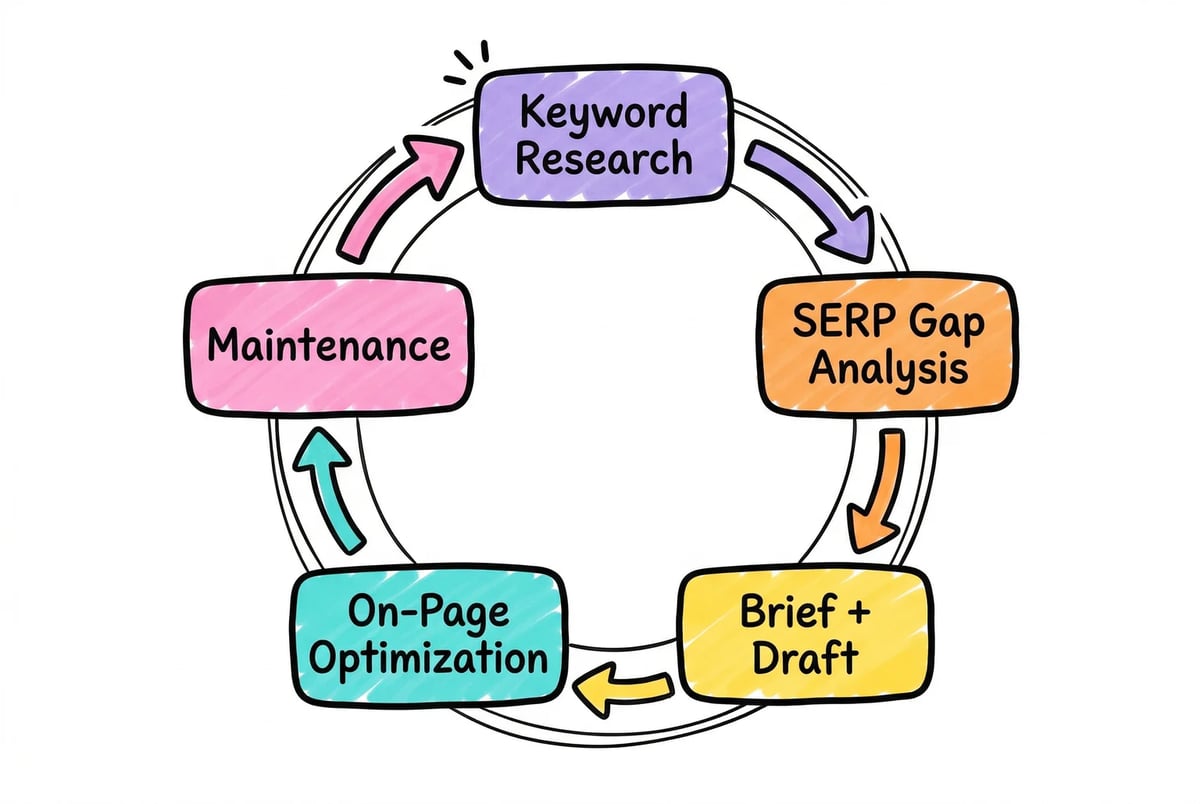
Then the loop closes. Maintenance surfaces new keyword gaps. Those gaps feed back into research. New posts get briefs. The cycle runs again, and each pass through it builds on the last.
That’s the workflow. Not a set of tools sitting next to each other, but a sequence where each step sets up the next one, and where the end of one cycle becomes the start of the next.
Start With a Single Gap
Drop a competitor URL into Marketing Assistant and run a keyword gap analysis. That one action puts you at step one of the workflow with real data already in hand. No blank prompt, no guessing what to write about next. From there, the sequence runs: brief, draft, on-page, maintenance, and back to research.
Sources
- Keyword Clustering Guide — Keyword Insights
- Keyword clustering & SEO (InfraNodus docs) — InfraNodus
- AI keyword cluster generators (blog) — Juma AI
- Competitor Analysis Tool (Junia templates) — Junia AI
- Build keyword gap analysis (Juma AI flows) — Juma AI
- Gap analysis (guide) — Search Engine Land
- AI Tools for Competitor Keyword Analysis — MagAI
- Keyword gap analysis (LLMRefs) — LLMRefs
- Keyword gap (Link-Assistant) — Link-Assistant
- Keyword Clustering (Nightwatch blog) — Nightwatch
- Leveraging AI for Keyword Clustering and Search Intent Analysis — Agency Platform
- Automated competitor SEO analysis — CXL
- YouTube video (keyword clustering example) — YouTube
- n8n workflow: Categorize SEO keywords and create content strategy with AI and Airtable — n8n
- Best keyword grouping tools — Luciano Viterale
- SEO Content Brief (Writerush) — writerush.ai
- How to Write an SEO Article Brief (Dashly) — dashly.io
- Prompt Ideas & Examples for SEO (Search Engine Journal) — Search Engine Journal
- Content Briefs with AI — Template & Examples (Serpstat) — Serpstat
- How to Build Content Briefs (Content Harmony) — Content Harmony
- 5 Elements of a Highly Successful Content Brief (MarketMuse) — MarketMuse
- SEO Content Briefs (RankUp Academy) — RankUp
- SEO Content Brief Strategies (Siteimprove) — Siteimprove
- How to Use Content Briefs to Improve Your Content Process (monday.com) — monday.com
- SEO Content Automation (auto-post.io) — auto-post.io
- Top AI SEO Tools (Growth Natives) — Growth Natives
- AI SEO Brief Template (SwiftSEO) — SwiftSEO
- Content Brief Prompts for Perplexity & AI (Airops) — Airops
- Content Brief Generator (MediaShower) — MediaShower
- AI Content Brief (SEOClarity) — SEOClarity
- AI Writing Process — Bronwyn Powell (blog)
- A Pragmatic Writing Workflow — Tech Writers (Substack)
- How to SEO Content Brief — Originality.ai (blog)
- How to Use AI in SEO — ALM Corp (blog)
- SEO Content Brief (product/guide) — HarborSEO.ai
- Header Tags and SEO — SEO Sherpa
- How to Use Headings on Your Site — Yoast
- AI SEO Prompts for Blog Outlines — MyMagicPrompt
- AI Content Brief (blog) — SEOboost
- Agency Case Study — Alli AI — Alli AI
- SEO Agency AI Automation — ECO & Tech (project page) — ECO & Tech
- SEO + AI — AI Multiple — AI Multiple
- AI progress stalls SEO tasks, new models… — Search Engine Land — Search Engine Land
- SEO tasks that take most of the time (survey) — NytroSEO — NytroSEO
- On-page SEO Automation — ClickRank.ai — ClickRank.ai
- On-page SEO checklist / common issues — NextGrowth — NextGrowth.ai
- Bulk Title Checker (tool) — PikaSEO — PikaSEO
- Title & Description Checker (SE Ranking free tool) — SE Ranking
- Bulk Meta Titles and Descriptions — Hypotenuse AI (help) — Hypotenuse AI
- On-Page SEO Automation — AEO Engine — AEO Engine
- SEO Performance Metrics — Siteimprove blog — Siteimprove
- Automating Workflows for SEO — Moz Blog — Moz
- Complete SEO Audit Checklist + AI Prompts — MarketingAid — MarketingAid
- Bulk Title Tag Length Checker — Ralf van Veen — Ralf van Veen (personal site/tools)
- Content Decay: What It Is And How To Revive Your Old Content For Better SEO — eIntelligenceWeb
- Content Decay Solved: A Framework for Refreshing Old SEO Content — The King of Search
- Why Removing Outdated Stats Improves Trust — The Content Credibility Factor — Hashmeta
- Content Decay: AI Overviews — Older Pages Are Disappearing From Answer Engines — Marcel Digital
- Guide to Content Decay — Search Engine Land
- The AI-Powered Content Audit: How to Refresh, Repurpose and Rescue Your Existing SMB Content — The AI Hat
- Content Audit content-agent (Sanity) — Sanity
- AI Content Audits: Using Machine Learning to Refresh Old Content — Big Drop Inc.
- AI Content Audit Tools (GA4 & GSC) — The Rank Masters
- Headless CMS: Benefits and Use Cases — Naturaily
- Kontent.ai Introduces Industry’s First Headless CMS with Native AI Capabilities — CMS Critic
- Decoupled/Headless CMS (Sanity) — Sanity
- AI SEO Workflow: Automating Keyword Research, Schema & Content Optimization — Boltic
- Automated SEO Guide & Creation — TrySight.ai
- Automate SEO Tasks with n8n — The Ultimate Workflow Guide — Hype Studio
- Need a custom-made SEO blog post writing automation — n8n Community
- YouTube video (CP4VyckWlIg) — YouTube
- The New Content Operating Model — Optimizely
- Ongoing SEO Checklist — GenerateLeads
- The Content Loop — Greenlane Marketing
- SEO Growth: Continuous Improvement — Search Engine Land
- SEO Maintenance — Everything You Need to Know — SEOTactica
- SEO Workflow — monday.com
- SEO Content Optimization — Best Practices — Siteimprove
- SEO Maintenance Checklist for Year-Round Wins — The AD Firm
- The Backbone of an SEO Strategy: Keyword Research — Zag Interactive
- SEO Maintenance — Softtrix