
The productivity tool that somehow makes you more exhausted
You find an AI tool. You spend a Saturday generating thirty posts. You schedule them, feel briefly like a person who has their act together, and then two weeks later the queue runs dry and you’re back to staring at a blank document on a Tuesday night wondering what you even stand for as a brand.
This is not a story about the wrong tool. It’s a story about a broken system.
Burnout in marketing is not a niche complaint. A 2024 survey of over 2,000 media, marketing, and creative professionals found that 70% had experienced burnout in the past year. For solo founders specifically, the math gets worse fast: limited daily time for marketing, an outsized burden of keeping the content engine running, and no one to hand the task to when the energy runs out.
The standard advice is to add an AI tool to the mix. And AI for social media does help, briefly. The problem is that generating content is only a small fraction of the actual weekly cost. The real drain is the cognitive load that comes before and after the words: deciding what angle to take this week, keeping the tone consistent with what you said last month, and starting that whole negotiation over again seven days later. AI speeds up the typing. It doesn’t fix the loop.

About 26% of US marketers report something researchers have started calling “AI brain fry”: the particular exhaustion of supervising, editing, and second-guessing AI output at volume. The tool doesn’t reduce the system’s demands. It just changes which part of the system wears you down.
The bottleneck was never typing speed. It’s having something coherent to say, week after week, without rebuilding the whole thing from scratch. That’s a system problem, and tools alone don’t solve system problems.
One piece of content in, a week of posts out
The fix is not a better prompt. It’s a different structure entirely.
A repurposing engine treats one strong piece of pillar content: a blog post, a podcast episode, a long interview, a detailed case study, as the raw material for everything else that week. AI doesn’t generate your ideas from thin air. It processes existing thinking into formats each platform can actually use. The direction of travel flips: instead of starting from zero every Monday, you start from something you already believe and already know is true.
Here is how the engine actually runs.
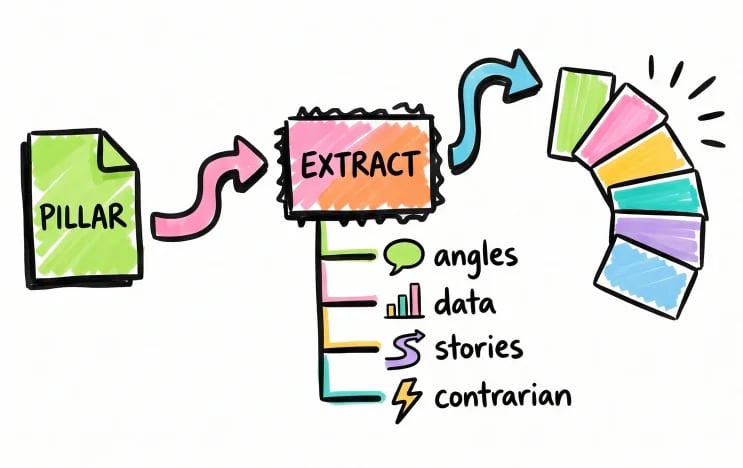
Stage 1: Pick your pillar.
Once a week, you select one piece of content you have already produced. The best candidates are specific and substantive: a post where you made a real argument, shared a real result, or told a story with a clear before-and-after. Thin content produces thin derivatives. A 2,000-word essay on why a common industry belief is wrong gives the engine something to work with. A listicle of generic tips does not.
Stage 2: Extract the angles.
This is where AI earns its place. You paste the full piece into your AI tool and ask it to pull out the distinct extractable elements: the core argument, the supporting data points, any concrete story or example embedded in the piece, and any claim in the post that runs counter to received wisdom. That last category, the contrarian angle, is often the most valuable one, because it’s the one that generates actual engagement rather than polite scrolling.
A single 3,000-word blog post can yield 20 or more distinct assets when you treat it modularly. The extraction step is what makes that possible. You are not asking AI to invent angles. You are asking it to surface what is already there, organized in a way you can work from.
Stage 3: Format for each platform.
The extracted angles do not get posted as-is. They get reformatted according to what each platform rewards, and those norms differ significantly. A contrarian argument that works on LinkedIn as a 200-word reflection might work on X as a punchy single claim that opens a thread, and might work on Instagram not as text at all but as a visual that poses the question without answering it. The formatting step is where platform logic applies, and it’s the step most people skip by posting the same thing everywhere and wondering why it performs differently.
Stage 4: Batch the output.
Rather than handling one post at a time, you produce the week’s worth of content in a single session. The extraction has already happened. The platform logic is already decided. What remains is execution, and batching it means you make the creative decisions once rather than five times across five separate mornings.
Documented practitioner examples show solopreneurs producing ten or more platform-specific assets from a single modular source in a single working session. That compression is not about AI being fast. It’s about the system eliminating the restart cost every time.
This is what makes ai for social media content actually sustainable. Not the speed of generation, but the removal of the weekly decision tax. The pillar content carries the thinking. The engine handles the distribution of that thinking into formats. You stop rebuilding from scratch and start working from something real.
Same pillar content, three completely different posts
The repurposing engine produces raw material. What each platform actually needs from that material is a separate question, and the answer is different enough across LinkedIn, X, and Instagram that treating them the same is where most repurposing efforts quietly fail.
Here is what the engine does well on each platform, where it still needs a human to step in, and what the workflow looks like in practice.
AI handles the structural work on LinkedIn extremely well. It can take a contrarian argument from your pillar piece and expand it into a 200-word reflection with a clear opening hook, a supporting example, and a closing observation. That format matches what the platform rewards: long-form content receives roughly 7x more views than short posts, and the sweet spot for storytelling and thought leadership sits around 1,300 to 1,700 characters. AI can hit that length consistently, which is more than most humans do when writing on a Tuesday morning with four other things open.
What AI cannot do is decide which angle actually represents your real professional view, or calibrate the level of vulnerability that feels authentic versus performed. LinkedIn’s audience responds to specificity and to posts that sound like a real person made a real observation, not to content that reads like it was assembled from professional-tone templates. That calibration is yours to make.
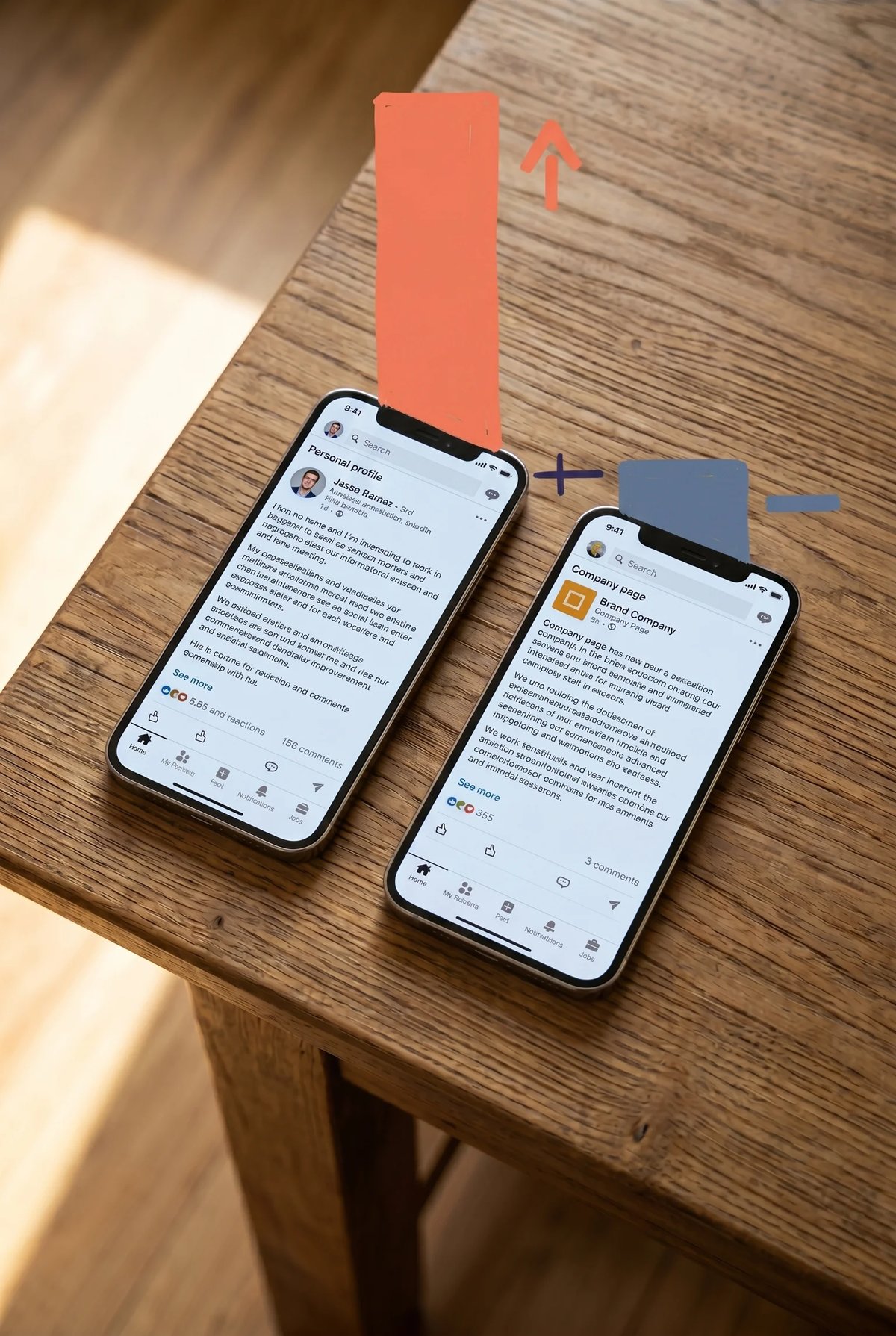
One workflow note worth taking seriously: personal profiles significantly outperform company pages on LinkedIn, generating roughly 5x more engagement per post. If you are a founder running ai for social media marketing through a brand account, the distribution math is working against you. The repurposing engine’s LinkedIn output should almost always route through a personal profile.
X / Twitter
X rewards volume and speed in a way LinkedIn does not. A posting cadence of around 3 to 5 times per day is where most accounts see consistent reach, which means the engine needs to produce more output for this platform than for any other. That is actually where AI does some of its most useful work: taking a single argument from your pillar content and producing five or six distinct single-claim variations, each frameable as a standalone tweet or as the opening of a short thread.
The human judgment call on X is sequencing and timing. Which variation leads? Which one runs on day three when the first one underperforms? A thread that opens on the contrarian claim and builds to the data point often lands differently than the same thread in reverse. AI will give you the components; it will not tell you which ordering matches how your specific audience reads.
Dickie Bush, who built Ship 30 for 30 partly around daily atomic essay writing on X, has documented how much of his content strategy involves reframing the same core ideas across multiple posts rather than generating new ideas each time. That is the repurposing logic in practice, even without a formal engine behind it.
Instagram is where the mismatch between AI output and platform reality tends to show up most visibly. An analysis of roughly 9.1 million Instagram posts found that short captions under 30 words outperform longer captions for engagement. AI, left to its own defaults, tends to produce captions that are too long, too explanatory, and too text-forward for a platform where the visual carries most of the weight.
The workflow adjustment here is deliberate compression. Take whatever the engine produces, then cut it down to the essential claim or question. What AI handles well on Instagram is generating multiple caption variations from the same angle so you can pick the one that lands at the right register. What you still have to decide is whether the visual you are pairing it with actually earns the caption, because no amount of correct caption length fixes a visual that makes no argument.
The broader pattern across all three platforms is the same: AI handles the structural conversion of your pillar content into platform-appropriate formats, and a human makes the judgment calls about voice, sequencing, and what is actually worth saying this week. The engine does not replace that judgment. It just means you are applying your judgment to finished drafts instead of blank pages.
The whole system fits inside one hour a week
The workflow described above only works if it actually runs. That means the weekly routine has to be short enough that you do not skip it, structured enough that you do not have to make decisions about what to do next, and output-heavy enough to cover all three platforms without starting over on each one.
Here is what a single weekly session looks like in practice.
Step 1: Pick your pillar piece (5 minutes)
Choose one piece of existing content: a blog post, a newsletter, a podcast transcript, a case study. One piece per week. The only selection criterion is whether it contains a real argument or insight that your audience has not seen you make recently. You are not writing anything new here. You are selecting.
Step 2: Extract the angles (10 minutes)
Paste the full text of your pillar piece into ChatGPT and run this prompt, adapted from ClickMinded’s AI marketing workflow:
"Here is a piece of content I've written: [paste content]. Please extract the following from it: 3 contrarian or counterintuitive claims, 3 specific data points or facts, 2 personal stories or concrete examples, and 2 broader lessons or takeaways. Return them as a numbered list with no additional commentary."This gives you a menu of raw material. Every post you create this week will draw from something on that list. You are not asking AI to invent content. You are asking it to surface what is already there.
Step 3: Batch the platform posts (20 minutes)
With your extraction list in hand, run a second prompt for each platform, feeding in the specific angles you want to use. For LinkedIn, ask for a 1,300-character post built around one contrarian claim. For X, ask for five single-claim variations on one data point, each under 280 characters, plus a five-tweet thread opening. For Instagram, ask for three caption options under 30 words each, based on one concrete example.
Do all three in the same session. By the end of this step you have a full week of drafts across every platform, derived from one piece of content, without writing a single post from scratch.

Step 4: Edit for voice (15 minutes)
Read each draft out loud. Change anything that sounds like it was assembled rather than said. Add one specific detail AI did not have access to: a reaction you got, a number that surprised you, something that happened after the piece was published. This is the step that makes the content actually yours. It is also the step most people skip, which is why most AI-assisted content sounds the same.
Step 5: Schedule (10 minutes)
Drop the posts into your scheduling tool. LinkedIn goes out two to three times this week. X runs daily, with the thread as the anchor. Instagram posts two to three times, paired with whatever visual you have. Done.
The full session runs about an hour. That is the whole maintenance cost of a working ai for social media content system: one piece of pillar content in, a week of platform-specific posts out. This AI marketing guide cover this repurposing logic across the broader content operation, including brand voice setup and scaling the same approach into email and SEO, if you want to see how the system extends past social.
The only thing that breaks the routine is skipping the pillar content step and trying to generate posts without source material. That is the version that burns out. This one does not.
If you’d rather just paste a URL and watch it happen
The system above works. It also takes about an hour to set up the first time, and some people would rather see the repurposing engine running before they commit to building it themselves.
mOS applies the same logic described in this guide: paste a URL from a blog post, article, or any existing piece of content, and it generates a week of platform-specific social posts from that source material. Pillar content in, formatted drafts for LinkedIn, X, and Instagram out. No blank prompt, no starting from scratch, no decisions about what angle to take.
There is a free tier, so you can run it on one piece of content before deciding whether it fits your workflow.
It will not replace the voice editing step from section four. The posts it generates are drafts, not finished copy, and the same rule applies: read them out loud, add one detail AI could not have known, and make them sound like you. The system is the same whether you build it manually or start here.
If the hour-per-week routine from this guide sounds like the right long-term structure, build it. If you want to see what ai for social media content actually looks like when the repurposing engine is already running, the URL box is the faster starting point.
Sources
- Career & Salary Survey: Overwhelmed and emotionally exhausted (Marketing Week) — Marketing Week
- What 2024 taught marketers about burnout, AI and diversity (ndash blog) — ndash
- Mentally Healthy Survey 2024: 70% of industry reports burnout (LBB Online) — LBB Online
- Are online marketers overwhelmed? (Stacked Marketer) — Stacked Marketer
- Burnout hits 70% of media, marketing and creative professionals (AMI summary) — Australian Marketing Institute (AMI)
- The State of Marketers Report 2025 (The Marketing Meetup) — The Marketing Meetup
- Marketers overwhelmed and emotionally exhausted (Marketing Week) — Marketing Week
- How to do marketing as a solo founder without burning out (Averi.ai blog) — Averi.ai
- Why solo founders fail (HyperTXT blog) — HyperTXT
- Solo Founders Report (Carta Data) — Carta
- Content marketing statistics (Content Marketing Institute, 2024) — Content Marketing Institute (CMI)
- Top content marketing purposes (Statista) — Statista
- Research: marketers are wasting time and money on AI tools (New Digital Age) — New Digital Age
- Social media burnout led to an unexpected discovery about AI content (On Pattison, anecdote) — On Pattison
- Study: marketers susceptible to AI-induced burnout (eMarketer summary) — eMarketer
- Content repurposing at scale: How to turn 1 piece into 20 assets — Averi.ai
- Content Repurposing — Complete Guide — Libril
- The Complete Guide to Repurposing Content — Maximize Your Marketing ROI — CloudPresent
- Repurposing Content Guide — Buffer
- Best Practices — Content Repurposing (Ultimate Guide) — Content10x
- Content Repurposing Strategies — WalkWithPic
- Content Repurposing Playbook (case examples) — Circle.so
- Video: Content Multiplier system (repurposing workflow) — YouTube
- Is Repurposing Content Worth It? — MattGiaro.com
- The Ultimate Guide to Repurposing Content and Saving Time — ChristinaGalbato.com
- Content Strategy for Solopreneurs (repurposing examples) — MewrCreate
- AI Content Marketing Stack for Solopreneurs — Write, Repurpose, Distribute — F3FundIt
- How to Repurpose Content Across Platforms to Maximize Engagement — HannonHill
- 10 Fresh Content Repurposing Strategies to Multiply Your ROI — Skyword
- Content Repurposing: Getting More Value from Every Asset — StraightNorth
- LinkedIn post length: The ultimate guide to maximizing engagement in 2025 — Minvo.pro
- LinkedIn best posting times 2025 — LinkIntel (getlinkintel.com)
- LinkedIn statistics (blog) — Botdog
- Average engagement per LinkedIn post (Statista) — Statista
- How the LinkedIn algorithm works (Hootsuite blog) — Hootsuite
- Best times to post on LinkedIn (Buffer) — Buffer
- Twitter study (Metricool) — Metricool
- How often to post on Twitter 2025 — TweetArchivist
- Best times to post on Twitter (Sprout Social) — Sprout Social
- Organic best practices (X / Twitter business help) — X (formerly Twitter) Business
- Instagram caption length — study and recommendations (Socialinsider) — Socialinsider
- Social media caption length guide (Glow Social) — Glow Social
- Instagram engagement report (HubSpot offer/report) — HubSpot
- 5 steps to launch a new Substack (Dickie Bush) — Dickie Bush / Substack
- Episode: Dickie Bush — writing Twitter & Ship 30 (Nathan Barry podcast/post) — NathanBarry.com
- A.I. For The Win: 11 ChatGPT Prompts To Create High-Powered Campaigns — Strikepoint Media
- 50 AI ChatGPT Marketing Prompts — Complete Guide — EQ4C (tools.eq4c.com)
- ChatGPT Prompts (marketing) — Single Grain — Single Grain
- AI Marketing — ClickMinded — ClickMinded
- ClickMinded (home) — ClickMinded
- AI Digital Marketing — ClickMinded — ClickMinded
- BlackFriday-GPTs-Prompts — Marketing.md (GitHub) — GitHub (friuns2)
- AI Prompts for Social Media Marketing — Chad Wyatt — Chad Wyatt
- ClickMinded — (video referenced) — YouTube
- Social Media Marketing Strategy — ClickMinded Guides — ClickMinded
- Marketing Starter Kit — ClickMinded Start — ClickMinded
- Resources — ClickMinded — ClickMinded
- Free Tools — ClickMinded — ClickMinded
- Marketing Strategy Generator — ClickMinded — ClickMinded
- Best Free AI Tools for Social Media Posts — Dialzara
- Social Media Post Generator — PlayPlay
- AI Social Media Post Generator — SocialRails
- Free AI for Social Media Content Creation — Jenova.ai
- Best AI Social Media Post Generator — CyberLink
- Free AI Social Media Post Generator — Koala
- Content Ideas Generator — Hootsuite
- Top 10 Free Tools for Social Media Marketer — Kontentino
- AI Social Media Post Generator — LetAggieDoIt
- AI Post Generator — SocialBee
- How to Repurpose Old Content — Marketing Inc.
- Repurpose Old Website Content — GoDaddy
- Most Undervalued Marketing Tool — Foundation Inc.
- Repurpose (Glossary) — Digital Marketing Institute
- Content Repurposing — Moosend